

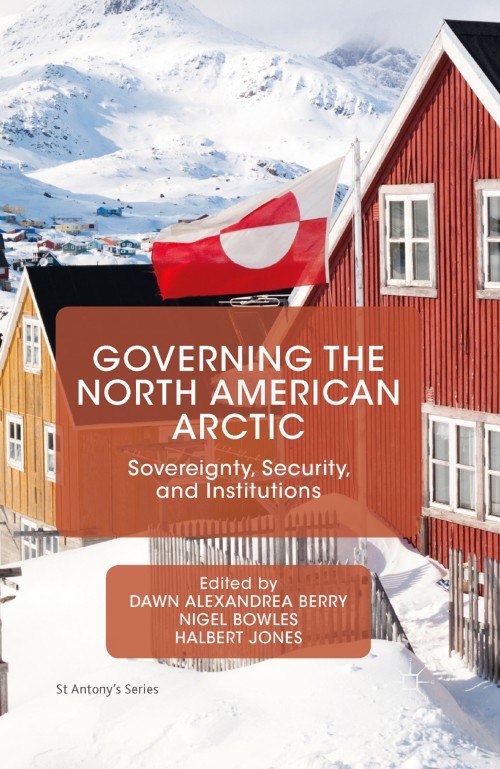
Governing the North American Arctic [electronic resource] : Sovereignty, Security, and Institutions / edited by Dawn Alexandrea Berry, Nigel Bowles, Halbert Jones.
Erişim Adresi
ISBN
9781137493910
Dil Kodu
İngilizce
Yer Numarası
DK/19652
Basım Bildirimi
1st ed. 2016.
Yayın Bilgisi
London : Palgrave Macmillan UK : Imprint: Palgrave Macmillan, 2016.
Fiziksel Niteleme
XI, 277 p. online resource.
Dizi
St Antony's Series, 2633-5972
Özet, vb.
Though it has been home for centuries to indigenous peoples who have mastered its conditions, the Arctic has historically proven to be a difficult region for governments to administer. Extreme temperatures, vast distances, and widely dispersed patterns of settlement have made it impossible for bureaucracies based in far-off capitals to erect and maintain the kind of infrastructure and institutions that they have built elsewhere. As climate change transforms the polar regions, this book seeks to explore how the challenges of governance are developing and being met in Alaska, the Canadian Far North, and Greenland, while also drawing upon lessons from the region's past. Though the experience of each of these jurisdictions is unique, their place within democratic, federal systems and the prominence within each of them of issues relating to the rights of indigenous peoples situates them as part of an identifiably 'North American Arctic.' Today, as this volume shows, their institutions are evolving to address contemporary issues of security, environmental protection, indigenous rights, and economic development.
Konu
Political planning.
Environmental policy.
Human geography.
Political science.
International relations.
Public Policy.
Environmental Policy.
Human Geography.
Political Science.
International Relations.
Environmental policy.
Human geography.
Political science.
International relations.
Public Policy.
Environmental Policy.
Human Geography.
Political Science.
International Relations.
Diğer Yazarlar
Kurum Adı
