LEADER 03887nam a22005775i 4500
001 818475
003 TR_AnAIT
005 20260130180947
007 cr nn 008mamaa
008 170428s2017 gw | s |||| 0|eng d
020 |a9783658174460|9978-3-658-17446-0
024 7 |a10.1007/978-3-658-17446-0|2doi
041 |aeng
049 |aTürk Tarih Kurumu Kütüphanesi
050 4|aJF20-1177
072 7|aJPB|2bicssc
072 7|aPOL009000|2bisacsh
072 7|aJPB|2thema
082 04|a320.3|223
090 |aDK/19683
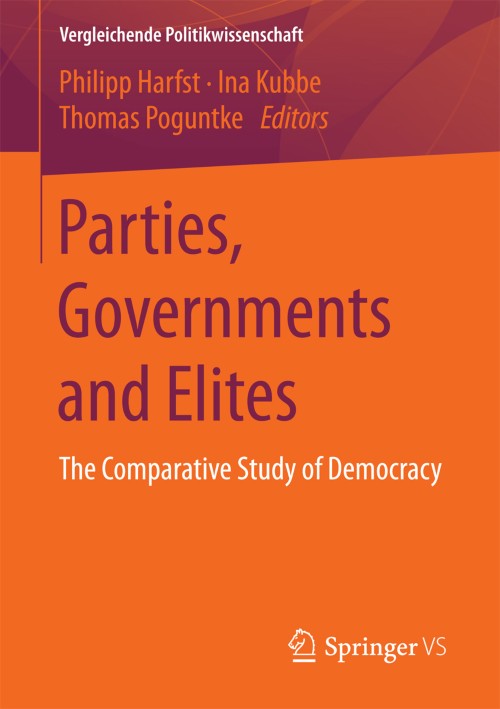
245 10|aParties, Governments and Elites|h[electronic resource] :|bThe Comparative Study of Democracy /|cedited by Philipp Harfst, Ina Kubbe, Thomas Poguntke.
250 |a1st ed. 2017.
264 1|aWiesbaden :|bSpringer Fachmedien Wiesbaden :|bImprint: Springer VS,|c2017.
300 |aVI, 322 p. 22 illus.|bonline resource.
336 |atext|btxt|2rdacontent
337 |acomputer|bc|2rdamedia
338 |aonline resource|bcr|2rdacarrier
347 |atext file|bPDF|2rda
490 1 |aVergleichende Politikwissenschaft,|x2569-8702
505 0 |aParties and Democracy in Comparative Perspective -- Governments and Democracy in Comparative Perspective -- Elites and Democracy in Comparative Perspective -- Looking Onward: Perspectives of Comparative Political Science.
520 |aParties, governments and elites are at the core of the study of democracy. The traditional view is that parties as collective actors play a paramount role in the democratic process. However, this classical perspective has been challenged by political actors, observers of modern democracy as well as political scientists. Modern political parties assume different roles, contemporary leaders can more heavily influence politics, governments face new constraints and new collective bodies continue to form, propose new ways of participation and policy making, and attract citizens and activists. In the light of these observations, the comparative study of democracy faces a number of important and still largely unsolved questions that the present volume will address. Contents Parties and Democracy in Comparative Perspective.- Governments and Democracy in Comparative Perspective.- Elites and Democracy in Comparative Perspective.- Looking Onward: Perspectives of Comparative Political Science Target Groups - Researchers and students of comparative political science - Practitioners of democracy promotion and stabilisation The Editors Dr. Philipp Harfst is Assistant Professor of Political Science at the University of Oldenburg, Germany. Dr. Ina Kubbe is Post-Doctoral Fellow at Tel Aviv University, Israel. Dr. Thomas Poguntke is Professor of Comparative Politics and Director of the Düsseldorf Party Research Institute (PRuF) at the University of Düsseldorf, Germany.
650 0|aComparative government.
650 0|aElections.
650 0|aPolitical science.
650 0|aAfrica|xPolitics and government.
650 0|aEurope|xPolitics and government.
650 14|aComparative Politics.
650 24|aElectoral Politics.
650 24|aPolitical Science.
650 24|aAfrican Politics.
650 24|aEuropean Politics.
700 1 |aHarfst, Philipp.|eeditor.|4edt|4http://id.loc.gov/vocabulary/relators/edt
700 1 |aKubbe, Ina.|eeditor.|4edt|4http://id.loc.gov/vocabulary/relators/edt
700 1 |aPoguntke, Thomas.|eeditor.|4edt|4http://id.loc.gov/vocabulary/relators/edt
710 2 |aSpringerLink (Online service)
773 0 |tSpringer Nature eBook
776 08|iPrinted edition:|z9783658174453
776 08|iPrinted edition:|z9783658174477
830 0|aVergleichende Politikwissenschaft,|x2569-8702
856 40|uhttps://doi.org/10.1007/978-3-658-17446-0
912 |aZDB-2-POS
912 |aZDB-2-SXPI
950 |aPolitical Science and International Studies (SpringerNature-41174)
950 |aPolitical Science and International Studies (R0) (SpringerNature-43724)