

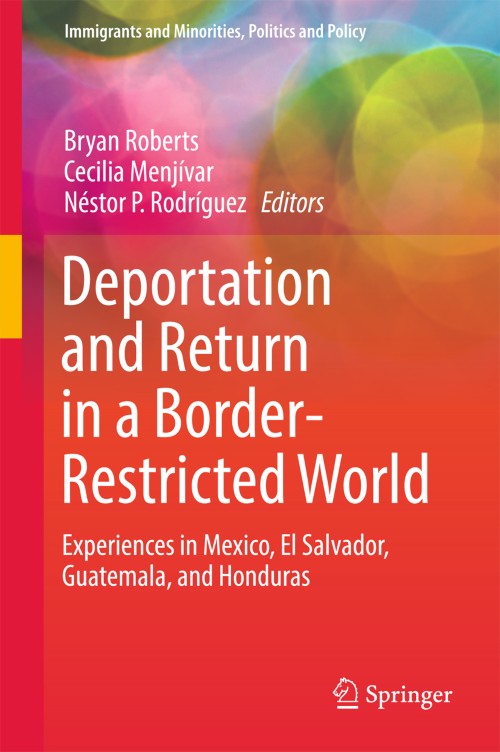
Deportation and Return in a Border-Restricted World [electronic resource] : Experiences in Mexico, El Salvador, Guatemala, and Honduras / edited by Bryan Roberts, Cecilia Menjívar, Nestor P. Rodríguez.
Erişim Adresi
ISBN
9783319497785
Dil Kodu
İngilizce
Yer Numarası
DK/19871
Basım Bildirimi
1st ed. 2017.
Yayın Bilgisi
Cham : Springer International Publishing : Imprint: Springer, 2017.
Fiziksel Niteleme
XIII, 187 p. 7 illus. online resource.
Dizi
Immigrants and Minorities, Politics and Policy, 2625-8552
İçindekiler Notu
Part 1. Introduction -- Chapter 1. Voluntary and Forced Return Migration -- Chapter 2. Migration Times and Ethnic Identity: Mexican Migration to the United States Over Three Generations -- Part 2. Voluntary and Non-Voluntary Return -- Chapter 3. From Mexico to Hawaii: Tracing the Migration History of One Family in Sabinilla, Jalisco -- Chapter 4. Driven “Home”: Stories of Voluntary and Involuntary Reasons for Return among Migrants in Jalisco and Oaxaca, Mexico.-Chapter 5. Return Migrants and Potential Challenges for Future Legal Migration: Guatemalan Cases -- Part 3: Deportation -- Chapter 6. Fragmented Identities: Contentions of Space and Identity among Salvadoran Deportees -- Chapter 7. Trapped at the Border: The Difficult Integration of Deportees in Tijuana -- Chapter 8. Displacing Lives and Closing Pathways to Hope: The Health Impacts of Deportation and Return Migration in El Progreso, Honduras -- Part 4. The New Disappeared -- Chapter 9. Never to Return: The New Disappeared of El Salvador -- Bibliography -- Index.
Özet, vb.
This volume focuses on recent experiences of return migration to Mexico and Central America from the United States. For most of the twentieth century, return migration to the US was a normal part of the migration process from Mexico and Central America, typically resulting in the eventual permanent settlement of migrants in the US. In recent years, however, such migration has become involuntary, as a growing proportion of return migration is taking place through formal orders of deportation. This book discusses return migration to Mexico, Guatemala, El Salvador and Honduras, addressing different reasons for return, whether voluntary or involuntary, and highlighting the unique challenges faced by returnees to each region. Particular emphasis is placed on the lack of government and institutional policies in place for returning migrants who wish to attain work, training, or shelter in their home countries. Finally, the authors take a look at the phenomenon of migrants who can never return because they have disappeared during the migration process. Through its multinational focus, diverse thematic outlook, and use of ethnographic and survey methods, this volume provides an original contribution to the topic of return migration and broadens the scope of the literature currently available. As such, this book will be important to scholars and students interested in immigration policy and Latin America as well as policy makers and activists.
Konu
Political planning.
Social policy.
Emigration and immigration.
Public Policy.
Social Policy.
Human Migration.
Social policy.
Emigration and immigration.
Public Policy.
Social Policy.
Human Migration.
Diğer Yazarlar
Kurum Adı
Eseri Alıntıla
Referansları kullanmadan önce gözden geçirmeniz ve varsa gerekli düzeltmeleri yapmanız önerilir.
Dijital Kaynak
MARC Görünümü
LEADER 04652nam a22005415i 4500
001 818663
003 TR_AnAIT
005 20260130180343
007 cr nn 008mamaa
008 170419s2017 sz | s |||| 0|eng d
020 |a9783319497785|9978-3-319-49778-5
024 7 |a10.1007/978-3-319-49778-5|2doi
041 |aeng
049 |aTürk Tarih Kurumu Kütüphanesi
050 4|aJF1525.P6
072 7|aJPP|2bicssc
072 7|aPOL028000|2bisacsh
072 7|aJPP|2thema
082 04|a320.6|223
090 |aDK/19871
245 10|aDeportation and Return in a Border-Restricted World|h[electronic resource] :|bExperiences in Mexico, El Salvador, Guatemala, and Honduras /|cedited by Bryan Roberts, Cecilia Menjívar, Nestor P. Rodríguez.
250 |a1st ed. 2017.
264 1|aCham :|bSpringer International Publishing :|bImprint: Springer,|c2017.
300 |aXIII, 187 p. 7 illus.|bonline resource.
336 |atext|btxt|2rdacontent
337 |acomputer|bc|2rdamedia
338 |aonline resource|bcr|2rdacarrier
347 |atext file|bPDF|2rda
490 1 |aImmigrants and Minorities, Politics and Policy,|x2625-8552
505 0 |aPart 1. Introduction -- Chapter 1. Voluntary and Forced Return Migration -- Chapter 2. Migration Times and Ethnic Identity: Mexican Migration to the United States Over Three Generations -- Part 2. Voluntary and Non-Voluntary Return -- Chapter 3. From Mexico to Hawaii: Tracing the Migration History of One Family in Sabinilla, Jalisco -- Chapter 4. Driven “Home”: Stories of Voluntary and Involuntary Reasons for Return among Migrants in Jalisco and Oaxaca, Mexico.-Chapter 5. Return Migrants and Potential Challenges for Future Legal Migration: Guatemalan Cases -- Part 3: Deportation -- Chapter 6. Fragmented Identities: Contentions of Space and Identity among Salvadoran Deportees -- Chapter 7. Trapped at the Border: The Difficult Integration of Deportees in Tijuana -- Chapter 8. Displacing Lives and Closing Pathways to Hope: The Health Impacts of Deportation and Return Migration in El Progreso, Honduras -- Part 4. The New Disappeared -- Chapter 9. Never to Return: The New Disappeared of El Salvador -- Bibliography -- Index.
520 |aThis volume focuses on recent experiences of return migration to Mexico and Central America from the United States. For most of the twentieth century, return migration to the US was a normal part of the migration process from Mexico and Central America, typically resulting in the eventual permanent settlement of migrants in the US. In recent years, however, such migration has become involuntary, as a growing proportion of return migration is taking place through formal orders of deportation. This book discusses return migration to Mexico, Guatemala, El Salvador and Honduras, addressing different reasons for return, whether voluntary or involuntary, and highlighting the unique challenges faced by returnees to each region. Particular emphasis is placed on the lack of government and institutional policies in place for returning migrants who wish to attain work, training, or shelter in their home countries. Finally, the authors take a look at the phenomenon of migrants who can never return because they have disappeared during the migration process. Through its multinational focus, diverse thematic outlook, and use of ethnographic and survey methods, this volume provides an original contribution to the topic of return migration and broadens the scope of the literature currently available. As such, this book will be important to scholars and students interested in immigration policy and Latin America as well as policy makers and activists.
650 0|aPolitical planning.
650 0|aSocial policy.
650 0|aEmigration and immigration.
650 14|aPublic Policy.
650 24|aSocial Policy.
650 24|aHuman Migration.
700 1 |aRoberts, Bryan.|eeditor.|4edt|4http://id.loc.gov/vocabulary/relators/edt
700 1 |aMenjívar, Cecilia.|eeditor.|4edt|4http://id.loc.gov/vocabulary/relators/edt
700 1 |aRodríguez, Nestor P.|eeditor.|4edt|4http://id.loc.gov/vocabulary/relators/edt
710 2 |aSpringerLink (Online service)
773 0 |tSpringer Nature eBook
776 08|iPrinted edition:|z9783319497778
776 08|iPrinted edition:|z9783319497792
776 08|iPrinted edition:|z9783319842394
830 0|aImmigrants and Minorities, Politics and Policy,|x2625-8552
856 40|uhttps://doi.org/10.1007/978-3-319-49778-5
912 |aZDB-2-POS
912 |aZDB-2-SXPI
950 |aPolitical Science and International Studies (SpringerNature-41174)
950 |aPolitical Science and International Studies (R0) (SpringerNature-43724)
001 818663
003 TR_AnAIT
005 20260130180343
007 cr nn 008mamaa
008 170419s2017 sz | s |||| 0|eng d
020 |a9783319497785|9978-3-319-49778-5
024 7 |a10.1007/978-3-319-49778-5|2doi
041 |aeng
049 |aTürk Tarih Kurumu Kütüphanesi
050 4|aJF1525.P6
072 7|aJPP|2bicssc
072 7|aPOL028000|2bisacsh
072 7|aJPP|2thema
082 04|a320.6|223
090 |aDK/19871
245 10|aDeportation and Return in a Border-Restricted World|h[electronic resource] :|bExperiences in Mexico, El Salvador, Guatemala, and Honduras /|cedited by Bryan Roberts, Cecilia Menjívar, Nestor P. Rodríguez.
250 |a1st ed. 2017.
264 1|aCham :|bSpringer International Publishing :|bImprint: Springer,|c2017.
300 |aXIII, 187 p. 7 illus.|bonline resource.
336 |atext|btxt|2rdacontent
337 |acomputer|bc|2rdamedia
338 |aonline resource|bcr|2rdacarrier
347 |atext file|bPDF|2rda
490 1 |aImmigrants and Minorities, Politics and Policy,|x2625-8552
505 0 |aPart 1. Introduction -- Chapter 1. Voluntary and Forced Return Migration -- Chapter 2. Migration Times and Ethnic Identity: Mexican Migration to the United States Over Three Generations -- Part 2. Voluntary and Non-Voluntary Return -- Chapter 3. From Mexico to Hawaii: Tracing the Migration History of One Family in Sabinilla, Jalisco -- Chapter 4. Driven “Home”: Stories of Voluntary and Involuntary Reasons for Return among Migrants in Jalisco and Oaxaca, Mexico.-Chapter 5. Return Migrants and Potential Challenges for Future Legal Migration: Guatemalan Cases -- Part 3: Deportation -- Chapter 6. Fragmented Identities: Contentions of Space and Identity among Salvadoran Deportees -- Chapter 7. Trapped at the Border: The Difficult Integration of Deportees in Tijuana -- Chapter 8. Displacing Lives and Closing Pathways to Hope: The Health Impacts of Deportation and Return Migration in El Progreso, Honduras -- Part 4. The New Disappeared -- Chapter 9. Never to Return: The New Disappeared of El Salvador -- Bibliography -- Index.
520 |aThis volume focuses on recent experiences of return migration to Mexico and Central America from the United States. For most of the twentieth century, return migration to the US was a normal part of the migration process from Mexico and Central America, typically resulting in the eventual permanent settlement of migrants in the US. In recent years, however, such migration has become involuntary, as a growing proportion of return migration is taking place through formal orders of deportation. This book discusses return migration to Mexico, Guatemala, El Salvador and Honduras, addressing different reasons for return, whether voluntary or involuntary, and highlighting the unique challenges faced by returnees to each region. Particular emphasis is placed on the lack of government and institutional policies in place for returning migrants who wish to attain work, training, or shelter in their home countries. Finally, the authors take a look at the phenomenon of migrants who can never return because they have disappeared during the migration process. Through its multinational focus, diverse thematic outlook, and use of ethnographic and survey methods, this volume provides an original contribution to the topic of return migration and broadens the scope of the literature currently available. As such, this book will be important to scholars and students interested in immigration policy and Latin America as well as policy makers and activists.
650 0|aPolitical planning.
650 0|aSocial policy.
650 0|aEmigration and immigration.
650 14|aPublic Policy.
650 24|aSocial Policy.
650 24|aHuman Migration.
700 1 |aRoberts, Bryan.|eeditor.|4edt|4http://id.loc.gov/vocabulary/relators/edt
700 1 |aMenjívar, Cecilia.|eeditor.|4edt|4http://id.loc.gov/vocabulary/relators/edt
700 1 |aRodríguez, Nestor P.|eeditor.|4edt|4http://id.loc.gov/vocabulary/relators/edt
710 2 |aSpringerLink (Online service)
773 0 |tSpringer Nature eBook
776 08|iPrinted edition:|z9783319497778
776 08|iPrinted edition:|z9783319497792
776 08|iPrinted edition:|z9783319842394
830 0|aImmigrants and Minorities, Politics and Policy,|x2625-8552
856 40|uhttps://doi.org/10.1007/978-3-319-49778-5
912 |aZDB-2-POS
912 |aZDB-2-SXPI
950 |aPolitical Science and International Studies (SpringerNature-41174)
950 |aPolitical Science and International Studies (R0) (SpringerNature-43724)
Materyaller
Depodan talep edilen materyal sadece kütüphane içerisinde kullanılmaktadır.
Materyal dışarıya ödünç verilmemektedir.
Materyal dışarıya ödünç verilmemektedir.
