

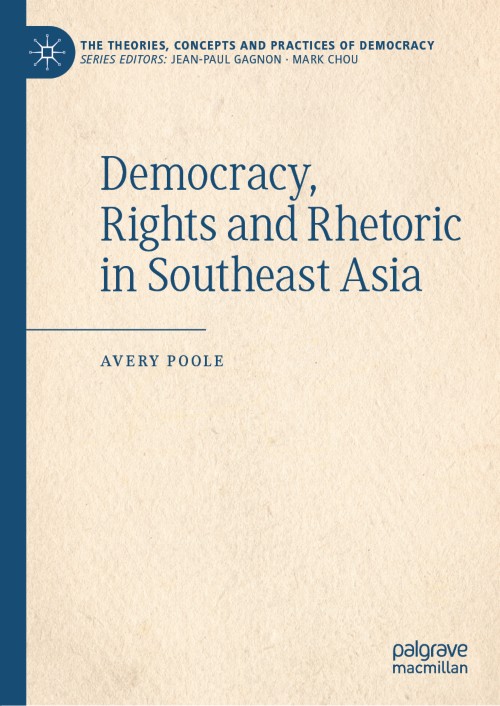
Democracy, Rights and Rhetoric in Southeast Asia [electronic resource] / by Avery Poole.
Erişim Adresi
ISBN
9783030155223
Dil Kodu
İngilizce
Yer Numarası
DK/19949
Yazar
Basım Bildirimi
1st ed. 2019.
Yayın Bilgisi
Cham : Springer International Publishing : Imprint: Palgrave Pivot, 2019.
Fiziksel Niteleme
XI, 83 p. 1 illus. online resource.
Dizi
The Theories, Concepts and Practices of Democracy, 2947-4477
İçindekiler Notu
1 Conceptions of Democracy and Human Rights in Southeast Asia -- 2 Democracy in Rhetoric and Reality -- 3 Human Rights and Regional Institutions -- 4 Conclusions: Liberal Norms and the Role of Regional Organisations.
Özet, vb.
‘Southeast Asia has become a more authoritarian place in the last decade, so why do regional elites continue to use the rhetoric of democracy and human rights? Why have non-democratic states even worked to establish human rights institutions? Avery Poole’s book is an insightful, accessible and illuminating account that answers these questions. It’s a timely and very valuable piece of scholarship.’ –David Capie, Victoria University of Wellington, New Zealand ‘This book is very interesting and does an excellent job of addressing its core concern: why has ASEAN evoked the rhetoric of democracy and human rights and what does this rhetoric mean in practice? The author has put forward a clear and defensible thesis: the ASEAN states have adopted this rhetoric because it legitimizes their organization in the eyes of the Western world’ –Shaun Narine, St Thomas University, Fredericton, Canada Southeast Asia is a vast, populous and diverse region. The Association of Southeast Asian Nations (ASEAN) promotes democracy and human rights as central to regional order and cooperation, but most members are not democratic and have poor or questionable human rights records. This book explores why Southeast Asian countries have collectively adopted the rhetoric of democracy and human rights, and argues that they are motivated by their concerns about external regional legitimacy. It analyses ASEAN’s references to democracy and the reality of backsliding in several countries; examines the adoption of human rights rhetoric; and considers the implications for how we understand regional cooperation. The book is relevant for students and analysts who are interested in regionalism in Southeast Asia and elsewhere – particularly given growing global concerns about liberal democracy and the gaps between rhetoric and political realities. Avery D.H. Poole is Senior Fellow at the Australia and New Zealand School ofGovernment (ANZSOG) and Honorary Senior Lecturer at the Crawford School of Public Policy at the Australian National University. She was previously Assistant Director of the Melbourne School of Government at the University of Melbourne, Australia.
Konu
Political science.
Human rights.
Asia __ Politics and government.
Regionalism.
Communication in politics.
Comparative government.
Political Science.
Human Rights.
Asian Politics.
Regionalism.
Political Communication.
Comparative Politics.
Human rights.
Asia __ Politics and government.
Regionalism.
Communication in politics.
Comparative government.
Political Science.
Human Rights.
Asian Politics.
Regionalism.
Political Communication.
Comparative Politics.
Kurum Adı
