

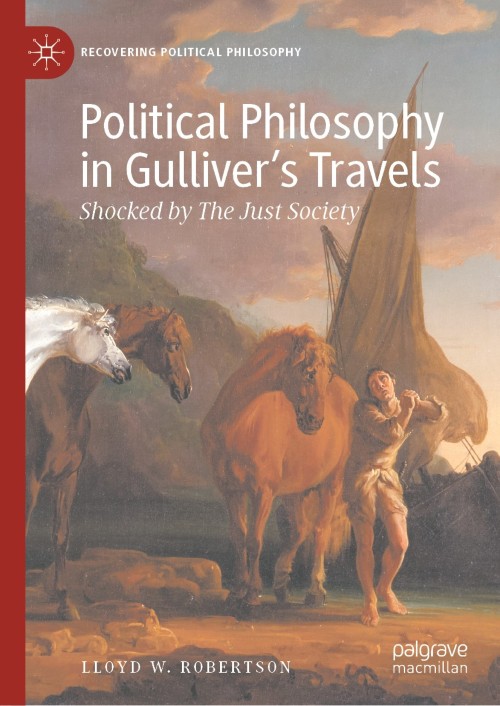
Political Philosophy in Gulliver’s Travels [electronic resource] : Shocked by The Just Society / by Lloyd W. Robertson.
Erişim Adresi
ISBN
9783030988531
Dil Kodu
İngilizce
Yer Numarası
DK/19989
Yazar
Basım Bildirimi
1st ed. 2022.
Yayın Bilgisi
Cham : Springer International Publishing : Imprint: Palgrave Macmillan, 2022.
Fiziksel Niteleme
XIV, 213 p. online resource.
Dizi
Recovering Political Philosophy, 2524-7174
İçindekiler Notu
Chapter 1. Introduction -- Chapter 2. Little People and Big People -- Chapter 3. Nameless Moderns: Science, Miracles and Faith -- Chapter 4. A Realistic Utopia, and Human Passions -- Chapter 5. Heroic Ancients -- Chapter 6. Rational Horses and Humans -- Chapter 7. European Imperialism and The Bible -- Chapter 8. What we can learn.
Özet, vb.
“Robertson guides us to a deeper understanding of Swift's intention in writing his tale of Gulliver’s fantastical voyages. We discover an exploration of the permanent questions that characterize human life and define our contemporary dilemma, including: what constitutes knowledge, and how can we ensure it is directed toward the human good? We gain fresh tools to investigate such questions with Robertson as our skillful guide.” —Patrick Malcolmson, Professor Emeritus, Department of Political Science, St. Thomas University, Canada “This book is a much needed re-discovery of Swift. We can all gain from Robertson’s study a new appreciation of Swift's greatness as a thinker in addition to a literary giant and, of course, a satirist.” —Colin D. Pearce, Lyceum Professor, Lyceum Program, Clemson Institute for the Study of Capitalism, USA This book analyzes Jonathan Swift’s Gulliver’s Travels from a political philosophy perspective. When authors have focused on politics in Swift’s writings, this has usually meant a study of how Swift located himself on issues of his day such as church and state, and Ireland. Robertson claims by contrast that Gulliver’s Travels is fundamentally a book about the “ancients” (e.g. Plato, Aristotle), and the “moderns” (science and technology), and their contrasting views about the human condition. The claim that the Travels is “a kind of prolegomena” to political philosophy leaves open the possibility that it does not achieve, or seek to achieve, a fusion of various teachings but rather uses the device of alien societies to point us to uncomfortable aspects of political philosophy’s “larger questions” we are prone to ignore. Swift, Robertson argues, draws our attention to some version of the classical republic, as idealized in Aristotle’s political writings and in Plato’s Republic, as opposed to a modern regime which, at its best or most intellectual, emphasizes modern science and technology in combination as a way to improve the human condition. Lloyd W. Robertson is a former lecturer in political science at St. Thomas University in Canada, among other post-secondary institutions.
Konu
Political science __ Philosophy.
Political science.
Literature __ History and criticism.
Literature, Modern __ 18th century.
Political Philosophy.
Political Theory.
Literary Criticism.
Eighteenth-Century Literature.
Political science.
Literature __ History and criticism.
Literature, Modern __ 18th century.
Political Philosophy.
Political Theory.
Literary Criticism.
Eighteenth-Century Literature.
Kurum Adı
Eseri Alıntıla
Referansları kullanmadan önce gözden geçirmeniz ve varsa gerekli düzeltmeleri yapmanız önerilir.
Dijital Kaynak
MARC Görünümü
LEADER 04505nam a22005415i 4500
001 818781
003 TR_AnAIT
005 20260130180027
007 cr nn 008mamaa
008 220701s2022 sz | s |||| 0|eng d
020 |a9783030988531|9978-3-030-98853-1
024 7 |a10.1007/978-3-030-98853-1|2doi
041 |aeng
049 |aTürk Tarih Kurumu Kütüphanesi
050 4|aB65
072 7|aHPS|2bicssc
072 7|aPHI019000|2bisacsh
072 7|aQDTS|2thema
082 04|a320.01|223
090 |aDK/19989
100 1 |aRobertson, Lloyd W.|eauthor.|4aut|4http://id.loc.gov/vocabulary/relators/aut
245 10|aPolitical Philosophy in Gulliver’s Travels|h[electronic resource] :|bShocked by The Just Society /|cby Lloyd W. Robertson.
250 |a1st ed. 2022.
264 1|aCham :|bSpringer International Publishing :|bImprint: Palgrave Macmillan,|c2022.
300 |aXIV, 213 p.|bonline resource.
336 |atext|btxt|2rdacontent
337 |acomputer|bc|2rdamedia
338 |aonline resource|bcr|2rdacarrier
347 |atext file|bPDF|2rda
490 1 |aRecovering Political Philosophy,|x2524-7174
505 0 |aChapter 1. Introduction -- Chapter 2. Little People and Big People -- Chapter 3. Nameless Moderns: Science, Miracles and Faith -- Chapter 4. A Realistic Utopia, and Human Passions -- Chapter 5. Heroic Ancients -- Chapter 6. Rational Horses and Humans -- Chapter 7. European Imperialism and The Bible -- Chapter 8. What we can learn.
520 |a“Robertson guides us to a deeper understanding of Swift's intention in writing his tale of Gulliver’s fantastical voyages. We discover an exploration of the permanent questions that characterize human life and define our contemporary dilemma, including: what constitutes knowledge, and how can we ensure it is directed toward the human good? We gain fresh tools to investigate such questions with Robertson as our skillful guide.” —Patrick Malcolmson, Professor Emeritus, Department of Political Science, St. Thomas University, Canada “This book is a much needed re-discovery of Swift. We can all gain from Robertson’s study a new appreciation of Swift's greatness as a thinker in addition to a literary giant and, of course, a satirist.” —Colin D. Pearce, Lyceum Professor, Lyceum Program, Clemson Institute for the Study of Capitalism, USA This book analyzes Jonathan Swift’s Gulliver’s Travels from a political philosophy perspective. When authors have focused on politics in Swift’s writings, this has usually meant a study of how Swift located himself on issues of his day such as church and state, and Ireland. Robertson claims by contrast that Gulliver’s Travels is fundamentally a book about the “ancients” (e.g. Plato, Aristotle), and the “moderns” (science and technology), and their contrasting views about the human condition. The claim that the Travels is “a kind of prolegomena” to political philosophy leaves open the possibility that it does not achieve, or seek to achieve, a fusion of various teachings but rather uses the device of alien societies to point us to uncomfortable aspects of political philosophy’s “larger questions” we are prone to ignore. Swift, Robertson argues, draws our attention to some version of the classical republic, as idealized in Aristotle’s political writings and in Plato’s Republic, as opposed to a modern regime which, at its best or most intellectual, emphasizes modern science and technology in combination as a way to improve the human condition. Lloyd W. Robertson is a former lecturer in political science at St. Thomas University in Canada, among other post-secondary institutions.
650 0|aPolitical science|xPhilosophy.
650 0|aPolitical science.
650 0|aLiterature|xHistory and criticism.
650 0|aLiterature, Modern|x18th century.
650 14|aPolitical Philosophy.
650 24|aPolitical Theory.
650 24|aLiterary Criticism.
650 24|aEighteenth-Century Literature.
710 2 |aSpringerLink (Online service)
773 0 |tSpringer Nature eBook
776 08|iPrinted edition:|z9783030988524
776 08|iPrinted edition:|z9783030988548
776 08|iPrinted edition:|z9783030988555
830 0|aRecovering Political Philosophy,|x2524-7174
856 40|uhttps://doi.org/10.1007/978-3-030-98853-1
912 |aZDB-2-POS
912 |aZDB-2-SXPI
950 |aPolitical Science and International Studies (SpringerNature-41174)
950 |aPolitical Science and International Studies (R0) (SpringerNature-43724)
Materyaller
Depodan talep edilen materyal sadece kütüphane içerisinde kullanılmaktadır.
Materyal dışarıya ödünç verilmemektedir.
Materyal dışarıya ödünç verilmemektedir.
