

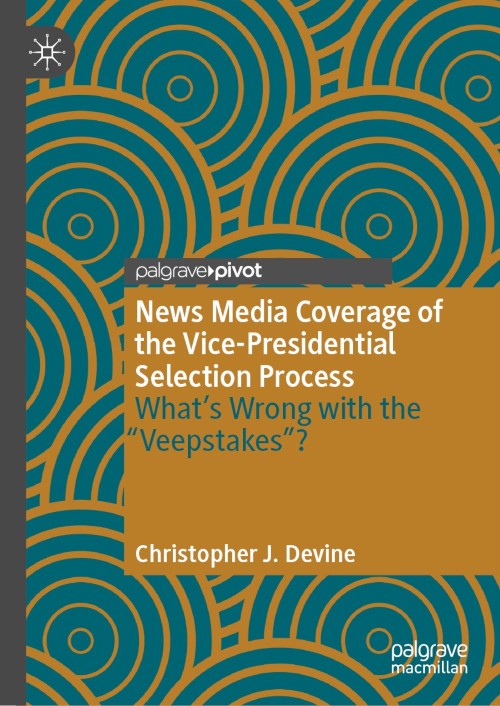
News Media Coverage of the Vice-Presidential Selection Process [electronic resource] : What's Wrong with the "Veepstakes"? / by Christopher J. Devine.
Erişim Adresi
ISBN
9783031281662
Dil Kodu
İngilizce
Yer Numarası
DK/20017
Basım Bildirimi
1st ed. 2023.
Yayın Bilgisi
Cham : Springer Nature Switzerland : Imprint: Palgrave Macmillan, 2023.
Fiziksel Niteleme
XIX, 137 p. 3 illus., 2 illus. in color. online resource.
İçindekiler Notu
Chapter 1. Introduction -- Chapter 2. How the Veepstakes Came to Be -- Chapter 3. Studying the Veepstakes -- Chapter 4. Veepstakes Media Coverage, 2000-2016 -- Chapter 5. Veepstakes Media Coverage, 2020 -- Chapter 6. Conclusion.
Özet, vb.
“In this important volume, Devine examines how the media describe potential candidates when covering the ‘veepstakes,’ and he insightfully critiques the media’s relative focus on electoral versus governing considerations.” —Herbert F. Weisberg, Professor Emeritus of Political Science, The Ohio State University, USA “Well-written and full of fascinating details…. I loved this book and learned a lot from it. I couldn’t put it down until I finished it.” —Karine Prémont, Professor of Political Science, University of Sherbrooke and Deputy Director, Center for United States Studies, University of Québec, Montréal, Canada “A must-read for anyone who is interested in developing a greater understanding of political media coverage, vice-presidential selection, and American electoral politics.” —Andrew D. Green, Behavioral Sciences Department Chair and Professor of Political Science, Central College, USA This book provides the first systematic, empirical analysis of the media’s approach to US vice-presidential selection (or the “veepstakes”). In their news coverage, Devine finds that media outlets typically treat vice-presidential selection as little more than a game—by focusing on how potential running mates might help to win the election, rather than how they might help the next president to govern. Based on an original content analysis of hundreds of veepstakes profiles from 2000–2020, this book quantifies the news media’s relative emphasis on various selection criteria, in general and across different electoral circumstances. The analysis suggests that journalists generally fail to serve the public interest by emphasizing electoral over governing considerations. However, Devine also points to positive examples of media coverage that help the public to evaluate potential running mates’ governing credentials, and suggests ways in which scholars, journalists, and citizens might encourage media outlets toprovide more substantive, responsible coverage of the vice-presidential selection process in future elections. Christopher J. Devine is Associate Professor of Political Science at the University of Dayton, USA. His previous books include Do Running Mates Matter? The Influence of Vice Presidential Candidates in Presidential Elections (2020).
Konu
Communication in politics.
America __ Politics and government.
Journalism.
Political Communication.
American Politics.
News Journalism.
America __ Politics and government.
Journalism.
Political Communication.
American Politics.
News Journalism.
Kurum Adı
Eseri Alıntıla
Referansları kullanmadan önce gözden geçirmeniz ve varsa gerekli düzeltmeleri yapmanız önerilir.
Dijital Kaynak
MARC Görünümü
LEADER 05719nam a22006375i 4500
001 818809
003 TR_AnAIT
005 20260130175933
007 cr nn 008mamaa
008 230401s2023 sz | s |||| 0|eng d
020 |a9783031281662|9978-3-031-28166-2
024 7 |a10.1007/978-3-031-28166-2|2doi
041 |aeng
049 |aTürk Tarih Kurumu Kütüphanesi
050 4|aJA85-85.2
072 7|aJPH|2bicssc
072 7|aGTC|2bicssc
072 7|aPOL000000|2bisacsh
072 7|aJPH|2thema
072 7|aGTC|2thema
082 04|a320.014|223
090 |aDK/20017
100 1 |aDevine, Christopher J.|eauthor.|0(orcid)0000-0003-2445-9775|1https://orcid.org/0000-0003-2445-9775|4aut|4http://id.loc.gov/vocabulary/relators/aut
245 10|aNews Media Coverage of the Vice-Presidential Selection Process|h[electronic resource] :|bWhat's Wrong with the "Veepstakes"? /|cby Christopher J. Devine.
250 |a1st ed. 2023.
264 1|aCham :|bSpringer Nature Switzerland :|bImprint: Palgrave Macmillan,|c2023.
300 |aXIX, 137 p. 3 illus., 2 illus. in color.|bonline resource.
336 |atext|btxt|2rdacontent
337 |acomputer|bc|2rdamedia
338 |aonline resource|bcr|2rdacarrier
341 0 |bTable of contents navigation|2onix
341 0 |bSingle logical reading order|2onix
341 0 |bShort alternative textual descriptions|2onix
341 0 |bUse of color is not sole means of conveying information|2onix
341 0 |bUse of high contrast between text and background color|2onix
341 0 |bNext / Previous structural navigation|2onix
341 0 |bAll non-decorative content supports reading without sight|2onix
347 |atext file|bPDF|2rda
505 0 |aChapter 1. Introduction -- Chapter 2. How the Veepstakes Came to Be -- Chapter 3. Studying the Veepstakes -- Chapter 4. Veepstakes Media Coverage, 2000-2016 -- Chapter 5. Veepstakes Media Coverage, 2020 -- Chapter 6. Conclusion.
520 |a“In this important volume, Devine examines how the media describe potential candidates when covering the ‘veepstakes,’ and he insightfully critiques the media’s relative focus on electoral versus governing considerations.” —Herbert F. Weisberg, Professor Emeritus of Political Science, The Ohio State University, USA “Well-written and full of fascinating details…. I loved this book and learned a lot from it. I couldn’t put it down until I finished it.” —Karine Prémont, Professor of Political Science, University of Sherbrooke and Deputy Director, Center for United States Studies, University of Québec, Montréal, Canada “A must-read for anyone who is interested in developing a greater understanding of political media coverage, vice-presidential selection, and American electoral politics.” —Andrew D. Green, Behavioral Sciences Department Chair and Professor of Political Science, Central College, USA This book provides the first systematic, empirical analysis of the media’s approach to US vice-presidential selection (or the “veepstakes”). In their news coverage, Devine finds that media outlets typically treat vice-presidential selection as little more than a game—by focusing on how potential running mates might help to win the election, rather than how they might help the next president to govern. Based on an original content analysis of hundreds of veepstakes profiles from 2000–2020, this book quantifies the news media’s relative emphasis on various selection criteria, in general and across different electoral circumstances. The analysis suggests that journalists generally fail to serve the public interest by emphasizing electoral over governing considerations. However, Devine also points to positive examples of media coverage that help the public to evaluate potential running mates’ governing credentials, and suggests ways in which scholars, journalists, and citizens might encourage media outlets toprovide more substantive, responsible coverage of the vice-presidential selection process in future elections. Christopher J. Devine is Associate Professor of Political Science at the University of Dayton, USA. His previous books include Do Running Mates Matter? The Influence of Vice Presidential Candidates in Presidential Elections (2020).
532 8 |aAccessibility summary: This PDF does not fully comply with PDF/UA standards, but does feature limited screen reader support, described non-text content (images, graphs), bookmarks for easy navigation and searchable, selectable text. Users of assistive technologies may experience difficulty navigating or interpreting content in this document. We recognize the importance of accessibility, and we welcome queries about accessibility for any of our products. If you have a question or an access need, please get in touch with us at accessibilitysupport@springernature.com.
532 8 |aNo reading system accessibility options actively disabled
532 8 |aPublisher contact for further accessibility information: accessibilitysupport@springernature.com
650 0|aCommunication in politics.
650 0|aAmerica|xPolitics and government.
650 0|aJournalism.
650 14|aPolitical Communication.
650 24|aAmerican Politics.
650 24|aNews Journalism.
710 2 |aSpringerLink (Online service)
773 0 |tSpringer Nature eBook
776 08|iPrinted edition:|z9783031281655
776 08|iPrinted edition:|z9783031281679
776 08|iPrinted edition:|z9783031281686
856 40|uhttps://doi.org/10.1007/978-3-031-28166-2
912 |aZDB-2-POS
912 |aZDB-2-SXPI
950 |aPolitical Science and International Studies (SpringerNature-41174)
950 |aPolitical Science and International Studies (R0) (SpringerNature-43724)
001 818809
003 TR_AnAIT
005 20260130175933
007 cr nn 008mamaa
008 230401s2023 sz | s |||| 0|eng d
020 |a9783031281662|9978-3-031-28166-2
024 7 |a10.1007/978-3-031-28166-2|2doi
041 |aeng
049 |aTürk Tarih Kurumu Kütüphanesi
050 4|aJA85-85.2
072 7|aJPH|2bicssc
072 7|aGTC|2bicssc
072 7|aPOL000000|2bisacsh
072 7|aJPH|2thema
072 7|aGTC|2thema
082 04|a320.014|223
090 |aDK/20017
100 1 |aDevine, Christopher J.|eauthor.|0(orcid)0000-0003-2445-9775|1https://orcid.org/0000-0003-2445-9775|4aut|4http://id.loc.gov/vocabulary/relators/aut
245 10|aNews Media Coverage of the Vice-Presidential Selection Process|h[electronic resource] :|bWhat's Wrong with the "Veepstakes"? /|cby Christopher J. Devine.
250 |a1st ed. 2023.
264 1|aCham :|bSpringer Nature Switzerland :|bImprint: Palgrave Macmillan,|c2023.
300 |aXIX, 137 p. 3 illus., 2 illus. in color.|bonline resource.
336 |atext|btxt|2rdacontent
337 |acomputer|bc|2rdamedia
338 |aonline resource|bcr|2rdacarrier
341 0 |bTable of contents navigation|2onix
341 0 |bSingle logical reading order|2onix
341 0 |bShort alternative textual descriptions|2onix
341 0 |bUse of color is not sole means of conveying information|2onix
341 0 |bUse of high contrast between text and background color|2onix
341 0 |bNext / Previous structural navigation|2onix
341 0 |bAll non-decorative content supports reading without sight|2onix
347 |atext file|bPDF|2rda
505 0 |aChapter 1. Introduction -- Chapter 2. How the Veepstakes Came to Be -- Chapter 3. Studying the Veepstakes -- Chapter 4. Veepstakes Media Coverage, 2000-2016 -- Chapter 5. Veepstakes Media Coverage, 2020 -- Chapter 6. Conclusion.
520 |a“In this important volume, Devine examines how the media describe potential candidates when covering the ‘veepstakes,’ and he insightfully critiques the media’s relative focus on electoral versus governing considerations.” —Herbert F. Weisberg, Professor Emeritus of Political Science, The Ohio State University, USA “Well-written and full of fascinating details…. I loved this book and learned a lot from it. I couldn’t put it down until I finished it.” —Karine Prémont, Professor of Political Science, University of Sherbrooke and Deputy Director, Center for United States Studies, University of Québec, Montréal, Canada “A must-read for anyone who is interested in developing a greater understanding of political media coverage, vice-presidential selection, and American electoral politics.” —Andrew D. Green, Behavioral Sciences Department Chair and Professor of Political Science, Central College, USA This book provides the first systematic, empirical analysis of the media’s approach to US vice-presidential selection (or the “veepstakes”). In their news coverage, Devine finds that media outlets typically treat vice-presidential selection as little more than a game—by focusing on how potential running mates might help to win the election, rather than how they might help the next president to govern. Based on an original content analysis of hundreds of veepstakes profiles from 2000–2020, this book quantifies the news media’s relative emphasis on various selection criteria, in general and across different electoral circumstances. The analysis suggests that journalists generally fail to serve the public interest by emphasizing electoral over governing considerations. However, Devine also points to positive examples of media coverage that help the public to evaluate potential running mates’ governing credentials, and suggests ways in which scholars, journalists, and citizens might encourage media outlets toprovide more substantive, responsible coverage of the vice-presidential selection process in future elections. Christopher J. Devine is Associate Professor of Political Science at the University of Dayton, USA. His previous books include Do Running Mates Matter? The Influence of Vice Presidential Candidates in Presidential Elections (2020).
532 8 |aAccessibility summary: This PDF does not fully comply with PDF/UA standards, but does feature limited screen reader support, described non-text content (images, graphs), bookmarks for easy navigation and searchable, selectable text. Users of assistive technologies may experience difficulty navigating or interpreting content in this document. We recognize the importance of accessibility, and we welcome queries about accessibility for any of our products. If you have a question or an access need, please get in touch with us at accessibilitysupport@springernature.com.
532 8 |aNo reading system accessibility options actively disabled
532 8 |aPublisher contact for further accessibility information: accessibilitysupport@springernature.com
650 0|aCommunication in politics.
650 0|aAmerica|xPolitics and government.
650 0|aJournalism.
650 14|aPolitical Communication.
650 24|aAmerican Politics.
650 24|aNews Journalism.
710 2 |aSpringerLink (Online service)
773 0 |tSpringer Nature eBook
776 08|iPrinted edition:|z9783031281655
776 08|iPrinted edition:|z9783031281679
776 08|iPrinted edition:|z9783031281686
856 40|uhttps://doi.org/10.1007/978-3-031-28166-2
912 |aZDB-2-POS
912 |aZDB-2-SXPI
950 |aPolitical Science and International Studies (SpringerNature-41174)
950 |aPolitical Science and International Studies (R0) (SpringerNature-43724)
Materyaller
Depodan talep edilen materyal sadece kütüphane içerisinde kullanılmaktadır.
Materyal dışarıya ödünç verilmemektedir.
Materyal dışarıya ödünç verilmemektedir.
