

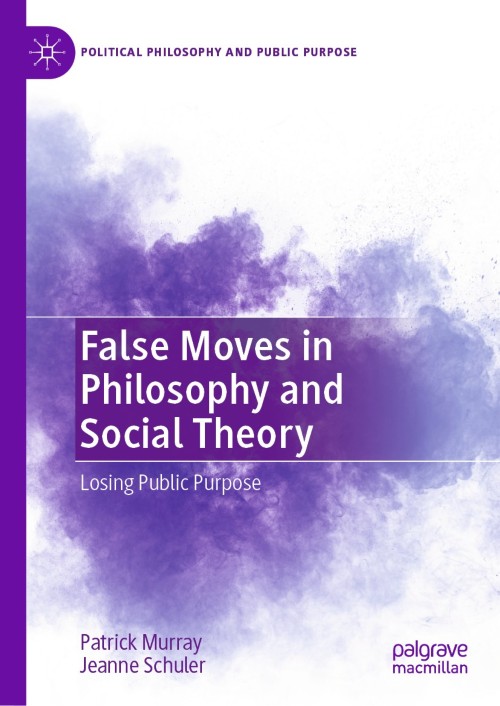
False Moves in Philosophy and Social Theory [electronic resource] : Losing Public Purpose / by Patrick Murray, Jeanne Schuler.
Erişim Adresi
ISBN
9783031350283
Dil Kodu
İngilizce
Yer Numarası
DK/20030
Yazar
Basım Bildirimi
1st ed. 2023.
Yayın Bilgisi
Cham : Springer International Publishing : Imprint: Palgrave Macmillan, 2023.
Fiziksel Niteleme
XXIX, 406 p. 1 illus. online resource.
Dizi
Political Philosophy and Public Purpose, 2524-7158
İçindekiler Notu
Introduction: How Factoring Philosophy Puts Philosophy on the Sidelines -- Chapter One: Is Life Absurd? -- Chapter Two: Being Mortal -- Chapter Three: Reinventing Humans: The Strange Allure of Stoicism -- Chapter Four: Beyond the Illusion of Philosophical Egoism: Recovering Self-Love and Selfishness -- Chapter Five: Moral Luck, Responsibility, and this Worldly Life -- Chapter Six: The Pure Self in Political Life: Reconsidering the Primacy of the Right over the Good -- Chapter Seven: Values as Purely Subjective: Against the Idea of “A New Creation” -- Chapter Eight: Setting Aside the Purely Subjective: Reclaiming the Discourse of Truth and Error -- Beyond “the Illusion of the Economic”: Renewing the Concept of Capital: A Foreword to Chapters Nine, Ten, and Eleven -- Chapter Nine: Why Wealth is a Poor Concept -- Chapter Ten: Capital, the Truth about Utility -- Chapter Eleven: The Myth of Instrumental Reason and Action -- Conclusion: Just Enough Phenomenology -- Appendix A: Dogmas of Factoring Philosophy -- Appendix B: Symptoms of Factoring Philosophy.
Özet, vb.
This book considers diverse philosophical topics unified by the identification of false moves commonly found in modern philosophy, mainstream Anglo-American philosophy, and social theory. The authors expose the sources of fundamental problems that recur in philosophy—basic problems with what the authors call factoring philosophy. Factoring philosophy fails to attend to the phenomenological task of determining when what is distinguishable is separable and when not. Consequently, factoring philosophy makes phenomenological mistakes, false moves, when it treats as separable what is only distinguishable. Analytic philosophy is prone to false moves when it fails to recognize that phenomenology is the necessary complement to analysis. There is nothing wrong with analysis—we might as well give up thinking as give up analysis—and nothing is wrong with the values prized by analytic philosophy. As Hegel observed, “philosophizing requires, above all, that each thought should be grasped in its full precision and that nothing should remain vague and indeterminate.” Ultimately, this book contends that false moves prevail in philosophical analysis and social theory when they neglect their phenomenological foundations. Patrick Murray is John C. Kenefick Faculty Chair in the Humanities, Creighton University, USA. Jeanne Schuler is Professor of Philosophy, Creighton University, USA.
Konu
Political science __ Philosophy.
Political science.
Social sciences __ Philosophy.
Analysis (Philosophy).
Marxian school of sociology.
Political Philosophy.
Political Science.
Social Theory.
Analytic Philosophy.
Marxist Sociology.
Political science.
Social sciences __ Philosophy.
Analysis (Philosophy).
Marxian school of sociology.
Political Philosophy.
Political Science.
Social Theory.
Analytic Philosophy.
Marxist Sociology.
Diğer Yazarlar
Kurum Adı
Eseri Alıntıla
Referansları kullanmadan önce gözden geçirmeniz ve varsa gerekli düzeltmeleri yapmanız önerilir.
Dijital Kaynak
MARC Görünümü
LEADER 05753nam a22006855i 4500
001 818822
003 TR_AnAIT
005 20260130175849
007 cr nn 008mamaa
008 230912s2023 sz | s |||| 0|eng d
020 |a9783031350283|9978-3-031-35028-3
024 7 |a10.1007/978-3-031-35028-3|2doi
041 |aeng
049 |aTürk Tarih Kurumu Kütüphanesi
050 4|aB65
072 7|aHPS|2bicssc
072 7|aPHI019000|2bisacsh
072 7|aQDTS|2thema
082 04|a320.01|223
090 |aDK/20030
100 1 |aMurray, Patrick.|eauthor.|4aut|4http://id.loc.gov/vocabulary/relators/aut
245 10|aFalse Moves in Philosophy and Social Theory|h[electronic resource] :|bLosing Public Purpose /|cby Patrick Murray, Jeanne Schuler.
250 |a1st ed. 2023.
264 1|aCham :|bSpringer International Publishing :|bImprint: Palgrave Macmillan,|c2023.
300 |aXXIX, 406 p. 1 illus.|bonline resource.
336 |atext|btxt|2rdacontent
337 |acomputer|bc|2rdamedia
338 |aonline resource|bcr|2rdacarrier
341 0 |bTable of contents navigation|2onix
341 0 |bSingle logical reading order|2onix
341 0 |bUse of color is not sole means of conveying information|2onix
341 0 |bUse of high contrast between text and background color|2onix
341 0 |bNext / Previous structural navigation|2onix
341 0 |bAll non-decorative content supports reading without sight|2onix
347 |atext file|bPDF|2rda
490 1 |aPolitical Philosophy and Public Purpose,|x2524-7158
505 0 |aIntroduction: How Factoring Philosophy Puts Philosophy on the Sidelines -- Chapter One: Is Life Absurd? -- Chapter Two: Being Mortal -- Chapter Three: Reinventing Humans: The Strange Allure of Stoicism -- Chapter Four: Beyond the Illusion of Philosophical Egoism: Recovering Self-Love and Selfishness -- Chapter Five: Moral Luck, Responsibility, and this Worldly Life -- Chapter Six: The Pure Self in Political Life: Reconsidering the Primacy of the Right over the Good -- Chapter Seven: Values as Purely Subjective: Against the Idea of “A New Creation” -- Chapter Eight: Setting Aside the Purely Subjective: Reclaiming the Discourse of Truth and Error -- Beyond “the Illusion of the Economic”: Renewing the Concept of Capital: A Foreword to Chapters Nine, Ten, and Eleven -- Chapter Nine: Why Wealth is a Poor Concept -- Chapter Ten: Capital, the Truth about Utility -- Chapter Eleven: The Myth of Instrumental Reason and Action -- Conclusion: Just Enough Phenomenology -- Appendix A: Dogmas of Factoring Philosophy -- Appendix B: Symptoms of Factoring Philosophy.
520 |aThis book considers diverse philosophical topics unified by the identification of false moves commonly found in modern philosophy, mainstream Anglo-American philosophy, and social theory. The authors expose the sources of fundamental problems that recur in philosophy—basic problems with what the authors call factoring philosophy. Factoring philosophy fails to attend to the phenomenological task of determining when what is distinguishable is separable and when not. Consequently, factoring philosophy makes phenomenological mistakes, false moves, when it treats as separable what is only distinguishable. Analytic philosophy is prone to false moves when it fails to recognize that phenomenology is the necessary complement to analysis. There is nothing wrong with analysis—we might as well give up thinking as give up analysis—and nothing is wrong with the values prized by analytic philosophy. As Hegel observed, “philosophizing requires, above all, that each thought should be grasped in its full precision and that nothing should remain vague and indeterminate.” Ultimately, this book contends that false moves prevail in philosophical analysis and social theory when they neglect their phenomenological foundations. Patrick Murray is John C. Kenefick Faculty Chair in the Humanities, Creighton University, USA. Jeanne Schuler is Professor of Philosophy, Creighton University, USA.
532 8 |aAccessibility summary: This PDF does not fully comply with PDF/UA standards, but does feature limited screen reader support, bookmarks for easy navigation and searchable, selectable text. Users of assistive technologies may experience difficulty navigating or interpreting content in this document. We recognize the importance of accessibility, and we welcome queries about accessibility for any of our products. If you have a question or an access need, please get in touch with us at accessibilitysupport@springernature.com.
532 8 |aNo reading system accessibility options actively disabled
532 8 |aPublisher contact for further accessibility information: accessibilitysupport@springernature.com
650 0|aPolitical science|xPhilosophy.
650 0|aPolitical science.
650 0|aSocial sciences|xPhilosophy.
650 0|aAnalysis (Philosophy).
650 0|aMarxian school of sociology.
650 14|aPolitical Philosophy.
650 24|aPolitical Science.
650 24|aSocial Theory.
650 24|aAnalytic Philosophy.
650 24|aMarxist Sociology.
700 1 |aSchuler, Jeanne.|eauthor.|4aut|4http://id.loc.gov/vocabulary/relators/aut
710 2 |aSpringerLink (Online service)
773 0 |tSpringer Nature eBook
776 08|iPrinted edition:|z9783031350276
776 08|iPrinted edition:|z9783031350290
776 08|iPrinted edition:|z9783031350306
830 0|aPolitical Philosophy and Public Purpose,|x2524-7158
856 40|uhttps://doi.org/10.1007/978-3-031-35028-3
912 |aZDB-2-POS
912 |aZDB-2-SXPI
950 |aPolitical Science and International Studies (SpringerNature-41174)
950 |aPolitical Science and International Studies (R0) (SpringerNature-43724)
001 818822
003 TR_AnAIT
005 20260130175849
007 cr nn 008mamaa
008 230912s2023 sz | s |||| 0|eng d
020 |a9783031350283|9978-3-031-35028-3
024 7 |a10.1007/978-3-031-35028-3|2doi
041 |aeng
049 |aTürk Tarih Kurumu Kütüphanesi
050 4|aB65
072 7|aHPS|2bicssc
072 7|aPHI019000|2bisacsh
072 7|aQDTS|2thema
082 04|a320.01|223
090 |aDK/20030
100 1 |aMurray, Patrick.|eauthor.|4aut|4http://id.loc.gov/vocabulary/relators/aut
245 10|aFalse Moves in Philosophy and Social Theory|h[electronic resource] :|bLosing Public Purpose /|cby Patrick Murray, Jeanne Schuler.
250 |a1st ed. 2023.
264 1|aCham :|bSpringer International Publishing :|bImprint: Palgrave Macmillan,|c2023.
300 |aXXIX, 406 p. 1 illus.|bonline resource.
336 |atext|btxt|2rdacontent
337 |acomputer|bc|2rdamedia
338 |aonline resource|bcr|2rdacarrier
341 0 |bTable of contents navigation|2onix
341 0 |bSingle logical reading order|2onix
341 0 |bUse of color is not sole means of conveying information|2onix
341 0 |bUse of high contrast between text and background color|2onix
341 0 |bNext / Previous structural navigation|2onix
341 0 |bAll non-decorative content supports reading without sight|2onix
347 |atext file|bPDF|2rda
490 1 |aPolitical Philosophy and Public Purpose,|x2524-7158
505 0 |aIntroduction: How Factoring Philosophy Puts Philosophy on the Sidelines -- Chapter One: Is Life Absurd? -- Chapter Two: Being Mortal -- Chapter Three: Reinventing Humans: The Strange Allure of Stoicism -- Chapter Four: Beyond the Illusion of Philosophical Egoism: Recovering Self-Love and Selfishness -- Chapter Five: Moral Luck, Responsibility, and this Worldly Life -- Chapter Six: The Pure Self in Political Life: Reconsidering the Primacy of the Right over the Good -- Chapter Seven: Values as Purely Subjective: Against the Idea of “A New Creation” -- Chapter Eight: Setting Aside the Purely Subjective: Reclaiming the Discourse of Truth and Error -- Beyond “the Illusion of the Economic”: Renewing the Concept of Capital: A Foreword to Chapters Nine, Ten, and Eleven -- Chapter Nine: Why Wealth is a Poor Concept -- Chapter Ten: Capital, the Truth about Utility -- Chapter Eleven: The Myth of Instrumental Reason and Action -- Conclusion: Just Enough Phenomenology -- Appendix A: Dogmas of Factoring Philosophy -- Appendix B: Symptoms of Factoring Philosophy.
520 |aThis book considers diverse philosophical topics unified by the identification of false moves commonly found in modern philosophy, mainstream Anglo-American philosophy, and social theory. The authors expose the sources of fundamental problems that recur in philosophy—basic problems with what the authors call factoring philosophy. Factoring philosophy fails to attend to the phenomenological task of determining when what is distinguishable is separable and when not. Consequently, factoring philosophy makes phenomenological mistakes, false moves, when it treats as separable what is only distinguishable. Analytic philosophy is prone to false moves when it fails to recognize that phenomenology is the necessary complement to analysis. There is nothing wrong with analysis—we might as well give up thinking as give up analysis—and nothing is wrong with the values prized by analytic philosophy. As Hegel observed, “philosophizing requires, above all, that each thought should be grasped in its full precision and that nothing should remain vague and indeterminate.” Ultimately, this book contends that false moves prevail in philosophical analysis and social theory when they neglect their phenomenological foundations. Patrick Murray is John C. Kenefick Faculty Chair in the Humanities, Creighton University, USA. Jeanne Schuler is Professor of Philosophy, Creighton University, USA.
532 8 |aAccessibility summary: This PDF does not fully comply with PDF/UA standards, but does feature limited screen reader support, bookmarks for easy navigation and searchable, selectable text. Users of assistive technologies may experience difficulty navigating or interpreting content in this document. We recognize the importance of accessibility, and we welcome queries about accessibility for any of our products. If you have a question or an access need, please get in touch with us at accessibilitysupport@springernature.com.
532 8 |aNo reading system accessibility options actively disabled
532 8 |aPublisher contact for further accessibility information: accessibilitysupport@springernature.com
650 0|aPolitical science|xPhilosophy.
650 0|aPolitical science.
650 0|aSocial sciences|xPhilosophy.
650 0|aAnalysis (Philosophy).
650 0|aMarxian school of sociology.
650 14|aPolitical Philosophy.
650 24|aPolitical Science.
650 24|aSocial Theory.
650 24|aAnalytic Philosophy.
650 24|aMarxist Sociology.
700 1 |aSchuler, Jeanne.|eauthor.|4aut|4http://id.loc.gov/vocabulary/relators/aut
710 2 |aSpringerLink (Online service)
773 0 |tSpringer Nature eBook
776 08|iPrinted edition:|z9783031350276
776 08|iPrinted edition:|z9783031350290
776 08|iPrinted edition:|z9783031350306
830 0|aPolitical Philosophy and Public Purpose,|x2524-7158
856 40|uhttps://doi.org/10.1007/978-3-031-35028-3
912 |aZDB-2-POS
912 |aZDB-2-SXPI
950 |aPolitical Science and International Studies (SpringerNature-41174)
950 |aPolitical Science and International Studies (R0) (SpringerNature-43724)
Materyaller
Depodan talep edilen materyal sadece kütüphane içerisinde kullanılmaktadır.
Materyal dışarıya ödünç verilmemektedir.
Materyal dışarıya ödünç verilmemektedir.
