

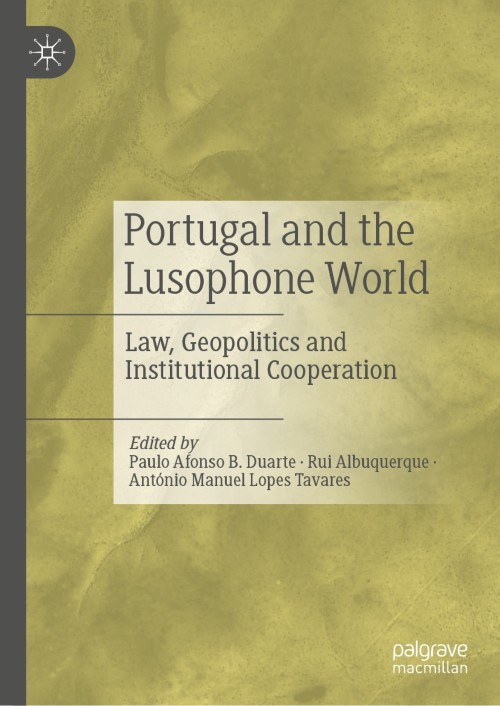
Portugal and the Lusophone World [electronic resource] : Law, Geopolitics and Institutional Cooperation / edited by Paulo Afonso B. Duarte, Rui Albuquerque, António Manuel Lopes Tavares.
Erişim Adresi
ISBN
9789819904556
Dil Kodu
İngilizce
Yer Numarası
DK/20134
Basım Bildirimi
1st ed. 2023.
Yayın Bilgisi
Singapore : Springer Nature Singapore : Imprint: Palgrave Macmillan, 2023.
Fiziksel Niteleme
LIV, 595 p. 21 illus., 18 illus. in color. online resource.
İçindekiler Notu
Introduction -- Part I: Legal issues and Politics within the Lusophone World -- Chapter 1. The Feasibility of the Portuguese Legal System in the Former African Colonies -- Chapter 2. The onto-anthropological foundation of Criminal Law in Brazil -- Chapter 3. Base Erosion and Profit Shifting: a view of Portugal and Brazil -- Chapter 4. Economic Law: a focus on Lusophone Competition Laws -- Chapter 5. The Role and Influence of Portuguese Law in the Macau SAR of the People’s Republic of China: Issues and Perspectives -- Chapter 6. The Pillars of Portuguese Foreign Policy: From the first globalization to the 21st century. -Chapter 7. Reframing Portuguese Foreign Policy after 1974: The Lusophone Discourse as Instrument of a Global Coloniality of Power -- Chapter 8. Portugal and China Geopolitics: Avenues to Cooperation -- Part II. The Atlantic and the Lusophone World -- Chapter 9. China, Portugal and the Atlantic: the Shifting Geopolitics, by Jorge Tavares da Silva, Paulo Afonso B. Duarteand Rui Pereira -- Chapter 10. Lusophone Connections and China’s Growing Presence in the South Atlantic -- Chapter 11. “So much sea”: opportunities and challenges in Portugal-Brazil maritime cooperation -- Chapter 12. Lusophone cooperation frameworks and the expansion of the Atlantic Maritime Security -- Chapter 13. The Spatial Development Initiatives: The Case of African Portuguese Speaking Countries -- Chapter 14. Brazil´s reach out to Africa -- Chapter 15. The nativist movement in Angola: a proposal for a modern state and society in the Lusophone context -- Chapter 16. Cabo Verde´s Geopolitical Position in the Mid-Atlantic -- Chapter 17. Mozambique Geopolitics in the Lusophone World: Challenges and Perspectives -- Chapter 18. Luso-Mozambican Diplomatic Cooperation in the Case of the Terrorist Conflict in Cabo Delgado -- Chapter 19. Lusophone Geopolitics: Blue Economy and Maritime Security in Contemporary Mozambique’s Geopolitics -- Part III. Influence and Institutional cooperation in the Lusophone World -- Chapter 20. The Geopolitics of the Portuguese Language: Knowledge and Influence -- Chapter 21. The Portuguese Science Diplomacy and EU’s External Activities with Lusophone Africa: Looking at the Co-Building Approach -- Chapter 22. The Nets that Empires Weave: The Commonwealth of Nations and the Community of Portuguese-Speaking Countries -- Chapter 23. The Soft Power of the Community of Portuguese Speaking Countries -- Chapter 24. Wavering cooperation: Portugal and Lusophone Africa at the United Nations General Assembly -- Chapter 25. Transition to a New Geopolitics of Energy: the Lusophone World -- Chapter 26. The Role of Forum Macao in the People’s Republic of China Foreign Policy -- Chapter 27. The Geopolitics of Timor-Leste: Belt & Road Initiative, ASEAN and CPLP.
Özet, vb.
This book responds to a serious need for a consistent and comprehensive publication which combines an analysis of Law, Geopolitics and Institutional cooperation within the Lusophone world. Research in the book includes contributions from scholars with diverse educational and professional experiences working in these disciplines, from all around the world. The book will assist readers in comprehending, recognizing and discussing on-going debates about the Lusophone world in the 21st century. Paulo Duarte is an Assistant Professor at Universidade Lusófona do Porto and Invited Professor at the University of Minho. Rui Albuquerque is a Professor at Universidade Lusófona do Porto, at the Faculty of Law and Political Science. António Manuel Lopes Tavares is a Professor at Universidade Lusófona do Porto, at the Faculty of Law and Political Science.
Konu
International relations.
Constitutional law.
Foreign Policy.
Constitutional Law.
Constitutional law.
Foreign Policy.
Constitutional Law.
Kurum Adı
Eseri Alıntıla
Referansları kullanmadan önce gözden geçirmeniz ve varsa gerekli düzeltmeleri yapmanız önerilir.
Dijital Kaynak
MARC Görünümü
LEADER 06879nam a22006135i 4500
001 818926
003 TR_AnAIT
005 20260130175521
007 cr nn 008mamaa
008 230503s2023 si | s |||| 0|eng d
020 |a9789819904556|9978-981-99-0455-6
024 7 |a10.1007/978-981-99-0455-6|2doi
041 |aeng
049 |aTürk Tarih Kurumu Kütüphanesi
050 4|aJZ2-6530
072 7|aJPS|2bicssc
072 7|aPOL028000|2bisacsh
072 7|aJPS|2thema
082 04|a327.1|223
090 |aDK/20134
245 10|aPortugal and the Lusophone World|h[electronic resource] :|bLaw, Geopolitics and Institutional Cooperation /|cedited by Paulo Afonso B. Duarte, Rui Albuquerque, António Manuel Lopes Tavares.
250 |a1st ed. 2023.
264 1|aSingapore :|bSpringer Nature Singapore :|bImprint: Palgrave Macmillan,|c2023.
300 |aLIV, 595 p. 21 illus., 18 illus. in color.|bonline resource.
336 |atext|btxt|2rdacontent
337 |acomputer|bc|2rdamedia
338 |aonline resource|bcr|2rdacarrier
341 0 |bTable of contents navigation|2onix
341 0 |bSingle logical reading order|2onix
341 0 |bShort alternative textual descriptions|2onix
341 0 |bUse of color is not sole means of conveying information|2onix
341 0 |bUse of high contrast between text and background color|2onix
341 0 |bNext / Previous structural navigation|2onix
341 0 |bAll non-decorative content supports reading without sight|2onix
347 |atext file|bPDF|2rda
505 0 |aIntroduction -- Part I: Legal issues and Politics within the Lusophone World -- Chapter 1. The Feasibility of the Portuguese Legal System in the Former African Colonies -- Chapter 2. The onto-anthropological foundation of Criminal Law in Brazil -- Chapter 3. Base Erosion and Profit Shifting: a view of Portugal and Brazil -- Chapter 4. Economic Law: a focus on Lusophone Competition Laws -- Chapter 5. The Role and Influence of Portuguese Law in the Macau SAR of the People’s Republic of China: Issues and Perspectives -- Chapter 6. The Pillars of Portuguese Foreign Policy: From the first globalization to the 21st century. -Chapter 7. Reframing Portuguese Foreign Policy after 1974: The Lusophone Discourse as Instrument of a Global Coloniality of Power -- Chapter 8. Portugal and China Geopolitics: Avenues to Cooperation -- Part II. The Atlantic and the Lusophone World -- Chapter 9. China, Portugal and the Atlantic: the Shifting Geopolitics, by Jorge Tavares da Silva, Paulo Afonso B. Duarteand Rui Pereira -- Chapter 10. Lusophone Connections and China’s Growing Presence in the South Atlantic -- Chapter 11. “So much sea”: opportunities and challenges in Portugal-Brazil maritime cooperation -- Chapter 12. Lusophone cooperation frameworks and the expansion of the Atlantic Maritime Security -- Chapter 13. The Spatial Development Initiatives: The Case of African Portuguese Speaking Countries -- Chapter 14. Brazil´s reach out to Africa -- Chapter 15. The nativist movement in Angola: a proposal for a modern state and society in the Lusophone context -- Chapter 16. Cabo Verde´s Geopolitical Position in the Mid-Atlantic -- Chapter 17. Mozambique Geopolitics in the Lusophone World: Challenges and Perspectives -- Chapter 18. Luso-Mozambican Diplomatic Cooperation in the Case of the Terrorist Conflict in Cabo Delgado -- Chapter 19. Lusophone Geopolitics: Blue Economy and Maritime Security in Contemporary Mozambique’s Geopolitics -- Part III. Influence and Institutional cooperation in the Lusophone World -- Chapter 20. The Geopolitics of the Portuguese Language: Knowledge and Influence -- Chapter 21. The Portuguese Science Diplomacy and EU’s External Activities with Lusophone Africa: Looking at the Co-Building Approach -- Chapter 22. The Nets that Empires Weave: The Commonwealth of Nations and the Community of Portuguese-Speaking Countries -- Chapter 23. The Soft Power of the Community of Portuguese Speaking Countries -- Chapter 24. Wavering cooperation: Portugal and Lusophone Africa at the United Nations General Assembly -- Chapter 25. Transition to a New Geopolitics of Energy: the Lusophone World -- Chapter 26. The Role of Forum Macao in the People’s Republic of China Foreign Policy -- Chapter 27. The Geopolitics of Timor-Leste: Belt & Road Initiative, ASEAN and CPLP.
520 |aThis book responds to a serious need for a consistent and comprehensive publication which combines an analysis of Law, Geopolitics and Institutional cooperation within the Lusophone world. Research in the book includes contributions from scholars with diverse educational and professional experiences working in these disciplines, from all around the world. The book will assist readers in comprehending, recognizing and discussing on-going debates about the Lusophone world in the 21st century. Paulo Duarte is an Assistant Professor at Universidade Lusófona do Porto and Invited Professor at the University of Minho. Rui Albuquerque is a Professor at Universidade Lusófona do Porto, at the Faculty of Law and Political Science. António Manuel Lopes Tavares is a Professor at Universidade Lusófona do Porto, at the Faculty of Law and Political Science.
532 8 |aAccessibility summary: This PDF does not fully comply with PDF/UA standards, but does feature limited screen reader support, described non-text content (images, graphs), bookmarks for easy navigation and searchable, selectable text. Users of assistive technologies may experience difficulty navigating or interpreting content in this document. We recognize the importance of accessibility, and we welcome queries about accessibility for any of our products. If you have a question or an access need, please get in touch with us at accessibilitysupport@springernature.com.
532 8 |aNo reading system accessibility options actively disabled
532 8 |aPublisher contact for further accessibility information: accessibilitysupport@springernature.com
650 0|aInternational relations.
650 0|aConstitutional law.
650 14|aForeign Policy.
650 24|aConstitutional Law.
700 1 |aDuarte, Paulo Afonso B.|eeditor.|4edt|4http://id.loc.gov/vocabulary/relators/edt
700 1 |aAlbuquerque, Rui.|eeditor.|4edt|4http://id.loc.gov/vocabulary/relators/edt
700 1 |aTavares, António Manuel Lopes.|eeditor.|4edt|4http://id.loc.gov/vocabulary/relators/edt
710 2 |aSpringerLink (Online service)
773 0 |tSpringer Nature eBook
776 08|iPrinted edition:|z9789819904549
776 08|iPrinted edition:|z9789819904563
776 08|iPrinted edition:|z9789819904570
856 40|uhttps://doi.org/10.1007/978-981-99-0455-6
912 |aZDB-2-POS
912 |aZDB-2-SXPI
950 |aPolitical Science and International Studies (SpringerNature-41174)
950 |aPolitical Science and International Studies (R0) (SpringerNature-43724)
001 818926
003 TR_AnAIT
005 20260130175521
007 cr nn 008mamaa
008 230503s2023 si | s |||| 0|eng d
020 |a9789819904556|9978-981-99-0455-6
024 7 |a10.1007/978-981-99-0455-6|2doi
041 |aeng
049 |aTürk Tarih Kurumu Kütüphanesi
050 4|aJZ2-6530
072 7|aJPS|2bicssc
072 7|aPOL028000|2bisacsh
072 7|aJPS|2thema
082 04|a327.1|223
090 |aDK/20134
245 10|aPortugal and the Lusophone World|h[electronic resource] :|bLaw, Geopolitics and Institutional Cooperation /|cedited by Paulo Afonso B. Duarte, Rui Albuquerque, António Manuel Lopes Tavares.
250 |a1st ed. 2023.
264 1|aSingapore :|bSpringer Nature Singapore :|bImprint: Palgrave Macmillan,|c2023.
300 |aLIV, 595 p. 21 illus., 18 illus. in color.|bonline resource.
336 |atext|btxt|2rdacontent
337 |acomputer|bc|2rdamedia
338 |aonline resource|bcr|2rdacarrier
341 0 |bTable of contents navigation|2onix
341 0 |bSingle logical reading order|2onix
341 0 |bShort alternative textual descriptions|2onix
341 0 |bUse of color is not sole means of conveying information|2onix
341 0 |bUse of high contrast between text and background color|2onix
341 0 |bNext / Previous structural navigation|2onix
341 0 |bAll non-decorative content supports reading without sight|2onix
347 |atext file|bPDF|2rda
505 0 |aIntroduction -- Part I: Legal issues and Politics within the Lusophone World -- Chapter 1. The Feasibility of the Portuguese Legal System in the Former African Colonies -- Chapter 2. The onto-anthropological foundation of Criminal Law in Brazil -- Chapter 3. Base Erosion and Profit Shifting: a view of Portugal and Brazil -- Chapter 4. Economic Law: a focus on Lusophone Competition Laws -- Chapter 5. The Role and Influence of Portuguese Law in the Macau SAR of the People’s Republic of China: Issues and Perspectives -- Chapter 6. The Pillars of Portuguese Foreign Policy: From the first globalization to the 21st century. -Chapter 7. Reframing Portuguese Foreign Policy after 1974: The Lusophone Discourse as Instrument of a Global Coloniality of Power -- Chapter 8. Portugal and China Geopolitics: Avenues to Cooperation -- Part II. The Atlantic and the Lusophone World -- Chapter 9. China, Portugal and the Atlantic: the Shifting Geopolitics, by Jorge Tavares da Silva, Paulo Afonso B. Duarteand Rui Pereira -- Chapter 10. Lusophone Connections and China’s Growing Presence in the South Atlantic -- Chapter 11. “So much sea”: opportunities and challenges in Portugal-Brazil maritime cooperation -- Chapter 12. Lusophone cooperation frameworks and the expansion of the Atlantic Maritime Security -- Chapter 13. The Spatial Development Initiatives: The Case of African Portuguese Speaking Countries -- Chapter 14. Brazil´s reach out to Africa -- Chapter 15. The nativist movement in Angola: a proposal for a modern state and society in the Lusophone context -- Chapter 16. Cabo Verde´s Geopolitical Position in the Mid-Atlantic -- Chapter 17. Mozambique Geopolitics in the Lusophone World: Challenges and Perspectives -- Chapter 18. Luso-Mozambican Diplomatic Cooperation in the Case of the Terrorist Conflict in Cabo Delgado -- Chapter 19. Lusophone Geopolitics: Blue Economy and Maritime Security in Contemporary Mozambique’s Geopolitics -- Part III. Influence and Institutional cooperation in the Lusophone World -- Chapter 20. The Geopolitics of the Portuguese Language: Knowledge and Influence -- Chapter 21. The Portuguese Science Diplomacy and EU’s External Activities with Lusophone Africa: Looking at the Co-Building Approach -- Chapter 22. The Nets that Empires Weave: The Commonwealth of Nations and the Community of Portuguese-Speaking Countries -- Chapter 23. The Soft Power of the Community of Portuguese Speaking Countries -- Chapter 24. Wavering cooperation: Portugal and Lusophone Africa at the United Nations General Assembly -- Chapter 25. Transition to a New Geopolitics of Energy: the Lusophone World -- Chapter 26. The Role of Forum Macao in the People’s Republic of China Foreign Policy -- Chapter 27. The Geopolitics of Timor-Leste: Belt & Road Initiative, ASEAN and CPLP.
520 |aThis book responds to a serious need for a consistent and comprehensive publication which combines an analysis of Law, Geopolitics and Institutional cooperation within the Lusophone world. Research in the book includes contributions from scholars with diverse educational and professional experiences working in these disciplines, from all around the world. The book will assist readers in comprehending, recognizing and discussing on-going debates about the Lusophone world in the 21st century. Paulo Duarte is an Assistant Professor at Universidade Lusófona do Porto and Invited Professor at the University of Minho. Rui Albuquerque is a Professor at Universidade Lusófona do Porto, at the Faculty of Law and Political Science. António Manuel Lopes Tavares is a Professor at Universidade Lusófona do Porto, at the Faculty of Law and Political Science.
532 8 |aAccessibility summary: This PDF does not fully comply with PDF/UA standards, but does feature limited screen reader support, described non-text content (images, graphs), bookmarks for easy navigation and searchable, selectable text. Users of assistive technologies may experience difficulty navigating or interpreting content in this document. We recognize the importance of accessibility, and we welcome queries about accessibility for any of our products. If you have a question or an access need, please get in touch with us at accessibilitysupport@springernature.com.
532 8 |aNo reading system accessibility options actively disabled
532 8 |aPublisher contact for further accessibility information: accessibilitysupport@springernature.com
650 0|aInternational relations.
650 0|aConstitutional law.
650 14|aForeign Policy.
650 24|aConstitutional Law.
700 1 |aDuarte, Paulo Afonso B.|eeditor.|4edt|4http://id.loc.gov/vocabulary/relators/edt
700 1 |aAlbuquerque, Rui.|eeditor.|4edt|4http://id.loc.gov/vocabulary/relators/edt
700 1 |aTavares, António Manuel Lopes.|eeditor.|4edt|4http://id.loc.gov/vocabulary/relators/edt
710 2 |aSpringerLink (Online service)
773 0 |tSpringer Nature eBook
776 08|iPrinted edition:|z9789819904549
776 08|iPrinted edition:|z9789819904563
776 08|iPrinted edition:|z9789819904570
856 40|uhttps://doi.org/10.1007/978-981-99-0455-6
912 |aZDB-2-POS
912 |aZDB-2-SXPI
950 |aPolitical Science and International Studies (SpringerNature-41174)
950 |aPolitical Science and International Studies (R0) (SpringerNature-43724)
Materyaller
Depodan talep edilen materyal sadece kütüphane içerisinde kullanılmaktadır.
Materyal dışarıya ödünç verilmemektedir.
Materyal dışarıya ödünç verilmemektedir.
