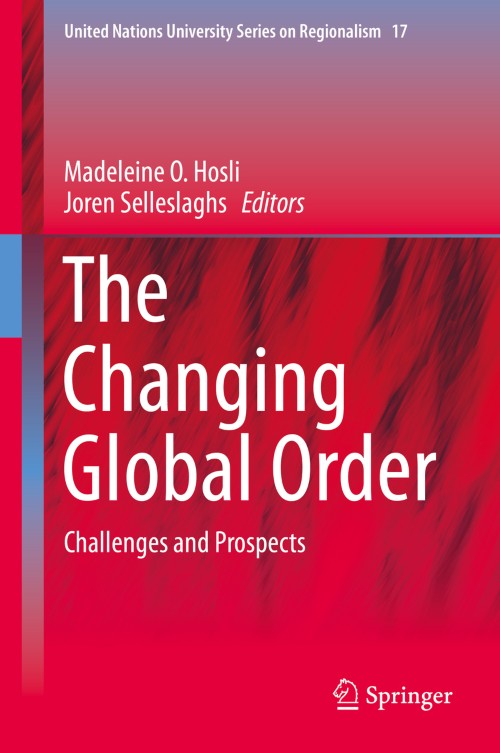
The Changing Global Order [electronic resource] : Challenges and Prospects / edited by Madeleine O. Hosli, Joren Selleslaghs.
Erişim Adresi
ISBN
9783030216030
Dil Kodu
İngilizce
Yer Numarası
DK/20192
Basım Bildirimi
1st ed. 2020.
Yayın Bilgisi
Cham : Springer International Publishing : Imprint: Springer, 2020.
Fiziksel Niteleme
XXVII, 456 p. 14 illus., 7 illus. in color. online resource.
Dizi
United Nations University Series on Regionalism, 2214-9856 ; 17
İçindekiler Notu
Part I. Theories of International Relations to understand the Changing Global Order -- Chapter 1. Traditional Theories of International Relations; D. Buck and M.O. Hosli -- Chapter 2. Alternative Post-Positivist Theories of IR and the Need for a Global IR Scholarship; I. Baruah and J. Selleslaghs -- Part II. The Changing World Order: The Rise of New Powers -- Chapter 3. Power Politics; R. De Wijk -- Chapter 4. The Rise of China; J. Shi and Z. Langjia -- Chapter 5. Russia in the Changing Global Order: Multipolarity, Multilateralism, and Sovereignty; A. Gerrits -- Chapter 6. India as an Emerging Power; C. Van de Wetering -- Part III. Regional Organisations in Global Affairs -- Chapter 7. The Rise of Regions: Introduction to Regional Integration & Organisations; J. Selleslaghs and L. Van Langenhove -- Chapter 8. The European Union: Integration, Institutions and External Relations in a Globalised and Regionalised World; J. Selleslaghs,M. Télo and M.O. Hosli -- Chapter 9. The Shanghai Cooperation Organisation; G. Scott-Smith -- Chapter 10. ASEAN as a Conflict Manager; F. Queen and F. Sheng -- Chapter 11. Regionalism in Latin America: Eclectic, Multi-Faceted and Multi-Layered; J. Selleslaghs, J. Briceño Ruiz and P. de Lombaerde -- Chapter 12. Regional integration in South Asia: SAARC; I. Baruah -- Part IV. International Organisations and Global Governance 2.0 -- Chapter 13. Global Governance 2.0; A. Kasper -- Chapter 14. The United Nations and the Security Council: History, Current Composition, and Reform Proposals; M.O. Hosli and T. Dörfler -- Chapter 15. NATO in a Changing World; R. Tosbotn and E. CusumanoP. Moro and S. Zavagli -- Chapter 16. International Economic Organisations, G20; J. Kantorowicz -- Part V. Conflict, Conflict Resolution and International Security -- Chapter 17. The Enforcement of International Law; E. Kantorowicz-Reznichenko -- Chapter 18. The International Norm Dynamics of Responsibility to Protect; J. Speiser -- Chapter 19. Methods of Conflict Resolution: Negotiation; P. Meerts -- Chapter 20. Debunking the Myths of International Mediation Conceptualizing Bias, Power and Success; S. Vuković -- Closing Remarks: General Conclusion to the Book; M.O. Hosli, J. Selleslaghs, R. Johnson and E. Ramon.
Özet, vb.
This volume offers a comprehensive evaluation of the concept of global order, with a particular emphasis on the role of regional organisations within global governance institutions such as the United Nations. Building from a solid theoretical base it draws upon the expertise of numerous leading international scholars offering a broad array of timely and relevant case studies. These all take into consideration the historical setting, before analysing the contemporary situation and offering suggestions for potential realignments and readjustments that may be witnessed in the future. The volume adopts an interdisciplinary approach when addressing some of the most pressing issues of global governance which our global community must tackle. This presents the readers an opportunity to understand related topics such as political economy, international law, institutions of global governance, in conjunction with the academic field of International Relations (IR). It further helps studentsand interested readers understand the theoretical and practical foundations to the changing nature of global affairs. .
Konu
Political science.
Economic sociology.
International relations.
Political Science.
Economic Sociology.
International Relations.
Economic sociology.
International relations.
Political Science.
Economic Sociology.
International Relations.
Diğer Yazarlar
Kurum Adı

Eseri Alıntıla
Referansları kullanmadan önce gözden geçirmeniz ve varsa gerekli düzeltmeleri yapmanız önerilir.
Dijital Kaynak
MARC Görünümü
LEADER 06636nam a22006495i 4500
001 818984
003 TR_AnAIT
005 20260130175332
007 cr nn 008mamaa
008 191122s2020 sz | s |||| 0|eng d
020 |a9783030216030|9978-3-030-21603-0
024 7 |a10.1007/978-3-030-21603-0|2doi
041 |aeng
049 |aTürk Tarih Kurumu Kütüphanesi
050 4|aJA1-92
072 7|aJPA|2bicssc
072 7|aPOL000000|2bisacsh
072 7|aJPA|2thema
082 04|a320|223
090 |aDK/20192
245 14|aThe Changing Global Order|h[electronic resource] :|bChallenges and Prospects /|cedited by Madeleine O. Hosli, Joren Selleslaghs.
250 |a1st ed. 2020.
264 1|aCham :|bSpringer International Publishing :|bImprint: Springer,|c2020.
300 |aXXVII, 456 p. 14 illus., 7 illus. in color.|bonline resource.
336 |atext|btxt|2rdacontent
337 |acomputer|bc|2rdamedia
338 |aonline resource|bcr|2rdacarrier
341 0 |bTable of contents navigation|2onix
341 0 |bSingle logical reading order|2onix
341 0 |bShort alternative textual descriptions|2onix
341 0 |bUse of color is not sole means of conveying information|2onix
341 0 |bUse of high contrast between text and background color|2onix
341 0 |bNext / Previous structural navigation|2onix
341 0 |bAll non-decorative content supports reading without sight|2onix
347 |atext file|bPDF|2rda
490 1 |aUnited Nations University Series on Regionalism,|x2214-9856 ;|v17
505 0 |aPart I. Theories of International Relations to understand the Changing Global Order -- Chapter 1. Traditional Theories of International Relations; D. Buck and M.O. Hosli -- Chapter 2. Alternative Post-Positivist Theories of IR and the Need for a Global IR Scholarship; I. Baruah and J. Selleslaghs -- Part II. The Changing World Order: The Rise of New Powers -- Chapter 3. Power Politics; R. De Wijk -- Chapter 4. The Rise of China; J. Shi and Z. Langjia -- Chapter 5. Russia in the Changing Global Order: Multipolarity, Multilateralism, and Sovereignty; A. Gerrits -- Chapter 6. India as an Emerging Power; C. Van de Wetering -- Part III. Regional Organisations in Global Affairs -- Chapter 7. The Rise of Regions: Introduction to Regional Integration & Organisations; J. Selleslaghs and L. Van Langenhove -- Chapter 8. The European Union: Integration, Institutions and External Relations in a Globalised and Regionalised World; J. Selleslaghs,M. Télo and M.O. Hosli -- Chapter 9. The Shanghai Cooperation Organisation; G. Scott-Smith -- Chapter 10. ASEAN as a Conflict Manager; F. Queen and F. Sheng -- Chapter 11. Regionalism in Latin America: Eclectic, Multi-Faceted and Multi-Layered; J. Selleslaghs, J. Briceño Ruiz and P. de Lombaerde -- Chapter 12. Regional integration in South Asia: SAARC; I. Baruah -- Part IV. International Organisations and Global Governance 2.0 -- Chapter 13. Global Governance 2.0; A. Kasper -- Chapter 14. The United Nations and the Security Council: History, Current Composition, and Reform Proposals; M.O. Hosli and T. Dörfler -- Chapter 15. NATO in a Changing World; R. Tosbotn and E. CusumanoP. Moro and S. Zavagli -- Chapter 16. International Economic Organisations, G20; J. Kantorowicz -- Part V. Conflict, Conflict Resolution and International Security -- Chapter 17. The Enforcement of International Law; E. Kantorowicz-Reznichenko -- Chapter 18. The International Norm Dynamics of Responsibility to Protect; J. Speiser -- Chapter 19. Methods of Conflict Resolution: Negotiation; P. Meerts -- Chapter 20. Debunking the Myths of International Mediation Conceptualizing Bias, Power and Success; S. Vuković -- Closing Remarks: General Conclusion to the Book; M.O. Hosli, J. Selleslaghs, R. Johnson and E. Ramon.
520 |aThis volume offers a comprehensive evaluation of the concept of global order, with a particular emphasis on the role of regional organisations within global governance institutions such as the United Nations. Building from a solid theoretical base it draws upon the expertise of numerous leading international scholars offering a broad array of timely and relevant case studies. These all take into consideration the historical setting, before analysing the contemporary situation and offering suggestions for potential realignments and readjustments that may be witnessed in the future. The volume adopts an interdisciplinary approach when addressing some of the most pressing issues of global governance which our global community must tackle. This presents the readers an opportunity to understand related topics such as political economy, international law, institutions of global governance, in conjunction with the academic field of International Relations (IR). It further helps studentsand interested readers understand the theoretical and practical foundations to the changing nature of global affairs. .
532 8 |aAccessibility summary: This PDF does not fully comply with PDF/UA standards, but does feature limited screen reader support, described non-text content (images, graphs), bookmarks for easy navigation and searchable, selectable text. Users of assistive technologies may experience difficulty navigating or interpreting content in this document. We recognize the importance of accessibility, and we welcome queries about accessibility for any of our products. If you have a question or an access need, please get in touch with us at accessibilitysupport@springernature.com.
532 8 |aNo reading system accessibility options actively disabled
532 8 |aPublisher contact for further accessibility information: accessibilitysupport@springernature.com
650 0|aPolitical science.
650 0|aEconomic sociology.
650 0|aInternational relations.
650 14|aPolitical Science.
650 24|aEconomic Sociology.
650 24|aInternational Relations.
700 1 |aHosli, Madeleine O.|eeditor.|4edt|4http://id.loc.gov/vocabulary/relators/edt
700 1 |aSelleslaghs, Joren.|eeditor.|4edt|4http://id.loc.gov/vocabulary/relators/edt
710 2 |aSpringerLink (Online service)
773 0 |tSpringer Nature eBook
776 08|iPrinted edition:|z9783030216023
776 08|iPrinted edition:|z9783030216047
776 08|iPrinted edition:|z9783030216054
830 0|aUnited Nations University Series on Regionalism,|x2214-9856 ;|v17
856 40|uhttps://doi.org/10.1007/978-3-030-21603-0
912 |aZDB-2-POS
912 |aZDB-2-SXPI
950 |aPolitical Science and International Studies (SpringerNature-41174)
950 |aPolitical Science and International Studies (R0) (SpringerNature-43724)
001 818984
003 TR_AnAIT
005 20260130175332
007 cr nn 008mamaa
008 191122s2020 sz | s |||| 0|eng d
020 |a9783030216030|9978-3-030-21603-0
024 7 |a10.1007/978-3-030-21603-0|2doi
041 |aeng
049 |aTürk Tarih Kurumu Kütüphanesi
050 4|aJA1-92
072 7|aJPA|2bicssc
072 7|aPOL000000|2bisacsh
072 7|aJPA|2thema
082 04|a320|223
090 |aDK/20192
245 14|aThe Changing Global Order|h[electronic resource] :|bChallenges and Prospects /|cedited by Madeleine O. Hosli, Joren Selleslaghs.
250 |a1st ed. 2020.
264 1|aCham :|bSpringer International Publishing :|bImprint: Springer,|c2020.
300 |aXXVII, 456 p. 14 illus., 7 illus. in color.|bonline resource.
336 |atext|btxt|2rdacontent
337 |acomputer|bc|2rdamedia
338 |aonline resource|bcr|2rdacarrier
341 0 |bTable of contents navigation|2onix
341 0 |bSingle logical reading order|2onix
341 0 |bShort alternative textual descriptions|2onix
341 0 |bUse of color is not sole means of conveying information|2onix
341 0 |bUse of high contrast between text and background color|2onix
341 0 |bNext / Previous structural navigation|2onix
341 0 |bAll non-decorative content supports reading without sight|2onix
347 |atext file|bPDF|2rda
490 1 |aUnited Nations University Series on Regionalism,|x2214-9856 ;|v17
505 0 |aPart I. Theories of International Relations to understand the Changing Global Order -- Chapter 1. Traditional Theories of International Relations; D. Buck and M.O. Hosli -- Chapter 2. Alternative Post-Positivist Theories of IR and the Need for a Global IR Scholarship; I. Baruah and J. Selleslaghs -- Part II. The Changing World Order: The Rise of New Powers -- Chapter 3. Power Politics; R. De Wijk -- Chapter 4. The Rise of China; J. Shi and Z. Langjia -- Chapter 5. Russia in the Changing Global Order: Multipolarity, Multilateralism, and Sovereignty; A. Gerrits -- Chapter 6. India as an Emerging Power; C. Van de Wetering -- Part III. Regional Organisations in Global Affairs -- Chapter 7. The Rise of Regions: Introduction to Regional Integration & Organisations; J. Selleslaghs and L. Van Langenhove -- Chapter 8. The European Union: Integration, Institutions and External Relations in a Globalised and Regionalised World; J. Selleslaghs,M. Télo and M.O. Hosli -- Chapter 9. The Shanghai Cooperation Organisation; G. Scott-Smith -- Chapter 10. ASEAN as a Conflict Manager; F. Queen and F. Sheng -- Chapter 11. Regionalism in Latin America: Eclectic, Multi-Faceted and Multi-Layered; J. Selleslaghs, J. Briceño Ruiz and P. de Lombaerde -- Chapter 12. Regional integration in South Asia: SAARC; I. Baruah -- Part IV. International Organisations and Global Governance 2.0 -- Chapter 13. Global Governance 2.0; A. Kasper -- Chapter 14. The United Nations and the Security Council: History, Current Composition, and Reform Proposals; M.O. Hosli and T. Dörfler -- Chapter 15. NATO in a Changing World; R. Tosbotn and E. CusumanoP. Moro and S. Zavagli -- Chapter 16. International Economic Organisations, G20; J. Kantorowicz -- Part V. Conflict, Conflict Resolution and International Security -- Chapter 17. The Enforcement of International Law; E. Kantorowicz-Reznichenko -- Chapter 18. The International Norm Dynamics of Responsibility to Protect; J. Speiser -- Chapter 19. Methods of Conflict Resolution: Negotiation; P. Meerts -- Chapter 20. Debunking the Myths of International Mediation Conceptualizing Bias, Power and Success; S. Vuković -- Closing Remarks: General Conclusion to the Book; M.O. Hosli, J. Selleslaghs, R. Johnson and E. Ramon.
520 |aThis volume offers a comprehensive evaluation of the concept of global order, with a particular emphasis on the role of regional organisations within global governance institutions such as the United Nations. Building from a solid theoretical base it draws upon the expertise of numerous leading international scholars offering a broad array of timely and relevant case studies. These all take into consideration the historical setting, before analysing the contemporary situation and offering suggestions for potential realignments and readjustments that may be witnessed in the future. The volume adopts an interdisciplinary approach when addressing some of the most pressing issues of global governance which our global community must tackle. This presents the readers an opportunity to understand related topics such as political economy, international law, institutions of global governance, in conjunction with the academic field of International Relations (IR). It further helps studentsand interested readers understand the theoretical and practical foundations to the changing nature of global affairs. .
532 8 |aAccessibility summary: This PDF does not fully comply with PDF/UA standards, but does feature limited screen reader support, described non-text content (images, graphs), bookmarks for easy navigation and searchable, selectable text. Users of assistive technologies may experience difficulty navigating or interpreting content in this document. We recognize the importance of accessibility, and we welcome queries about accessibility for any of our products. If you have a question or an access need, please get in touch with us at accessibilitysupport@springernature.com.
532 8 |aNo reading system accessibility options actively disabled
532 8 |aPublisher contact for further accessibility information: accessibilitysupport@springernature.com
650 0|aPolitical science.
650 0|aEconomic sociology.
650 0|aInternational relations.
650 14|aPolitical Science.
650 24|aEconomic Sociology.
650 24|aInternational Relations.
700 1 |aHosli, Madeleine O.|eeditor.|4edt|4http://id.loc.gov/vocabulary/relators/edt
700 1 |aSelleslaghs, Joren.|eeditor.|4edt|4http://id.loc.gov/vocabulary/relators/edt
710 2 |aSpringerLink (Online service)
773 0 |tSpringer Nature eBook
776 08|iPrinted edition:|z9783030216023
776 08|iPrinted edition:|z9783030216047
776 08|iPrinted edition:|z9783030216054
830 0|aUnited Nations University Series on Regionalism,|x2214-9856 ;|v17
856 40|uhttps://doi.org/10.1007/978-3-030-21603-0
912 |aZDB-2-POS
912 |aZDB-2-SXPI
950 |aPolitical Science and International Studies (SpringerNature-41174)
950 |aPolitical Science and International Studies (R0) (SpringerNature-43724)
Materyaller
Depodan talep edilen materyal sadece kütüphane içerisinde kullanılmaktadır.
Materyal dışarıya ödünç verilmemektedir.
