

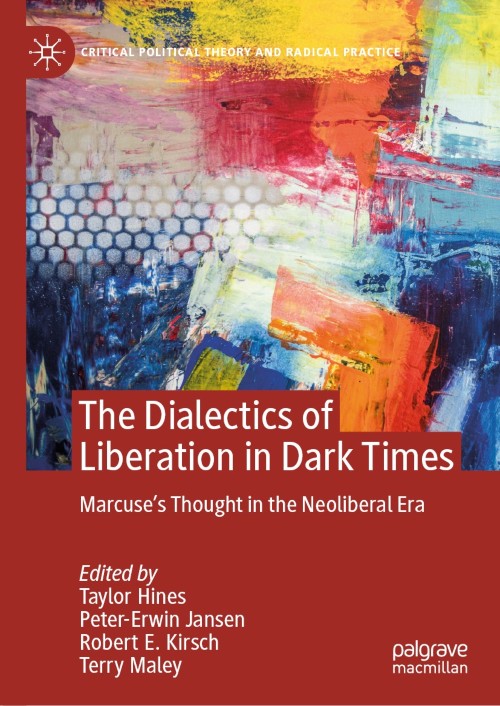
The Dialectics of Liberation in Dark Times [electronic resource] : Marcuse's Thought in the Neoliberal Era / edited by Taylor Hines, Peter-Erwin Jansen, Robert E. Kirsch, Terry Maley.
Erişim Adresi
ISBN
9783031224881
Dil Kodu
İngilizce
Yer Numarası
DK/20227
Basım Bildirimi
1st ed. 2023.
Yayın Bilgisi
Cham : Springer International Publishing : Imprint: Palgrave Macmillan, 2023.
Fiziksel Niteleme
XIV, 419 p. 1 illus. online resource.
Dizi
Critical Political Theory and Radical Practice, 2731-6599
İçindekiler Notu
Introduction -- Part I: Neoliberal Authoritarianism -- Chapter 1: Terry Maley, Building on Marcuse: An Assessment of the New Phase of Neoliberal Despotism -- Chapter 2: Samir Gandesha, The “Authoritarian Personality” Reconsidered: The Phantom of “Left Fascism” -- Chapter 3: Luca Mandara, Marcuse and the Social Networkers -- Chapter 4: Rodney Doody, The Hedonism and Asceticism of Neoliberal Subjectivity: The Crude Needs of Consumer Capitalism and its Social, Psychological, and Ecological Devastation -- Chapter 5: Christian Garland, Turning Sense Into Nonsense and Nonsense Into Sense: Critical Theory to Refuse the Fallacy of Populism -- Chapter 6: Lauren Langman, Refusals Redux -- Part II: Neoliberalism and Technological Rationality -- Chapter 7: Stefan Gandler, Multiple Subjectivities in Neoliberal Times: Reflections from a Critical Theory in Latin America -- Chapter 8: Haggag Ali, Receptions of Herbert Marcuse’s Critical Theory: A ComparativeApproach to Telos and Al Fekr Al Mo’āṣer -- Chapter 9: Wes Furlotte, A Dialectical Critique of Pure Recognition: Settler-Colonialism within Advanced Industrial Canada -- Chapter 10: Nicole K. Mayberry, Color-Blind Racism and One-Dimensionality: Imagining Marcusean Conditions of Freedom Through the Black Radical Tradition -- Chapter 11: Taylor Hines, Artificial Reverie and Administered Negativity -- Chapter 12: Robert E. Kirsch, Reigniting Racket Theory: Horkheimer’s Unfinished Project and Marcuse’s Affinity for American Institutionalism -- Part III: Socialism(s): Still the Proper Response -- Chapter 13: Peter-Erwin Jansen, Human Rights: A Concrete Utopian Concept -- Chapter 14: Charles Reitz, Revolutionary Ecological Liberation: EarthCommonWealth -- Chapter 15: Imaculada Kangussu, 2020: Nature Said, “Stop” -- Chapter 16: Casey Robertson, Marcusean Pathways for Queer Agency through Sonic Conceptions of Noise in the Twenty-First Century -- Chapter 17: James William Lincoln, The Unfreedom of Moral Perception during Occurrent Experience -- Chapter 18: Peter Marcuse, From Reform Politics towards Liberation during the Suicide of Capitalism: Examples from Housing Policy -- Afterword, Douglas Kellner.
Özet, vb.
This book develops Marcuse’s critique of advanced industrial society and deploys it as a lens to critically analyze contemporary neoliberalism and its structural failures. In the chapters, Marcuse scholars explore three related topics: First, Marcuse’s theory as it applies to the relationship between neoliberalism and authoritarianism, including both the historical relationship between the two and the modern re-emergence of authoritarianism and nationalism in neoliberal states today. Second, a re-examination of the relationship between neoliberal subjectivity and technological rationality that seeks to understand the stabilizing forces of neoliberal society and the way these forces register at the level of thought. Third and finally, Marcuse’s conception of socialism in conversation with contemporary neoliberal rationality, and ways in which alternatives to the status quo remain possible. Together, this volume contributes to recent discussions of neoliberalism and contribute to thedevelopment of Marcuse scholarship. Taylor Hines is Assistant Teaching Professor at Barrett, the Honors College at Arizona State University, USA. Peter-Erwin Jansen is a Philosopher and Sociologist who studied with Jürgen Habermas and Axel Honneth at Goethe Universität, Germany, teaches at the University of Applied Sciences in Koblenz, Germany, and studies Holocaust Communication and Tolerance at Touro University in Berlin. Robert E. Kirsch is Assistant Professor in the Faculty of Leadership and Integrative Studies at Arizona State University, USA. Terry Maley teaches in the Politics Department and the Social and Political Thought graduate program at York University in Toronto, Canada.
Konu
Critical theory.
Political science.
World politics.
Critical Theory.
Political Theory.
Political Science.
Political History.
Political science.
World politics.
Critical Theory.
Political Theory.
Political Science.
Political History.
Kurum Adı
Eseri Alıntıla
Referansları kullanmadan önce gözden geçirmeniz ve varsa gerekli düzeltmeleri yapmanız önerilir.
Dijital Kaynak
MARC Görünümü
LEADER 07271nam a22006735i 4500
001 819019
003 TR_AnAIT
005 20260130175204
007 cr nn 008mamaa
008 230929s2023 sz | s |||| 0|eng d
020 |a9783031224881|9978-3-031-22488-1
024 7 |a10.1007/978-3-031-22488-1|2doi
041 |aeng
049 |aTürk Tarih Kurumu Kütüphanesi
050 4|aHM480
072 7|aHPS|2bicssc
072 7|aPHI040000|2bisacsh
072 7|aQDTS|2thema
082 04|a142|223
090 |aDK/20227
245 14|aThe Dialectics of Liberation in Dark Times|h[electronic resource] :|bMarcuse's Thought in the Neoliberal Era /|cedited by Taylor Hines, Peter-Erwin Jansen, Robert E. Kirsch, Terry Maley.
250 |a1st ed. 2023.
264 1|aCham :|bSpringer International Publishing :|bImprint: Palgrave Macmillan,|c2023.
300 |aXIV, 419 p. 1 illus.|bonline resource.
336 |atext|btxt|2rdacontent
337 |acomputer|bc|2rdamedia
338 |aonline resource|bcr|2rdacarrier
341 0 |bTable of contents navigation|2onix
341 0 |bSingle logical reading order|2onix
341 0 |bUse of color is not sole means of conveying information|2onix
341 0 |bUse of high contrast between text and background color|2onix
341 0 |bNext / Previous structural navigation|2onix
341 0 |bAll non-decorative content supports reading without sight|2onix
347 |atext file|bPDF|2rda
490 1 |aCritical Political Theory and Radical Practice,|x2731-6599
505 0 |aIntroduction -- Part I: Neoliberal Authoritarianism -- Chapter 1: Terry Maley, Building on Marcuse: An Assessment of the New Phase of Neoliberal Despotism -- Chapter 2: Samir Gandesha, The “Authoritarian Personality” Reconsidered: The Phantom of “Left Fascism” -- Chapter 3: Luca Mandara, Marcuse and the Social Networkers -- Chapter 4: Rodney Doody, The Hedonism and Asceticism of Neoliberal Subjectivity: The Crude Needs of Consumer Capitalism and its Social, Psychological, and Ecological Devastation -- Chapter 5: Christian Garland, Turning Sense Into Nonsense and Nonsense Into Sense: Critical Theory to Refuse the Fallacy of Populism -- Chapter 6: Lauren Langman, Refusals Redux -- Part II: Neoliberalism and Technological Rationality -- Chapter 7: Stefan Gandler, Multiple Subjectivities in Neoliberal Times: Reflections from a Critical Theory in Latin America -- Chapter 8: Haggag Ali, Receptions of Herbert Marcuse’s Critical Theory: A ComparativeApproach to Telos and Al Fekr Al Mo’āṣer -- Chapter 9: Wes Furlotte, A Dialectical Critique of Pure Recognition: Settler-Colonialism within Advanced Industrial Canada -- Chapter 10: Nicole K. Mayberry, Color-Blind Racism and One-Dimensionality: Imagining Marcusean Conditions of Freedom Through the Black Radical Tradition -- Chapter 11: Taylor Hines, Artificial Reverie and Administered Negativity -- Chapter 12: Robert E. Kirsch, Reigniting Racket Theory: Horkheimer’s Unfinished Project and Marcuse’s Affinity for American Institutionalism -- Part III: Socialism(s): Still the Proper Response -- Chapter 13: Peter-Erwin Jansen, Human Rights: A Concrete Utopian Concept -- Chapter 14: Charles Reitz, Revolutionary Ecological Liberation: EarthCommonWealth -- Chapter 15: Imaculada Kangussu, 2020: Nature Said, “Stop” -- Chapter 16: Casey Robertson, Marcusean Pathways for Queer Agency through Sonic Conceptions of Noise in the Twenty-First Century -- Chapter 17: James William Lincoln, The Unfreedom of Moral Perception during Occurrent Experience -- Chapter 18: Peter Marcuse, From Reform Politics towards Liberation during the Suicide of Capitalism: Examples from Housing Policy -- Afterword, Douglas Kellner.
520 |aThis book develops Marcuse’s critique of advanced industrial society and deploys it as a lens to critically analyze contemporary neoliberalism and its structural failures. In the chapters, Marcuse scholars explore three related topics: First, Marcuse’s theory as it applies to the relationship between neoliberalism and authoritarianism, including both the historical relationship between the two and the modern re-emergence of authoritarianism and nationalism in neoliberal states today. Second, a re-examination of the relationship between neoliberal subjectivity and technological rationality that seeks to understand the stabilizing forces of neoliberal society and the way these forces register at the level of thought. Third and finally, Marcuse’s conception of socialism in conversation with contemporary neoliberal rationality, and ways in which alternatives to the status quo remain possible. Together, this volume contributes to recent discussions of neoliberalism and contribute to thedevelopment of Marcuse scholarship. Taylor Hines is Assistant Teaching Professor at Barrett, the Honors College at Arizona State University, USA. Peter-Erwin Jansen is a Philosopher and Sociologist who studied with Jürgen Habermas and Axel Honneth at Goethe Universität, Germany, teaches at the University of Applied Sciences in Koblenz, Germany, and studies Holocaust Communication and Tolerance at Touro University in Berlin. Robert E. Kirsch is Assistant Professor in the Faculty of Leadership and Integrative Studies at Arizona State University, USA. Terry Maley teaches in the Politics Department and the Social and Political Thought graduate program at York University in Toronto, Canada.
532 8 |aAccessibility summary: This PDF does not fully comply with PDF/UA standards, but does feature limited screen reader support, bookmarks for easy navigation and searchable, selectable text. Users of assistive technologies may experience difficulty navigating or interpreting content in this document. We recognize the importance of accessibility, and we welcome queries about accessibility for any of our products. If you have a question or an access need, please get in touch with us at accessibilitysupport@springernature.com.
532 8 |aNo reading system accessibility options actively disabled
532 8 |aPublisher contact for further accessibility information: accessibilitysupport@springernature.com
650 0|aCritical theory.
650 0|aPolitical science.
650 0|aWorld politics.
650 14|aCritical Theory.
650 24|aPolitical Theory.
650 24|aPolitical Science.
650 24|aPolitical History.
700 1 |aHines, Taylor.|eeditor.|4edt|4http://id.loc.gov/vocabulary/relators/edt
700 1 |aJansen, Peter-Erwin.|eeditor.|4edt|4http://id.loc.gov/vocabulary/relators/edt
700 1 |aKirsch, Robert E.|eeditor.|4edt|4http://id.loc.gov/vocabulary/relators/edt
700 1 |aMaley, Terry.|eeditor.|4edt|4http://id.loc.gov/vocabulary/relators/edt
710 2 |aSpringerLink (Online service)
773 0 |tSpringer Nature eBook
776 08|iPrinted edition:|z9783031224874
776 08|iPrinted edition:|z9783031224898
776 08|iPrinted edition:|z9783031224904
830 0|aCritical Political Theory and Radical Practice,|x2731-6599
856 40|uhttps://doi.org/10.1007/978-3-031-22488-1
912 |aZDB-2-POS
912 |aZDB-2-SXPI
950 |aPolitical Science and International Studies (SpringerNature-41174)
950 |aPolitical Science and International Studies (R0) (SpringerNature-43724)
001 819019
003 TR_AnAIT
005 20260130175204
007 cr nn 008mamaa
008 230929s2023 sz | s |||| 0|eng d
020 |a9783031224881|9978-3-031-22488-1
024 7 |a10.1007/978-3-031-22488-1|2doi
041 |aeng
049 |aTürk Tarih Kurumu Kütüphanesi
050 4|aHM480
072 7|aHPS|2bicssc
072 7|aPHI040000|2bisacsh
072 7|aQDTS|2thema
082 04|a142|223
090 |aDK/20227
245 14|aThe Dialectics of Liberation in Dark Times|h[electronic resource] :|bMarcuse's Thought in the Neoliberal Era /|cedited by Taylor Hines, Peter-Erwin Jansen, Robert E. Kirsch, Terry Maley.
250 |a1st ed. 2023.
264 1|aCham :|bSpringer International Publishing :|bImprint: Palgrave Macmillan,|c2023.
300 |aXIV, 419 p. 1 illus.|bonline resource.
336 |atext|btxt|2rdacontent
337 |acomputer|bc|2rdamedia
338 |aonline resource|bcr|2rdacarrier
341 0 |bTable of contents navigation|2onix
341 0 |bSingle logical reading order|2onix
341 0 |bUse of color is not sole means of conveying information|2onix
341 0 |bUse of high contrast between text and background color|2onix
341 0 |bNext / Previous structural navigation|2onix
341 0 |bAll non-decorative content supports reading without sight|2onix
347 |atext file|bPDF|2rda
490 1 |aCritical Political Theory and Radical Practice,|x2731-6599
505 0 |aIntroduction -- Part I: Neoliberal Authoritarianism -- Chapter 1: Terry Maley, Building on Marcuse: An Assessment of the New Phase of Neoliberal Despotism -- Chapter 2: Samir Gandesha, The “Authoritarian Personality” Reconsidered: The Phantom of “Left Fascism” -- Chapter 3: Luca Mandara, Marcuse and the Social Networkers -- Chapter 4: Rodney Doody, The Hedonism and Asceticism of Neoliberal Subjectivity: The Crude Needs of Consumer Capitalism and its Social, Psychological, and Ecological Devastation -- Chapter 5: Christian Garland, Turning Sense Into Nonsense and Nonsense Into Sense: Critical Theory to Refuse the Fallacy of Populism -- Chapter 6: Lauren Langman, Refusals Redux -- Part II: Neoliberalism and Technological Rationality -- Chapter 7: Stefan Gandler, Multiple Subjectivities in Neoliberal Times: Reflections from a Critical Theory in Latin America -- Chapter 8: Haggag Ali, Receptions of Herbert Marcuse’s Critical Theory: A ComparativeApproach to Telos and Al Fekr Al Mo’āṣer -- Chapter 9: Wes Furlotte, A Dialectical Critique of Pure Recognition: Settler-Colonialism within Advanced Industrial Canada -- Chapter 10: Nicole K. Mayberry, Color-Blind Racism and One-Dimensionality: Imagining Marcusean Conditions of Freedom Through the Black Radical Tradition -- Chapter 11: Taylor Hines, Artificial Reverie and Administered Negativity -- Chapter 12: Robert E. Kirsch, Reigniting Racket Theory: Horkheimer’s Unfinished Project and Marcuse’s Affinity for American Institutionalism -- Part III: Socialism(s): Still the Proper Response -- Chapter 13: Peter-Erwin Jansen, Human Rights: A Concrete Utopian Concept -- Chapter 14: Charles Reitz, Revolutionary Ecological Liberation: EarthCommonWealth -- Chapter 15: Imaculada Kangussu, 2020: Nature Said, “Stop” -- Chapter 16: Casey Robertson, Marcusean Pathways for Queer Agency through Sonic Conceptions of Noise in the Twenty-First Century -- Chapter 17: James William Lincoln, The Unfreedom of Moral Perception during Occurrent Experience -- Chapter 18: Peter Marcuse, From Reform Politics towards Liberation during the Suicide of Capitalism: Examples from Housing Policy -- Afterword, Douglas Kellner.
520 |aThis book develops Marcuse’s critique of advanced industrial society and deploys it as a lens to critically analyze contemporary neoliberalism and its structural failures. In the chapters, Marcuse scholars explore three related topics: First, Marcuse’s theory as it applies to the relationship between neoliberalism and authoritarianism, including both the historical relationship between the two and the modern re-emergence of authoritarianism and nationalism in neoliberal states today. Second, a re-examination of the relationship between neoliberal subjectivity and technological rationality that seeks to understand the stabilizing forces of neoliberal society and the way these forces register at the level of thought. Third and finally, Marcuse’s conception of socialism in conversation with contemporary neoliberal rationality, and ways in which alternatives to the status quo remain possible. Together, this volume contributes to recent discussions of neoliberalism and contribute to thedevelopment of Marcuse scholarship. Taylor Hines is Assistant Teaching Professor at Barrett, the Honors College at Arizona State University, USA. Peter-Erwin Jansen is a Philosopher and Sociologist who studied with Jürgen Habermas and Axel Honneth at Goethe Universität, Germany, teaches at the University of Applied Sciences in Koblenz, Germany, and studies Holocaust Communication and Tolerance at Touro University in Berlin. Robert E. Kirsch is Assistant Professor in the Faculty of Leadership and Integrative Studies at Arizona State University, USA. Terry Maley teaches in the Politics Department and the Social and Political Thought graduate program at York University in Toronto, Canada.
532 8 |aAccessibility summary: This PDF does not fully comply with PDF/UA standards, but does feature limited screen reader support, bookmarks for easy navigation and searchable, selectable text. Users of assistive technologies may experience difficulty navigating or interpreting content in this document. We recognize the importance of accessibility, and we welcome queries about accessibility for any of our products. If you have a question or an access need, please get in touch with us at accessibilitysupport@springernature.com.
532 8 |aNo reading system accessibility options actively disabled
532 8 |aPublisher contact for further accessibility information: accessibilitysupport@springernature.com
650 0|aCritical theory.
650 0|aPolitical science.
650 0|aWorld politics.
650 14|aCritical Theory.
650 24|aPolitical Theory.
650 24|aPolitical Science.
650 24|aPolitical History.
700 1 |aHines, Taylor.|eeditor.|4edt|4http://id.loc.gov/vocabulary/relators/edt
700 1 |aJansen, Peter-Erwin.|eeditor.|4edt|4http://id.loc.gov/vocabulary/relators/edt
700 1 |aKirsch, Robert E.|eeditor.|4edt|4http://id.loc.gov/vocabulary/relators/edt
700 1 |aMaley, Terry.|eeditor.|4edt|4http://id.loc.gov/vocabulary/relators/edt
710 2 |aSpringerLink (Online service)
773 0 |tSpringer Nature eBook
776 08|iPrinted edition:|z9783031224874
776 08|iPrinted edition:|z9783031224898
776 08|iPrinted edition:|z9783031224904
830 0|aCritical Political Theory and Radical Practice,|x2731-6599
856 40|uhttps://doi.org/10.1007/978-3-031-22488-1
912 |aZDB-2-POS
912 |aZDB-2-SXPI
950 |aPolitical Science and International Studies (SpringerNature-41174)
950 |aPolitical Science and International Studies (R0) (SpringerNature-43724)
Materyaller
Depodan talep edilen materyal sadece kütüphane içerisinde kullanılmaktadır.
Materyal dışarıya ödünç verilmemektedir.
Materyal dışarıya ödünç verilmemektedir.
