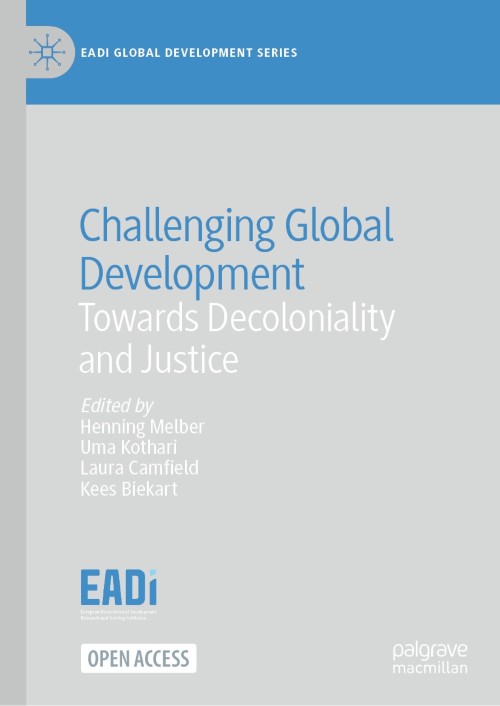
Challenging Global Development [electronic resource] : Towards Decoloniality and Justice / edited by Henning Melber, Uma Kothari, Laura Camfield, Kees Biekart.
Erişim Adresi
ISBN
9783031303081
Dil Kodu
İngilizce
Yer Numarası
DK/20232
Basım Bildirimi
1st ed. 2024.
Yayın Bilgisi
Cham : Springer Nature Switzerland : Imprint: Palgrave Macmillan, 2024.
Fiziksel Niteleme
XIII, 260 p. 8 illus., 7 illus. in color. online resource.
Dizi
EADI Global Development Series, 2947-8537
İçindekiler Notu
Chapter 1.Rethinking development and decolonising development studies -- Chapter 2. Essentialist approaches to global issues: the ontological limitations of development studies -- Chapter 3. Beyond the Sustainable Development Goals: Post-development Alternatives -- Chapter 4. In search of alternatives to development: learning from grounded initiatives -- Chapter 5. Why Is Development Elusive? Structural Adjustments of Africa in the Longue durée -- Chapter 6. Cultivating post-development: pluriversal transitions and radical spaces of engagement -- Chapter 7. Beyond Deconstruction and Toward Decoloniality: Pedagogy and Curriculum Design in SWANA & South Asia Studies in US Higher Education -- Chapter 8. Data collection versus knowledge theft: relational accountability and the research ethics of Indigenous knowledges -- Chapter 9. Assuming power in new forms: Learning to feel ‘with the other’ in decolonial research -- Chapter 10. Development and Post-development in a Time of Crisis -- Chapter 11. South-South Cooperation and Decoloniality -- Chapter 12. Decolonising Development Management: Epistemological Shifts and Practical actions -- Chapter 13. What is ‘development’, and can we ‘decolonise’ it? Some ontological and epistemological reflections -- Chapter 14. EADI Roundtable: Re-casting development studies in times of multiple crises.
Özet, vb.
This open access book presents contributions to decolonize development studies. It seeks to promote and sustain new forms of solidarity and conviviality that work towards achieving social justice.Recognising global poverty and inequalities as historic injustices, the book addresses how these can be challenged through teaching, research, and engagement in policy and practice, and the sorts of political barriers these might encounter. From a variety of perspectives and contexts, these chapters examine how decoloniality and solidarity can be developed, offering in-depth historical, theoretical, epistemological, and empirical analyses. Henning Melber is Extraordinary Professor at the Department of Political Sciences, University of Pretoria, and at the Centre for Gender and Africa Studies, University of the Free State in Bloemfontein, South Africa. Uma Kothari is Professor of Migration and Postcolonial Studies at the Global Development Institute, University of Manchester, UK. Laura Camfield is Professor of Development Research and Evaluation and Head of the School of International Development at the University of East Anglia (UEA), UK. Kees Biekart is Associate Professor of Political Sociology at the International Institute of Social Studies (ISS) of Erasmus University, the Netherlands.
Konu
Economic development.
Sociology.
Anthropology.
Political science.
Development Studies.
Sociology.
Anthropology.
Political Science.
Sociology.
Anthropology.
Political science.
Development Studies.
Sociology.
Anthropology.
Political Science.
Diğer Yazarlar
Kurum Adı

Eseri Alıntıla
Referansları kullanmadan önce gözden geçirmeniz ve varsa gerekli düzeltmeleri yapmanız önerilir.
Dijital Kaynak
MARC Görünümü
LEADER 06323nam a22007215i 4500
001 819024
003 TR_AnAIT
005 20260130175158
007 cr nn 008mamaa
008 231017s2024 sz | s |||| 0|eng d
020 |a9783031303081|9978-3-031-30308-1
024 7 |a10.1007/978-3-031-30308-1|2doi
041 |aeng
049 |aTürk Tarih Kurumu Kütüphanesi
050 4|aHD72-88
072 7|aGTF|2bicssc
072 7|aSOC042000|2bisacsh
072 7|aGTP|2thema
082 04|a338.9|223
090 |aDK/20232
245 10|aChallenging Global Development|h[electronic resource] :|bTowards Decoloniality and Justice /|cedited by Henning Melber, Uma Kothari, Laura Camfield, Kees Biekart.
250 |a1st ed. 2024.
264 1|aCham :|bSpringer Nature Switzerland :|bImprint: Palgrave Macmillan,|c2024.
300 |aXIII, 260 p. 8 illus., 7 illus. in color.|bonline resource.
336 |atext|btxt|2rdacontent
337 |acomputer|bc|2rdamedia
338 |aonline resource|bcr|2rdacarrier
341 0 |bTable of contents navigation|2onix
341 0 |bSingle logical reading order|2onix
341 0 |bShort alternative textual descriptions|2onix
341 0 |bUse of color is not sole means of conveying information|2onix
341 0 |bUse of high contrast between text and background color|2onix
341 0 |bNext / Previous structural navigation|2onix
341 0 |bAll non-decorative content supports reading without sight|2onix
347 |atext file|bPDF|2rda
490 1 |aEADI Global Development Series,|x2947-8537
505 0 |aChapter 1.Rethinking development and decolonising development studies -- Chapter 2. Essentialist approaches to global issues: the ontological limitations of development studies -- Chapter 3. Beyond the Sustainable Development Goals: Post-development Alternatives -- Chapter 4. In search of alternatives to development: learning from grounded initiatives -- Chapter 5. Why Is Development Elusive? Structural Adjustments of Africa in the Longue durée -- Chapter 6. Cultivating post-development: pluriversal transitions and radical spaces of engagement -- Chapter 7. Beyond Deconstruction and Toward Decoloniality: Pedagogy and Curriculum Design in SWANA & South Asia Studies in US Higher Education -- Chapter 8. Data collection versus knowledge theft: relational accountability and the research ethics of Indigenous knowledges -- Chapter 9. Assuming power in new forms: Learning to feel ‘with the other’ in decolonial research -- Chapter 10. Development and Post-development in a Time of Crisis -- Chapter 11. South-South Cooperation and Decoloniality -- Chapter 12. Decolonising Development Management: Epistemological Shifts and Practical actions -- Chapter 13. What is ‘development’, and can we ‘decolonise’ it? Some ontological and epistemological reflections -- Chapter 14. EADI Roundtable: Re-casting development studies in times of multiple crises.
506 0 |aOpen Access
520 |aThis open access book presents contributions to decolonize development studies. It seeks to promote and sustain new forms of solidarity and conviviality that work towards achieving social justice.Recognising global poverty and inequalities as historic injustices, the book addresses how these can be challenged through teaching, research, and engagement in policy and practice, and the sorts of political barriers these might encounter. From a variety of perspectives and contexts, these chapters examine how decoloniality and solidarity can be developed, offering in-depth historical, theoretical, epistemological, and empirical analyses. Henning Melber is Extraordinary Professor at the Department of Political Sciences, University of Pretoria, and at the Centre for Gender and Africa Studies, University of the Free State in Bloemfontein, South Africa. Uma Kothari is Professor of Migration and Postcolonial Studies at the Global Development Institute, University of Manchester, UK. Laura Camfield is Professor of Development Research and Evaluation and Head of the School of International Development at the University of East Anglia (UEA), UK. Kees Biekart is Associate Professor of Political Sociology at the International Institute of Social Studies (ISS) of Erasmus University, the Netherlands.
532 8 |aAccessibility summary: This PDF does not fully comply with PDF/UA standards, but does feature limited screen reader support, described non-text content (images, graphs), bookmarks for easy navigation and searchable, selectable text. Users of assistive technologies may experience difficulty navigating or interpreting content in this document. We recognize the importance of accessibility, and we welcome queries about accessibility for any of our products. If you have a question or an access need, please get in touch with us at accessibilitysupport@springernature.com.
532 8 |aNo reading system accessibility options actively disabled
532 8 |aPublisher contact for further accessibility information: accessibilitysupport@springernature.com
650 0|aEconomic development.
650 0|aSociology.
650 0|aAnthropology.
650 0|aPolitical science.
650 14|aDevelopment Studies.
650 24|aSociology.
650 24|aAnthropology.
650 24|aPolitical Science.
700 1 |aMelber, Henning.|eeditor.|4edt|4http://id.loc.gov/vocabulary/relators/edt
700 1 |aKothari, Uma.|eeditor.|4edt|4http://id.loc.gov/vocabulary/relators/edt
700 1 |aCamfield, Laura.|eeditor.|0(orcid)0000-0002-0165-9857|1https://orcid.org/0000-0002-0165-9857|4edt|4http://id.loc.gov/vocabulary/relators/edt
700 1 |aBiekart, Kees.|eeditor.|0(orcid)0000-0002-6429-5974|1https://orcid.org/0000-0002-6429-5974|4edt|4http://id.loc.gov/vocabulary/relators/edt
710 2 |aSpringerLink (Online service)
773 0 |tSpringer Nature eBook
776 08|iPrinted edition:|z9783031303074
776 08|iPrinted edition:|z9783031303098
776 08|iPrinted edition:|z9783031303104
830 0|aEADI Global Development Series,|x2947-8537
856 40|uhttps://doi.org/10.1007/978-3-031-30308-1
912 |aZDB-2-POS
912 |aZDB-2-SXPI
912 |aZDB-2-SOB
950 |aPolitical Science and International Studies (SpringerNature-41174)
950 |aPolitical Science and International Studies (R0) (SpringerNature-43724)
001 819024
003 TR_AnAIT
005 20260130175158
007 cr nn 008mamaa
008 231017s2024 sz | s |||| 0|eng d
020 |a9783031303081|9978-3-031-30308-1
024 7 |a10.1007/978-3-031-30308-1|2doi
041 |aeng
049 |aTürk Tarih Kurumu Kütüphanesi
050 4|aHD72-88
072 7|aGTF|2bicssc
072 7|aSOC042000|2bisacsh
072 7|aGTP|2thema
082 04|a338.9|223
090 |aDK/20232
245 10|aChallenging Global Development|h[electronic resource] :|bTowards Decoloniality and Justice /|cedited by Henning Melber, Uma Kothari, Laura Camfield, Kees Biekart.
250 |a1st ed. 2024.
264 1|aCham :|bSpringer Nature Switzerland :|bImprint: Palgrave Macmillan,|c2024.
300 |aXIII, 260 p. 8 illus., 7 illus. in color.|bonline resource.
336 |atext|btxt|2rdacontent
337 |acomputer|bc|2rdamedia
338 |aonline resource|bcr|2rdacarrier
341 0 |bTable of contents navigation|2onix
341 0 |bSingle logical reading order|2onix
341 0 |bShort alternative textual descriptions|2onix
341 0 |bUse of color is not sole means of conveying information|2onix
341 0 |bUse of high contrast between text and background color|2onix
341 0 |bNext / Previous structural navigation|2onix
341 0 |bAll non-decorative content supports reading without sight|2onix
347 |atext file|bPDF|2rda
490 1 |aEADI Global Development Series,|x2947-8537
505 0 |aChapter 1.Rethinking development and decolonising development studies -- Chapter 2. Essentialist approaches to global issues: the ontological limitations of development studies -- Chapter 3. Beyond the Sustainable Development Goals: Post-development Alternatives -- Chapter 4. In search of alternatives to development: learning from grounded initiatives -- Chapter 5. Why Is Development Elusive? Structural Adjustments of Africa in the Longue durée -- Chapter 6. Cultivating post-development: pluriversal transitions and radical spaces of engagement -- Chapter 7. Beyond Deconstruction and Toward Decoloniality: Pedagogy and Curriculum Design in SWANA & South Asia Studies in US Higher Education -- Chapter 8. Data collection versus knowledge theft: relational accountability and the research ethics of Indigenous knowledges -- Chapter 9. Assuming power in new forms: Learning to feel ‘with the other’ in decolonial research -- Chapter 10. Development and Post-development in a Time of Crisis -- Chapter 11. South-South Cooperation and Decoloniality -- Chapter 12. Decolonising Development Management: Epistemological Shifts and Practical actions -- Chapter 13. What is ‘development’, and can we ‘decolonise’ it? Some ontological and epistemological reflections -- Chapter 14. EADI Roundtable: Re-casting development studies in times of multiple crises.
506 0 |aOpen Access
520 |aThis open access book presents contributions to decolonize development studies. It seeks to promote and sustain new forms of solidarity and conviviality that work towards achieving social justice.Recognising global poverty and inequalities as historic injustices, the book addresses how these can be challenged through teaching, research, and engagement in policy and practice, and the sorts of political barriers these might encounter. From a variety of perspectives and contexts, these chapters examine how decoloniality and solidarity can be developed, offering in-depth historical, theoretical, epistemological, and empirical analyses. Henning Melber is Extraordinary Professor at the Department of Political Sciences, University of Pretoria, and at the Centre for Gender and Africa Studies, University of the Free State in Bloemfontein, South Africa. Uma Kothari is Professor of Migration and Postcolonial Studies at the Global Development Institute, University of Manchester, UK. Laura Camfield is Professor of Development Research and Evaluation and Head of the School of International Development at the University of East Anglia (UEA), UK. Kees Biekart is Associate Professor of Political Sociology at the International Institute of Social Studies (ISS) of Erasmus University, the Netherlands.
532 8 |aAccessibility summary: This PDF does not fully comply with PDF/UA standards, but does feature limited screen reader support, described non-text content (images, graphs), bookmarks for easy navigation and searchable, selectable text. Users of assistive technologies may experience difficulty navigating or interpreting content in this document. We recognize the importance of accessibility, and we welcome queries about accessibility for any of our products. If you have a question or an access need, please get in touch with us at accessibilitysupport@springernature.com.
532 8 |aNo reading system accessibility options actively disabled
532 8 |aPublisher contact for further accessibility information: accessibilitysupport@springernature.com
650 0|aEconomic development.
650 0|aSociology.
650 0|aAnthropology.
650 0|aPolitical science.
650 14|aDevelopment Studies.
650 24|aSociology.
650 24|aAnthropology.
650 24|aPolitical Science.
700 1 |aMelber, Henning.|eeditor.|4edt|4http://id.loc.gov/vocabulary/relators/edt
700 1 |aKothari, Uma.|eeditor.|4edt|4http://id.loc.gov/vocabulary/relators/edt
700 1 |aCamfield, Laura.|eeditor.|0(orcid)0000-0002-0165-9857|1https://orcid.org/0000-0002-0165-9857|4edt|4http://id.loc.gov/vocabulary/relators/edt
700 1 |aBiekart, Kees.|eeditor.|0(orcid)0000-0002-6429-5974|1https://orcid.org/0000-0002-6429-5974|4edt|4http://id.loc.gov/vocabulary/relators/edt
710 2 |aSpringerLink (Online service)
773 0 |tSpringer Nature eBook
776 08|iPrinted edition:|z9783031303074
776 08|iPrinted edition:|z9783031303098
776 08|iPrinted edition:|z9783031303104
830 0|aEADI Global Development Series,|x2947-8537
856 40|uhttps://doi.org/10.1007/978-3-031-30308-1
912 |aZDB-2-POS
912 |aZDB-2-SXPI
912 |aZDB-2-SOB
950 |aPolitical Science and International Studies (SpringerNature-41174)
950 |aPolitical Science and International Studies (R0) (SpringerNature-43724)
Materyaller
Depodan talep edilen materyal sadece kütüphane içerisinde kullanılmaktadır.
Materyal dışarıya ödünç verilmemektedir.
