

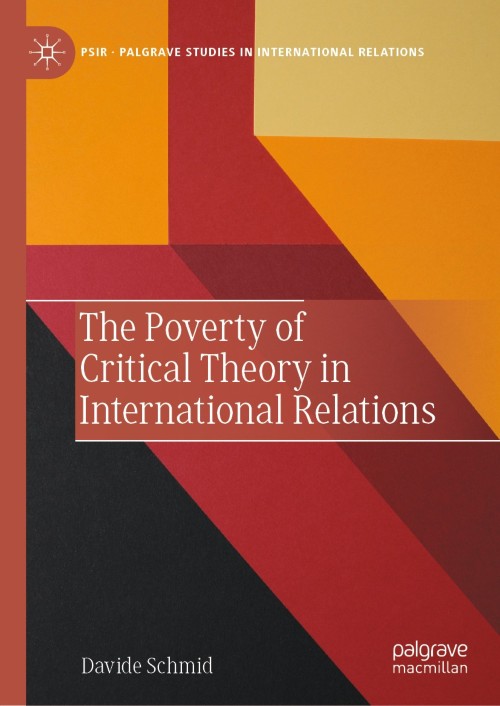
The Poverty of Critical Theory in International Relations [electronic resource] / by Davide Schmid.
Erişim Adresi
ISBN
9783031225871
Dil Kodu
İngilizce
Yer Numarası
DK/20305
Basım Bildirimi
1st ed. 2023.
Yayın Bilgisi
Cham : Springer International Publishing : Imprint: Palgrave Macmillan, 2023.
Fiziksel Niteleme
XI, 206 p. 1 illus. online resource.
Dizi
Palgrave Studies in International Relations, 2946-2681
İçindekiler Notu
Chapter 1: Introduction -- Chapter 2: The crisis of critique -- Chapter 3: Two Histories of the Frankfurt School- Chapter 4: The Habermasian Paradigm -- Chapter 5: Habermas and Cosmopolitan Democracy -- Chapter 6: Linklater and Critical International Relations Theory -- Chapter 7: The way ahead -- Chapter 8: Conclusion.
Özet, vb.
This book addresses the ‘crisis of critique’ of Frankfurt School Critical Theory in International Relations and puts forward a proposal for how it can be overcome. It starts from the premise that the present conjuncture, marked by capitalist crisis and a fracturing international order, urgently calls for critical perspectives capable of clarifying the state of global affairs and the emancipatory struggles within it. Critical Theory in International Relations should be well placed to provide answers to this demand, yet it finds itself today in a state of decline. Its prevailing form – that of a universalist cosmopolitan project – reflects a narrow Eurocentric perspective and the concerns of a time now past, while the Frankfurt School tradition as a whole struggles to develop new modes of analysis and new political imaginaries that are appropriate to the current historical situation. The book diagnoses this situation of intellectual and political crisis and seeks to trace a way out. It does so by providing a comprehensive account of the development of Critical Theory in International Relations and the ways in which it has applied Frankfurt School thought to the study of international politics. It then makes a provocative case as to the exhaustion of the cosmopolitan and Habermasian paradigm of critique that has guided Frankfurt School research on international politics for the past thirty years. Finally, it puts forward a proposal for the revitalisation of Critical Theory in IR through a renewed emphasis on the critique of political economy and sketches a research agenda which can make the tradition relevant again to contemporary political questions. Davide Schmid is a Senior Lecturer in Politics and International Relations at Manchester Metropolitan University, UK. His research sits at the intersection of Critical Theory and International Political Economy.
Konu
International relations.
International Relations Theory.
International Relations Theory.
Kurum Adı
Eseri Alıntıla
Referansları kullanmadan önce gözden geçirmeniz ve varsa gerekli düzeltmeleri yapmanız önerilir.
Dijital Kaynak
MARC Görünümü
LEADER 05161nam a22005775i 4500
001 819097
003 TR_AnAIT
005 20260130174929
007 cr nn 008mamaa
008 230131s2023 sz | s |||| 0|eng d
020 |a9783031225871|9978-3-031-22587-1
024 7 |a10.1007/978-3-031-22587-1|2doi
041 |aeng
049 |aTürk Tarih Kurumu Kütüphanesi
050 4|aJZ2-6530
072 7|aJPS|2bicssc
072 7|aPOL011000|2bisacsh
072 7|aJPS|2thema
082 04|a327.101|223
090 |aDK/20305
100 1 |aSchmid, Davide.|eauthor.|0(orcid)0000-0001-6931-505X|1https://orcid.org/0000-0001-6931-505X|4aut|4http://id.loc.gov/vocabulary/relators/aut
245 14|aThe Poverty of Critical Theory in International Relations|h[electronic resource] /|cby Davide Schmid.
250 |a1st ed. 2023.
264 1|aCham :|bSpringer International Publishing :|bImprint: Palgrave Macmillan,|c2023.
300 |aXI, 206 p. 1 illus.|bonline resource.
336 |atext|btxt|2rdacontent
337 |acomputer|bc|2rdamedia
338 |aonline resource|bcr|2rdacarrier
341 0 |bTable of contents navigation|2onix
341 0 |bSingle logical reading order|2onix
341 0 |bUse of color is not sole means of conveying information|2onix
341 0 |bUse of high contrast between text and background color|2onix
341 0 |bNext / Previous structural navigation|2onix
341 0 |bAll non-decorative content supports reading without sight|2onix
347 |atext file|bPDF|2rda
490 1 |aPalgrave Studies in International Relations,|x2946-2681
505 0 |aChapter 1: Introduction -- Chapter 2: The crisis of critique -- Chapter 3: Two Histories of the Frankfurt School- Chapter 4: The Habermasian Paradigm -- Chapter 5: Habermas and Cosmopolitan Democracy -- Chapter 6: Linklater and Critical International Relations Theory -- Chapter 7: The way ahead -- Chapter 8: Conclusion.
520 |aThis book addresses the ‘crisis of critique’ of Frankfurt School Critical Theory in International Relations and puts forward a proposal for how it can be overcome. It starts from the premise that the present conjuncture, marked by capitalist crisis and a fracturing international order, urgently calls for critical perspectives capable of clarifying the state of global affairs and the emancipatory struggles within it. Critical Theory in International Relations should be well placed to provide answers to this demand, yet it finds itself today in a state of decline. Its prevailing form – that of a universalist cosmopolitan project – reflects a narrow Eurocentric perspective and the concerns of a time now past, while the Frankfurt School tradition as a whole struggles to develop new modes of analysis and new political imaginaries that are appropriate to the current historical situation. The book diagnoses this situation of intellectual and political crisis and seeks to trace a way out. It does so by providing a comprehensive account of the development of Critical Theory in International Relations and the ways in which it has applied Frankfurt School thought to the study of international politics. It then makes a provocative case as to the exhaustion of the cosmopolitan and Habermasian paradigm of critique that has guided Frankfurt School research on international politics for the past thirty years. Finally, it puts forward a proposal for the revitalisation of Critical Theory in IR through a renewed emphasis on the critique of political economy and sketches a research agenda which can make the tradition relevant again to contemporary political questions. Davide Schmid is a Senior Lecturer in Politics and International Relations at Manchester Metropolitan University, UK. His research sits at the intersection of Critical Theory and International Political Economy.
532 8 |aAccessibility summary: This PDF does not fully comply with PDF/UA standards, but does feature limited screen reader support, bookmarks for easy navigation and searchable, selectable text. Users of assistive technologies may experience difficulty navigating or interpreting content in this document. We recognize the importance of accessibility, and we welcome queries about accessibility for any of our products. If you have a question or an access need, please get in touch with us at accessibilitysupport@springernature.com.
532 8 |aNo reading system accessibility options actively disabled
532 8 |aPublisher contact for further accessibility information: accessibilitysupport@springernature.com
650 0|aInternational relations.
650 14|aInternational Relations Theory.
710 2 |aSpringerLink (Online service)
773 0 |tSpringer Nature eBook
776 08|iPrinted edition:|z9783031225864
776 08|iPrinted edition:|z9783031225888
776 08|iPrinted edition:|z9783031225895
830 0|aPalgrave Studies in International Relations,|x2946-2681
856 40|uhttps://doi.org/10.1007/978-3-031-22587-1
912 |aZDB-2-POS
912 |aZDB-2-SXPI
950 |aPolitical Science and International Studies (SpringerNature-41174)
950 |aPolitical Science and International Studies (R0) (SpringerNature-43724)
001 819097
003 TR_AnAIT
005 20260130174929
007 cr nn 008mamaa
008 230131s2023 sz | s |||| 0|eng d
020 |a9783031225871|9978-3-031-22587-1
024 7 |a10.1007/978-3-031-22587-1|2doi
041 |aeng
049 |aTürk Tarih Kurumu Kütüphanesi
050 4|aJZ2-6530
072 7|aJPS|2bicssc
072 7|aPOL011000|2bisacsh
072 7|aJPS|2thema
082 04|a327.101|223
090 |aDK/20305
100 1 |aSchmid, Davide.|eauthor.|0(orcid)0000-0001-6931-505X|1https://orcid.org/0000-0001-6931-505X|4aut|4http://id.loc.gov/vocabulary/relators/aut
245 14|aThe Poverty of Critical Theory in International Relations|h[electronic resource] /|cby Davide Schmid.
250 |a1st ed. 2023.
264 1|aCham :|bSpringer International Publishing :|bImprint: Palgrave Macmillan,|c2023.
300 |aXI, 206 p. 1 illus.|bonline resource.
336 |atext|btxt|2rdacontent
337 |acomputer|bc|2rdamedia
338 |aonline resource|bcr|2rdacarrier
341 0 |bTable of contents navigation|2onix
341 0 |bSingle logical reading order|2onix
341 0 |bUse of color is not sole means of conveying information|2onix
341 0 |bUse of high contrast between text and background color|2onix
341 0 |bNext / Previous structural navigation|2onix
341 0 |bAll non-decorative content supports reading without sight|2onix
347 |atext file|bPDF|2rda
490 1 |aPalgrave Studies in International Relations,|x2946-2681
505 0 |aChapter 1: Introduction -- Chapter 2: The crisis of critique -- Chapter 3: Two Histories of the Frankfurt School- Chapter 4: The Habermasian Paradigm -- Chapter 5: Habermas and Cosmopolitan Democracy -- Chapter 6: Linklater and Critical International Relations Theory -- Chapter 7: The way ahead -- Chapter 8: Conclusion.
520 |aThis book addresses the ‘crisis of critique’ of Frankfurt School Critical Theory in International Relations and puts forward a proposal for how it can be overcome. It starts from the premise that the present conjuncture, marked by capitalist crisis and a fracturing international order, urgently calls for critical perspectives capable of clarifying the state of global affairs and the emancipatory struggles within it. Critical Theory in International Relations should be well placed to provide answers to this demand, yet it finds itself today in a state of decline. Its prevailing form – that of a universalist cosmopolitan project – reflects a narrow Eurocentric perspective and the concerns of a time now past, while the Frankfurt School tradition as a whole struggles to develop new modes of analysis and new political imaginaries that are appropriate to the current historical situation. The book diagnoses this situation of intellectual and political crisis and seeks to trace a way out. It does so by providing a comprehensive account of the development of Critical Theory in International Relations and the ways in which it has applied Frankfurt School thought to the study of international politics. It then makes a provocative case as to the exhaustion of the cosmopolitan and Habermasian paradigm of critique that has guided Frankfurt School research on international politics for the past thirty years. Finally, it puts forward a proposal for the revitalisation of Critical Theory in IR through a renewed emphasis on the critique of political economy and sketches a research agenda which can make the tradition relevant again to contemporary political questions. Davide Schmid is a Senior Lecturer in Politics and International Relations at Manchester Metropolitan University, UK. His research sits at the intersection of Critical Theory and International Political Economy.
532 8 |aAccessibility summary: This PDF does not fully comply with PDF/UA standards, but does feature limited screen reader support, bookmarks for easy navigation and searchable, selectable text. Users of assistive technologies may experience difficulty navigating or interpreting content in this document. We recognize the importance of accessibility, and we welcome queries about accessibility for any of our products. If you have a question or an access need, please get in touch with us at accessibilitysupport@springernature.com.
532 8 |aNo reading system accessibility options actively disabled
532 8 |aPublisher contact for further accessibility information: accessibilitysupport@springernature.com
650 0|aInternational relations.
650 14|aInternational Relations Theory.
710 2 |aSpringerLink (Online service)
773 0 |tSpringer Nature eBook
776 08|iPrinted edition:|z9783031225864
776 08|iPrinted edition:|z9783031225888
776 08|iPrinted edition:|z9783031225895
830 0|aPalgrave Studies in International Relations,|x2946-2681
856 40|uhttps://doi.org/10.1007/978-3-031-22587-1
912 |aZDB-2-POS
912 |aZDB-2-SXPI
950 |aPolitical Science and International Studies (SpringerNature-41174)
950 |aPolitical Science and International Studies (R0) (SpringerNature-43724)
Materyaller
Depodan talep edilen materyal sadece kütüphane içerisinde kullanılmaktadır.
Materyal dışarıya ödünç verilmemektedir.
Materyal dışarıya ödünç verilmemektedir.
