LEADER 03861nam a22005055i 4500
001 819170
003 TR_AnAIT
005 20260130174732
007 cr nn 008mamaa
008 201113s2021 sz | s |||| 0|eng d
020 |a9783030601119|9978-3-030-60111-9
024 7 |a10.1007/978-3-030-60111-9|2doi
041 |aeng
049 |aTürk Tarih Kurumu Kütüphanesi
050 4|aJZ2-6530
072 7|aJPS|2bicssc
072 7|aPOL011000|2bisacsh
072 7|aJPS|2thema
082 04|a327.101|223
090 |aDK/20378
100 1 |aMurphy, Michael P. A.|eauthor.|0(orcid)0000-0002-9523-4402|1https://orcid.org/0000-0002-9523-4402|4aut|4http://id.loc.gov/vocabulary/relators/aut
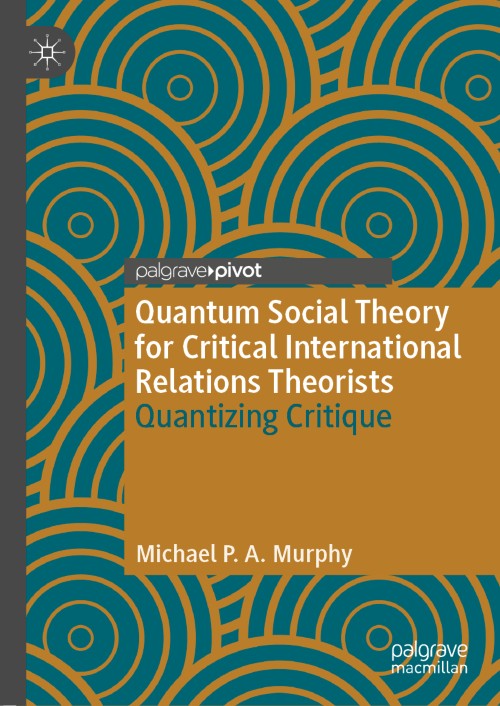
245 10|aQuantum Social Theory for Critical International Relations Theorists|h[electronic resource] :|bQuantizing Critique /|cby Michael P. A. Murphy.
250 |a1st ed. 2021.
264 1|aCham :|bSpringer International Publishing :|bImprint: Palgrave Macmillan,|c2021.
300 |aVIII, 110 p. 1 illus.|bonline resource.
336 |atext|btxt|2rdacontent
337 |acomputer|bc|2rdamedia
338 |aonline resource|bcr|2rdacarrier
347 |atext file|bPDF|2rda
490 1 |aPalgrave Studies in International Relations,|x2946-2681
505 0 |aChapter 1. Introduction: Uncertainty, Paradoxes, and Critical Intuition -- Part 1: From the Laboratory to the Social World -- Chapter 2 – Quantum Mechanics for Social Scientists: Wave/Particle Duality, Observer Effect, Entanglement -- Chapter 3 – Analogy or Actuality? How Social Scientists Are Taking the Quantum Leap -- Part 2: Quantizing Critique through Translation and Application -- Chapter 4. Translating on Common Ground: Borders, Autoethnography, Assemblages -- Chapter 5. Applying a Quantum Imaginary: The Example of “Quactor”-Network Theory -- Chapter 6. Concluding Thoughts and Future Directions.
520 |aThis book examines the crossroads of quantum and critical approaches to International Relations and argues that these approaches share a common project of uncovering complexity and uncertainty. The “quantum turn” in International Relations theory has produced a number of interesting insights into the complex ways in which our assumptions about the physics of the world around us can limit our understanding of social life. While critique is possible within a Newtonian social science, core assumptions of separability and determinism of classical physics impose limits on what is imaginable. The author argues that by adopting a quantum imaginary, social theory can move beyond its Newtonian limits, and explore two methods for quantizing conceptual models—translation and application. This book is the first introductory book to quantum social theory ideas specifically intended for an audience of critical International Relations. Michael P. A. Murphy is a SSHRC Doctoral Fellow in International Relations and Political Theory at the University of Ottawa, Canada. He has published over a dozen peer-reviewed articles in journals such as Contemporary Security Policy, International Relations, the Journal of International Political Theory, and Critical Studies on Security.
650 0|aInternational relations.
650 0|aPolitical science.
650 0|aSocial sciences|xPhilosophy.
650 14|aInternational Relations Theory.
650 24|aPolitical Theory.
650 24|aSocial Theory.
710 2 |aSpringerLink (Online service)
773 0 |tSpringer Nature eBook
776 08|iPrinted edition:|z9783030601102
776 08|iPrinted edition:|z9783030601126
830 0|aPalgrave Studies in International Relations,|x2946-2681
856 40|uhttps://doi.org/10.1007/978-3-030-60111-9
912 |aZDB-2-POS
912 |aZDB-2-SXPI
950 |aPolitical Science and International Studies (SpringerNature-41174)
950 |aPolitical Science and International Studies (R0) (SpringerNature-43724)