

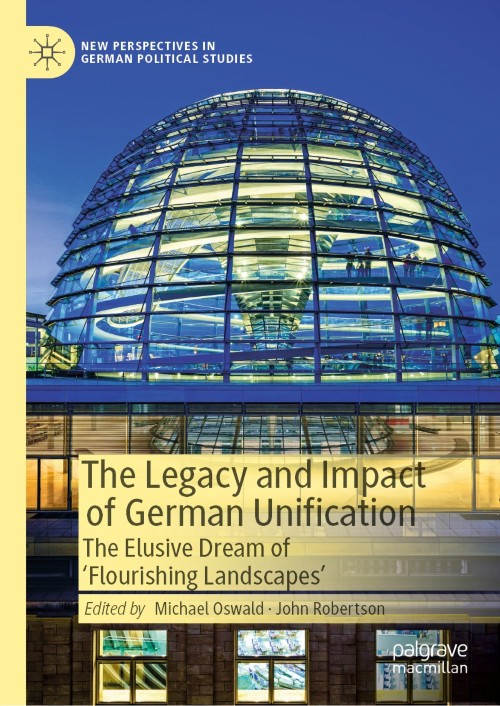
The Legacy and Impact of German Unification [electronic resource] : The Elusive Dream of 'Flourishing Landscapes' / edited by Michael Oswald, John Robertson.
Erişim Adresi
ISBN
9783030971540
Dil Kodu
İngilizce
Yer Numarası
DK/20388
Basım Bildirimi
1st ed. 2022.
Yayın Bilgisi
Cham : Springer International Publishing : Imprint: Palgrave Macmillan, 2022.
Fiziksel Niteleme
XXII, 403 p. 20 illus., 1 illus. in color. online resource.
Dizi
New Perspectives in German Political Studies, 2947-6755
İçindekiler Notu
Chapter 1: Three Decades of “Flourishing Landscapes”: An Introduction to German Unification and the Challenge of Managing Its Legacy into the Next Decade -- Chapter 2: Continuity and Change in the Office of German Chancellor -- Chapter 3: The German Party System Since 1990: From Incorporation to Fragmentation -- Chapter 4: The Resurgence and Decline of the Social Democratic Party in the Berlin Republic (1990–2020) -- Chapter 5: Fighting Against the Decline. Concepts of Modernization of the Conservative "Volksparteien" in Germany -- Chapter 6: Post-Communism in a United Germany: Die Linke -- Chapter 7: Alliance 90/The Greens: A Left Party with A Centrist Appeal in Coalition Politics -- Chapter 8: The Right-Wing Populist Disruption in the Berlin Republic. Opportunity Structures and Success of the Alternative for Germany (AfD) -- Chapter 9: The Reluctant Modernizer: Gender Equality in Unified Germany -- Chapter 10: The Götterdämmerung of the Nation Brand: German Identity after 30 years of Unification -- Chapter 11: “Germany is a Disaster Now“: US Perspectives on the Berlin Republic Over the Course of Time -- Chapter 12: The Changing Faces of Germany’s Social Market Economy -- Chapter 13: European Divergences: Germany, France and Italy in Global Economic Governance -- Chapter 14: France, Germany and European Security: Building Castles in the Sky? -- Chapter 15: Frozen in Trump’s headlights – Germany’s astounding foreign policy of obstinacy.
Özet, vb.
On October 3, 1990 the future of both Europe and Germany became powerfully and inexorably intertwined across a politically broadened continent powering transformative social, political and economic interactions. The thirty year mark after the then reigning chancellor Helmut Kohl promised 'flourishing landscapes' in the former GDR is more than just a new anniversary from which mandatory reflections must follow. Arguably, it represents a temporal boundary between the adjustments and reactions conditioned and captivated by a sense of something new and uncertain, and that point moving forward from which unification’s legacy inescapably tethers Germany’s future to normal politics shaped by the issues of the moment, and not politics gripped by the debates of unification itself. That legacy is defined by an accumulation over thirty years of adjustments, mutations, counter-adjustments and strategic reactions which have now delivered through the many ripples of change a Germany managing the course-trajectory which unification has relentlessly plotted. The foreseeable future will certainly see that legacy of unification tenaciously continue to project yet shrouded within the background of Germany’s routine politics. This volume explores that legacy within the post-unification era and reflects on the way forward into a near-term German future no longer consumed with unification itself but with the reality of politics it has steadily defined. Michael Oswald is Assistant Professor of Political Science at the University of Passau, Germany, Research Associate at the John F. Kennedy Institute, Free University of Berlin, Germany, Faculty at the Institute of European and International Studies (CIFE), France, and the author of The Palgrave Handbook of Populism (2021). John Robertson is Professor of Political Science at Texas A&M University, USA. He is the author and co-author of numerous articles dealing with European affairs andcomparative politics published in leading political science journals, including the American Political Science Review, American Journal of Political Science, Journal of Politics, Comparative Politics, German Politics, International Political Science Review, and International Studies Quarterly.
Konu
Europe __ Politics and government.
Political sociology.
World politics.
Political science.
European Politics.
Political Sociology.
Political History.
Governance and Government.
Political sociology.
World politics.
Political science.
European Politics.
Political Sociology.
Political History.
Governance and Government.
Diğer Yazarlar
Kurum Adı
Eseri Alıntıla
Referansları kullanmadan önce gözden geçirmeniz ve varsa gerekli düzeltmeleri yapmanız önerilir.
Dijital Kaynak
MARC Görünümü
LEADER 05893nam a22005655i 4500
001 819180
003 TR_AnAIT
005 20260130174713
007 cr nn 008mamaa
008 220517s2022 sz | s |||| 0|eng d
020 |a9783030971540|9978-3-030-97154-0
024 7 |a10.1007/978-3-030-97154-0|2doi
041 |aeng
049 |aTürk Tarih Kurumu Kütüphanesi
050 4|aJN1-9692.2
072 7|aJP|2bicssc
072 7|a1D|2bicssc
072 7|aPOL058000|2bisacsh
072 7|aJP|x1D|2thema
082 04|a320.94|223
090 |aDK/20388
245 14|aThe Legacy and Impact of German Unification|h[electronic resource] :|bThe Elusive Dream of 'Flourishing Landscapes' /|cedited by Michael Oswald, John Robertson.
250 |a1st ed. 2022.
264 1|aCham :|bSpringer International Publishing :|bImprint: Palgrave Macmillan,|c2022.
300 |aXXII, 403 p. 20 illus., 1 illus. in color.|bonline resource.
336 |atext|btxt|2rdacontent
337 |acomputer|bc|2rdamedia
338 |aonline resource|bcr|2rdacarrier
347 |atext file|bPDF|2rda
490 1 |aNew Perspectives in German Political Studies,|x2947-6755
505 0 |aChapter 1: Three Decades of “Flourishing Landscapes”: An Introduction to German Unification and the Challenge of Managing Its Legacy into the Next Decade -- Chapter 2: Continuity and Change in the Office of German Chancellor -- Chapter 3: The German Party System Since 1990: From Incorporation to Fragmentation -- Chapter 4: The Resurgence and Decline of the Social Democratic Party in the Berlin Republic (1990–2020) -- Chapter 5: Fighting Against the Decline. Concepts of Modernization of the Conservative "Volksparteien" in Germany -- Chapter 6: Post-Communism in a United Germany: Die Linke -- Chapter 7: Alliance 90/The Greens: A Left Party with A Centrist Appeal in Coalition Politics -- Chapter 8: The Right-Wing Populist Disruption in the Berlin Republic. Opportunity Structures and Success of the Alternative for Germany (AfD) -- Chapter 9: The Reluctant Modernizer: Gender Equality in Unified Germany -- Chapter 10: The Götterdämmerung of the Nation Brand: German Identity after 30 years of Unification -- Chapter 11: “Germany is a Disaster Now“: US Perspectives on the Berlin Republic Over the Course of Time -- Chapter 12: The Changing Faces of Germany’s Social Market Economy -- Chapter 13: European Divergences: Germany, France and Italy in Global Economic Governance -- Chapter 14: France, Germany and European Security: Building Castles in the Sky? -- Chapter 15: Frozen in Trump’s headlights – Germany’s astounding foreign policy of obstinacy.
520 |aOn October 3, 1990 the future of both Europe and Germany became powerfully and inexorably intertwined across a politically broadened continent powering transformative social, political and economic interactions. The thirty year mark after the then reigning chancellor Helmut Kohl promised 'flourishing landscapes' in the former GDR is more than just a new anniversary from which mandatory reflections must follow. Arguably, it represents a temporal boundary between the adjustments and reactions conditioned and captivated by a sense of something new and uncertain, and that point moving forward from which unification’s legacy inescapably tethers Germany’s future to normal politics shaped by the issues of the moment, and not politics gripped by the debates of unification itself. That legacy is defined by an accumulation over thirty years of adjustments, mutations, counter-adjustments and strategic reactions which have now delivered through the many ripples of change a Germany managing the course-trajectory which unification has relentlessly plotted. The foreseeable future will certainly see that legacy of unification tenaciously continue to project yet shrouded within the background of Germany’s routine politics. This volume explores that legacy within the post-unification era and reflects on the way forward into a near-term German future no longer consumed with unification itself but with the reality of politics it has steadily defined. Michael Oswald is Assistant Professor of Political Science at the University of Passau, Germany, Research Associate at the John F. Kennedy Institute, Free University of Berlin, Germany, Faculty at the Institute of European and International Studies (CIFE), France, and the author of The Palgrave Handbook of Populism (2021). John Robertson is Professor of Political Science at Texas A&M University, USA. He is the author and co-author of numerous articles dealing with European affairs andcomparative politics published in leading political science journals, including the American Political Science Review, American Journal of Political Science, Journal of Politics, Comparative Politics, German Politics, International Political Science Review, and International Studies Quarterly.
650 0|aEurope|xPolitics and government.
650 0|aPolitical sociology.
650 0|aWorld politics.
650 0|aPolitical science.
650 14|aEuropean Politics.
650 24|aPolitical Sociology.
650 24|aPolitical History.
650 24|aGovernance and Government.
700 1 |aOswald, Michael.|eeditor.|4edt|4http://id.loc.gov/vocabulary/relators/edt
700 1 |aRobertson, John.|eeditor.|4edt|4http://id.loc.gov/vocabulary/relators/edt
710 2 |aSpringerLink (Online service)
773 0 |tSpringer Nature eBook
776 08|iPrinted edition:|z9783030971533
776 08|iPrinted edition:|z9783030971557
776 08|iPrinted edition:|z9783030971564
830 0|aNew Perspectives in German Political Studies,|x2947-6755
856 40|uhttps://doi.org/10.1007/978-3-030-97154-0
912 |aZDB-2-POS
912 |aZDB-2-SXPI
950 |aPolitical Science and International Studies (SpringerNature-41174)
950 |aPolitical Science and International Studies (R0) (SpringerNature-43724)
001 819180
003 TR_AnAIT
005 20260130174713
007 cr nn 008mamaa
008 220517s2022 sz | s |||| 0|eng d
020 |a9783030971540|9978-3-030-97154-0
024 7 |a10.1007/978-3-030-97154-0|2doi
041 |aeng
049 |aTürk Tarih Kurumu Kütüphanesi
050 4|aJN1-9692.2
072 7|aJP|2bicssc
072 7|a1D|2bicssc
072 7|aPOL058000|2bisacsh
072 7|aJP|x1D|2thema
082 04|a320.94|223
090 |aDK/20388
245 14|aThe Legacy and Impact of German Unification|h[electronic resource] :|bThe Elusive Dream of 'Flourishing Landscapes' /|cedited by Michael Oswald, John Robertson.
250 |a1st ed. 2022.
264 1|aCham :|bSpringer International Publishing :|bImprint: Palgrave Macmillan,|c2022.
300 |aXXII, 403 p. 20 illus., 1 illus. in color.|bonline resource.
336 |atext|btxt|2rdacontent
337 |acomputer|bc|2rdamedia
338 |aonline resource|bcr|2rdacarrier
347 |atext file|bPDF|2rda
490 1 |aNew Perspectives in German Political Studies,|x2947-6755
505 0 |aChapter 1: Three Decades of “Flourishing Landscapes”: An Introduction to German Unification and the Challenge of Managing Its Legacy into the Next Decade -- Chapter 2: Continuity and Change in the Office of German Chancellor -- Chapter 3: The German Party System Since 1990: From Incorporation to Fragmentation -- Chapter 4: The Resurgence and Decline of the Social Democratic Party in the Berlin Republic (1990–2020) -- Chapter 5: Fighting Against the Decline. Concepts of Modernization of the Conservative "Volksparteien" in Germany -- Chapter 6: Post-Communism in a United Germany: Die Linke -- Chapter 7: Alliance 90/The Greens: A Left Party with A Centrist Appeal in Coalition Politics -- Chapter 8: The Right-Wing Populist Disruption in the Berlin Republic. Opportunity Structures and Success of the Alternative for Germany (AfD) -- Chapter 9: The Reluctant Modernizer: Gender Equality in Unified Germany -- Chapter 10: The Götterdämmerung of the Nation Brand: German Identity after 30 years of Unification -- Chapter 11: “Germany is a Disaster Now“: US Perspectives on the Berlin Republic Over the Course of Time -- Chapter 12: The Changing Faces of Germany’s Social Market Economy -- Chapter 13: European Divergences: Germany, France and Italy in Global Economic Governance -- Chapter 14: France, Germany and European Security: Building Castles in the Sky? -- Chapter 15: Frozen in Trump’s headlights – Germany’s astounding foreign policy of obstinacy.
520 |aOn October 3, 1990 the future of both Europe and Germany became powerfully and inexorably intertwined across a politically broadened continent powering transformative social, political and economic interactions. The thirty year mark after the then reigning chancellor Helmut Kohl promised 'flourishing landscapes' in the former GDR is more than just a new anniversary from which mandatory reflections must follow. Arguably, it represents a temporal boundary between the adjustments and reactions conditioned and captivated by a sense of something new and uncertain, and that point moving forward from which unification’s legacy inescapably tethers Germany’s future to normal politics shaped by the issues of the moment, and not politics gripped by the debates of unification itself. That legacy is defined by an accumulation over thirty years of adjustments, mutations, counter-adjustments and strategic reactions which have now delivered through the many ripples of change a Germany managing the course-trajectory which unification has relentlessly plotted. The foreseeable future will certainly see that legacy of unification tenaciously continue to project yet shrouded within the background of Germany’s routine politics. This volume explores that legacy within the post-unification era and reflects on the way forward into a near-term German future no longer consumed with unification itself but with the reality of politics it has steadily defined. Michael Oswald is Assistant Professor of Political Science at the University of Passau, Germany, Research Associate at the John F. Kennedy Institute, Free University of Berlin, Germany, Faculty at the Institute of European and International Studies (CIFE), France, and the author of The Palgrave Handbook of Populism (2021). John Robertson is Professor of Political Science at Texas A&M University, USA. He is the author and co-author of numerous articles dealing with European affairs andcomparative politics published in leading political science journals, including the American Political Science Review, American Journal of Political Science, Journal of Politics, Comparative Politics, German Politics, International Political Science Review, and International Studies Quarterly.
650 0|aEurope|xPolitics and government.
650 0|aPolitical sociology.
650 0|aWorld politics.
650 0|aPolitical science.
650 14|aEuropean Politics.
650 24|aPolitical Sociology.
650 24|aPolitical History.
650 24|aGovernance and Government.
700 1 |aOswald, Michael.|eeditor.|4edt|4http://id.loc.gov/vocabulary/relators/edt
700 1 |aRobertson, John.|eeditor.|4edt|4http://id.loc.gov/vocabulary/relators/edt
710 2 |aSpringerLink (Online service)
773 0 |tSpringer Nature eBook
776 08|iPrinted edition:|z9783030971533
776 08|iPrinted edition:|z9783030971557
776 08|iPrinted edition:|z9783030971564
830 0|aNew Perspectives in German Political Studies,|x2947-6755
856 40|uhttps://doi.org/10.1007/978-3-030-97154-0
912 |aZDB-2-POS
912 |aZDB-2-SXPI
950 |aPolitical Science and International Studies (SpringerNature-41174)
950 |aPolitical Science and International Studies (R0) (SpringerNature-43724)
Materyaller
Depodan talep edilen materyal sadece kütüphane içerisinde kullanılmaktadır.
Materyal dışarıya ödünç verilmemektedir.
Materyal dışarıya ödünç verilmemektedir.
