

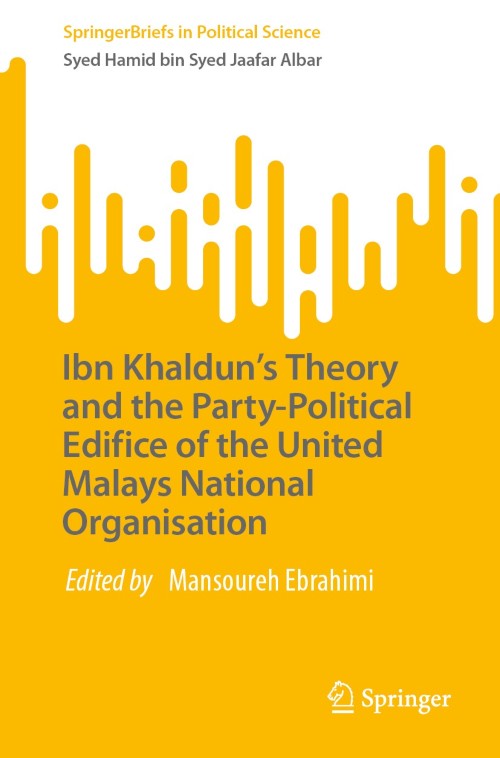
Ibn Khaldun’s Theory and the Party-Political Edifice of the United Malays National Organisation [electronic resource] / by Syed Hamid bin Syed Jaafar Albar.
Erişim Adresi
ISBN
9789811973888
Dil Kodu
İngilizce
Yer Numarası
DK/20396
Basım Bildirimi
1st ed. 2023.
Yayın Bilgisi
Singapore : Springer Nature Singapore : Imprint: Springer, 2023.
Fiziksel Niteleme
XIV, 96 p. 6 illus., 3 illus. in color. online resource.
Dizi
SpringerBriefs in Political Science, 2191-5474
İçindekiler Notu
UMNO A Malay-Ethnic Based Political Party -- Ibn Khaldun’s Socio-Political Condition and Theory of asabiyyah and umran -- Rise of UMNO in Malaysian Politics.
Özet, vb.
This concise book examines the decline and erosion of UMNO as a dominant political party of Malaysia through the perspective of Ibn Khaldun's theory of asabiyyah and umran. It uses the qualitative method of data collection from Ibn Khaldun's original works. After discussing Ibn Khaldun's theory of asabiyyah and umran, UMNOs umranic contributions and erosion of Malay asabiyyah are discussed in detail. The research outlines how asabiyyah led to UMNOs rise to prominence, gain of political power, bringing of progress and development of Malaysia to an umranic stage before it started to decline and erode in concordance with the five stages of Ibn Khaldun's theory of rise and fall of civilizations. This book highlights that early leaders of UMNO played significant role in fostering group feeling and solidarity of the Malays (asabiyyah). Asabiyyah was the engine that propelled UMNO to transform the Malays and Malaysia to an umranic society. In conclusion, the later leaders of UMNO contributedto weakening of the Malay asabiyyah and the fall of UMNO from power in the 14th General Elections in 2018. The process of UMNOs decline and erosion of political power is primarily caused by the leaders’ failures and shortcomings. The author, a Malaysian lawyer and long-standing Minister in the Prime Minister's Department, Minister of Justice, Minister of Defence, Minister of Foreign Affairs, and Minister of Home Affairs in the Barisan Nasional in Malaysia, concludes with the recommendation that for UMNO to be relevant again in the current political landscape, it must initiate new and serious approaches and initiatives to change itself and must focus on good governance and rule of law in a multi-ethnic Malaysian society. Relevant to scholars and practitioners in political science, sociology, and Islamic studies, this book is a landmark commentary on contemporary Malaysian politics, drawing from the author's own experience as a member of parliament in his various ministerial positions over three decades.
Konu
Asia __ Politics and government.
Islam __ Study and teaching.
Islam and the social sciences.
Islamic sociology.
Religion and politics.
Social sciences.
Asian Politics.
Islamic Studies.
Social Scientific Studies of Islam.
Politics and Religion.
Society.
Islam __ Study and teaching.
Islam and the social sciences.
Islamic sociology.
Religion and politics.
Social sciences.
Asian Politics.
Islamic Studies.
Social Scientific Studies of Islam.
Politics and Religion.
Society.
Kurum Adı
Eseri Alıntıla
Referansları kullanmadan önce gözden geçirmeniz ve varsa gerekli düzeltmeleri yapmanız önerilir.
Dijital Kaynak
MARC Görünümü
LEADER 05545nam a22006975i 4500
001 819188
003 TR_AnAIT
005 20260130174657
007 cr nn 008mamaa
008 230725s2023 si | s |||| 0|eng d
020 |a9789811973888|9978-981-19-7388-8
024 7 |a10.1007/978-981-19-7388-8|2doi
041 |aeng
049 |aTürk Tarih Kurumu Kütüphanesi
050 4|aJQ1-1852
072 7|aJP|2bicssc
072 7|a1F|2bicssc
072 7|aPOL054000|2bisacsh
072 7|aJP|x1F|2thema
082 04|a320.95|223
090 |aDK/20396
100 1 |abin Syed Jaafar Albar, Syed Hamid.|eauthor.|4aut|4http://id.loc.gov/vocabulary/relators/aut
245 10|aIbn Khaldun’s Theory and the Party-Political Edifice of the United Malays National Organisation|h[electronic resource] /|cby Syed Hamid bin Syed Jaafar Albar.
250 |a1st ed. 2023.
264 1|aSingapore :|bSpringer Nature Singapore :|bImprint: Springer,|c2023.
300 |aXIV, 96 p. 6 illus., 3 illus. in color.|bonline resource.
336 |atext|btxt|2rdacontent
337 |acomputer|bc|2rdamedia
338 |aonline resource|bcr|2rdacarrier
341 0 |bTable of contents navigation|2onix
341 0 |bSingle logical reading order|2onix
341 0 |bShort alternative textual descriptions|2onix
341 0 |bUse of color is not sole means of conveying information|2onix
341 0 |bUse of high contrast between text and background color|2onix
341 0 |bNext / Previous structural navigation|2onix
341 0 |bAll non-decorative content supports reading without sight|2onix
347 |atext file|bPDF|2rda
490 1 |aSpringerBriefs in Political Science,|x2191-5474
505 0 |aUMNO A Malay-Ethnic Based Political Party -- Ibn Khaldun’s Socio-Political Condition and Theory of asabiyyah and umran -- Rise of UMNO in Malaysian Politics.
520 |aThis concise book examines the decline and erosion of UMNO as a dominant political party of Malaysia through the perspective of Ibn Khaldun's theory of asabiyyah and umran. It uses the qualitative method of data collection from Ibn Khaldun's original works. After discussing Ibn Khaldun's theory of asabiyyah and umran, UMNOs umranic contributions and erosion of Malay asabiyyah are discussed in detail. The research outlines how asabiyyah led to UMNOs rise to prominence, gain of political power, bringing of progress and development of Malaysia to an umranic stage before it started to decline and erode in concordance with the five stages of Ibn Khaldun's theory of rise and fall of civilizations. This book highlights that early leaders of UMNO played significant role in fostering group feeling and solidarity of the Malays (asabiyyah). Asabiyyah was the engine that propelled UMNO to transform the Malays and Malaysia to an umranic society. In conclusion, the later leaders of UMNO contributedto weakening of the Malay asabiyyah and the fall of UMNO from power in the 14th General Elections in 2018. The process of UMNOs decline and erosion of political power is primarily caused by the leaders’ failures and shortcomings. The author, a Malaysian lawyer and long-standing Minister in the Prime Minister's Department, Minister of Justice, Minister of Defence, Minister of Foreign Affairs, and Minister of Home Affairs in the Barisan Nasional in Malaysia, concludes with the recommendation that for UMNO to be relevant again in the current political landscape, it must initiate new and serious approaches and initiatives to change itself and must focus on good governance and rule of law in a multi-ethnic Malaysian society. Relevant to scholars and practitioners in political science, sociology, and Islamic studies, this book is a landmark commentary on contemporary Malaysian politics, drawing from the author's own experience as a member of parliament in his various ministerial positions over three decades.
532 8 |aAccessibility summary: This PDF does not fully comply with PDF/UA standards, but does feature limited screen reader support, described non-text content (images, graphs), bookmarks for easy navigation and searchable, selectable text. Users of assistive technologies may experience difficulty navigating or interpreting content in this document. We recognize the importance of accessibility, and we welcome queries about accessibility for any of our products. If you have a question or an access need, please get in touch with us at accessibilitysupport@springernature.com.
532 8 |aNo reading system accessibility options actively disabled
532 8 |aPublisher contact for further accessibility information: accessibilitysupport@springernature.com
650 0|aAsia|xPolitics and government.
650 0|aIslam|xStudy and teaching.
650 0|aIslam and the social sciences.
650 0|aIslamic sociology.
650 0|aReligion and politics.
650 0|aSocial sciences.
650 14|aAsian Politics.
650 24|aIslamic Studies.
650 24|aSocial Scientific Studies of Islam.
650 24|aPolitics and Religion.
650 24|aSociety.
710 2 |aSpringerLink (Online service)
773 0 |tSpringer Nature eBook
776 08|iPrinted edition:|z9789811973871
776 08|iPrinted edition:|z9789811973895
830 0|aSpringerBriefs in Political Science,|x2191-5474
856 40|uhttps://doi.org/10.1007/978-981-19-7388-8
912 |aZDB-2-POS
912 |aZDB-2-SXPI
950 |aPolitical Science and International Studies (SpringerNature-41174)
950 |aPolitical Science and International Studies (R0) (SpringerNature-43724)
001 819188
003 TR_AnAIT
005 20260130174657
007 cr nn 008mamaa
008 230725s2023 si | s |||| 0|eng d
020 |a9789811973888|9978-981-19-7388-8
024 7 |a10.1007/978-981-19-7388-8|2doi
041 |aeng
049 |aTürk Tarih Kurumu Kütüphanesi
050 4|aJQ1-1852
072 7|aJP|2bicssc
072 7|a1F|2bicssc
072 7|aPOL054000|2bisacsh
072 7|aJP|x1F|2thema
082 04|a320.95|223
090 |aDK/20396
100 1 |abin Syed Jaafar Albar, Syed Hamid.|eauthor.|4aut|4http://id.loc.gov/vocabulary/relators/aut
245 10|aIbn Khaldun’s Theory and the Party-Political Edifice of the United Malays National Organisation|h[electronic resource] /|cby Syed Hamid bin Syed Jaafar Albar.
250 |a1st ed. 2023.
264 1|aSingapore :|bSpringer Nature Singapore :|bImprint: Springer,|c2023.
300 |aXIV, 96 p. 6 illus., 3 illus. in color.|bonline resource.
336 |atext|btxt|2rdacontent
337 |acomputer|bc|2rdamedia
338 |aonline resource|bcr|2rdacarrier
341 0 |bTable of contents navigation|2onix
341 0 |bSingle logical reading order|2onix
341 0 |bShort alternative textual descriptions|2onix
341 0 |bUse of color is not sole means of conveying information|2onix
341 0 |bUse of high contrast between text and background color|2onix
341 0 |bNext / Previous structural navigation|2onix
341 0 |bAll non-decorative content supports reading without sight|2onix
347 |atext file|bPDF|2rda
490 1 |aSpringerBriefs in Political Science,|x2191-5474
505 0 |aUMNO A Malay-Ethnic Based Political Party -- Ibn Khaldun’s Socio-Political Condition and Theory of asabiyyah and umran -- Rise of UMNO in Malaysian Politics.
520 |aThis concise book examines the decline and erosion of UMNO as a dominant political party of Malaysia through the perspective of Ibn Khaldun's theory of asabiyyah and umran. It uses the qualitative method of data collection from Ibn Khaldun's original works. After discussing Ibn Khaldun's theory of asabiyyah and umran, UMNOs umranic contributions and erosion of Malay asabiyyah are discussed in detail. The research outlines how asabiyyah led to UMNOs rise to prominence, gain of political power, bringing of progress and development of Malaysia to an umranic stage before it started to decline and erode in concordance with the five stages of Ibn Khaldun's theory of rise and fall of civilizations. This book highlights that early leaders of UMNO played significant role in fostering group feeling and solidarity of the Malays (asabiyyah). Asabiyyah was the engine that propelled UMNO to transform the Malays and Malaysia to an umranic society. In conclusion, the later leaders of UMNO contributedto weakening of the Malay asabiyyah and the fall of UMNO from power in the 14th General Elections in 2018. The process of UMNOs decline and erosion of political power is primarily caused by the leaders’ failures and shortcomings. The author, a Malaysian lawyer and long-standing Minister in the Prime Minister's Department, Minister of Justice, Minister of Defence, Minister of Foreign Affairs, and Minister of Home Affairs in the Barisan Nasional in Malaysia, concludes with the recommendation that for UMNO to be relevant again in the current political landscape, it must initiate new and serious approaches and initiatives to change itself and must focus on good governance and rule of law in a multi-ethnic Malaysian society. Relevant to scholars and practitioners in political science, sociology, and Islamic studies, this book is a landmark commentary on contemporary Malaysian politics, drawing from the author's own experience as a member of parliament in his various ministerial positions over three decades.
532 8 |aAccessibility summary: This PDF does not fully comply with PDF/UA standards, but does feature limited screen reader support, described non-text content (images, graphs), bookmarks for easy navigation and searchable, selectable text. Users of assistive technologies may experience difficulty navigating or interpreting content in this document. We recognize the importance of accessibility, and we welcome queries about accessibility for any of our products. If you have a question or an access need, please get in touch with us at accessibilitysupport@springernature.com.
532 8 |aNo reading system accessibility options actively disabled
532 8 |aPublisher contact for further accessibility information: accessibilitysupport@springernature.com
650 0|aAsia|xPolitics and government.
650 0|aIslam|xStudy and teaching.
650 0|aIslam and the social sciences.
650 0|aIslamic sociology.
650 0|aReligion and politics.
650 0|aSocial sciences.
650 14|aAsian Politics.
650 24|aIslamic Studies.
650 24|aSocial Scientific Studies of Islam.
650 24|aPolitics and Religion.
650 24|aSociety.
710 2 |aSpringerLink (Online service)
773 0 |tSpringer Nature eBook
776 08|iPrinted edition:|z9789811973871
776 08|iPrinted edition:|z9789811973895
830 0|aSpringerBriefs in Political Science,|x2191-5474
856 40|uhttps://doi.org/10.1007/978-981-19-7388-8
912 |aZDB-2-POS
912 |aZDB-2-SXPI
950 |aPolitical Science and International Studies (SpringerNature-41174)
950 |aPolitical Science and International Studies (R0) (SpringerNature-43724)
Materyaller
Depodan talep edilen materyal sadece kütüphane içerisinde kullanılmaktadır.
Materyal dışarıya ödünç verilmemektedir.
Materyal dışarıya ödünç verilmemektedir.
