

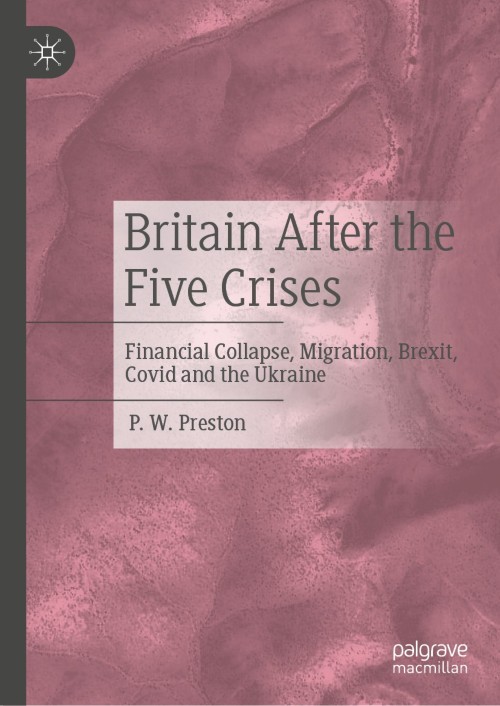
Britain After the Five Crises [electronic resource] : Financial Collapse, Migration, Brexit, Covid and the Ukraine / by P. W. Preston.
Erişim Adresi
ISBN
9783031436505
Dil Kodu
İngilizce
Yer Numarası
DK/20402
Yazar
Basım Bildirimi
1st ed. 2023.
Yayın Bilgisi
Cham : Springer Nature Switzerland : Imprint: Palgrave Macmillan, 2023.
Fiziksel Niteleme
XIV, 268 p. 2 illus. online resource.
İçindekiler Notu
1.Britain: a decade of crises, 2008-2022 -- 2. The British Empire: finessing the collapse, 1942-56 -- 3. European Union: particular anxieties, deeper issues, 2008-22 -- 4. Britain’s Financial Crisis: debts, bail-outs and austerity, 2008-10 -- 5. European Union: the migration crisis, 1999-2015 -- 6. Brexit Crisis: unpacking some of the lessons, 2016-22 -- 7.The Covid-19 Pandemic, 2020 -- 8. The Disaster in Ukraine: tracking the failures of political elites, 1991-2022 -- 9. Re-imagining Britain: crises, identity and representation,1973-98 -- 10. On Living in a Rich Country. - 11. Afterword.
Özet, vb.
The period 2008–2022 has seen the British state/government embroiled in a number of full-blown crises, each impacting the fundamental operations of the state and demanding, therefore, urgent responses from the government of the day. In the first case, the 2008 near-collapse and partial nationalization of the banking system consequent upon decades of irresponsible credit creation coupled to permissive regulation; in the second , the migration crisis of 2015, which saw waves of refugees moving through Europe, provoking anxious responses from European Union member states and opening-up related political debates in Britain; thus, third , the 2016 referendum in regard to membership of the European Union, which the London-based elite clearly thought they would navigate easily before, to their evident shock, losing, an event itself precipitating further extraordinary Westminster manoeuvring; and then fourth the 2020 Covid- 19 pandemic, met with an initial casualsangfroid before the government, its actions informed by epidemiological modelling, made an abrupt shift to ‘lockdown’, with dramatic social and economic consequences. To these episodes, whose impacts run down to the present, could be added, fifth, the 2022 disaster in Ukraine where the British state/government has chosen to involve itself by supporting one set of combatants in a conflict where presently, after more than a year of fighting, there is little sign of a means to the resolution of the violence. This book examines the crises and tracks how each developed; how state/ government failings in one case were rehearsed in the next; and, more generally, how these crises have been amplified by the decades-long celebration of globalization theory; and, finally, at how following the most recent crisis the future might unfold, hence the ideas of deglobalization, resilience and, more speculatively, the possibilities of democratization. P. W. Preston is Emeritus Professor of Political Sociology in the Department of Political Science and International Studies, University of Birmingham, UK.
Konu
Europe __ Politics and government.
World politics.
Political sociology.
European Politics.
Political History.
Political Sociology.
World politics.
Political sociology.
European Politics.
Political History.
Political Sociology.
Kurum Adı
Eseri Alıntıla
Referansları kullanmadan önce gözden geçirmeniz ve varsa gerekli düzeltmeleri yapmanız önerilir.
Dijital Kaynak
MARC Görünümü
LEADER 05709nam a22006255i 4500
001 819194
003 TR_AnAIT
005 20260130174647
007 cr nn 008mamaa
008 231102s2023 sz | s |||| 0|eng d
020 |a9783031436505|9978-3-031-43650-5
024 7 |a10.1007/978-3-031-43650-5|2doi
041 |aeng
049 |aTürk Tarih Kurumu Kütüphanesi
050 4|aJN1-9692.2
072 7|aJP|2bicssc
072 7|a1D|2bicssc
072 7|aPOL058000|2bisacsh
072 7|aJP|x1D|2thema
082 04|a320.94|223
090 |aDK/20402
100 1 |aPreston, P. W.|eauthor.|4aut|4http://id.loc.gov/vocabulary/relators/aut
245 10|aBritain After the Five Crises|h[electronic resource] :|bFinancial Collapse, Migration, Brexit, Covid and the Ukraine /|cby P. W. Preston.
250 |a1st ed. 2023.
264 1|aCham :|bSpringer Nature Switzerland :|bImprint: Palgrave Macmillan,|c2023.
300 |aXIV, 268 p. 2 illus.|bonline resource.
336 |atext|btxt|2rdacontent
337 |acomputer|bc|2rdamedia
338 |aonline resource|bcr|2rdacarrier
341 0 |bTable of contents navigation|2onix
341 0 |bSingle logical reading order|2onix
341 0 |bShort alternative textual descriptions|2onix
341 0 |bUse of color is not sole means of conveying information|2onix
341 0 |bUse of high contrast between text and background color|2onix
341 0 |bNext / Previous structural navigation|2onix
341 0 |bAll non-decorative content supports reading without sight|2onix
347 |atext file|bPDF|2rda
505 0 |a1.Britain: a decade of crises, 2008-2022 -- 2. The British Empire: finessing the collapse, 1942-56 -- 3. European Union: particular anxieties, deeper issues, 2008-22 -- 4. Britain’s Financial Crisis: debts, bail-outs and austerity, 2008-10 -- 5. European Union: the migration crisis, 1999-2015 -- 6. Brexit Crisis: unpacking some of the lessons, 2016-22 -- 7.The Covid-19 Pandemic, 2020 -- 8. The Disaster in Ukraine: tracking the failures of political elites, 1991-2022 -- 9. Re-imagining Britain: crises, identity and representation,1973-98 -- 10. On Living in a Rich Country. - 11. Afterword.
520 |aThe period 2008–2022 has seen the British state/government embroiled in a number of full-blown crises, each impacting the fundamental operations of the state and demanding, therefore, urgent responses from the government of the day. In the first case, the 2008 near-collapse and partial nationalization of the banking system consequent upon decades of irresponsible credit creation coupled to permissive regulation; in the second , the migration crisis of 2015, which saw waves of refugees moving through Europe, provoking anxious responses from European Union member states and opening-up related political debates in Britain; thus, third , the 2016 referendum in regard to membership of the European Union, which the London-based elite clearly thought they would navigate easily before, to their evident shock, losing, an event itself precipitating further extraordinary Westminster manoeuvring; and then fourth the 2020 Covid- 19 pandemic, met with an initial casualsangfroid before the government, its actions informed by epidemiological modelling, made an abrupt shift to ‘lockdown’, with dramatic social and economic consequences. To these episodes, whose impacts run down to the present, could be added, fifth, the 2022 disaster in Ukraine where the British state/government has chosen to involve itself by supporting one set of combatants in a conflict where presently, after more than a year of fighting, there is little sign of a means to the resolution of the violence. This book examines the crises and tracks how each developed; how state/ government failings in one case were rehearsed in the next; and, more generally, how these crises have been amplified by the decades-long celebration of globalization theory; and, finally, at how following the most recent crisis the future might unfold, hence the ideas of deglobalization, resilience and, more speculatively, the possibilities of democratization. P. W. Preston is Emeritus Professor of Political Sociology in the Department of Political Science and International Studies, University of Birmingham, UK.
532 8 |aAccessibility summary: This PDF does not fully comply with PDF/UA standards, but does feature limited screen reader support, described non-text content (images, graphs), bookmarks for easy navigation and searchable, selectable text. Users of assistive technologies may experience difficulty navigating or interpreting content in this document. We recognize the importance of accessibility, and we welcome queries about accessibility for any of our products. If you have a question or an access need, please get in touch with us at accessibilitysupport@springernature.com.
532 8 |aNo reading system accessibility options actively disabled
532 8 |aPublisher contact for further accessibility information: accessibilitysupport@springernature.com
650 0|aEurope|xPolitics and government.
650 0|aWorld politics.
650 0|aPolitical sociology.
650 14|aEuropean Politics.
650 24|aPolitical History.
650 24|aPolitical Sociology.
710 2 |aSpringerLink (Online service)
773 0 |tSpringer Nature eBook
776 08|iPrinted edition:|z9783031436499
776 08|iPrinted edition:|z9783031436512
776 08|iPrinted edition:|z9783031436529
856 40|uhttps://doi.org/10.1007/978-3-031-43650-5
912 |aZDB-2-POS
912 |aZDB-2-SXPI
950 |aPolitical Science and International Studies (SpringerNature-41174)
950 |aPolitical Science and International Studies (R0) (SpringerNature-43724)
001 819194
003 TR_AnAIT
005 20260130174647
007 cr nn 008mamaa
008 231102s2023 sz | s |||| 0|eng d
020 |a9783031436505|9978-3-031-43650-5
024 7 |a10.1007/978-3-031-43650-5|2doi
041 |aeng
049 |aTürk Tarih Kurumu Kütüphanesi
050 4|aJN1-9692.2
072 7|aJP|2bicssc
072 7|a1D|2bicssc
072 7|aPOL058000|2bisacsh
072 7|aJP|x1D|2thema
082 04|a320.94|223
090 |aDK/20402
100 1 |aPreston, P. W.|eauthor.|4aut|4http://id.loc.gov/vocabulary/relators/aut
245 10|aBritain After the Five Crises|h[electronic resource] :|bFinancial Collapse, Migration, Brexit, Covid and the Ukraine /|cby P. W. Preston.
250 |a1st ed. 2023.
264 1|aCham :|bSpringer Nature Switzerland :|bImprint: Palgrave Macmillan,|c2023.
300 |aXIV, 268 p. 2 illus.|bonline resource.
336 |atext|btxt|2rdacontent
337 |acomputer|bc|2rdamedia
338 |aonline resource|bcr|2rdacarrier
341 0 |bTable of contents navigation|2onix
341 0 |bSingle logical reading order|2onix
341 0 |bShort alternative textual descriptions|2onix
341 0 |bUse of color is not sole means of conveying information|2onix
341 0 |bUse of high contrast between text and background color|2onix
341 0 |bNext / Previous structural navigation|2onix
341 0 |bAll non-decorative content supports reading without sight|2onix
347 |atext file|bPDF|2rda
505 0 |a1.Britain: a decade of crises, 2008-2022 -- 2. The British Empire: finessing the collapse, 1942-56 -- 3. European Union: particular anxieties, deeper issues, 2008-22 -- 4. Britain’s Financial Crisis: debts, bail-outs and austerity, 2008-10 -- 5. European Union: the migration crisis, 1999-2015 -- 6. Brexit Crisis: unpacking some of the lessons, 2016-22 -- 7.The Covid-19 Pandemic, 2020 -- 8. The Disaster in Ukraine: tracking the failures of political elites, 1991-2022 -- 9. Re-imagining Britain: crises, identity and representation,1973-98 -- 10. On Living in a Rich Country. - 11. Afterword.
520 |aThe period 2008–2022 has seen the British state/government embroiled in a number of full-blown crises, each impacting the fundamental operations of the state and demanding, therefore, urgent responses from the government of the day. In the first case, the 2008 near-collapse and partial nationalization of the banking system consequent upon decades of irresponsible credit creation coupled to permissive regulation; in the second , the migration crisis of 2015, which saw waves of refugees moving through Europe, provoking anxious responses from European Union member states and opening-up related political debates in Britain; thus, third , the 2016 referendum in regard to membership of the European Union, which the London-based elite clearly thought they would navigate easily before, to their evident shock, losing, an event itself precipitating further extraordinary Westminster manoeuvring; and then fourth the 2020 Covid- 19 pandemic, met with an initial casualsangfroid before the government, its actions informed by epidemiological modelling, made an abrupt shift to ‘lockdown’, with dramatic social and economic consequences. To these episodes, whose impacts run down to the present, could be added, fifth, the 2022 disaster in Ukraine where the British state/government has chosen to involve itself by supporting one set of combatants in a conflict where presently, after more than a year of fighting, there is little sign of a means to the resolution of the violence. This book examines the crises and tracks how each developed; how state/ government failings in one case were rehearsed in the next; and, more generally, how these crises have been amplified by the decades-long celebration of globalization theory; and, finally, at how following the most recent crisis the future might unfold, hence the ideas of deglobalization, resilience and, more speculatively, the possibilities of democratization. P. W. Preston is Emeritus Professor of Political Sociology in the Department of Political Science and International Studies, University of Birmingham, UK.
532 8 |aAccessibility summary: This PDF does not fully comply with PDF/UA standards, but does feature limited screen reader support, described non-text content (images, graphs), bookmarks for easy navigation and searchable, selectable text. Users of assistive technologies may experience difficulty navigating or interpreting content in this document. We recognize the importance of accessibility, and we welcome queries about accessibility for any of our products. If you have a question or an access need, please get in touch with us at accessibilitysupport@springernature.com.
532 8 |aNo reading system accessibility options actively disabled
532 8 |aPublisher contact for further accessibility information: accessibilitysupport@springernature.com
650 0|aEurope|xPolitics and government.
650 0|aWorld politics.
650 0|aPolitical sociology.
650 14|aEuropean Politics.
650 24|aPolitical History.
650 24|aPolitical Sociology.
710 2 |aSpringerLink (Online service)
773 0 |tSpringer Nature eBook
776 08|iPrinted edition:|z9783031436499
776 08|iPrinted edition:|z9783031436512
776 08|iPrinted edition:|z9783031436529
856 40|uhttps://doi.org/10.1007/978-3-031-43650-5
912 |aZDB-2-POS
912 |aZDB-2-SXPI
950 |aPolitical Science and International Studies (SpringerNature-41174)
950 |aPolitical Science and International Studies (R0) (SpringerNature-43724)
Materyaller
Depodan talep edilen materyal sadece kütüphane içerisinde kullanılmaktadır.
Materyal dışarıya ödünç verilmemektedir.
Materyal dışarıya ödünç verilmemektedir.
