

Sub-Saharan Political Cultures of Deceit in Language, Literature, and the Media, Volume II [electronic resource] : Across National Contexts / edited by Esther Mavengano, Isaac Mhute.
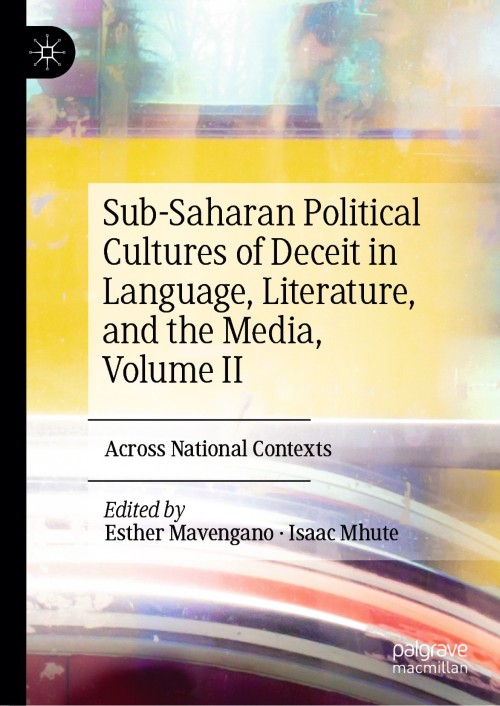
Erişim Adresi
ISBN
9783031428838
Dil Kodu
İngilizce
Yer Numarası
DK/20426
Basım Bildirimi
1st ed. 2023.
Yayın Bilgisi
Cham : Springer Nature Switzerland : Imprint: Palgrave Macmillan, 2023.
Fiziksel Niteleme
XXIII, 428 p. 4 illus., 2 illus. in color. online resource.
İçindekiler Notu
1. The Sub-Saharan African Postcolonial Politics: A Daunting Present. Esther Mavengano and Isaac Mhute -- Part 1: Cultures of Deceit in Postcolonial Sub-Saharan Literary Imaginings -- 2. Memorialising Gender and Childhood under the throes of von Trotha’s Extermination Order: Trauma, Agency and Survival in Serebov’s Mama Namibia. Nelson Mlambo, Collen Sabao and Coletta Kandemiri- 3. Speaking from below: Reflections on the Postcolonial Subaltern Practices of Resisting Deceit and Penury in Valerie Tagwira’s novel, Trapped. Esther Mavengano -- 4. Towards Using Literature to Deal with Fear of Ethno-Religious and Linguistic Differences in African Post- Colonial Politics. Nkereuwem, Ogonna Nchekwube -- 5. The Postcoloniality and Decoloniality of Namibian literature in Kubuitsile’s The Scattering and Utley’s The Lie of the Land. Collen Sabao & Nelson Mlambo -- Part 2: Language/ Media and Postcolonial Deceit in Sub-Saharan Africa -- 6. Postcolonial Gender dichotomies: Integrating Digital Technologies, Local Content and Local Languages in Empowering Rural-Black Women in Southern Africa. Gift Masengwe & Wadzanai Chihombori-Ndlovu -- 7. Hate Speech, a Source of Linguistic, Religious and Ethnic Intolerance among the sub-Saharan African Peoples: The Case of Nigeria. Robert, Odey Simon, Nwode, Goodluck Chigbo & Bibian, Ugoala -- 8. We’ll fish out MP mole and punish the person”: Language, politics and culture of deceit in Ghana’s politics. Charles Prempeh -- 9. Mass Media in Deceitful Pragmatic Misrepresentation of, and the Heightened Intergroup Conflicts among Sub-Saharan African Ethno-Religious and Linguistic Groups. Osuchukwu, Caroline Nonye, Bibian, Ugoala & Robert, Odey Simon -- 10. Post-colonial Political, Economic and Ethnic Discourse: A case of Mozambique and Rwanda. Donald Peter Chimanikire & Valerie Rumbidzai Jeche & Jane Tsitsi Mudzamiri -- Part 3: The Media and political deceit in postcolonial Sub- Saharan Africa -- 11. Survival of the Private Media under Zimbabwe’s Politico-economic crises. Pedzisai Ruhanya & Bekezela Gumbo -- 12. Digital Authoritarianism in Postcolonial Nigeria: Internet Control Techniques and Censorship. Desmond Onyemechi Okocha, Maureen Chigbo & Melchizedec J. Onobe -- 13. Tragic labels, catastrophic consequences: Colonial treachery and the Cameroonian calamity. Jacob Mapara -- 14. Populism as a new Political Tactic of Postcolonial Deceit in Nigerian Contemporary Digital Era. Desmond Okocho & Jesse Ishaku -- Part 4: Postcolonial Political Dialectics in Religion and Human Rights discourses -- 15. The impact of legacies of the past on the emergence of conflict and deceit in Sub-Saharan African politics. Fabian Maugnganidze -- 16. Iscariotean Dialectics and the Demise of Emancipatory Pan-African States in Sub-Saharan Africa. George Michael Kizito -- 17. Discourse on violent Disenfranchisements and Threats to Religious and Ethnic Minorities in Postcolonial Zimbabwe. Edmore Dube -- 18. The Entanglement of the Church and the State during Mugabe’s Reign in Postcolonial Zimbabwe: A Social Conflict Perspective. Tobias Marevesa & Esther Mavengano -- 19. A Culture of deceit and Human Rights violations in Postcolonail Sub-Saharan African politics. Fabian Maunganidze -- 20. The Youth and Political Leadership and Governance in Postcolonial Sub-Saharan Africa. Takavafira Masarira Zhou & Costain Tandi -- 21. Too Good to be True: Unfulfilled Campaign Promises, Pledges, and Political Deceit in Zimbabwe. Gift Mwonzora.
Özet, vb.
This two-volume set charts a cross-disciplinary discursive terrain that proffers rich insights about deceit in contemporary postcolonial Sub-Saharan African politics. In an attempt to produce a nuanced and multifaceted academic dialoguing platform, the two volumes have a particular focus on the aspects of treachery, fear of difference (oppositional politics), and discourses/semiotics of mis/self-representation. The major aim of the proposed volumes is to contribute toward the often problematized conversations about the unfolding (post)colonial Sub-Saharan world which is topical in decolonial and Pan-African studies. The volumes seek to place political thinking and postcolonial political systems under the scholarly gaze with the view to highlight and enhance the participation of African cross-disciplinary scholarship in the postcolonial political processes of the continent. Most significantly, it is through such probing of the limitations of our own disciplinary perspectives which can help us appreciate the complexity of the postcolonial Sub-Saharan African politics. The first volume uses Zimbabwe as a case study, while the second volume examines postcolonial politics in Sub-Saharan Africa more broadly. The first volume uses Zimbabwe as a case study, while the second volume examines postcolonial politics in Sub-Saharan Africa more broadly. The first volume uses Zimbabwe as a case study, while the second volume examines postcolonial politics in Sub-Saharan Africa more broadly. Esther Mavengano is Lecturer in English and Media Studies, Great Zimbabwe University, Zimbabwe. She is a Research Fellow at the Research Institute for Theology, and Religion, College of Human Sciences, UNISA, South Africa and a von Humboldt Postdoctoral Fellow in the Department of English, Institute of English and American Studies, Faculty of Linguistics, Literature and Cultural Studies, Technology University Dresden, Germany. Isaac Mhute is Associate Professor of Language, Literature and Culture Studies, Midlands State University, Zimbabwe.
Konu
Africa __ Politics and government.
Communication in politics.
Africa, Sub-Saharan __ History.
Knowledge, Sociology of.
Semiotics.
African Politics.
Political Communication.
History of Sub-Saharan Africa.
Sociology of Knowledge and Discourse.
Semiotics.
Communication in politics.
Africa, Sub-Saharan __ History.
Knowledge, Sociology of.
Semiotics.
African Politics.
Political Communication.
History of Sub-Saharan Africa.
Sociology of Knowledge and Discourse.
Semiotics.
Diğer Yazarlar
Kurum Adı
Eseri Alıntıla
Referansları kullanmadan önce gözden geçirmeniz ve varsa gerekli düzeltmeleri yapmanız önerilir.
Dijital Kaynak
MARC Görünümü
LEADER 08928nam a22006855i 4500
001 819218
003 TR_AnAIT
005 20260130174552
007 cr nn 008mamaa
008 231212s2023 sz | s |||| 0|eng d
020 |a9783031428838|9978-3-031-42883-8
024 7 |a10.1007/978-3-031-42883-8|2doi
041 |aeng
049 |aTürk Tarih Kurumu Kütüphanesi
050 4|aJQ1870-3981
072 7|aJP|2bicssc
072 7|a1H|2bicssc
072 7|aPOL053000|2bisacsh
072 7|aJP|x1H|2thema
082 04|a320.96|223
090 |aDK/20426
245 10|aSub-Saharan Political Cultures of Deceit in Language, Literature, and the Media, Volume II|h[electronic resource] :|bAcross National Contexts /|cedited by Esther Mavengano, Isaac Mhute.
250 |a1st ed. 2023.
264 1|aCham :|bSpringer Nature Switzerland :|bImprint: Palgrave Macmillan,|c2023.
300 |aXXIII, 428 p. 4 illus., 2 illus. in color.|bonline resource.
336 |atext|btxt|2rdacontent
337 |acomputer|bc|2rdamedia
338 |aonline resource|bcr|2rdacarrier
341 0 |bTable of contents navigation|2onix
341 0 |bSingle logical reading order|2onix
341 0 |bShort alternative textual descriptions|2onix
341 0 |bUse of color is not sole means of conveying information|2onix
341 0 |bUse of high contrast between text and background color|2onix
341 0 |bNext / Previous structural navigation|2onix
341 0 |bAll non-decorative content supports reading without sight|2onix
347 |atext file|bPDF|2rda
505 0 |a1. The Sub-Saharan African Postcolonial Politics: A Daunting Present. Esther Mavengano and Isaac Mhute -- Part 1: Cultures of Deceit in Postcolonial Sub-Saharan Literary Imaginings -- 2. Memorialising Gender and Childhood under the throes of von Trotha’s Extermination Order: Trauma, Agency and Survival in Serebov’s Mama Namibia. Nelson Mlambo, Collen Sabao and Coletta Kandemiri- 3. Speaking from below: Reflections on the Postcolonial Subaltern Practices of Resisting Deceit and Penury in Valerie Tagwira’s novel, Trapped. Esther Mavengano -- 4. Towards Using Literature to Deal with Fear of Ethno-Religious and Linguistic Differences in African Post- Colonial Politics. Nkereuwem, Ogonna Nchekwube -- 5. The Postcoloniality and Decoloniality of Namibian literature in Kubuitsile’s The Scattering and Utley’s The Lie of the Land. Collen Sabao & Nelson Mlambo -- Part 2: Language/ Media and Postcolonial Deceit in Sub-Saharan Africa -- 6. Postcolonial Gender dichotomies: Integrating Digital Technologies, Local Content and Local Languages in Empowering Rural-Black Women in Southern Africa. Gift Masengwe & Wadzanai Chihombori-Ndlovu -- 7. Hate Speech, a Source of Linguistic, Religious and Ethnic Intolerance among the sub-Saharan African Peoples: The Case of Nigeria. Robert, Odey Simon, Nwode, Goodluck Chigbo & Bibian, Ugoala -- 8. We’ll fish out MP mole and punish the person”: Language, politics and culture of deceit in Ghana’s politics. Charles Prempeh -- 9. Mass Media in Deceitful Pragmatic Misrepresentation of, and the Heightened Intergroup Conflicts among Sub-Saharan African Ethno-Religious and Linguistic Groups. Osuchukwu, Caroline Nonye, Bibian, Ugoala & Robert, Odey Simon -- 10. Post-colonial Political, Economic and Ethnic Discourse: A case of Mozambique and Rwanda. Donald Peter Chimanikire & Valerie Rumbidzai Jeche & Jane Tsitsi Mudzamiri -- Part 3: The Media and political deceit in postcolonial Sub- Saharan Africa -- 11. Survival of the Private Media under Zimbabwe’s Politico-economic crises. Pedzisai Ruhanya & Bekezela Gumbo -- 12. Digital Authoritarianism in Postcolonial Nigeria: Internet Control Techniques and Censorship. Desmond Onyemechi Okocha, Maureen Chigbo & Melchizedec J. Onobe -- 13. Tragic labels, catastrophic consequences: Colonial treachery and the Cameroonian calamity. Jacob Mapara -- 14. Populism as a new Political Tactic of Postcolonial Deceit in Nigerian Contemporary Digital Era. Desmond Okocho & Jesse Ishaku -- Part 4: Postcolonial Political Dialectics in Religion and Human Rights discourses -- 15. The impact of legacies of the past on the emergence of conflict and deceit in Sub-Saharan African politics. Fabian Maugnganidze -- 16. Iscariotean Dialectics and the Demise of Emancipatory Pan-African States in Sub-Saharan Africa. George Michael Kizito -- 17. Discourse on violent Disenfranchisements and Threats to Religious and Ethnic Minorities in Postcolonial Zimbabwe. Edmore Dube -- 18. The Entanglement of the Church and the State during Mugabe’s Reign in Postcolonial Zimbabwe: A Social Conflict Perspective. Tobias Marevesa & Esther Mavengano -- 19. A Culture of deceit and Human Rights violations in Postcolonail Sub-Saharan African politics. Fabian Maunganidze -- 20. The Youth and Political Leadership and Governance in Postcolonial Sub-Saharan Africa. Takavafira Masarira Zhou & Costain Tandi -- 21. Too Good to be True: Unfulfilled Campaign Promises, Pledges, and Political Deceit in Zimbabwe. Gift Mwonzora.
520 |aThis two-volume set charts a cross-disciplinary discursive terrain that proffers rich insights about deceit in contemporary postcolonial Sub-Saharan African politics. In an attempt to produce a nuanced and multifaceted academic dialoguing platform, the two volumes have a particular focus on the aspects of treachery, fear of difference (oppositional politics), and discourses/semiotics of mis/self-representation. The major aim of the proposed volumes is to contribute toward the often problematized conversations about the unfolding (post)colonial Sub-Saharan world which is topical in decolonial and Pan-African studies. The volumes seek to place political thinking and postcolonial political systems under the scholarly gaze with the view to highlight and enhance the participation of African cross-disciplinary scholarship in the postcolonial political processes of the continent. Most significantly, it is through such probing of the limitations of our own disciplinary perspectives which can help us appreciate the complexity of the postcolonial Sub-Saharan African politics. The first volume uses Zimbabwe as a case study, while the second volume examines postcolonial politics in Sub-Saharan Africa more broadly. The first volume uses Zimbabwe as a case study, while the second volume examines postcolonial politics in Sub-Saharan Africa more broadly. The first volume uses Zimbabwe as a case study, while the second volume examines postcolonial politics in Sub-Saharan Africa more broadly. Esther Mavengano is Lecturer in English and Media Studies, Great Zimbabwe University, Zimbabwe. She is a Research Fellow at the Research Institute for Theology, and Religion, College of Human Sciences, UNISA, South Africa and a von Humboldt Postdoctoral Fellow in the Department of English, Institute of English and American Studies, Faculty of Linguistics, Literature and Cultural Studies, Technology University Dresden, Germany. Isaac Mhute is Associate Professor of Language, Literature and Culture Studies, Midlands State University, Zimbabwe.
532 8 |aAccessibility summary: This PDF does not fully comply with PDF/UA standards, but does feature limited screen reader support, described non-text content (images, graphs), bookmarks for easy navigation and searchable, selectable text. Users of assistive technologies may experience difficulty navigating or interpreting content in this document. We recognize the importance of accessibility, and we welcome queries about accessibility for any of our products. If you have a question or an access need, please get in touch with us at accessibilitysupport@springernature.com.
532 8 |aNo reading system accessibility options actively disabled
532 8 |aPublisher contact for further accessibility information: accessibilitysupport@springernature.com
650 0|aAfrica|xPolitics and government.
650 0|aCommunication in politics.
650 0|aAfrica, Sub-Saharan|xHistory.
650 0|aKnowledge, Sociology of.
650 0|aSemiotics.
650 14|aAfrican Politics.
650 24|aPolitical Communication.
650 24|aHistory of Sub-Saharan Africa.
650 24|aSociology of Knowledge and Discourse.
650 24|aSemiotics.
700 1 |aMavengano, Esther.|eeditor.|4edt|4http://id.loc.gov/vocabulary/relators/edt
700 1 |aMhute, Isaac.|eeditor.|4edt|4http://id.loc.gov/vocabulary/relators/edt
710 2 |aSpringerLink (Online service)
773 0 |tSpringer Nature eBook
776 08|iPrinted edition:|z9783031428821
776 08|iPrinted edition:|z9783031428845
776 08|iPrinted edition:|z9783031428852
856 40|uhttps://doi.org/10.1007/978-3-031-42883-8
912 |aZDB-2-POS
912 |aZDB-2-SXPI
950 |aPolitical Science and International Studies (SpringerNature-41174)
950 |aPolitical Science and International Studies (R0) (SpringerNature-43724)
001 819218
003 TR_AnAIT
005 20260130174552
007 cr nn 008mamaa
008 231212s2023 sz | s |||| 0|eng d
020 |a9783031428838|9978-3-031-42883-8
024 7 |a10.1007/978-3-031-42883-8|2doi
041 |aeng
049 |aTürk Tarih Kurumu Kütüphanesi
050 4|aJQ1870-3981
072 7|aJP|2bicssc
072 7|a1H|2bicssc
072 7|aPOL053000|2bisacsh
072 7|aJP|x1H|2thema
082 04|a320.96|223
090 |aDK/20426
245 10|aSub-Saharan Political Cultures of Deceit in Language, Literature, and the Media, Volume II|h[electronic resource] :|bAcross National Contexts /|cedited by Esther Mavengano, Isaac Mhute.
250 |a1st ed. 2023.
264 1|aCham :|bSpringer Nature Switzerland :|bImprint: Palgrave Macmillan,|c2023.
300 |aXXIII, 428 p. 4 illus., 2 illus. in color.|bonline resource.
336 |atext|btxt|2rdacontent
337 |acomputer|bc|2rdamedia
338 |aonline resource|bcr|2rdacarrier
341 0 |bTable of contents navigation|2onix
341 0 |bSingle logical reading order|2onix
341 0 |bShort alternative textual descriptions|2onix
341 0 |bUse of color is not sole means of conveying information|2onix
341 0 |bUse of high contrast between text and background color|2onix
341 0 |bNext / Previous structural navigation|2onix
341 0 |bAll non-decorative content supports reading without sight|2onix
347 |atext file|bPDF|2rda
505 0 |a1. The Sub-Saharan African Postcolonial Politics: A Daunting Present. Esther Mavengano and Isaac Mhute -- Part 1: Cultures of Deceit in Postcolonial Sub-Saharan Literary Imaginings -- 2. Memorialising Gender and Childhood under the throes of von Trotha’s Extermination Order: Trauma, Agency and Survival in Serebov’s Mama Namibia. Nelson Mlambo, Collen Sabao and Coletta Kandemiri- 3. Speaking from below: Reflections on the Postcolonial Subaltern Practices of Resisting Deceit and Penury in Valerie Tagwira’s novel, Trapped. Esther Mavengano -- 4. Towards Using Literature to Deal with Fear of Ethno-Religious and Linguistic Differences in African Post- Colonial Politics. Nkereuwem, Ogonna Nchekwube -- 5. The Postcoloniality and Decoloniality of Namibian literature in Kubuitsile’s The Scattering and Utley’s The Lie of the Land. Collen Sabao & Nelson Mlambo -- Part 2: Language/ Media and Postcolonial Deceit in Sub-Saharan Africa -- 6. Postcolonial Gender dichotomies: Integrating Digital Technologies, Local Content and Local Languages in Empowering Rural-Black Women in Southern Africa. Gift Masengwe & Wadzanai Chihombori-Ndlovu -- 7. Hate Speech, a Source of Linguistic, Religious and Ethnic Intolerance among the sub-Saharan African Peoples: The Case of Nigeria. Robert, Odey Simon, Nwode, Goodluck Chigbo & Bibian, Ugoala -- 8. We’ll fish out MP mole and punish the person”: Language, politics and culture of deceit in Ghana’s politics. Charles Prempeh -- 9. Mass Media in Deceitful Pragmatic Misrepresentation of, and the Heightened Intergroup Conflicts among Sub-Saharan African Ethno-Religious and Linguistic Groups. Osuchukwu, Caroline Nonye, Bibian, Ugoala & Robert, Odey Simon -- 10. Post-colonial Political, Economic and Ethnic Discourse: A case of Mozambique and Rwanda. Donald Peter Chimanikire & Valerie Rumbidzai Jeche & Jane Tsitsi Mudzamiri -- Part 3: The Media and political deceit in postcolonial Sub- Saharan Africa -- 11. Survival of the Private Media under Zimbabwe’s Politico-economic crises. Pedzisai Ruhanya & Bekezela Gumbo -- 12. Digital Authoritarianism in Postcolonial Nigeria: Internet Control Techniques and Censorship. Desmond Onyemechi Okocha, Maureen Chigbo & Melchizedec J. Onobe -- 13. Tragic labels, catastrophic consequences: Colonial treachery and the Cameroonian calamity. Jacob Mapara -- 14. Populism as a new Political Tactic of Postcolonial Deceit in Nigerian Contemporary Digital Era. Desmond Okocho & Jesse Ishaku -- Part 4: Postcolonial Political Dialectics in Religion and Human Rights discourses -- 15. The impact of legacies of the past on the emergence of conflict and deceit in Sub-Saharan African politics. Fabian Maugnganidze -- 16. Iscariotean Dialectics and the Demise of Emancipatory Pan-African States in Sub-Saharan Africa. George Michael Kizito -- 17. Discourse on violent Disenfranchisements and Threats to Religious and Ethnic Minorities in Postcolonial Zimbabwe. Edmore Dube -- 18. The Entanglement of the Church and the State during Mugabe’s Reign in Postcolonial Zimbabwe: A Social Conflict Perspective. Tobias Marevesa & Esther Mavengano -- 19. A Culture of deceit and Human Rights violations in Postcolonail Sub-Saharan African politics. Fabian Maunganidze -- 20. The Youth and Political Leadership and Governance in Postcolonial Sub-Saharan Africa. Takavafira Masarira Zhou & Costain Tandi -- 21. Too Good to be True: Unfulfilled Campaign Promises, Pledges, and Political Deceit in Zimbabwe. Gift Mwonzora.
520 |aThis two-volume set charts a cross-disciplinary discursive terrain that proffers rich insights about deceit in contemporary postcolonial Sub-Saharan African politics. In an attempt to produce a nuanced and multifaceted academic dialoguing platform, the two volumes have a particular focus on the aspects of treachery, fear of difference (oppositional politics), and discourses/semiotics of mis/self-representation. The major aim of the proposed volumes is to contribute toward the often problematized conversations about the unfolding (post)colonial Sub-Saharan world which is topical in decolonial and Pan-African studies. The volumes seek to place political thinking and postcolonial political systems under the scholarly gaze with the view to highlight and enhance the participation of African cross-disciplinary scholarship in the postcolonial political processes of the continent. Most significantly, it is through such probing of the limitations of our own disciplinary perspectives which can help us appreciate the complexity of the postcolonial Sub-Saharan African politics. The first volume uses Zimbabwe as a case study, while the second volume examines postcolonial politics in Sub-Saharan Africa more broadly. The first volume uses Zimbabwe as a case study, while the second volume examines postcolonial politics in Sub-Saharan Africa more broadly. The first volume uses Zimbabwe as a case study, while the second volume examines postcolonial politics in Sub-Saharan Africa more broadly. Esther Mavengano is Lecturer in English and Media Studies, Great Zimbabwe University, Zimbabwe. She is a Research Fellow at the Research Institute for Theology, and Religion, College of Human Sciences, UNISA, South Africa and a von Humboldt Postdoctoral Fellow in the Department of English, Institute of English and American Studies, Faculty of Linguistics, Literature and Cultural Studies, Technology University Dresden, Germany. Isaac Mhute is Associate Professor of Language, Literature and Culture Studies, Midlands State University, Zimbabwe.
532 8 |aAccessibility summary: This PDF does not fully comply with PDF/UA standards, but does feature limited screen reader support, described non-text content (images, graphs), bookmarks for easy navigation and searchable, selectable text. Users of assistive technologies may experience difficulty navigating or interpreting content in this document. We recognize the importance of accessibility, and we welcome queries about accessibility for any of our products. If you have a question or an access need, please get in touch with us at accessibilitysupport@springernature.com.
532 8 |aNo reading system accessibility options actively disabled
532 8 |aPublisher contact for further accessibility information: accessibilitysupport@springernature.com
650 0|aAfrica|xPolitics and government.
650 0|aCommunication in politics.
650 0|aAfrica, Sub-Saharan|xHistory.
650 0|aKnowledge, Sociology of.
650 0|aSemiotics.
650 14|aAfrican Politics.
650 24|aPolitical Communication.
650 24|aHistory of Sub-Saharan Africa.
650 24|aSociology of Knowledge and Discourse.
650 24|aSemiotics.
700 1 |aMavengano, Esther.|eeditor.|4edt|4http://id.loc.gov/vocabulary/relators/edt
700 1 |aMhute, Isaac.|eeditor.|4edt|4http://id.loc.gov/vocabulary/relators/edt
710 2 |aSpringerLink (Online service)
773 0 |tSpringer Nature eBook
776 08|iPrinted edition:|z9783031428821
776 08|iPrinted edition:|z9783031428845
776 08|iPrinted edition:|z9783031428852
856 40|uhttps://doi.org/10.1007/978-3-031-42883-8
912 |aZDB-2-POS
912 |aZDB-2-SXPI
950 |aPolitical Science and International Studies (SpringerNature-41174)
950 |aPolitical Science and International Studies (R0) (SpringerNature-43724)
Materyaller
Depodan talep edilen materyal sadece kütüphane içerisinde kullanılmaktadır.
Materyal dışarıya ödünç verilmemektedir.
Materyal dışarıya ödünç verilmemektedir.
