

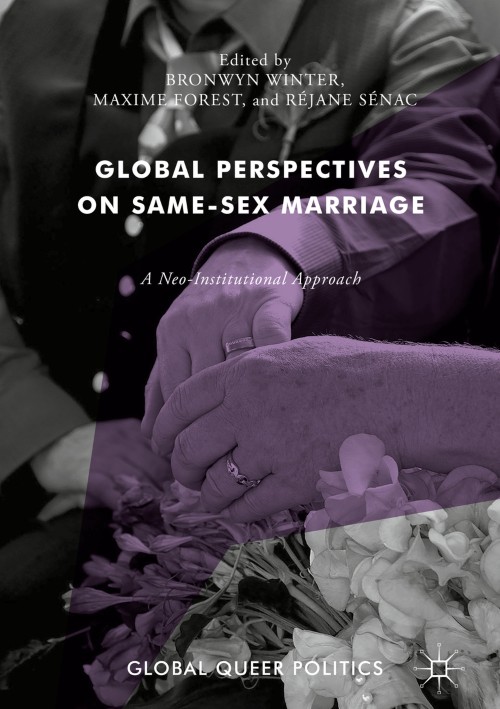
Global Perspectives on Same-Sex Marriage [electronic resource] : A Neo-Institutional Approach / edited by Bronwyn Winter, Maxime Forest, Réjane Sénac.
Erişim Adresi
ISBN
9783319627649
Dil Kodu
İngilizce
Yer Numarası
DK/20458
Basım Bildirimi
1st ed. 2018.
Yayın Bilgisi
Cham : Springer International Publishing : Imprint: Palgrave Macmillan, 2018.
Fiziksel Niteleme
XVII, 241 p. online resource.
Dizi
Global Queer Politics, 2569-1309
İçindekiler Notu
1. Institutionalizing Same-Sex Marriage in Argentina and Mexico: The Role of Federalism -- 2. A Tale of Two Congresses: Sex, Institutions and Evangelicals in Brazil and Chile -- 3. Historical Institutionalism and Same-Sex Marriage: A Comparative Analysis of the U.S. And Canada -- 4. Understanding Same-Sex Marriage Debates in Malawi and South Africa -- 5. Same-Sex Marriage in France and Spain: Comparing Resistance in a Centralized Secular Republic and the Dynamics of Change in A "Quasi-Federal" Constitutional Monarchy -- 6. Europeanizing vs. Nationalizing the Issue of Same-Sex Marriage in Central Europe: A Comparative Analysis of Framing Processes in Croatia, Hungary, Slovakia and Slovenia -- 7. Preserving the Social Fabric: Debating Family, Equality, and Polity in the United Kingdom, the Republic of Ireland and Australia -- 8. The Globalization of LGBT Identity and Same-Sex Marriage as a Catalyst of Neo-Institutional Values: Singapore and Indonesia in Focus -- 9. Pathways to Legalizing Same-Sex Marriage in China and Taiwan: Globalization And "Chinese Values".
Özet, vb.
This book provides a comparative, neo-institutionalist approach to the different factors impacting state adoption of—or refusal to adopt—same-sex marriage laws. The now twenty-one countries where lesbians and gay men can legally marry include recent or longstanding democracies, republics and parliamentary monarchies, and unitary and federal states. They all reflect different positions with respect to religion and the cultural foundations of the nation. Countries opposed to such legalization, and those having taken measures in recent years to legally reinforce the heterosexual fundaments of marriage, present a similar diversity. This diversity, in a globalized context where the idea of same-sex marriage has become integral to claims for LGBTI equality and indeed LGBTI human rights, gives rise to the following question: which factors contribute to institutionalizing same-sex marriage? The analytical framework used for exploring these factors in this book is neo-institutio nalism. Through three neo-institutionalist lenses—historical, sociological and discursive—contributors investigate two aspects of the processes of adoption or opposition of equal recognition of same-sex partnerships. Firstly, they reveal how claims by LGBTIQ movements are being framed politically and brought to parliamentary politics. Secondly, they explore the ways in which same-sex marriage becomes institutionalized (or resisted) through legal and societal norms and practices. Although it adopts neo-institutionalism as its main theoretical framework, the book incorporates a broad range of perspectives, including scholarship on social movements, LGBTI rights, heterosexuality and social norms, and gender and politics.
Konu
Identity politics.
Comparative government.
Globalization.
Economic development.
Ethnology.
Law and the social sciences.
Politics and Gender.
Comparative Politics.
Globalization.
Development Studies.
Sociocultural Anthropology.
Socio-Legal Studies.
Comparative government.
Globalization.
Economic development.
Ethnology.
Law and the social sciences.
Politics and Gender.
Comparative Politics.
Globalization.
Development Studies.
Sociocultural Anthropology.
Socio-Legal Studies.
Diğer Yazarlar
Kurum Adı
Eseri Alıntıla
Referansları kullanmadan önce gözden geçirmeniz ve varsa gerekli düzeltmeleri yapmanız önerilir.
Dijital Kaynak
MARC Görünümü
LEADER 05159nam a22006495i 4500
001 819250
003 TR_AnAIT
005 20260130174453
007 cr nn 008mamaa
008 171109s2018 sz | s |||| 0|eng d
020 |a9783319627649|9978-3-319-62764-9
024 7 |a10.1007/978-3-319-62764-9|2doi
041 |aeng
049 |aTürk Tarih Kurumu Kütüphanesi
050 4|aJA76
072 7|aJP|2bicssc
072 7|aJFSJ|2bicssc
072 7|aPOL000000|2bisacsh
072 7|aJP|2thema
072 7|aJBSF|2thema
082 04|a320.562|223
082 04|a323.33|223
090 |aDK/20458
245 10|aGlobal Perspectives on Same-Sex Marriage|h[electronic resource] :|bA Neo-Institutional Approach /|cedited by Bronwyn Winter, Maxime Forest, Réjane Sénac.
250 |a1st ed. 2018.
264 1|aCham :|bSpringer International Publishing :|bImprint: Palgrave Macmillan,|c2018.
300 |aXVII, 241 p.|bonline resource.
336 |atext|btxt|2rdacontent
337 |acomputer|bc|2rdamedia
338 |aonline resource|bcr|2rdacarrier
347 |atext file|bPDF|2rda
490 1 |aGlobal Queer Politics,|x2569-1309
505 0 |a1. Institutionalizing Same-Sex Marriage in Argentina and Mexico: The Role of Federalism -- 2. A Tale of Two Congresses: Sex, Institutions and Evangelicals in Brazil and Chile -- 3. Historical Institutionalism and Same-Sex Marriage: A Comparative Analysis of the U.S. And Canada -- 4. Understanding Same-Sex Marriage Debates in Malawi and South Africa -- 5. Same-Sex Marriage in France and Spain: Comparing Resistance in a Centralized Secular Republic and the Dynamics of Change in A "Quasi-Federal" Constitutional Monarchy -- 6. Europeanizing vs. Nationalizing the Issue of Same-Sex Marriage in Central Europe: A Comparative Analysis of Framing Processes in Croatia, Hungary, Slovakia and Slovenia -- 7. Preserving the Social Fabric: Debating Family, Equality, and Polity in the United Kingdom, the Republic of Ireland and Australia -- 8. The Globalization of LGBT Identity and Same-Sex Marriage as a Catalyst of Neo-Institutional Values: Singapore and Indonesia in Focus -- 9. Pathways to Legalizing Same-Sex Marriage in China and Taiwan: Globalization And "Chinese Values".
520 |aThis book provides a comparative, neo-institutionalist approach to the different factors impacting state adoption of—or refusal to adopt—same-sex marriage laws. The now twenty-one countries where lesbians and gay men can legally marry include recent or longstanding democracies, republics and parliamentary monarchies, and unitary and federal states. They all reflect different positions with respect to religion and the cultural foundations of the nation. Countries opposed to such legalization, and those having taken measures in recent years to legally reinforce the heterosexual fundaments of marriage, present a similar diversity. This diversity, in a globalized context where the idea of same-sex marriage has become integral to claims for LGBTI equality and indeed LGBTI human rights, gives rise to the following question: which factors contribute to institutionalizing same-sex marriage? The analytical framework used for exploring these factors in this book is neo-institutio nalism. Through three neo-institutionalist lenses—historical, sociological and discursive—contributors investigate two aspects of the processes of adoption or opposition of equal recognition of same-sex partnerships. Firstly, they reveal how claims by LGBTIQ movements are being framed politically and brought to parliamentary politics. Secondly, they explore the ways in which same-sex marriage becomes institutionalized (or resisted) through legal and societal norms and practices. Although it adopts neo-institutionalism as its main theoretical framework, the book incorporates a broad range of perspectives, including scholarship on social movements, LGBTI rights, heterosexuality and social norms, and gender and politics.
650 0|aIdentity politics.
650 0|aComparative government.
650 0|aGlobalization.
650 0|aEconomic development.
650 0|aEthnology.
650 0|aLaw and the social sciences.
650 14|aPolitics and Gender.
650 24|aComparative Politics.
650 24|aGlobalization.
650 24|aDevelopment Studies.
650 24|aSociocultural Anthropology.
650 24|aSocio-Legal Studies.
700 1 |aWinter, Bronwyn.|eeditor.|4edt|4http://id.loc.gov/vocabulary/relators/edt
700 1 |aForest, Maxime.|eeditor.|4edt|4http://id.loc.gov/vocabulary/relators/edt
700 1 |aSénac, Réjane.|eeditor.|4edt|4http://id.loc.gov/vocabulary/relators/edt
710 2 |aSpringerLink (Online service)
773 0 |tSpringer Nature eBook
776 08|iPrinted edition:|z9783319627632
776 08|iPrinted edition:|z9783319627656
776 08|iPrinted edition:|z9783319873886
830 0|aGlobal Queer Politics,|x2569-1309
856 40|uhttps://doi.org/10.1007/978-3-319-62764-9
912 |aZDB-2-POS
912 |aZDB-2-SXPI
950 |aPolitical Science and International Studies (SpringerNature-41174)
950 |aPolitical Science and International Studies (R0) (SpringerNature-43724)
001 819250
003 TR_AnAIT
005 20260130174453
007 cr nn 008mamaa
008 171109s2018 sz | s |||| 0|eng d
020 |a9783319627649|9978-3-319-62764-9
024 7 |a10.1007/978-3-319-62764-9|2doi
041 |aeng
049 |aTürk Tarih Kurumu Kütüphanesi
050 4|aJA76
072 7|aJP|2bicssc
072 7|aJFSJ|2bicssc
072 7|aPOL000000|2bisacsh
072 7|aJP|2thema
072 7|aJBSF|2thema
082 04|a320.562|223
082 04|a323.33|223
090 |aDK/20458
245 10|aGlobal Perspectives on Same-Sex Marriage|h[electronic resource] :|bA Neo-Institutional Approach /|cedited by Bronwyn Winter, Maxime Forest, Réjane Sénac.
250 |a1st ed. 2018.
264 1|aCham :|bSpringer International Publishing :|bImprint: Palgrave Macmillan,|c2018.
300 |aXVII, 241 p.|bonline resource.
336 |atext|btxt|2rdacontent
337 |acomputer|bc|2rdamedia
338 |aonline resource|bcr|2rdacarrier
347 |atext file|bPDF|2rda
490 1 |aGlobal Queer Politics,|x2569-1309
505 0 |a1. Institutionalizing Same-Sex Marriage in Argentina and Mexico: The Role of Federalism -- 2. A Tale of Two Congresses: Sex, Institutions and Evangelicals in Brazil and Chile -- 3. Historical Institutionalism and Same-Sex Marriage: A Comparative Analysis of the U.S. And Canada -- 4. Understanding Same-Sex Marriage Debates in Malawi and South Africa -- 5. Same-Sex Marriage in France and Spain: Comparing Resistance in a Centralized Secular Republic and the Dynamics of Change in A "Quasi-Federal" Constitutional Monarchy -- 6. Europeanizing vs. Nationalizing the Issue of Same-Sex Marriage in Central Europe: A Comparative Analysis of Framing Processes in Croatia, Hungary, Slovakia and Slovenia -- 7. Preserving the Social Fabric: Debating Family, Equality, and Polity in the United Kingdom, the Republic of Ireland and Australia -- 8. The Globalization of LGBT Identity and Same-Sex Marriage as a Catalyst of Neo-Institutional Values: Singapore and Indonesia in Focus -- 9. Pathways to Legalizing Same-Sex Marriage in China and Taiwan: Globalization And "Chinese Values".
520 |aThis book provides a comparative, neo-institutionalist approach to the different factors impacting state adoption of—or refusal to adopt—same-sex marriage laws. The now twenty-one countries where lesbians and gay men can legally marry include recent or longstanding democracies, republics and parliamentary monarchies, and unitary and federal states. They all reflect different positions with respect to religion and the cultural foundations of the nation. Countries opposed to such legalization, and those having taken measures in recent years to legally reinforce the heterosexual fundaments of marriage, present a similar diversity. This diversity, in a globalized context where the idea of same-sex marriage has become integral to claims for LGBTI equality and indeed LGBTI human rights, gives rise to the following question: which factors contribute to institutionalizing same-sex marriage? The analytical framework used for exploring these factors in this book is neo-institutio nalism. Through three neo-institutionalist lenses—historical, sociological and discursive—contributors investigate two aspects of the processes of adoption or opposition of equal recognition of same-sex partnerships. Firstly, they reveal how claims by LGBTIQ movements are being framed politically and brought to parliamentary politics. Secondly, they explore the ways in which same-sex marriage becomes institutionalized (or resisted) through legal and societal norms and practices. Although it adopts neo-institutionalism as its main theoretical framework, the book incorporates a broad range of perspectives, including scholarship on social movements, LGBTI rights, heterosexuality and social norms, and gender and politics.
650 0|aIdentity politics.
650 0|aComparative government.
650 0|aGlobalization.
650 0|aEconomic development.
650 0|aEthnology.
650 0|aLaw and the social sciences.
650 14|aPolitics and Gender.
650 24|aComparative Politics.
650 24|aGlobalization.
650 24|aDevelopment Studies.
650 24|aSociocultural Anthropology.
650 24|aSocio-Legal Studies.
700 1 |aWinter, Bronwyn.|eeditor.|4edt|4http://id.loc.gov/vocabulary/relators/edt
700 1 |aForest, Maxime.|eeditor.|4edt|4http://id.loc.gov/vocabulary/relators/edt
700 1 |aSénac, Réjane.|eeditor.|4edt|4http://id.loc.gov/vocabulary/relators/edt
710 2 |aSpringerLink (Online service)
773 0 |tSpringer Nature eBook
776 08|iPrinted edition:|z9783319627632
776 08|iPrinted edition:|z9783319627656
776 08|iPrinted edition:|z9783319873886
830 0|aGlobal Queer Politics,|x2569-1309
856 40|uhttps://doi.org/10.1007/978-3-319-62764-9
912 |aZDB-2-POS
912 |aZDB-2-SXPI
950 |aPolitical Science and International Studies (SpringerNature-41174)
950 |aPolitical Science and International Studies (R0) (SpringerNature-43724)
Materyaller
Depodan talep edilen materyal sadece kütüphane içerisinde kullanılmaktadır.
Materyal dışarıya ödünç verilmemektedir.
Materyal dışarıya ödünç verilmemektedir.
