

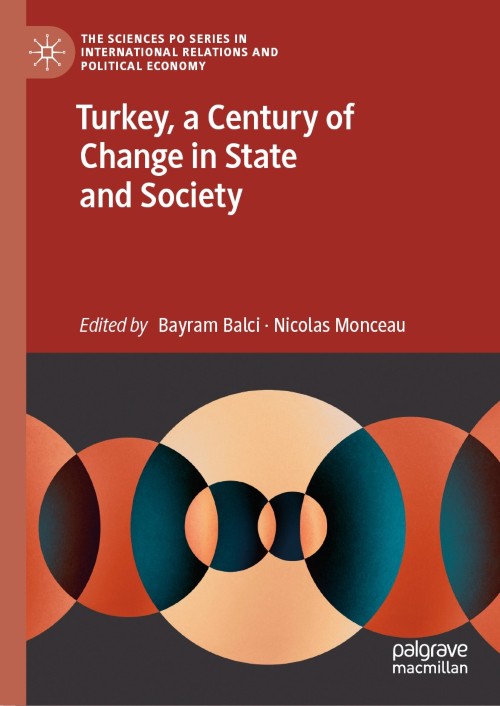
Turkey, a Century of Change in State and Society [electronic resource] / edited by Bayram Balci, Nicolas Monceau.
Erişim Adresi
ISBN
9783031334443
Dil Kodu
İngilizce
Yer Numarası
DK/20487
Basım Bildirimi
1st ed. 2023.
Yayın Bilgisi
Cham : Springer International Publishing : Imprint: Palgrave Macmillan, 2023.
Fiziksel Niteleme
XI, 210 p. 5 illus., 2 illus. in color. online resource.
Dizi
The Sciences Po Series in International Relations and Political Economy, 2945-6088
İçindekiler Notu
Chapter 1. Introduction: From the Ottoman Empire to Republican Turkey. A Century of Disjunctions and Continuities, by Bayram Balci and Nicolas Monceau -- Chapter 2. Belonging to a Republic or Something Else: An Assessment of the Evolution and Challenges to Modern Citizenship in Contemporary Turkey, by Özlem Kaygusuz -- Chapter 3. Transformations in the Turkish Economy: A Political Economy Analysis of 100 Years of the Republic of Turkey, by Ümit Akcay -- Chapter 4. The State and Religion from 1923 to 2023: Major Tendencies in an Incomplete Development, by Bayram Balci -- Chapter 5. Turkey’s Nation-Building and the Kurdish question, by Evren Balta -- Chapter 6. Turkey, the West and Endless Search for Power, by Ilhan Üzgel -- Chapter 7. Turkey and Europe, an Ambivalent Relationship since the Establishment of the Turkish Republic, by Nicolas Monceau -- Chapter 8. Conclusion: Turkey at the crossroads in 2023, by Bayram Balci and Nicolas Monceau. .
Özet, vb.
The Republic of Turkey celebrates the centenary of its proclamation in 2023. Founded on the ruins of the Ottoman Empire, one of the world’s greatest empires both in terms of its geographical extent and its longevity, Republican Turkey has gone through a century of profound and constant changes and transformations from politics to society, economy to religion, or culture to history. These changes have been produced by inner and foreign policies carried out and implemented by the country’s leaders – from Atatürk, the founder of modern Turkey to Recep Tayyip Erdoğan, the current Turkish President in 2023 - but also under the influence of the regional and international context. This collective work aims to take stock of the great achievements of the Turkish republican project. It attempts to draw a general presentation of the evolution of contemporary Turkey in six main areas which constitute six major issues for the country: the general political evolution of Turkey focusing on the issueof citizenship; the transformations in the Turkish economy through a political economy analysis; the evolution of the relationship between religion, state and society; Turkey’s nation-building and the Kurdish question, which still seeks a solution; the changes in Turkish foreign policy focusing on the relationship between Turkey and the West; the relationship between Turkey and Europe, caught between the model of civilization for the republican regime and the prospects of accession to the European Union. Several “focus points” also concentrate on specific subjects such as the Alevi issue, the Cyprus issue or the Turkish soft power with an accent on Africa. Bayram Balci is CNRS researcher at CERI-Sciences Po Paris. His works and publications are related to religion and politics in Turkey, Central Asia, the Caucasus, and the Middle East. Nicolas Monceau is Associate Professor of Political Science, University of Bordeaux, France. His research focuses on Turkish Politics and Turkey in its regional and international environment. He has published several books on Turkey and the Middle East, Turkey and the EU and the Turkish elite.
Konu
International relations.
International economic relations.
International Relations Theory.
International Political Economy’.
International economic relations.
International Relations Theory.
International Political Economy’.
Diğer Yazarlar
Kurum Adı
Eseri Alıntıla
Referansları kullanmadan önce gözden geçirmeniz ve varsa gerekli düzeltmeleri yapmanız önerilir.
Dijital Kaynak
MARC Görünümü
LEADER 06381nam a22006255i 4500
001 819280
003 TR_AnAIT
005 20260130174351
007 cr nn 008mamaa
008 230601s2023 sz | s |||| 0|eng d
020 |a9783031334443|9978-3-031-33444-3
024 7 |a10.1007/978-3-031-33444-3|2doi
041 |aeng
049 |aTürk Tarih Kurumu Kütüphanesi
050 4|aJZ2-6530
072 7|aJPS|2bicssc
072 7|aPOL011000|2bisacsh
072 7|aJPS|2thema
082 04|a327.101|223
090 |aDK/20487
245 10|aTurkey, a Century of Change in State and Society|h[electronic resource] /|cedited by Bayram Balci, Nicolas Monceau.
250 |a1st ed. 2023.
264 1|aCham :|bSpringer International Publishing :|bImprint: Palgrave Macmillan,|c2023.
300 |aXI, 210 p. 5 illus., 2 illus. in color.|bonline resource.
336 |atext|btxt|2rdacontent
337 |acomputer|bc|2rdamedia
338 |aonline resource|bcr|2rdacarrier
341 0 |bTable of contents navigation|2onix
341 0 |bSingle logical reading order|2onix
341 0 |bShort alternative textual descriptions|2onix
341 0 |bUse of color is not sole means of conveying information|2onix
341 0 |bUse of high contrast between text and background color|2onix
341 0 |bNext / Previous structural navigation|2onix
341 0 |bAll non-decorative content supports reading without sight|2onix
347 |atext file|bPDF|2rda
490 1 |aThe Sciences Po Series in International Relations and Political Economy,|x2945-6088
505 0 |aChapter 1. Introduction: From the Ottoman Empire to Republican Turkey. A Century of Disjunctions and Continuities, by Bayram Balci and Nicolas Monceau -- Chapter 2. Belonging to a Republic or Something Else: An Assessment of the Evolution and Challenges to Modern Citizenship in Contemporary Turkey, by Özlem Kaygusuz -- Chapter 3. Transformations in the Turkish Economy: A Political Economy Analysis of 100 Years of the Republic of Turkey, by Ümit Akcay -- Chapter 4. The State and Religion from 1923 to 2023: Major Tendencies in an Incomplete Development, by Bayram Balci -- Chapter 5. Turkey’s Nation-Building and the Kurdish question, by Evren Balta -- Chapter 6. Turkey, the West and Endless Search for Power, by Ilhan Üzgel -- Chapter 7. Turkey and Europe, an Ambivalent Relationship since the Establishment of the Turkish Republic, by Nicolas Monceau -- Chapter 8. Conclusion: Turkey at the crossroads in 2023, by Bayram Balci and Nicolas Monceau. .
520 |aThe Republic of Turkey celebrates the centenary of its proclamation in 2023. Founded on the ruins of the Ottoman Empire, one of the world’s greatest empires both in terms of its geographical extent and its longevity, Republican Turkey has gone through a century of profound and constant changes and transformations from politics to society, economy to religion, or culture to history. These changes have been produced by inner and foreign policies carried out and implemented by the country’s leaders – from Atatürk, the founder of modern Turkey to Recep Tayyip Erdoğan, the current Turkish President in 2023 - but also under the influence of the regional and international context. This collective work aims to take stock of the great achievements of the Turkish republican project. It attempts to draw a general presentation of the evolution of contemporary Turkey in six main areas which constitute six major issues for the country: the general political evolution of Turkey focusing on the issueof citizenship; the transformations in the Turkish economy through a political economy analysis; the evolution of the relationship between religion, state and society; Turkey’s nation-building and the Kurdish question, which still seeks a solution; the changes in Turkish foreign policy focusing on the relationship between Turkey and the West; the relationship between Turkey and Europe, caught between the model of civilization for the republican regime and the prospects of accession to the European Union. Several “focus points” also concentrate on specific subjects such as the Alevi issue, the Cyprus issue or the Turkish soft power with an accent on Africa. Bayram Balci is CNRS researcher at CERI-Sciences Po Paris. His works and publications are related to religion and politics in Turkey, Central Asia, the Caucasus, and the Middle East. Nicolas Monceau is Associate Professor of Political Science, University of Bordeaux, France. His research focuses on Turkish Politics and Turkey in its regional and international environment. He has published several books on Turkey and the Middle East, Turkey and the EU and the Turkish elite.
532 8 |aAccessibility summary: This PDF does not fully comply with PDF/UA standards, but does feature limited screen reader support, described non-text content (images, graphs), bookmarks for easy navigation and searchable, selectable text. Users of assistive technologies may experience difficulty navigating or interpreting content in this document. We recognize the importance of accessibility, and we welcome queries about accessibility for any of our products. If you have a question or an access need, please get in touch with us at accessibilitysupport@springernature.com.
532 8 |aNo reading system accessibility options actively disabled
532 8 |aPublisher contact for further accessibility information: accessibilitysupport@springernature.com
650 0|aInternational relations.
650 0|aInternational economic relations.
650 14|aInternational Relations Theory.
650 24|aInternational Political Economy’.
700 1 |aBalci, Bayram.|eeditor.|4edt|4http://id.loc.gov/vocabulary/relators/edt
700 1 |aMonceau, Nicolas.|eeditor.|4edt|4http://id.loc.gov/vocabulary/relators/edt
710 2 |aSpringerLink (Online service)
773 0 |tSpringer Nature eBook
776 08|iPrinted edition:|z9783031334436
776 08|iPrinted edition:|z9783031334450
776 08|iPrinted edition:|z9783031334467
830 0|aThe Sciences Po Series in International Relations and Political Economy,|x2945-6088
856 40|uhttps://doi.org/10.1007/978-3-031-33444-3
912 |aZDB-2-POS
912 |aZDB-2-SXPI
950 |aPolitical Science and International Studies (SpringerNature-41174)
950 |aPolitical Science and International Studies (R0) (SpringerNature-43724)
001 819280
003 TR_AnAIT
005 20260130174351
007 cr nn 008mamaa
008 230601s2023 sz | s |||| 0|eng d
020 |a9783031334443|9978-3-031-33444-3
024 7 |a10.1007/978-3-031-33444-3|2doi
041 |aeng
049 |aTürk Tarih Kurumu Kütüphanesi
050 4|aJZ2-6530
072 7|aJPS|2bicssc
072 7|aPOL011000|2bisacsh
072 7|aJPS|2thema
082 04|a327.101|223
090 |aDK/20487
245 10|aTurkey, a Century of Change in State and Society|h[electronic resource] /|cedited by Bayram Balci, Nicolas Monceau.
250 |a1st ed. 2023.
264 1|aCham :|bSpringer International Publishing :|bImprint: Palgrave Macmillan,|c2023.
300 |aXI, 210 p. 5 illus., 2 illus. in color.|bonline resource.
336 |atext|btxt|2rdacontent
337 |acomputer|bc|2rdamedia
338 |aonline resource|bcr|2rdacarrier
341 0 |bTable of contents navigation|2onix
341 0 |bSingle logical reading order|2onix
341 0 |bShort alternative textual descriptions|2onix
341 0 |bUse of color is not sole means of conveying information|2onix
341 0 |bUse of high contrast between text and background color|2onix
341 0 |bNext / Previous structural navigation|2onix
341 0 |bAll non-decorative content supports reading without sight|2onix
347 |atext file|bPDF|2rda
490 1 |aThe Sciences Po Series in International Relations and Political Economy,|x2945-6088
505 0 |aChapter 1. Introduction: From the Ottoman Empire to Republican Turkey. A Century of Disjunctions and Continuities, by Bayram Balci and Nicolas Monceau -- Chapter 2. Belonging to a Republic or Something Else: An Assessment of the Evolution and Challenges to Modern Citizenship in Contemporary Turkey, by Özlem Kaygusuz -- Chapter 3. Transformations in the Turkish Economy: A Political Economy Analysis of 100 Years of the Republic of Turkey, by Ümit Akcay -- Chapter 4. The State and Religion from 1923 to 2023: Major Tendencies in an Incomplete Development, by Bayram Balci -- Chapter 5. Turkey’s Nation-Building and the Kurdish question, by Evren Balta -- Chapter 6. Turkey, the West and Endless Search for Power, by Ilhan Üzgel -- Chapter 7. Turkey and Europe, an Ambivalent Relationship since the Establishment of the Turkish Republic, by Nicolas Monceau -- Chapter 8. Conclusion: Turkey at the crossroads in 2023, by Bayram Balci and Nicolas Monceau. .
520 |aThe Republic of Turkey celebrates the centenary of its proclamation in 2023. Founded on the ruins of the Ottoman Empire, one of the world’s greatest empires both in terms of its geographical extent and its longevity, Republican Turkey has gone through a century of profound and constant changes and transformations from politics to society, economy to religion, or culture to history. These changes have been produced by inner and foreign policies carried out and implemented by the country’s leaders – from Atatürk, the founder of modern Turkey to Recep Tayyip Erdoğan, the current Turkish President in 2023 - but also under the influence of the regional and international context. This collective work aims to take stock of the great achievements of the Turkish republican project. It attempts to draw a general presentation of the evolution of contemporary Turkey in six main areas which constitute six major issues for the country: the general political evolution of Turkey focusing on the issueof citizenship; the transformations in the Turkish economy through a political economy analysis; the evolution of the relationship between religion, state and society; Turkey’s nation-building and the Kurdish question, which still seeks a solution; the changes in Turkish foreign policy focusing on the relationship between Turkey and the West; the relationship between Turkey and Europe, caught between the model of civilization for the republican regime and the prospects of accession to the European Union. Several “focus points” also concentrate on specific subjects such as the Alevi issue, the Cyprus issue or the Turkish soft power with an accent on Africa. Bayram Balci is CNRS researcher at CERI-Sciences Po Paris. His works and publications are related to religion and politics in Turkey, Central Asia, the Caucasus, and the Middle East. Nicolas Monceau is Associate Professor of Political Science, University of Bordeaux, France. His research focuses on Turkish Politics and Turkey in its regional and international environment. He has published several books on Turkey and the Middle East, Turkey and the EU and the Turkish elite.
532 8 |aAccessibility summary: This PDF does not fully comply with PDF/UA standards, but does feature limited screen reader support, described non-text content (images, graphs), bookmarks for easy navigation and searchable, selectable text. Users of assistive technologies may experience difficulty navigating or interpreting content in this document. We recognize the importance of accessibility, and we welcome queries about accessibility for any of our products. If you have a question or an access need, please get in touch with us at accessibilitysupport@springernature.com.
532 8 |aNo reading system accessibility options actively disabled
532 8 |aPublisher contact for further accessibility information: accessibilitysupport@springernature.com
650 0|aInternational relations.
650 0|aInternational economic relations.
650 14|aInternational Relations Theory.
650 24|aInternational Political Economy’.
700 1 |aBalci, Bayram.|eeditor.|4edt|4http://id.loc.gov/vocabulary/relators/edt
700 1 |aMonceau, Nicolas.|eeditor.|4edt|4http://id.loc.gov/vocabulary/relators/edt
710 2 |aSpringerLink (Online service)
773 0 |tSpringer Nature eBook
776 08|iPrinted edition:|z9783031334436
776 08|iPrinted edition:|z9783031334450
776 08|iPrinted edition:|z9783031334467
830 0|aThe Sciences Po Series in International Relations and Political Economy,|x2945-6088
856 40|uhttps://doi.org/10.1007/978-3-031-33444-3
912 |aZDB-2-POS
912 |aZDB-2-SXPI
950 |aPolitical Science and International Studies (SpringerNature-41174)
950 |aPolitical Science and International Studies (R0) (SpringerNature-43724)
Materyaller
Depodan talep edilen materyal sadece kütüphane içerisinde kullanılmaktadır.
Materyal dışarıya ödünç verilmemektedir.
Materyal dışarıya ödünç verilmemektedir.
