

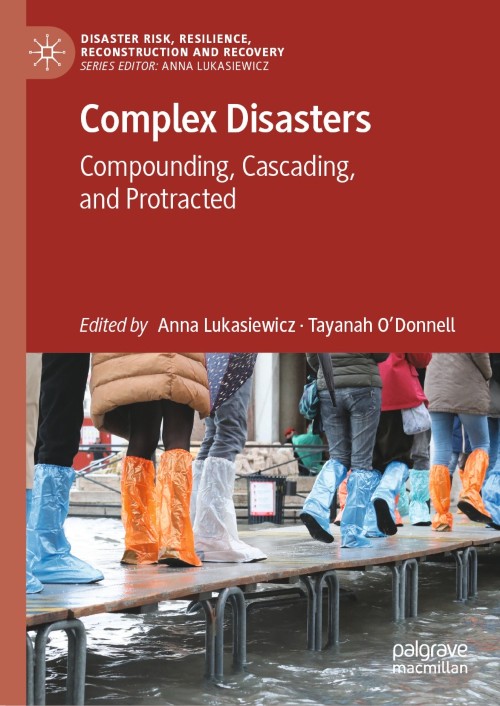
Complex Disasters [electronic resource] : Compounding, Cascading, and Protracted / edited by Anna Lukasiewicz, Tayanah O’Donnell.
Erişim Adresi
ISBN
9789811924286
Dil Kodu
İngilizce
Yer Numarası
DK/20593
Basım Bildirimi
1st ed. 2022.
Yayın Bilgisi
Singapore : Springer Nature Singapore : Imprint: Palgrave Macmillan, 2022.
Fiziksel Niteleme
XXVII, 394 p. 27 illus., 21 illus. in color. online resource.
Dizi
Disaster Risk, Resilience, Reconstruction and Recovery, 2662-5679
İçindekiler Notu
Section 1: Introducing the concepts -- Chapter 1: The Evolution of Complex Disasters -- Chapter 2: Fire and Flood: Contextualising compound, cascading, and protracted disaster -- Chapter 3: What’s in a name? Deconstructing risk and resilience -- Chapter 4: The Nature of Climate-related Disasters in Australia -- Chapter 5: Coasts: A Battleground in Disaster Preparedness, Response, and Climate Change Adaptation -- Section 2: Compound Risks and Impacts -- Chapter 6: Ten years on: Brisbane’s compounding flood risk -- Chapter 7: Accounting for the compounding effects of climate change on coastal residents -- Chapter 8: A health geography of the compound effects of contaminated sites and extreme weather events on mental health -- Chapter 9: Living with floods in Makassar, Indonesia: a qualitative investigation of compounding and cascading risks in the context of flood-prone informal settlements -- Chapter 10: Chokepoints: the challenges of improving surveillance of emerging biological hazards across the Indo-Pacific region -- Chapter 11: The role of gardening in response to cascading disaster on peri-urban fringe of Port Vila, Vanuatu -- Section 4: Protracted Disasters and their Impacts on Recovery -- Chapter 12: Public hazard awareness for culturally and linguistically diverse communities during protracted events -- Chapter 13: Earthquakes, tsunami and climate change: customary management and disaster adaptation -- Chapter 14: Kinship as cultural citizenship in post-disaster housing reconstruction: Narratives from fisherfolk in the Philippines -- Chapter 15: The disconnections that facilitate protracted disasters: barriers to adapting to fire in the Australian landscape -- Section 5: Managing Disaster Complexity -- Chapter 16: National policy frameworks for compound, cascading and protracted disasters: learning from other policy sectors -- Chapter 17: Definition and explanation of community disaster fatigue -- Chapter 18: Enabling a collaborative research environment to meet complexities of compound, cascading and protracted disasters -- Chapter 19: Complex disasters as part of everyday life.
Özet, vb.
This is an important, timely and provocative book! The authors explore the contested terrain of risk and disaster, challenging the reader through diverse, and at times disruptive, perspectives and analysis. Unusually for material on this subject, I found the book very accessible. It deserves to be widely read and I expect it to have significant influence on thinking and policy. The volume is also a wonderful tribute to Professor Helen James. -- Emeritus Professor John Handmer, FASSA, Senior Research Scholar, International Institute for Applied Systems Analysis (IIASA), Vienna Exploration of the complexity of disasters in a multi-hazard context is crucial to improving future disaster resilience. For policymakers the book provides evidence of the need to invest in disaster resilience and adaptation to address the growing threats posed by complex disasters. — Andrew Gissing, Fellow at Macquarie University and General Manager, Risk Frontiers, Sydney, Australia The authoring of complex disasters: compounding, cascading, and protracted is both timely and essential. This book makes a significant contribution in helping policy makers, academics, strategists, operational leaders as well as anyone else who is concerned about the current and future challenges in disaster risk management to think differently about disasters. -- Mark Crosweller AFMS, former Director-General Emergency Management, Canberra, Australia This Edited book introduces the concept of complex disasters and considers both disaster risks and impacts across the disaster management spectrum – Prevention – Preparation – Response and Recovery. Three types of complex disasters are analysed – ‘compound’, ‘cascading’ and ‘protracted’. The book will be useful to researchers in climate, disaster, or environmental and economic policy, disaster risk reduction, and climate change studies, and practitioners and policy makers applying disaster theory and knowledge into policy and decision-making. Anna Lukasiewicz researches topics around the distribution of natural resources; water governance; disaster justice and natural hazard management. She works at the interface of justice and natural resource management. Tayanah O’Donnell is an Honorary Associate Professor at the Australian National University and Partner with Deloitte, climate and sustainability. Her research interests include: climate and environmental regulation and policy, managed retreat, disaster resilience and climate change adaptation. She was previously a senior executive at the Australian Academy of Science.
Konu
Economic development.
Earth sciences.
Environment.
Geography.
Development Studies.
Earth Sciences.
Environmental Sciences.
Geography.
Earth sciences.
Environment.
Geography.
Development Studies.
Earth Sciences.
Environmental Sciences.
Geography.
Diğer Yazarlar
Kurum Adı
Eseri Alıntıla
Referansları kullanmadan önce gözden geçirmeniz ve varsa gerekli düzeltmeleri yapmanız önerilir.
Dijital Kaynak
MARC Görünümü
LEADER 08043nam a22006735i 4500
001 819386
003 TR_AnAIT
005 20260130174016
007 cr nn 008mamaa
008 221020s2022 si | s |||| 0|eng d
020 |a9789811924286|9978-981-19-2428-6
024 7 |a10.1007/978-981-19-2428-6|2doi
041 |aeng
049 |aTürk Tarih Kurumu Kütüphanesi
050 4|aHD72-88
072 7|aGTF|2bicssc
072 7|aSOC042000|2bisacsh
072 7|aGTP|2thema
082 04|a338.9|223
090 |aDK/20593
245 10|aComplex Disasters|h[electronic resource] :|bCompounding, Cascading, and Protracted /|cedited by Anna Lukasiewicz, Tayanah O’Donnell.
250 |a1st ed. 2022.
264 1|aSingapore :|bSpringer Nature Singapore :|bImprint: Palgrave Macmillan,|c2022.
300 |aXXVII, 394 p. 27 illus., 21 illus. in color.|bonline resource.
336 |atext|btxt|2rdacontent
337 |acomputer|bc|2rdamedia
338 |aonline resource|bcr|2rdacarrier
341 0 |bTable of contents navigation|2onix
341 0 |bSingle logical reading order|2onix
341 0 |bShort alternative textual descriptions|2onix
341 0 |bUse of color is not sole means of conveying information|2onix
341 0 |bUse of high contrast between text and background color|2onix
341 0 |bNext / Previous structural navigation|2onix
341 0 |bAll non-decorative content supports reading without sight|2onix
347 |atext file|bPDF|2rda
490 1 |aDisaster Risk, Resilience, Reconstruction and Recovery,|x2662-5679
505 0 |aSection 1: Introducing the concepts -- Chapter 1: The Evolution of Complex Disasters -- Chapter 2: Fire and Flood: Contextualising compound, cascading, and protracted disaster -- Chapter 3: What’s in a name? Deconstructing risk and resilience -- Chapter 4: The Nature of Climate-related Disasters in Australia -- Chapter 5: Coasts: A Battleground in Disaster Preparedness, Response, and Climate Change Adaptation -- Section 2: Compound Risks and Impacts -- Chapter 6: Ten years on: Brisbane’s compounding flood risk -- Chapter 7: Accounting for the compounding effects of climate change on coastal residents -- Chapter 8: A health geography of the compound effects of contaminated sites and extreme weather events on mental health -- Chapter 9: Living with floods in Makassar, Indonesia: a qualitative investigation of compounding and cascading risks in the context of flood-prone informal settlements -- Chapter 10: Chokepoints: the challenges of improving surveillance of emerging biological hazards across the Indo-Pacific region -- Chapter 11: The role of gardening in response to cascading disaster on peri-urban fringe of Port Vila, Vanuatu -- Section 4: Protracted Disasters and their Impacts on Recovery -- Chapter 12: Public hazard awareness for culturally and linguistically diverse communities during protracted events -- Chapter 13: Earthquakes, tsunami and climate change: customary management and disaster adaptation -- Chapter 14: Kinship as cultural citizenship in post-disaster housing reconstruction: Narratives from fisherfolk in the Philippines -- Chapter 15: The disconnections that facilitate protracted disasters: barriers to adapting to fire in the Australian landscape -- Section 5: Managing Disaster Complexity -- Chapter 16: National policy frameworks for compound, cascading and protracted disasters: learning from other policy sectors -- Chapter 17: Definition and explanation of community disaster fatigue -- Chapter 18: Enabling a collaborative research environment to meet complexities of compound, cascading and protracted disasters -- Chapter 19: Complex disasters as part of everyday life.
520 |aThis is an important, timely and provocative book! The authors explore the contested terrain of risk and disaster, challenging the reader through diverse, and at times disruptive, perspectives and analysis. Unusually for material on this subject, I found the book very accessible. It deserves to be widely read and I expect it to have significant influence on thinking and policy. The volume is also a wonderful tribute to Professor Helen James. -- Emeritus Professor John Handmer, FASSA, Senior Research Scholar, International Institute for Applied Systems Analysis (IIASA), Vienna Exploration of the complexity of disasters in a multi-hazard context is crucial to improving future disaster resilience. For policymakers the book provides evidence of the need to invest in disaster resilience and adaptation to address the growing threats posed by complex disasters. — Andrew Gissing, Fellow at Macquarie University and General Manager, Risk Frontiers, Sydney, Australia The authoring of complex disasters: compounding, cascading, and protracted is both timely and essential. This book makes a significant contribution in helping policy makers, academics, strategists, operational leaders as well as anyone else who is concerned about the current and future challenges in disaster risk management to think differently about disasters. -- Mark Crosweller AFMS, former Director-General Emergency Management, Canberra, Australia This Edited book introduces the concept of complex disasters and considers both disaster risks and impacts across the disaster management spectrum – Prevention – Preparation – Response and Recovery. Three types of complex disasters are analysed – ‘compound’, ‘cascading’ and ‘protracted’. The book will be useful to researchers in climate, disaster, or environmental and economic policy, disaster risk reduction, and climate change studies, and practitioners and policy makers applying disaster theory and knowledge into policy and decision-making. Anna Lukasiewicz researches topics around the distribution of natural resources; water governance; disaster justice and natural hazard management. She works at the interface of justice and natural resource management. Tayanah O’Donnell is an Honorary Associate Professor at the Australian National University and Partner with Deloitte, climate and sustainability. Her research interests include: climate and environmental regulation and policy, managed retreat, disaster resilience and climate change adaptation. She was previously a senior executive at the Australian Academy of Science.
532 8 |aAccessibility summary: This PDF does not fully comply with PDF/UA standards, but does feature limited screen reader support, described non-text content (images, graphs), bookmarks for easy navigation and searchable, selectable text. Users of assistive technologies may experience difficulty navigating or interpreting content in this document. We recognize the importance of accessibility, and we welcome queries about accessibility for any of our products. If you have a question or an access need, please get in touch with us at accessibilitysupport@springernature.com.
532 8 |aNo reading system accessibility options actively disabled
532 8 |aPublisher contact for further accessibility information: accessibilitysupport@springernature.com
650 0|aEconomic development.
650 0|aEarth sciences.
650 0|aEnvironment.
650 0|aGeography.
650 14|aDevelopment Studies.
650 24|aEarth Sciences.
650 24|aEnvironmental Sciences.
650 24|aGeography.
700 1 |aLukasiewicz, Anna.|eeditor.|4edt|4http://id.loc.gov/vocabulary/relators/edt
700 1 |aO’Donnell, Tayanah.|eeditor.|4edt|4http://id.loc.gov/vocabulary/relators/edt
710 2 |aSpringerLink (Online service)
773 0 |tSpringer Nature eBook
776 08|iPrinted edition:|z9789811924279
776 08|iPrinted edition:|z9789811924293
776 08|iPrinted edition:|z9789811924309
830 0|aDisaster Risk, Resilience, Reconstruction and Recovery,|x2662-5679
856 40|uhttps://doi.org/10.1007/978-981-19-2428-6
912 |aZDB-2-POS
912 |aZDB-2-SXPI
950 |aPolitical Science and International Studies (SpringerNature-41174)
950 |aPolitical Science and International Studies (R0) (SpringerNature-43724)
001 819386
003 TR_AnAIT
005 20260130174016
007 cr nn 008mamaa
008 221020s2022 si | s |||| 0|eng d
020 |a9789811924286|9978-981-19-2428-6
024 7 |a10.1007/978-981-19-2428-6|2doi
041 |aeng
049 |aTürk Tarih Kurumu Kütüphanesi
050 4|aHD72-88
072 7|aGTF|2bicssc
072 7|aSOC042000|2bisacsh
072 7|aGTP|2thema
082 04|a338.9|223
090 |aDK/20593
245 10|aComplex Disasters|h[electronic resource] :|bCompounding, Cascading, and Protracted /|cedited by Anna Lukasiewicz, Tayanah O’Donnell.
250 |a1st ed. 2022.
264 1|aSingapore :|bSpringer Nature Singapore :|bImprint: Palgrave Macmillan,|c2022.
300 |aXXVII, 394 p. 27 illus., 21 illus. in color.|bonline resource.
336 |atext|btxt|2rdacontent
337 |acomputer|bc|2rdamedia
338 |aonline resource|bcr|2rdacarrier
341 0 |bTable of contents navigation|2onix
341 0 |bSingle logical reading order|2onix
341 0 |bShort alternative textual descriptions|2onix
341 0 |bUse of color is not sole means of conveying information|2onix
341 0 |bUse of high contrast between text and background color|2onix
341 0 |bNext / Previous structural navigation|2onix
341 0 |bAll non-decorative content supports reading without sight|2onix
347 |atext file|bPDF|2rda
490 1 |aDisaster Risk, Resilience, Reconstruction and Recovery,|x2662-5679
505 0 |aSection 1: Introducing the concepts -- Chapter 1: The Evolution of Complex Disasters -- Chapter 2: Fire and Flood: Contextualising compound, cascading, and protracted disaster -- Chapter 3: What’s in a name? Deconstructing risk and resilience -- Chapter 4: The Nature of Climate-related Disasters in Australia -- Chapter 5: Coasts: A Battleground in Disaster Preparedness, Response, and Climate Change Adaptation -- Section 2: Compound Risks and Impacts -- Chapter 6: Ten years on: Brisbane’s compounding flood risk -- Chapter 7: Accounting for the compounding effects of climate change on coastal residents -- Chapter 8: A health geography of the compound effects of contaminated sites and extreme weather events on mental health -- Chapter 9: Living with floods in Makassar, Indonesia: a qualitative investigation of compounding and cascading risks in the context of flood-prone informal settlements -- Chapter 10: Chokepoints: the challenges of improving surveillance of emerging biological hazards across the Indo-Pacific region -- Chapter 11: The role of gardening in response to cascading disaster on peri-urban fringe of Port Vila, Vanuatu -- Section 4: Protracted Disasters and their Impacts on Recovery -- Chapter 12: Public hazard awareness for culturally and linguistically diverse communities during protracted events -- Chapter 13: Earthquakes, tsunami and climate change: customary management and disaster adaptation -- Chapter 14: Kinship as cultural citizenship in post-disaster housing reconstruction: Narratives from fisherfolk in the Philippines -- Chapter 15: The disconnections that facilitate protracted disasters: barriers to adapting to fire in the Australian landscape -- Section 5: Managing Disaster Complexity -- Chapter 16: National policy frameworks for compound, cascading and protracted disasters: learning from other policy sectors -- Chapter 17: Definition and explanation of community disaster fatigue -- Chapter 18: Enabling a collaborative research environment to meet complexities of compound, cascading and protracted disasters -- Chapter 19: Complex disasters as part of everyday life.
520 |aThis is an important, timely and provocative book! The authors explore the contested terrain of risk and disaster, challenging the reader through diverse, and at times disruptive, perspectives and analysis. Unusually for material on this subject, I found the book very accessible. It deserves to be widely read and I expect it to have significant influence on thinking and policy. The volume is also a wonderful tribute to Professor Helen James. -- Emeritus Professor John Handmer, FASSA, Senior Research Scholar, International Institute for Applied Systems Analysis (IIASA), Vienna Exploration of the complexity of disasters in a multi-hazard context is crucial to improving future disaster resilience. For policymakers the book provides evidence of the need to invest in disaster resilience and adaptation to address the growing threats posed by complex disasters. — Andrew Gissing, Fellow at Macquarie University and General Manager, Risk Frontiers, Sydney, Australia The authoring of complex disasters: compounding, cascading, and protracted is both timely and essential. This book makes a significant contribution in helping policy makers, academics, strategists, operational leaders as well as anyone else who is concerned about the current and future challenges in disaster risk management to think differently about disasters. -- Mark Crosweller AFMS, former Director-General Emergency Management, Canberra, Australia This Edited book introduces the concept of complex disasters and considers both disaster risks and impacts across the disaster management spectrum – Prevention – Preparation – Response and Recovery. Three types of complex disasters are analysed – ‘compound’, ‘cascading’ and ‘protracted’. The book will be useful to researchers in climate, disaster, or environmental and economic policy, disaster risk reduction, and climate change studies, and practitioners and policy makers applying disaster theory and knowledge into policy and decision-making. Anna Lukasiewicz researches topics around the distribution of natural resources; water governance; disaster justice and natural hazard management. She works at the interface of justice and natural resource management. Tayanah O’Donnell is an Honorary Associate Professor at the Australian National University and Partner with Deloitte, climate and sustainability. Her research interests include: climate and environmental regulation and policy, managed retreat, disaster resilience and climate change adaptation. She was previously a senior executive at the Australian Academy of Science.
532 8 |aAccessibility summary: This PDF does not fully comply with PDF/UA standards, but does feature limited screen reader support, described non-text content (images, graphs), bookmarks for easy navigation and searchable, selectable text. Users of assistive technologies may experience difficulty navigating or interpreting content in this document. We recognize the importance of accessibility, and we welcome queries about accessibility for any of our products. If you have a question or an access need, please get in touch with us at accessibilitysupport@springernature.com.
532 8 |aNo reading system accessibility options actively disabled
532 8 |aPublisher contact for further accessibility information: accessibilitysupport@springernature.com
650 0|aEconomic development.
650 0|aEarth sciences.
650 0|aEnvironment.
650 0|aGeography.
650 14|aDevelopment Studies.
650 24|aEarth Sciences.
650 24|aEnvironmental Sciences.
650 24|aGeography.
700 1 |aLukasiewicz, Anna.|eeditor.|4edt|4http://id.loc.gov/vocabulary/relators/edt
700 1 |aO’Donnell, Tayanah.|eeditor.|4edt|4http://id.loc.gov/vocabulary/relators/edt
710 2 |aSpringerLink (Online service)
773 0 |tSpringer Nature eBook
776 08|iPrinted edition:|z9789811924279
776 08|iPrinted edition:|z9789811924293
776 08|iPrinted edition:|z9789811924309
830 0|aDisaster Risk, Resilience, Reconstruction and Recovery,|x2662-5679
856 40|uhttps://doi.org/10.1007/978-981-19-2428-6
912 |aZDB-2-POS
912 |aZDB-2-SXPI
950 |aPolitical Science and International Studies (SpringerNature-41174)
950 |aPolitical Science and International Studies (R0) (SpringerNature-43724)
Materyaller
Depodan talep edilen materyal sadece kütüphane içerisinde kullanılmaktadır.
Materyal dışarıya ödünç verilmemektedir.
Materyal dışarıya ödünç verilmemektedir.
