

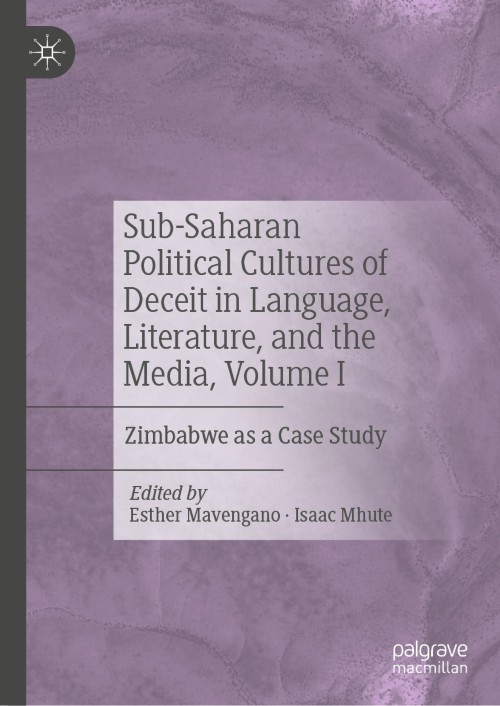
Sub-Saharan Political Cultures of Deceit in Language, Literature, and the Media, Volume I [electronic resource] : Zimbabwe as a Case Study / edited by Esther Mavengano, Isaac Mhute.
Erişim Adresi
ISBN
9783031353239
Dil Kodu
İngilizce
Yer Numarası
DK/20632
Basım Bildirimi
1st ed. 2023.
Yayın Bilgisi
Cham : Springer Nature Switzerland : Imprint: Palgrave Macmillan, 2023.
Fiziksel Niteleme
XXI, 370 p. 5 illus., 3 illus. in color. online resource.
İçindekiler Notu
1. Introduction: Contextualising the notion of deceit in the postcolonial Zimbabwe’s political landscape. Isaac Mhute and Esther Mavengano -- Part I : Language/discourse and a culture of deceit in Zimbabwe’s politics -- 2. Polit(r)icking and massaging the ballot in Zimbabwe’s Transitions. Liberty Muchativugwa Hove -- 3. The Paradox of POST- Colonial Politics: A Critical Appraisal of Zimbabwe’s False . Tawanda Shura & Isaac Mhute -- 4. Vachingovukura (whilst they are barking ineffectually); The Mango idiom and postcolonial deceit in Zimbabwe’s political discourse. Edmore Dube -- 5. Counting Cost, Ignoring the Value: Can the gap between Political and Linguistic Autonomy in Zimbabwe be Reconciled?. Beatrice Taringa -- 6. Judas Iscariotism and Zimbabwe Opposition Politics: Deceit, Fear of Difference and Language of Misrepresentation. Wilson Zivave -- 7. The political landscape and a culture of deceit in postcolonial Zimbabwe: Scholarly discourse under siege. Temba T. Rugwiji -- Part 2: The poetic and sonic narratives of political deceit in postcolonial times -- 8. The polemics of nationalism in Zimbabwean fictional and political discourses ‘Nyika inovakwa (kana kuputswa) nevene vayo’ (A nation is built (or destroyed) by its owners). Esther Mavengano -- 9. Through the lenses of betrayal: Ambivalence and other markers of deception in Aaron Chiundura Moyo’s Kuridza Ngoma Nedemo (1985). Angeline Mavis Madongonda & Enna Sukutai Gudhlanga -- 10. The Post-Independent Zimbabwean Leadership and literary imaginings of betrayal in Ignatius .Mabasa`s Novel Mapenzi (1999). Wellington Wasosa -- 11. Judas culture in Post-colonial Zimbabwe: Gendered and Land Redistribution in Raymond’s Choto’s Vavariro (1990). Enna Sukutai Gudhlanga & Angeline Mavis Madongonda -- 12. Metaphorisation and erotisisation of the female body in David Mungoshi’s The Fading Sun: A symbolic representation of the post-colonial Zimbabwean society. Andrew Mutingwende & Esther Mavengano -- 13. Politics of deceit: The Dynamics of political jingles in postcolonial Zimbabwe. Vimbai Moreblessing Matiza -- Part 3: The media, conflict and a culture of deceit in postcolonial Zimbabwean politics -- 14. The Media, Conflict and Culture of Deceit in Postcolonial Zimbabwean Politics. Takavafira Masarira Zhou -- 15. An analysis of the nexus between media and political polarisation in Zimbabwe. Gift Gwindingwe -- 16. Citizen or alien? Politics of urban control and the dis(ex)tortion of Democracy in Zimbabwe. Andrew Mutingwende -- 17. Power, Politics and Public Media Deceit in Zimbabwe, 2000-2023. Pedzisai Ruhanya & Bekezela Gumbo -- 18. Modeling Electoral Integrity on Political Campaigns in Zimbabwe: The Problems of Deception and Lying During General Elections. Gift Masengwe -- 19. Sanctions are the source of our suffering”: of ZANU PF’s exhausted rhetoric and blame-gaming tactics as hegemonic preservation. Collen Sabao.
Özet, vb.
This two-volume set charts a cross-disciplinary discursive terrain that proffers rich insights about deceit in contemporary postcolonial Sub-Saharan African politics. In an attempt to produce a nuanced and multi-faceted academic dialoguing platform, the two volumes have a particular focus on the aspects of treachery, fear of difference (oppositional politics), and discourses/ semiotics of mis/self- representation. The major aim of the proposed volumes is to contribute toward the often problematised conversations about the unfolding (post)colonial Sub-Saharan world which is topical in decolonial and Pan-African studies. The volumes seek to place political thinking and postcolonial political systems under the scholarly gaze with the view to highlight and enhance the participation of African cross-disciplinary scholarship in the postcolonial political processes of the continent. Most significantly, it is through such probing of the limitations of our own disciplinary perspectives which can help us appreciate the complexity of the postcolonial Sub-Saharan African politics. The first volume uses Zimbabwe as a case study, while the second volume broadens to examine postcolonial politics in Sub-Saharan Africa more broadly. Esther Mavengano is lecturer in English and Media Studies, Great Zimbabwe University, Zimbabwe. Isaac Mhute is Associate Professor of Language, Literature and Culture Studies, Midlands State University, Zimbabwe.
Konu
Africa __ Politics and government.
Communication in politics.
Africa, Sub-Saharan __ History.
Knowledge, Sociology of.
Semiotics.
African Politics.
Political Communication.
History of Sub-Saharan Africa.
Sociology of Knowledge and Discourse.
Semiotics.
Communication in politics.
Africa, Sub-Saharan __ History.
Knowledge, Sociology of.
Semiotics.
African Politics.
Political Communication.
History of Sub-Saharan Africa.
Sociology of Knowledge and Discourse.
Semiotics.
Diğer Yazarlar
Kurum Adı
Eseri Alıntıla
Referansları kullanmadan önce gözden geçirmeniz ve varsa gerekli düzeltmeleri yapmanız önerilir.
Dijital Kaynak
MARC Görünümü
LEADER 07762nam a22006855i 4500
001 819425
003 TR_AnAIT
005 20260130173837
007 cr nn 008mamaa
008 231118s2023 sz | s |||| 0|eng d
020 |a9783031353239|9978-3-031-35323-9
024 7 |a10.1007/978-3-031-35323-9|2doi
041 |aeng
049 |aTürk Tarih Kurumu Kütüphanesi
050 4|aJQ1870-3981
072 7|aJP|2bicssc
072 7|a1H|2bicssc
072 7|aPOL053000|2bisacsh
072 7|aJP|x1H|2thema
082 04|a320.96|223
090 |aDK/20632
245 10|aSub-Saharan Political Cultures of Deceit in Language, Literature, and the Media, Volume I|h[electronic resource] :|bZimbabwe as a Case Study /|cedited by Esther Mavengano, Isaac Mhute.
250 |a1st ed. 2023.
264 1|aCham :|bSpringer Nature Switzerland :|bImprint: Palgrave Macmillan,|c2023.
300 |aXXI, 370 p. 5 illus., 3 illus. in color.|bonline resource.
336 |atext|btxt|2rdacontent
337 |acomputer|bc|2rdamedia
338 |aonline resource|bcr|2rdacarrier
341 0 |bTable of contents navigation|2onix
341 0 |bSingle logical reading order|2onix
341 0 |bShort alternative textual descriptions|2onix
341 0 |bUse of color is not sole means of conveying information|2onix
341 0 |bUse of high contrast between text and background color|2onix
341 0 |bNext / Previous structural navigation|2onix
341 0 |bAll non-decorative content supports reading without sight|2onix
347 |atext file|bPDF|2rda
505 0 |a1. Introduction: Contextualising the notion of deceit in the postcolonial Zimbabwe’s political landscape. Isaac Mhute and Esther Mavengano -- Part I : Language/discourse and a culture of deceit in Zimbabwe’s politics -- 2. Polit(r)icking and massaging the ballot in Zimbabwe’s Transitions. Liberty Muchativugwa Hove -- 3. The Paradox of POST- Colonial Politics: A Critical Appraisal of Zimbabwe’s False . Tawanda Shura & Isaac Mhute -- 4. Vachingovukura (whilst they are barking ineffectually); The Mango idiom and postcolonial deceit in Zimbabwe’s political discourse. Edmore Dube -- 5. Counting Cost, Ignoring the Value: Can the gap between Political and Linguistic Autonomy in Zimbabwe be Reconciled?. Beatrice Taringa -- 6. Judas Iscariotism and Zimbabwe Opposition Politics: Deceit, Fear of Difference and Language of Misrepresentation. Wilson Zivave -- 7. The political landscape and a culture of deceit in postcolonial Zimbabwe: Scholarly discourse under siege. Temba T. Rugwiji -- Part 2: The poetic and sonic narratives of political deceit in postcolonial times -- 8. The polemics of nationalism in Zimbabwean fictional and political discourses ‘Nyika inovakwa (kana kuputswa) nevene vayo’ (A nation is built (or destroyed) by its owners). Esther Mavengano -- 9. Through the lenses of betrayal: Ambivalence and other markers of deception in Aaron Chiundura Moyo’s Kuridza Ngoma Nedemo (1985). Angeline Mavis Madongonda & Enna Sukutai Gudhlanga -- 10. The Post-Independent Zimbabwean Leadership and literary imaginings of betrayal in Ignatius .Mabasa`s Novel Mapenzi (1999). Wellington Wasosa -- 11. Judas culture in Post-colonial Zimbabwe: Gendered and Land Redistribution in Raymond’s Choto’s Vavariro (1990). Enna Sukutai Gudhlanga & Angeline Mavis Madongonda -- 12. Metaphorisation and erotisisation of the female body in David Mungoshi’s The Fading Sun: A symbolic representation of the post-colonial Zimbabwean society. Andrew Mutingwende & Esther Mavengano -- 13. Politics of deceit: The Dynamics of political jingles in postcolonial Zimbabwe. Vimbai Moreblessing Matiza -- Part 3: The media, conflict and a culture of deceit in postcolonial Zimbabwean politics -- 14. The Media, Conflict and Culture of Deceit in Postcolonial Zimbabwean Politics. Takavafira Masarira Zhou -- 15. An analysis of the nexus between media and political polarisation in Zimbabwe. Gift Gwindingwe -- 16. Citizen or alien? Politics of urban control and the dis(ex)tortion of Democracy in Zimbabwe. Andrew Mutingwende -- 17. Power, Politics and Public Media Deceit in Zimbabwe, 2000-2023. Pedzisai Ruhanya & Bekezela Gumbo -- 18. Modeling Electoral Integrity on Political Campaigns in Zimbabwe: The Problems of Deception and Lying During General Elections. Gift Masengwe -- 19. Sanctions are the source of our suffering”: of ZANU PF’s exhausted rhetoric and blame-gaming tactics as hegemonic preservation. Collen Sabao.
520 |aThis two-volume set charts a cross-disciplinary discursive terrain that proffers rich insights about deceit in contemporary postcolonial Sub-Saharan African politics. In an attempt to produce a nuanced and multi-faceted academic dialoguing platform, the two volumes have a particular focus on the aspects of treachery, fear of difference (oppositional politics), and discourses/ semiotics of mis/self- representation. The major aim of the proposed volumes is to contribute toward the often problematised conversations about the unfolding (post)colonial Sub-Saharan world which is topical in decolonial and Pan-African studies. The volumes seek to place political thinking and postcolonial political systems under the scholarly gaze with the view to highlight and enhance the participation of African cross-disciplinary scholarship in the postcolonial political processes of the continent. Most significantly, it is through such probing of the limitations of our own disciplinary perspectives which can help us appreciate the complexity of the postcolonial Sub-Saharan African politics. The first volume uses Zimbabwe as a case study, while the second volume broadens to examine postcolonial politics in Sub-Saharan Africa more broadly. Esther Mavengano is lecturer in English and Media Studies, Great Zimbabwe University, Zimbabwe. Isaac Mhute is Associate Professor of Language, Literature and Culture Studies, Midlands State University, Zimbabwe.
532 8 |aAccessibility summary: This PDF does not fully comply with PDF/UA standards, but does feature limited screen reader support, described non-text content (images, graphs), bookmarks for easy navigation and searchable, selectable text. Users of assistive technologies may experience difficulty navigating or interpreting content in this document. We recognize the importance of accessibility, and we welcome queries about accessibility for any of our products. If you have a question or an access need, please get in touch with us at accessibilitysupport@springernature.com.
532 8 |aNo reading system accessibility options actively disabled
532 8 |aPublisher contact for further accessibility information: accessibilitysupport@springernature.com
650 0|aAfrica|xPolitics and government.
650 0|aCommunication in politics.
650 0|aAfrica, Sub-Saharan|xHistory.
650 0|aKnowledge, Sociology of.
650 0|aSemiotics.
650 14|aAfrican Politics.
650 24|aPolitical Communication.
650 24|aHistory of Sub-Saharan Africa.
650 24|aSociology of Knowledge and Discourse.
650 24|aSemiotics.
700 1 |aMavengano, Esther.|eeditor.|4edt|4http://id.loc.gov/vocabulary/relators/edt
700 1 |aMhute, Isaac.|eeditor.|4edt|4http://id.loc.gov/vocabulary/relators/edt
710 2 |aSpringerLink (Online service)
773 0 |tSpringer Nature eBook
776 08|iPrinted edition:|z9783031353222
776 08|iPrinted edition:|z9783031353246
776 08|iPrinted edition:|z9783031353253
856 40|uhttps://doi.org/10.1007/978-3-031-35323-9
912 |aZDB-2-POS
912 |aZDB-2-SXPI
950 |aPolitical Science and International Studies (SpringerNature-41174)
950 |aPolitical Science and International Studies (R0) (SpringerNature-43724)
001 819425
003 TR_AnAIT
005 20260130173837
007 cr nn 008mamaa
008 231118s2023 sz | s |||| 0|eng d
020 |a9783031353239|9978-3-031-35323-9
024 7 |a10.1007/978-3-031-35323-9|2doi
041 |aeng
049 |aTürk Tarih Kurumu Kütüphanesi
050 4|aJQ1870-3981
072 7|aJP|2bicssc
072 7|a1H|2bicssc
072 7|aPOL053000|2bisacsh
072 7|aJP|x1H|2thema
082 04|a320.96|223
090 |aDK/20632
245 10|aSub-Saharan Political Cultures of Deceit in Language, Literature, and the Media, Volume I|h[electronic resource] :|bZimbabwe as a Case Study /|cedited by Esther Mavengano, Isaac Mhute.
250 |a1st ed. 2023.
264 1|aCham :|bSpringer Nature Switzerland :|bImprint: Palgrave Macmillan,|c2023.
300 |aXXI, 370 p. 5 illus., 3 illus. in color.|bonline resource.
336 |atext|btxt|2rdacontent
337 |acomputer|bc|2rdamedia
338 |aonline resource|bcr|2rdacarrier
341 0 |bTable of contents navigation|2onix
341 0 |bSingle logical reading order|2onix
341 0 |bShort alternative textual descriptions|2onix
341 0 |bUse of color is not sole means of conveying information|2onix
341 0 |bUse of high contrast between text and background color|2onix
341 0 |bNext / Previous structural navigation|2onix
341 0 |bAll non-decorative content supports reading without sight|2onix
347 |atext file|bPDF|2rda
505 0 |a1. Introduction: Contextualising the notion of deceit in the postcolonial Zimbabwe’s political landscape. Isaac Mhute and Esther Mavengano -- Part I : Language/discourse and a culture of deceit in Zimbabwe’s politics -- 2. Polit(r)icking and massaging the ballot in Zimbabwe’s Transitions. Liberty Muchativugwa Hove -- 3. The Paradox of POST- Colonial Politics: A Critical Appraisal of Zimbabwe’s False . Tawanda Shura & Isaac Mhute -- 4. Vachingovukura (whilst they are barking ineffectually); The Mango idiom and postcolonial deceit in Zimbabwe’s political discourse. Edmore Dube -- 5. Counting Cost, Ignoring the Value: Can the gap between Political and Linguistic Autonomy in Zimbabwe be Reconciled?. Beatrice Taringa -- 6. Judas Iscariotism and Zimbabwe Opposition Politics: Deceit, Fear of Difference and Language of Misrepresentation. Wilson Zivave -- 7. The political landscape and a culture of deceit in postcolonial Zimbabwe: Scholarly discourse under siege. Temba T. Rugwiji -- Part 2: The poetic and sonic narratives of political deceit in postcolonial times -- 8. The polemics of nationalism in Zimbabwean fictional and political discourses ‘Nyika inovakwa (kana kuputswa) nevene vayo’ (A nation is built (or destroyed) by its owners). Esther Mavengano -- 9. Through the lenses of betrayal: Ambivalence and other markers of deception in Aaron Chiundura Moyo’s Kuridza Ngoma Nedemo (1985). Angeline Mavis Madongonda & Enna Sukutai Gudhlanga -- 10. The Post-Independent Zimbabwean Leadership and literary imaginings of betrayal in Ignatius .Mabasa`s Novel Mapenzi (1999). Wellington Wasosa -- 11. Judas culture in Post-colonial Zimbabwe: Gendered and Land Redistribution in Raymond’s Choto’s Vavariro (1990). Enna Sukutai Gudhlanga & Angeline Mavis Madongonda -- 12. Metaphorisation and erotisisation of the female body in David Mungoshi’s The Fading Sun: A symbolic representation of the post-colonial Zimbabwean society. Andrew Mutingwende & Esther Mavengano -- 13. Politics of deceit: The Dynamics of political jingles in postcolonial Zimbabwe. Vimbai Moreblessing Matiza -- Part 3: The media, conflict and a culture of deceit in postcolonial Zimbabwean politics -- 14. The Media, Conflict and Culture of Deceit in Postcolonial Zimbabwean Politics. Takavafira Masarira Zhou -- 15. An analysis of the nexus between media and political polarisation in Zimbabwe. Gift Gwindingwe -- 16. Citizen or alien? Politics of urban control and the dis(ex)tortion of Democracy in Zimbabwe. Andrew Mutingwende -- 17. Power, Politics and Public Media Deceit in Zimbabwe, 2000-2023. Pedzisai Ruhanya & Bekezela Gumbo -- 18. Modeling Electoral Integrity on Political Campaigns in Zimbabwe: The Problems of Deception and Lying During General Elections. Gift Masengwe -- 19. Sanctions are the source of our suffering”: of ZANU PF’s exhausted rhetoric and blame-gaming tactics as hegemonic preservation. Collen Sabao.
520 |aThis two-volume set charts a cross-disciplinary discursive terrain that proffers rich insights about deceit in contemporary postcolonial Sub-Saharan African politics. In an attempt to produce a nuanced and multi-faceted academic dialoguing platform, the two volumes have a particular focus on the aspects of treachery, fear of difference (oppositional politics), and discourses/ semiotics of mis/self- representation. The major aim of the proposed volumes is to contribute toward the often problematised conversations about the unfolding (post)colonial Sub-Saharan world which is topical in decolonial and Pan-African studies. The volumes seek to place political thinking and postcolonial political systems under the scholarly gaze with the view to highlight and enhance the participation of African cross-disciplinary scholarship in the postcolonial political processes of the continent. Most significantly, it is through such probing of the limitations of our own disciplinary perspectives which can help us appreciate the complexity of the postcolonial Sub-Saharan African politics. The first volume uses Zimbabwe as a case study, while the second volume broadens to examine postcolonial politics in Sub-Saharan Africa more broadly. Esther Mavengano is lecturer in English and Media Studies, Great Zimbabwe University, Zimbabwe. Isaac Mhute is Associate Professor of Language, Literature and Culture Studies, Midlands State University, Zimbabwe.
532 8 |aAccessibility summary: This PDF does not fully comply with PDF/UA standards, but does feature limited screen reader support, described non-text content (images, graphs), bookmarks for easy navigation and searchable, selectable text. Users of assistive technologies may experience difficulty navigating or interpreting content in this document. We recognize the importance of accessibility, and we welcome queries about accessibility for any of our products. If you have a question or an access need, please get in touch with us at accessibilitysupport@springernature.com.
532 8 |aNo reading system accessibility options actively disabled
532 8 |aPublisher contact for further accessibility information: accessibilitysupport@springernature.com
650 0|aAfrica|xPolitics and government.
650 0|aCommunication in politics.
650 0|aAfrica, Sub-Saharan|xHistory.
650 0|aKnowledge, Sociology of.
650 0|aSemiotics.
650 14|aAfrican Politics.
650 24|aPolitical Communication.
650 24|aHistory of Sub-Saharan Africa.
650 24|aSociology of Knowledge and Discourse.
650 24|aSemiotics.
700 1 |aMavengano, Esther.|eeditor.|4edt|4http://id.loc.gov/vocabulary/relators/edt
700 1 |aMhute, Isaac.|eeditor.|4edt|4http://id.loc.gov/vocabulary/relators/edt
710 2 |aSpringerLink (Online service)
773 0 |tSpringer Nature eBook
776 08|iPrinted edition:|z9783031353222
776 08|iPrinted edition:|z9783031353246
776 08|iPrinted edition:|z9783031353253
856 40|uhttps://doi.org/10.1007/978-3-031-35323-9
912 |aZDB-2-POS
912 |aZDB-2-SXPI
950 |aPolitical Science and International Studies (SpringerNature-41174)
950 |aPolitical Science and International Studies (R0) (SpringerNature-43724)
Materyaller
Depodan talep edilen materyal sadece kütüphane içerisinde kullanılmaktadır.
Materyal dışarıya ödünç verilmemektedir.
Materyal dışarıya ödünç verilmemektedir.
