

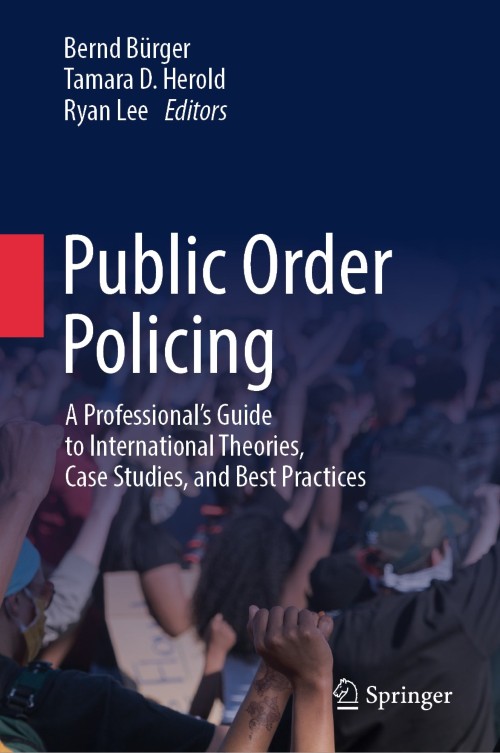
Public Order Policing [electronic resource] : A Professional's Guide to International Theories, Case Studies, and Best Practices / edited by Bernd Bürger, Tamara D. Herold, Ryan Lee.
Erişim Adresi
ISBN
9783031438561
Dil Kodu
İngilizce
Yer Numarası
DK/20667
Basım Bildirimi
1st ed. 2023.
Yayın Bilgisi
Cham : Springer International Publishing : Imprint: Springer, 2023.
Fiziksel Niteleme
XXII, 503 p. 25 illus., 5 illus. in color. online resource.
İçindekiler Notu
Chapter 1. Public Order Policing. From Theory to Practice -- Chapter 2. Preventing Crime at Assemblies -- Chapter 3. How Collective Violence Emerges and Escalates -- Chapter 4. Interpretive Regimes of Violence in Action. The “Welcome to Hell” Demonstration During the G20 Summit in Hamburg 2017 -- Chapter 5. Almost Forgotten Experiential Knowledge of De-escalation -- Chapter 6. The Role of Police in Assemblies: Ethical Implications, Imperatives, and Interventions -- Chapter 7. Differences in U.S. and German Police Organizations with an Impact on the Policing of Public Assemblies -- Chapter 8. Police Organization and the Policing of Assemblies in Germany -- Chapter 9. Police Organization and the Policing of Assemblies in the United States -- Chapter 10. Protection of Citizens’ Rights, Public Safety & Police Legitimacy - The Legal Equilibrium for Public Order -- Chapter 11. Public Order Policing in the UK -- Chapter 12. Specialized Public Order Units: Integrating a Community Policing Mindset -- Chapter 13. Maintaining Public Order from a Military Police Perspective -- Chapter 14. January 6th – a Challenge for Public Order Policing and Democracy -- Chapter 15. The "Yellow Vest Protests". A Challenge for Police and Democracy -- Chapter 16. Public Order Policing 2.0. Addressing the Challenges of the Information Age -- Chapter 17. Intelligence in Public Order Policing -- Chapter 18. The Importance of Police Public Relations in Assembly Situations -- Chapter 19. Mission Communication as an Integrative Overall Strategy in Protest 2.0 -- Chapter 20. Public Order Standards – Moving the Public Trust Needle Forward -- Chapter 21. Building an Evidence-Based Training Curriculum for Public Order Policing: A Case Study -- Chapter 22. Public Order Policing: Use of Force -- Chapter 23. Considerations for Personal Protective Equipment for Public Order Policing.
Özet, vb.
Successful public order management is critical to upholding democracy and maintaining the rule of law. Negative police-public interactions during assemblies can impact the safety and well-being of citizens and officers, as well as local and international perceptions of police legitimacy. As observed during events across the world, including assemblies in the U.S., Myanmar, Belarus, Russia, and elsewhere, police mismanagement of mass demonstrations often instigates crowd violence and other harmful behaviors. The causes of violence at assemblies are complex and multi-faceted. Failure to understand crowd dynamics that lead to violence limits police effectiveness and contributes to poor officer decision-making. This book offers an international review of public order management experiences and effective practices. Practical examples, grounded in multi-disciplinary theory and science, offer a roadmap to improve police response and increase safety at assemblies in democratic countries. The diverse content, perspectives, and lessons learned presented in this volume will serve as a useful guide for all people working in the field of public order management, including police officials, policymakers, and researchers. This edited volume was written by and for practitioners, pracademics, and academics to review the complex and demanding task of policing public order.
Konu
Comparative government.
Criminology.
Social psychology.
Human rights.
Mediation.
Dispute resolution (Law).
Arbitration (Administrative law).
Comparative Public Policy.
Crime Control and Security.
Social Psychology.
Comparative Politics.
Politics and Human Rights.
Dispute Resolution, Mediation, Arbitration.
Criminology.
Social psychology.
Human rights.
Mediation.
Dispute resolution (Law).
Arbitration (Administrative law).
Comparative Public Policy.
Crime Control and Security.
Social Psychology.
Comparative Politics.
Politics and Human Rights.
Dispute Resolution, Mediation, Arbitration.
Kurum Adı
Eseri Alıntıla
Referansları kullanmadan önce gözden geçirmeniz ve varsa gerekli düzeltmeleri yapmanız önerilir.
Dijital Kaynak
MARC Görünümü
LEADER 06893nam a22007335i 4500
001 819460
003 TR_AnAIT
005 20260130173633
007 cr nn 008mamaa
008 231231s2023 sz | s |||| 0|eng d
020 |a9783031438561|9978-3-031-43856-1
024 7 |a10.1007/978-3-031-43856-1|2doi
041 |aeng
049 |aTürk Tarih Kurumu Kütüphanesi
050 4|aJF20-1197.2
072 7|aJPB|2bicssc
072 7|aPOL009000|2bisacsh
072 7|aJPB|2thema
082 04|a320.3|223
082 04|a320.6|223
090 |aDK/20667
245 10|aPublic Order Policing|h[electronic resource] :|bA Professional's Guide to International Theories, Case Studies, and Best Practices /|cedited by Bernd Bürger, Tamara D. Herold, Ryan Lee.
250 |a1st ed. 2023.
264 1|aCham :|bSpringer International Publishing :|bImprint: Springer,|c2023.
300 |aXXII, 503 p. 25 illus., 5 illus. in color.|bonline resource.
336 |atext|btxt|2rdacontent
337 |acomputer|bc|2rdamedia
338 |aonline resource|bcr|2rdacarrier
341 0 |bTable of contents navigation|2onix
341 0 |bSingle logical reading order|2onix
341 0 |bShort alternative textual descriptions|2onix
341 0 |bUse of color is not sole means of conveying information|2onix
341 0 |bUse of high contrast between text and background color|2onix
341 0 |bNext / Previous structural navigation|2onix
341 0 |bAll non-decorative content supports reading without sight|2onix
347 |atext file|bPDF|2rda
505 0 |aChapter 1. Public Order Policing. From Theory to Practice -- Chapter 2. Preventing Crime at Assemblies -- Chapter 3. How Collective Violence Emerges and Escalates -- Chapter 4. Interpretive Regimes of Violence in Action. The “Welcome to Hell” Demonstration During the G20 Summit in Hamburg 2017 -- Chapter 5. Almost Forgotten Experiential Knowledge of De-escalation -- Chapter 6. The Role of Police in Assemblies: Ethical Implications, Imperatives, and Interventions -- Chapter 7. Differences in U.S. and German Police Organizations with an Impact on the Policing of Public Assemblies -- Chapter 8. Police Organization and the Policing of Assemblies in Germany -- Chapter 9. Police Organization and the Policing of Assemblies in the United States -- Chapter 10. Protection of Citizens’ Rights, Public Safety & Police Legitimacy - The Legal Equilibrium for Public Order -- Chapter 11. Public Order Policing in the UK -- Chapter 12. Specialized Public Order Units: Integrating a Community Policing Mindset -- Chapter 13. Maintaining Public Order from a Military Police Perspective -- Chapter 14. January 6th – a Challenge for Public Order Policing and Democracy -- Chapter 15. The "Yellow Vest Protests". A Challenge for Police and Democracy -- Chapter 16. Public Order Policing 2.0. Addressing the Challenges of the Information Age -- Chapter 17. Intelligence in Public Order Policing -- Chapter 18. The Importance of Police Public Relations in Assembly Situations -- Chapter 19. Mission Communication as an Integrative Overall Strategy in Protest 2.0 -- Chapter 20. Public Order Standards – Moving the Public Trust Needle Forward -- Chapter 21. Building an Evidence-Based Training Curriculum for Public Order Policing: A Case Study -- Chapter 22. Public Order Policing: Use of Force -- Chapter 23. Considerations for Personal Protective Equipment for Public Order Policing.
520 |aSuccessful public order management is critical to upholding democracy and maintaining the rule of law. Negative police-public interactions during assemblies can impact the safety and well-being of citizens and officers, as well as local and international perceptions of police legitimacy. As observed during events across the world, including assemblies in the U.S., Myanmar, Belarus, Russia, and elsewhere, police mismanagement of mass demonstrations often instigates crowd violence and other harmful behaviors. The causes of violence at assemblies are complex and multi-faceted. Failure to understand crowd dynamics that lead to violence limits police effectiveness and contributes to poor officer decision-making. This book offers an international review of public order management experiences and effective practices. Practical examples, grounded in multi-disciplinary theory and science, offer a roadmap to improve police response and increase safety at assemblies in democratic countries. The diverse content, perspectives, and lessons learned presented in this volume will serve as a useful guide for all people working in the field of public order management, including police officials, policymakers, and researchers. This edited volume was written by and for practitioners, pracademics, and academics to review the complex and demanding task of policing public order.
532 8 |aAccessibility summary: This PDF does not fully comply with PDF/UA standards, but does feature limited screen reader support, described non-text content (images, graphs), bookmarks for easy navigation and searchable, selectable text. Users of assistive technologies may experience difficulty navigating or interpreting content in this document. We recognize the importance of accessibility, and we welcome queries about accessibility for any of our products. If you have a question or an access need, please get in touch with us at accessibilitysupport@springernature.com.
532 8 |aNo reading system accessibility options actively disabled
532 8 |aPublisher contact for further accessibility information: accessibilitysupport@springernature.com
650 0|aComparative government.
650 0|aCriminology.
650 0|aSocial psychology.
650 0|aHuman rights.
650 0|aMediation.
650 0|aDispute resolution (Law).
650 0|aArbitration (Administrative law).
650 14|aComparative Public Policy.
650 24|aCrime Control and Security.
650 24|aSocial Psychology.
650 24|aComparative Politics.
650 24|aPolitics and Human Rights.
650 24|aDispute Resolution, Mediation, Arbitration.
700 1 |aBürger, Bernd.|eeditor.|4edt|4http://id.loc.gov/vocabulary/relators/edt
700 1 |aHerold, Tamara D.|eeditor.|0(orcid)0000-0003-3634-5900|1https://orcid.org/0000-0003-3634-5900|4edt|4http://id.loc.gov/vocabulary/relators/edt
700 1 |aLee, Ryan.|eeditor.|4edt|4http://id.loc.gov/vocabulary/relators/edt
710 2 |aSpringerLink (Online service)
773 0 |tSpringer Nature eBook
776 08|iPrinted edition:|z9783031438554
776 08|iPrinted edition:|z9783031438578
776 08|iPrinted edition:|z9783031438585
856 40|uhttps://doi.org/10.1007/978-3-031-43856-1
912 |aZDB-2-POS
912 |aZDB-2-SXPI
950 |aPolitical Science and International Studies (SpringerNature-41174)
950 |aPolitical Science and International Studies (R0) (SpringerNature-43724)
001 819460
003 TR_AnAIT
005 20260130173633
007 cr nn 008mamaa
008 231231s2023 sz | s |||| 0|eng d
020 |a9783031438561|9978-3-031-43856-1
024 7 |a10.1007/978-3-031-43856-1|2doi
041 |aeng
049 |aTürk Tarih Kurumu Kütüphanesi
050 4|aJF20-1197.2
072 7|aJPB|2bicssc
072 7|aPOL009000|2bisacsh
072 7|aJPB|2thema
082 04|a320.3|223
082 04|a320.6|223
090 |aDK/20667
245 10|aPublic Order Policing|h[electronic resource] :|bA Professional's Guide to International Theories, Case Studies, and Best Practices /|cedited by Bernd Bürger, Tamara D. Herold, Ryan Lee.
250 |a1st ed. 2023.
264 1|aCham :|bSpringer International Publishing :|bImprint: Springer,|c2023.
300 |aXXII, 503 p. 25 illus., 5 illus. in color.|bonline resource.
336 |atext|btxt|2rdacontent
337 |acomputer|bc|2rdamedia
338 |aonline resource|bcr|2rdacarrier
341 0 |bTable of contents navigation|2onix
341 0 |bSingle logical reading order|2onix
341 0 |bShort alternative textual descriptions|2onix
341 0 |bUse of color is not sole means of conveying information|2onix
341 0 |bUse of high contrast between text and background color|2onix
341 0 |bNext / Previous structural navigation|2onix
341 0 |bAll non-decorative content supports reading without sight|2onix
347 |atext file|bPDF|2rda
505 0 |aChapter 1. Public Order Policing. From Theory to Practice -- Chapter 2. Preventing Crime at Assemblies -- Chapter 3. How Collective Violence Emerges and Escalates -- Chapter 4. Interpretive Regimes of Violence in Action. The “Welcome to Hell” Demonstration During the G20 Summit in Hamburg 2017 -- Chapter 5. Almost Forgotten Experiential Knowledge of De-escalation -- Chapter 6. The Role of Police in Assemblies: Ethical Implications, Imperatives, and Interventions -- Chapter 7. Differences in U.S. and German Police Organizations with an Impact on the Policing of Public Assemblies -- Chapter 8. Police Organization and the Policing of Assemblies in Germany -- Chapter 9. Police Organization and the Policing of Assemblies in the United States -- Chapter 10. Protection of Citizens’ Rights, Public Safety & Police Legitimacy - The Legal Equilibrium for Public Order -- Chapter 11. Public Order Policing in the UK -- Chapter 12. Specialized Public Order Units: Integrating a Community Policing Mindset -- Chapter 13. Maintaining Public Order from a Military Police Perspective -- Chapter 14. January 6th – a Challenge for Public Order Policing and Democracy -- Chapter 15. The "Yellow Vest Protests". A Challenge for Police and Democracy -- Chapter 16. Public Order Policing 2.0. Addressing the Challenges of the Information Age -- Chapter 17. Intelligence in Public Order Policing -- Chapter 18. The Importance of Police Public Relations in Assembly Situations -- Chapter 19. Mission Communication as an Integrative Overall Strategy in Protest 2.0 -- Chapter 20. Public Order Standards – Moving the Public Trust Needle Forward -- Chapter 21. Building an Evidence-Based Training Curriculum for Public Order Policing: A Case Study -- Chapter 22. Public Order Policing: Use of Force -- Chapter 23. Considerations for Personal Protective Equipment for Public Order Policing.
520 |aSuccessful public order management is critical to upholding democracy and maintaining the rule of law. Negative police-public interactions during assemblies can impact the safety and well-being of citizens and officers, as well as local and international perceptions of police legitimacy. As observed during events across the world, including assemblies in the U.S., Myanmar, Belarus, Russia, and elsewhere, police mismanagement of mass demonstrations often instigates crowd violence and other harmful behaviors. The causes of violence at assemblies are complex and multi-faceted. Failure to understand crowd dynamics that lead to violence limits police effectiveness and contributes to poor officer decision-making. This book offers an international review of public order management experiences and effective practices. Practical examples, grounded in multi-disciplinary theory and science, offer a roadmap to improve police response and increase safety at assemblies in democratic countries. The diverse content, perspectives, and lessons learned presented in this volume will serve as a useful guide for all people working in the field of public order management, including police officials, policymakers, and researchers. This edited volume was written by and for practitioners, pracademics, and academics to review the complex and demanding task of policing public order.
532 8 |aAccessibility summary: This PDF does not fully comply with PDF/UA standards, but does feature limited screen reader support, described non-text content (images, graphs), bookmarks for easy navigation and searchable, selectable text. Users of assistive technologies may experience difficulty navigating or interpreting content in this document. We recognize the importance of accessibility, and we welcome queries about accessibility for any of our products. If you have a question or an access need, please get in touch with us at accessibilitysupport@springernature.com.
532 8 |aNo reading system accessibility options actively disabled
532 8 |aPublisher contact for further accessibility information: accessibilitysupport@springernature.com
650 0|aComparative government.
650 0|aCriminology.
650 0|aSocial psychology.
650 0|aHuman rights.
650 0|aMediation.
650 0|aDispute resolution (Law).
650 0|aArbitration (Administrative law).
650 14|aComparative Public Policy.
650 24|aCrime Control and Security.
650 24|aSocial Psychology.
650 24|aComparative Politics.
650 24|aPolitics and Human Rights.
650 24|aDispute Resolution, Mediation, Arbitration.
700 1 |aBürger, Bernd.|eeditor.|4edt|4http://id.loc.gov/vocabulary/relators/edt
700 1 |aHerold, Tamara D.|eeditor.|0(orcid)0000-0003-3634-5900|1https://orcid.org/0000-0003-3634-5900|4edt|4http://id.loc.gov/vocabulary/relators/edt
700 1 |aLee, Ryan.|eeditor.|4edt|4http://id.loc.gov/vocabulary/relators/edt
710 2 |aSpringerLink (Online service)
773 0 |tSpringer Nature eBook
776 08|iPrinted edition:|z9783031438554
776 08|iPrinted edition:|z9783031438578
776 08|iPrinted edition:|z9783031438585
856 40|uhttps://doi.org/10.1007/978-3-031-43856-1
912 |aZDB-2-POS
912 |aZDB-2-SXPI
950 |aPolitical Science and International Studies (SpringerNature-41174)
950 |aPolitical Science and International Studies (R0) (SpringerNature-43724)
Materyaller
Depodan talep edilen materyal sadece kütüphane içerisinde kullanılmaktadır.
Materyal dışarıya ödünç verilmemektedir.
Materyal dışarıya ödünç verilmemektedir.
