

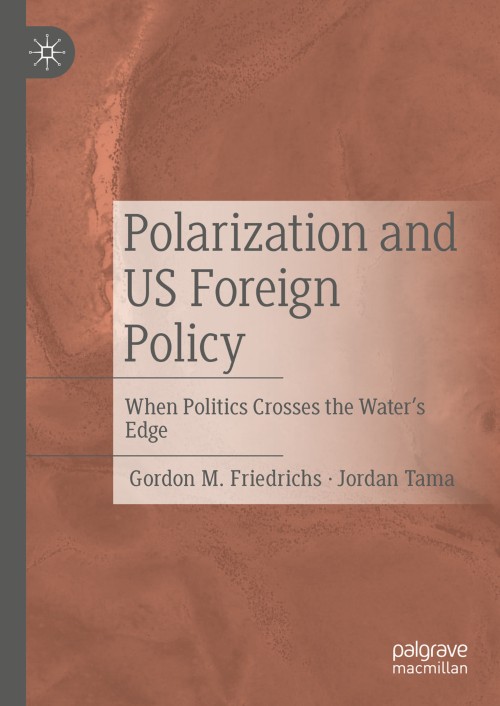
Polarization and US Foreign Policy [electronic resource] : When Politics Crosses the Water’s Edge / edited by Gordon M. Friedrichs, Jordan Tama.
Erişim Adresi
ISBN
9783031586187
Dil Kodu
İngilizce
Yer Numarası
DK/20898
Basım Bildirimi
1st ed. 2024.
Yayın Bilgisi
Cham : Springer Nature Switzerland : Imprint: Palgrave Macmillan, 2024.
Fiziksel Niteleme
XXIII, 419 p. 53 illus. online resource.
İçindekiler Notu
Chapter 1. Introduction: Polarization and America’s Role in the World” -- 2. Chapter 2. Are We Drowning at the Water’s Edge? Foreign Policy Polarization among the US Public -- Chapter 3. Finding the Water’s Edge: When Negative Partisanship Influences Foreign Policy Attitudes -- Chapter 4. Beyond Party: Ideological Convictions and Foreign Policy Conflicts in the US Congress -- Chapter 5. Foreign Policy Free Agents: How Lawmakers and Coalitions on the Political Margins Help Set Boundaries for U.S. Foreign Policy -- Chapter 6. Bryan W. Marshall and Patrick J. Haney, “Support and Defend? Executive Ascendancy and Congressional Abdication in US Foreign Policy -- Chapter 7. James Bryan and Jordan Tama, “The Prevalence of Bipartisanship in U.S. Foreign Policy: An Analysis of Important Congressional Votes -- Chapter 8. Congressional Polarization and Limitation Riders in Foreign Aid Appropriations -- Chapter 9. Social Fabric Decay: The Case of Congressional Travels Abroad. Chapter 10. Brakeman or Booster? Presidents, Ideological Polarization, Reciprocity and the Politics of US Arms Control Policy -- Chapter 11. Polarized We Trade? Intra-Party Polarization and U.S. Trade Policy -- Chapter 12. Polarization, Casualty Sensitivity, and Military Operations: Evidence from a Survey Experiment -- Chapter 13. The Reputational Consequences of Polarization for American Foreign Policy: Evidence from the US-UK Bilateral Relationship -- Chapter 14. Looking Ahead: Prospects for Effective Foreign Policy and Avenues for Further Research.
Özet, vb.
Polarization in the United States has been on the rise for several decades. In this context, few observers expect politics today to stop “at the water’s edge,” as the old cliché goes. But key questions about the relationship between polarization and US foreign policy remain to be fully answered. To what extent are American ideas about foreign policy now polarized along partisan lines? How is polarization changing the foreign policy behavior of the US Congress and President? And how is polarization altering the effectiveness of US foreign policy and influencing America’s role in the world? This edited volume explores these questions and more, bringing together existing knowledge as well as considering how the political dynamics and execution of US foreign policy may evolve in the years ahead. Gordon M. Friedrichs is a Senior Research Fellow at the Max Planck Institute for Comparative Public Law and International Law in Heidelberg, Germany. Jordan Tama is Provost Associate Professor in the Department of Foreign Policy and Global Security at American University in Washington DC, USA.
Konu
Political science.
International relations.
America __ Politics and government.
Politics and International Studies.
International Relations.
Foreign Policy.
American Politics.
Political Science.
International relations.
America __ Politics and government.
Politics and International Studies.
International Relations.
Foreign Policy.
American Politics.
Political Science.
Kurum Adı
Eseri Alıntıla
Referansları kullanmadan önce gözden geçirmeniz ve varsa gerekli düzeltmeleri yapmanız önerilir.
Dijital Kaynak
MARC Görünümü
LEADER 05922nam a22006495i 4500
001 819691
003 TR_AnAIT
005 20260130172634
007 cr nn 008mamaa
008 240627s2024 sz | s |||| 0|eng d
020 |a9783031586187|9978-3-031-58618-7
024 7 |a10.1007/978-3-031-58618-7|2doi
041 |aeng
049 |aTürk Tarih Kurumu Kütüphanesi
050 4|aJA1-92
072 7|aJP|2bicssc
072 7|aPOL000000|2bisacsh
072 7|aJP|2thema
082 04|a320|223
090 |aDK/20898
245 10|aPolarization and US Foreign Policy|h[electronic resource] :|bWhen Politics Crosses the Water’s Edge /|cedited by Gordon M. Friedrichs, Jordan Tama.
250 |a1st ed. 2024.
264 1|aCham :|bSpringer Nature Switzerland :|bImprint: Palgrave Macmillan,|c2024.
300 |aXXIII, 419 p. 53 illus.|bonline resource.
336 |atext|btxt|2rdacontent
337 |acomputer|bc|2rdamedia
338 |aonline resource|bcr|2rdacarrier
341 0 |bTable of contents navigation|2onix
341 0 |bSingle logical reading order|2onix
341 0 |bShort alternative textual descriptions|2onix
341 0 |bUse of color is not sole means of conveying information|2onix
341 0 |bUse of high contrast between text and background color|2onix
341 0 |bNext / Previous structural navigation|2onix
341 0 |bAll non-decorative content supports reading without sight|2onix
347 |atext file|bPDF|2rda
505 0 |aChapter 1. Introduction: Polarization and America’s Role in the World” -- 2. Chapter 2. Are We Drowning at the Water’s Edge? Foreign Policy Polarization among the US Public -- Chapter 3. Finding the Water’s Edge: When Negative Partisanship Influences Foreign Policy Attitudes -- Chapter 4. Beyond Party: Ideological Convictions and Foreign Policy Conflicts in the US Congress -- Chapter 5. Foreign Policy Free Agents: How Lawmakers and Coalitions on the Political Margins Help Set Boundaries for U.S. Foreign Policy -- Chapter 6. Bryan W. Marshall and Patrick J. Haney, “Support and Defend? Executive Ascendancy and Congressional Abdication in US Foreign Policy -- Chapter 7. James Bryan and Jordan Tama, “The Prevalence of Bipartisanship in U.S. Foreign Policy: An Analysis of Important Congressional Votes -- Chapter 8. Congressional Polarization and Limitation Riders in Foreign Aid Appropriations -- Chapter 9. Social Fabric Decay: The Case of Congressional Travels Abroad. Chapter 10. Brakeman or Booster? Presidents, Ideological Polarization, Reciprocity and the Politics of US Arms Control Policy -- Chapter 11. Polarized We Trade? Intra-Party Polarization and U.S. Trade Policy -- Chapter 12. Polarization, Casualty Sensitivity, and Military Operations: Evidence from a Survey Experiment -- Chapter 13. The Reputational Consequences of Polarization for American Foreign Policy: Evidence from the US-UK Bilateral Relationship -- Chapter 14. Looking Ahead: Prospects for Effective Foreign Policy and Avenues for Further Research.
520 |aPolarization in the United States has been on the rise for several decades. In this context, few observers expect politics today to stop “at the water’s edge,” as the old cliché goes. But key questions about the relationship between polarization and US foreign policy remain to be fully answered. To what extent are American ideas about foreign policy now polarized along partisan lines? How is polarization changing the foreign policy behavior of the US Congress and President? And how is polarization altering the effectiveness of US foreign policy and influencing America’s role in the world? This edited volume explores these questions and more, bringing together existing knowledge as well as considering how the political dynamics and execution of US foreign policy may evolve in the years ahead. Gordon M. Friedrichs is a Senior Research Fellow at the Max Planck Institute for Comparative Public Law and International Law in Heidelberg, Germany. Jordan Tama is Provost Associate Professor in the Department of Foreign Policy and Global Security at American University in Washington DC, USA.
532 8 |aAccessibility summary: This PDF does not fully comply with PDF/UA standards, but does feature limited screen reader support, described non-text content (images, graphs), bookmarks for easy navigation and searchable, selectable text. Users of assistive technologies may experience difficulty navigating or interpreting content in this document. We recognize the importance of accessibility, and we welcome queries about accessibility for any of our products. If you have a question or an access need, please get in touch with us at accessibilitysupport@springernature.com.
532 8 |aNo reading system accessibility options actively disabled
532 8 |aPublisher contact for further accessibility information: accessibilitysupport@springernature.com
650 0|aPolitical science.
650 0|aInternational relations.
650 0|aAmerica|xPolitics and government.
650 14|aPolitics and International Studies.
650 24|aInternational Relations.
650 24|aForeign Policy.
650 24|aAmerican Politics.
650 24|aPolitical Science.
700 1 |aFriedrichs, Gordon M.|eeditor.|4edt|4http://id.loc.gov/vocabulary/relators/edt
700 1 |aTama, Jordan.|eeditor.|0(orcid)0000-0003-4571-1351|1https://orcid.org/0000-0003-4571-1351|4edt|4http://id.loc.gov/vocabulary/relators/edt
710 2 |aSpringerLink (Online service)
773 0 |tSpringer Nature eBook
776 08|iPrinted edition:|z9783031586170
776 08|iPrinted edition:|z9783031586194
776 08|iPrinted edition:|z9783031586200
856 40|uhttps://doi.org/10.1007/978-3-031-58618-7
912 |aZDB-2-POS
912 |aZDB-2-SXPI
950 |aPolitical Science and International Studies (SpringerNature-41174)
950 |aPolitical Science and International Studies (R0) (SpringerNature-43724)
001 819691
003 TR_AnAIT
005 20260130172634
007 cr nn 008mamaa
008 240627s2024 sz | s |||| 0|eng d
020 |a9783031586187|9978-3-031-58618-7
024 7 |a10.1007/978-3-031-58618-7|2doi
041 |aeng
049 |aTürk Tarih Kurumu Kütüphanesi
050 4|aJA1-92
072 7|aJP|2bicssc
072 7|aPOL000000|2bisacsh
072 7|aJP|2thema
082 04|a320|223
090 |aDK/20898
245 10|aPolarization and US Foreign Policy|h[electronic resource] :|bWhen Politics Crosses the Water’s Edge /|cedited by Gordon M. Friedrichs, Jordan Tama.
250 |a1st ed. 2024.
264 1|aCham :|bSpringer Nature Switzerland :|bImprint: Palgrave Macmillan,|c2024.
300 |aXXIII, 419 p. 53 illus.|bonline resource.
336 |atext|btxt|2rdacontent
337 |acomputer|bc|2rdamedia
338 |aonline resource|bcr|2rdacarrier
341 0 |bTable of contents navigation|2onix
341 0 |bSingle logical reading order|2onix
341 0 |bShort alternative textual descriptions|2onix
341 0 |bUse of color is not sole means of conveying information|2onix
341 0 |bUse of high contrast between text and background color|2onix
341 0 |bNext / Previous structural navigation|2onix
341 0 |bAll non-decorative content supports reading without sight|2onix
347 |atext file|bPDF|2rda
505 0 |aChapter 1. Introduction: Polarization and America’s Role in the World” -- 2. Chapter 2. Are We Drowning at the Water’s Edge? Foreign Policy Polarization among the US Public -- Chapter 3. Finding the Water’s Edge: When Negative Partisanship Influences Foreign Policy Attitudes -- Chapter 4. Beyond Party: Ideological Convictions and Foreign Policy Conflicts in the US Congress -- Chapter 5. Foreign Policy Free Agents: How Lawmakers and Coalitions on the Political Margins Help Set Boundaries for U.S. Foreign Policy -- Chapter 6. Bryan W. Marshall and Patrick J. Haney, “Support and Defend? Executive Ascendancy and Congressional Abdication in US Foreign Policy -- Chapter 7. James Bryan and Jordan Tama, “The Prevalence of Bipartisanship in U.S. Foreign Policy: An Analysis of Important Congressional Votes -- Chapter 8. Congressional Polarization and Limitation Riders in Foreign Aid Appropriations -- Chapter 9. Social Fabric Decay: The Case of Congressional Travels Abroad. Chapter 10. Brakeman or Booster? Presidents, Ideological Polarization, Reciprocity and the Politics of US Arms Control Policy -- Chapter 11. Polarized We Trade? Intra-Party Polarization and U.S. Trade Policy -- Chapter 12. Polarization, Casualty Sensitivity, and Military Operations: Evidence from a Survey Experiment -- Chapter 13. The Reputational Consequences of Polarization for American Foreign Policy: Evidence from the US-UK Bilateral Relationship -- Chapter 14. Looking Ahead: Prospects for Effective Foreign Policy and Avenues for Further Research.
520 |aPolarization in the United States has been on the rise for several decades. In this context, few observers expect politics today to stop “at the water’s edge,” as the old cliché goes. But key questions about the relationship between polarization and US foreign policy remain to be fully answered. To what extent are American ideas about foreign policy now polarized along partisan lines? How is polarization changing the foreign policy behavior of the US Congress and President? And how is polarization altering the effectiveness of US foreign policy and influencing America’s role in the world? This edited volume explores these questions and more, bringing together existing knowledge as well as considering how the political dynamics and execution of US foreign policy may evolve in the years ahead. Gordon M. Friedrichs is a Senior Research Fellow at the Max Planck Institute for Comparative Public Law and International Law in Heidelberg, Germany. Jordan Tama is Provost Associate Professor in the Department of Foreign Policy and Global Security at American University in Washington DC, USA.
532 8 |aAccessibility summary: This PDF does not fully comply with PDF/UA standards, but does feature limited screen reader support, described non-text content (images, graphs), bookmarks for easy navigation and searchable, selectable text. Users of assistive technologies may experience difficulty navigating or interpreting content in this document. We recognize the importance of accessibility, and we welcome queries about accessibility for any of our products. If you have a question or an access need, please get in touch with us at accessibilitysupport@springernature.com.
532 8 |aNo reading system accessibility options actively disabled
532 8 |aPublisher contact for further accessibility information: accessibilitysupport@springernature.com
650 0|aPolitical science.
650 0|aInternational relations.
650 0|aAmerica|xPolitics and government.
650 14|aPolitics and International Studies.
650 24|aInternational Relations.
650 24|aForeign Policy.
650 24|aAmerican Politics.
650 24|aPolitical Science.
700 1 |aFriedrichs, Gordon M.|eeditor.|4edt|4http://id.loc.gov/vocabulary/relators/edt
700 1 |aTama, Jordan.|eeditor.|0(orcid)0000-0003-4571-1351|1https://orcid.org/0000-0003-4571-1351|4edt|4http://id.loc.gov/vocabulary/relators/edt
710 2 |aSpringerLink (Online service)
773 0 |tSpringer Nature eBook
776 08|iPrinted edition:|z9783031586170
776 08|iPrinted edition:|z9783031586194
776 08|iPrinted edition:|z9783031586200
856 40|uhttps://doi.org/10.1007/978-3-031-58618-7
912 |aZDB-2-POS
912 |aZDB-2-SXPI
950 |aPolitical Science and International Studies (SpringerNature-41174)
950 |aPolitical Science and International Studies (R0) (SpringerNature-43724)
Materyaller
Depodan talep edilen materyal sadece kütüphane içerisinde kullanılmaktadır.
Materyal dışarıya ödünç verilmemektedir.
Materyal dışarıya ödünç verilmemektedir.
