

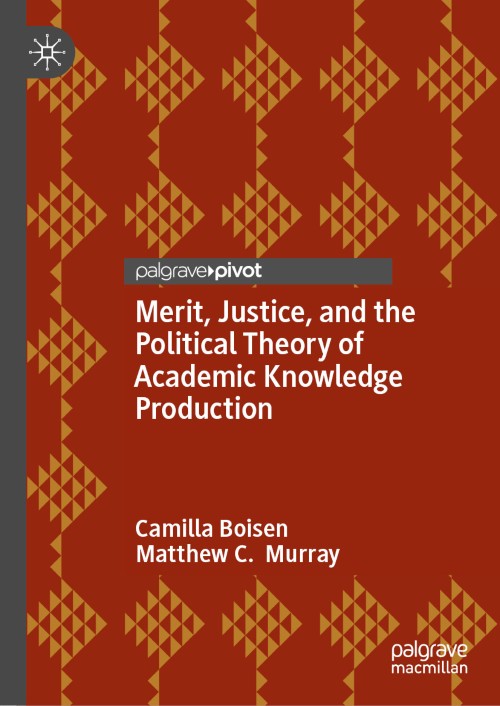
Merit, Justice, and the Political Theory of Academic Knowledge Production [electronic resource] / by Camilla Boisen, Matthew C. Murray.
Erişim Adresi
ISBN
9783031654985
Dil Kodu
İngilizce
Yer Numarası
DK/20924
Yazar
Basım Bildirimi
1st ed. 2024.
Yayın Bilgisi
Cham : Springer Nature Switzerland : Imprint: Palgrave Macmillan, 2024.
Fiziksel Niteleme
IX, 133 p. 1 illus. online resource.
İçindekiler Notu
Chapter 1: Introduction: Why interrogate the Concept of Merit -- Chapter 2: Production and Politique: Establishing Academic Production as Political -- Chapter 3: Merit as Moral: Merit as Moral: Justifications for Applications of Power -- Chapter 4: The Merit Mythology: Merit as Natural Selection -- Chapter 5: Accepting Dissent, Resistance and Error -- Chapter 6: Relegating the Rule of Merit and Escaping ‘Academic Fingertrap’.
Özet, vb.
Academia has long established itself as an institution of knowledge and ideas. Facing pressure, many academic fields and institutions have turned their attention, singularly and collectively, to the task of what to do to rectify the causes of under-representations both academic knowledge itself and who gets to be an academic producer of knowledge. Boisen and Murray argue that simply solving the contemporary symptoms of inequity in ideas, knowledge production and the academy is not enough. Political Theory must be used to analyze why dominant ideas and institutions, namely merit and the resulting meritocracy and meritocratic procedures, were given power in the first place. In using political theory and theories of justice, the book argues that academia must radically shift rather than procedurally reform these methods of evaluation in order to achieve a more coherent approach to diversity in ideas, academic knowledge producers and academic knowledge production, which are necessary to bring about other forms of social change and reform in our larger world. In questioning the ideals and the use of rival ideals to temper flawed concepts, the present motivations and justifications for producing academic knowledge can be relegated as political tools, allowing true meaningful reform. Boisen and Murray show how contemporary crises in academia around diversification of perspectives can only be solved by considering the justifications of academic knowledge production, and the inherent risk of retaining the established competitive and presumptively ‘natural’, but ultimately biased, methods of deriving academic authority. Camilla Boisen is a historian of political thought. She is Senior Lecturer of Writing and Associate Dean of Curricular Academic Planning for the Arts & Humanities at New York University, Abu Dhabi. Matthew C. Murray is the Assistant Director for Growthpolicy and Program Support at the Mossavar-Rahmani Center for Business and Government at the Harvard Kennedy School of Government. Matt runs the interdisciplinary research portal, Growthpolicy, supports the work of M-RCBG’s other 18 programs, has 3 previous published titles along with academic articles and taught Philosophy at Providence College for a decade in the fields of Political and Social Philosophy, Ethics and Moral Philosophy .
Konu
Political science.
Political Theory.
Political Theory.
Diğer Yazarlar
Kurum Adı
Eseri Alıntıla
Referansları kullanmadan önce gözden geçirmeniz ve varsa gerekli düzeltmeleri yapmanız önerilir.
Dijital Kaynak
MARC Görünümü
LEADER 05671nam a22005655i 4500
001 819717
003 TR_AnAIT
005 20260130172527
007 cr nn 008mamaa
008 240810s2024 sz | s |||| 0|eng d
020 |a9783031654985|9978-3-031-65498-5
024 7 |a10.1007/978-3-031-65498-5|2doi
041 |aeng
049 |aTürk Tarih Kurumu Kütüphanesi
050 4|aJC11-607
072 7|aJPA|2bicssc
072 7|aPOL010000|2bisacsh
072 7|aJPA|2thema
082 04|a320.01|223
090 |aDK/20924
100 1 |aBoisen, Camilla.|eauthor.|4aut|4http://id.loc.gov/vocabulary/relators/aut
245 10|aMerit, Justice, and the Political Theory of Academic Knowledge Production|h[electronic resource] /|cby Camilla Boisen, Matthew C. Murray.
250 |a1st ed. 2024.
264 1|aCham :|bSpringer Nature Switzerland :|bImprint: Palgrave Macmillan,|c2024.
300 |aIX, 133 p. 1 illus.|bonline resource.
336 |atext|btxt|2rdacontent
337 |acomputer|bc|2rdamedia
338 |aonline resource|bcr|2rdacarrier
341 0 |bTable of contents navigation|2onix
341 0 |bSingle logical reading order|2onix
341 0 |bUse of color is not sole means of conveying information|2onix
341 0 |bUse of high contrast between text and background color|2onix
341 0 |bNext / Previous structural navigation|2onix
341 0 |bAll non-decorative content supports reading without sight|2onix
347 |atext file|bPDF|2rda
505 0 |aChapter 1: Introduction: Why interrogate the Concept of Merit -- Chapter 2: Production and Politique: Establishing Academic Production as Political -- Chapter 3: Merit as Moral: Merit as Moral: Justifications for Applications of Power -- Chapter 4: The Merit Mythology: Merit as Natural Selection -- Chapter 5: Accepting Dissent, Resistance and Error -- Chapter 6: Relegating the Rule of Merit and Escaping ‘Academic Fingertrap’.
520 |aAcademia has long established itself as an institution of knowledge and ideas. Facing pressure, many academic fields and institutions have turned their attention, singularly and collectively, to the task of what to do to rectify the causes of under-representations both academic knowledge itself and who gets to be an academic producer of knowledge. Boisen and Murray argue that simply solving the contemporary symptoms of inequity in ideas, knowledge production and the academy is not enough. Political Theory must be used to analyze why dominant ideas and institutions, namely merit and the resulting meritocracy and meritocratic procedures, were given power in the first place. In using political theory and theories of justice, the book argues that academia must radically shift rather than procedurally reform these methods of evaluation in order to achieve a more coherent approach to diversity in ideas, academic knowledge producers and academic knowledge production, which are necessary to bring about other forms of social change and reform in our larger world. In questioning the ideals and the use of rival ideals to temper flawed concepts, the present motivations and justifications for producing academic knowledge can be relegated as political tools, allowing true meaningful reform. Boisen and Murray show how contemporary crises in academia around diversification of perspectives can only be solved by considering the justifications of academic knowledge production, and the inherent risk of retaining the established competitive and presumptively ‘natural’, but ultimately biased, methods of deriving academic authority. Camilla Boisen is a historian of political thought. She is Senior Lecturer of Writing and Associate Dean of Curricular Academic Planning for the Arts & Humanities at New York University, Abu Dhabi. Matthew C. Murray is the Assistant Director for Growthpolicy and Program Support at the Mossavar-Rahmani Center for Business and Government at the Harvard Kennedy School of Government. Matt runs the interdisciplinary research portal, Growthpolicy, supports the work of M-RCBG’s other 18 programs, has 3 previous published titles along with academic articles and taught Philosophy at Providence College for a decade in the fields of Political and Social Philosophy, Ethics and Moral Philosophy .
532 8 |aAccessibility summary: This PDF does not fully comply with PDF/UA standards, but does feature limited screen reader support, bookmarks for easy navigation and searchable, selectable text. Users of assistive technologies may experience difficulty navigating or interpreting content in this document. We recognize the importance of accessibility, and we welcome queries about accessibility for any of our products. If you have a question or an access need, please get in touch with us at accessibilitysupport@springernature.com.
532 8 |aNo reading system accessibility options actively disabled
532 8 |aPublisher contact for further accessibility information: accessibilitysupport@springernature.com
650 0|aPolitical science.
650 14|aPolitical Theory.
700 1 |aMurray, Matthew C.|eauthor.|0(orcid)0000-0002-1562-5703|1https://orcid.org/0000-0002-1562-5703|4aut|4http://id.loc.gov/vocabulary/relators/aut
710 2 |aSpringerLink (Online service)
773 0 |tSpringer Nature eBook
776 08|iPrinted edition:|z9783031654978
776 08|iPrinted edition:|z9783031654992
776 08|iPrinted edition:|z9783031655005
856 40|uhttps://doi.org/10.1007/978-3-031-65498-5
912 |aZDB-2-POS
912 |aZDB-2-SXPI
950 |aPolitical Science and International Studies (SpringerNature-41174)
950 |aPolitical Science and International Studies (R0) (SpringerNature-43724)
001 819717
003 TR_AnAIT
005 20260130172527
007 cr nn 008mamaa
008 240810s2024 sz | s |||| 0|eng d
020 |a9783031654985|9978-3-031-65498-5
024 7 |a10.1007/978-3-031-65498-5|2doi
041 |aeng
049 |aTürk Tarih Kurumu Kütüphanesi
050 4|aJC11-607
072 7|aJPA|2bicssc
072 7|aPOL010000|2bisacsh
072 7|aJPA|2thema
082 04|a320.01|223
090 |aDK/20924
100 1 |aBoisen, Camilla.|eauthor.|4aut|4http://id.loc.gov/vocabulary/relators/aut
245 10|aMerit, Justice, and the Political Theory of Academic Knowledge Production|h[electronic resource] /|cby Camilla Boisen, Matthew C. Murray.
250 |a1st ed. 2024.
264 1|aCham :|bSpringer Nature Switzerland :|bImprint: Palgrave Macmillan,|c2024.
300 |aIX, 133 p. 1 illus.|bonline resource.
336 |atext|btxt|2rdacontent
337 |acomputer|bc|2rdamedia
338 |aonline resource|bcr|2rdacarrier
341 0 |bTable of contents navigation|2onix
341 0 |bSingle logical reading order|2onix
341 0 |bUse of color is not sole means of conveying information|2onix
341 0 |bUse of high contrast between text and background color|2onix
341 0 |bNext / Previous structural navigation|2onix
341 0 |bAll non-decorative content supports reading without sight|2onix
347 |atext file|bPDF|2rda
505 0 |aChapter 1: Introduction: Why interrogate the Concept of Merit -- Chapter 2: Production and Politique: Establishing Academic Production as Political -- Chapter 3: Merit as Moral: Merit as Moral: Justifications for Applications of Power -- Chapter 4: The Merit Mythology: Merit as Natural Selection -- Chapter 5: Accepting Dissent, Resistance and Error -- Chapter 6: Relegating the Rule of Merit and Escaping ‘Academic Fingertrap’.
520 |aAcademia has long established itself as an institution of knowledge and ideas. Facing pressure, many academic fields and institutions have turned their attention, singularly and collectively, to the task of what to do to rectify the causes of under-representations both academic knowledge itself and who gets to be an academic producer of knowledge. Boisen and Murray argue that simply solving the contemporary symptoms of inequity in ideas, knowledge production and the academy is not enough. Political Theory must be used to analyze why dominant ideas and institutions, namely merit and the resulting meritocracy and meritocratic procedures, were given power in the first place. In using political theory and theories of justice, the book argues that academia must radically shift rather than procedurally reform these methods of evaluation in order to achieve a more coherent approach to diversity in ideas, academic knowledge producers and academic knowledge production, which are necessary to bring about other forms of social change and reform in our larger world. In questioning the ideals and the use of rival ideals to temper flawed concepts, the present motivations and justifications for producing academic knowledge can be relegated as political tools, allowing true meaningful reform. Boisen and Murray show how contemporary crises in academia around diversification of perspectives can only be solved by considering the justifications of academic knowledge production, and the inherent risk of retaining the established competitive and presumptively ‘natural’, but ultimately biased, methods of deriving academic authority. Camilla Boisen is a historian of political thought. She is Senior Lecturer of Writing and Associate Dean of Curricular Academic Planning for the Arts & Humanities at New York University, Abu Dhabi. Matthew C. Murray is the Assistant Director for Growthpolicy and Program Support at the Mossavar-Rahmani Center for Business and Government at the Harvard Kennedy School of Government. Matt runs the interdisciplinary research portal, Growthpolicy, supports the work of M-RCBG’s other 18 programs, has 3 previous published titles along with academic articles and taught Philosophy at Providence College for a decade in the fields of Political and Social Philosophy, Ethics and Moral Philosophy .
532 8 |aAccessibility summary: This PDF does not fully comply with PDF/UA standards, but does feature limited screen reader support, bookmarks for easy navigation and searchable, selectable text. Users of assistive technologies may experience difficulty navigating or interpreting content in this document. We recognize the importance of accessibility, and we welcome queries about accessibility for any of our products. If you have a question or an access need, please get in touch with us at accessibilitysupport@springernature.com.
532 8 |aNo reading system accessibility options actively disabled
532 8 |aPublisher contact for further accessibility information: accessibilitysupport@springernature.com
650 0|aPolitical science.
650 14|aPolitical Theory.
700 1 |aMurray, Matthew C.|eauthor.|0(orcid)0000-0002-1562-5703|1https://orcid.org/0000-0002-1562-5703|4aut|4http://id.loc.gov/vocabulary/relators/aut
710 2 |aSpringerLink (Online service)
773 0 |tSpringer Nature eBook
776 08|iPrinted edition:|z9783031654978
776 08|iPrinted edition:|z9783031654992
776 08|iPrinted edition:|z9783031655005
856 40|uhttps://doi.org/10.1007/978-3-031-65498-5
912 |aZDB-2-POS
912 |aZDB-2-SXPI
950 |aPolitical Science and International Studies (SpringerNature-41174)
950 |aPolitical Science and International Studies (R0) (SpringerNature-43724)
Materyaller
Depodan talep edilen materyal sadece kütüphane içerisinde kullanılmaktadır.
Materyal dışarıya ödünç verilmemektedir.
Materyal dışarıya ödünç verilmemektedir.
