

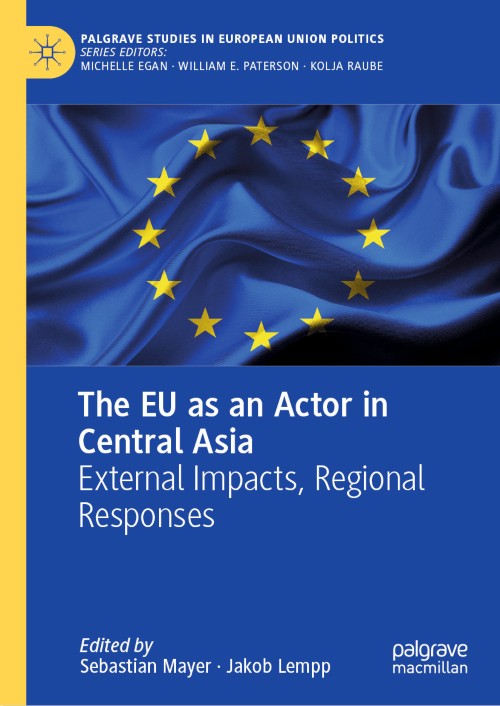
The EU as an Actor in Central Asia [electronic resource] : External Impacts, Regional Responses / edited by Sebastian Mayer, Jakob Lempp.
Erişim Adresi
ISBN
9783031513541
Dil Kodu
İngilizce
Yer Numarası
DK/20956
Basım Bildirimi
1st ed. 2024.
Yayın Bilgisi
Cham : Springer International Publishing : Imprint: Palgrave Macmillan, 2024.
Fiziksel Niteleme
XXIII, 318 p. 11 illus., 5 illus. in color. online resource.
Dizi
Palgrave Studies in European Union Politics, 2662-5881
İçindekiler Notu
1. Introduction: The European Union and Central Asia -- 2. Key turning points in EU-Central Asia Relations -- Part I. EU External Action and Regional Response -- 3. European Union Action towards Central Asia -- 4. EU Member States and Central Asia -- 5. Negotiating and Implementing the (E)PCAs -- 6. The EU and Central Asia: Mutual Perceptions -- Part II. Action-Response across Issue Areas -- 7. Economic Development and Trade -- 8. Provision of Security -- 9. Democratization and Human Rights -- 10. Environmental Affairs -- 11. Education -- 12. Conclusions.
Özet, vb.
"The European Union has matured as an actor in Central Asia but research has not followed suit. This is changing with this volume. Longtime Central Asia watchers with insights into EU policies offer a tour through the EU kitchen of foreign policymaking and discuss the Central Asian reaction to Brussels’ menu." –Jos Boonstra, Senior Researcher and Coordinator of the Europe-Central Asia Monitoring (EUCAM) initiative at the Centre for European Security Studies in Groningen, The Netherlands. This volume explains the behavior of the European Union (EU) towards Central Asia. In so doing, the responses of regional actors which impact the EU’s regional conduct, and the effects of competing external governance providers (particularly Russia and China), are considered. The current literature – often from an interdisciplinary, descriptive area studies angle – reveals some research gaps. Scholars chiefly explore the impacts of the EU on Kazakhstan, Uzbekistan, Kyrgyzstan, Tajikistan, and Turkmenistan, while action of the EU itself with its decision-making, preferences, and underlying drivers, remains underspecified. Focusing more explicitly on the EU, chapters in the book are systematically organized along a set of shared, overarching questions. Ultimately, the authors depict and explain EU action and assess how successful the organization has been in achieving its stated regional objectives in a number of policy fields: Economic Development and Trade; Security; Democratization and Human Rights; Water; and Education. Sebastian Mayer is DAAD Associate Professor of International Relations at the OSCE Academy and Associate Fellow at the American University of Central Asia in Bishkek, Kyrgyzstan. Jakob Lempp is Full Professor of Political Science with a focus on International Relations at Rhine-Waal University of Applied Sciences in Kleve, Germany.
Konu
Europe __ Politics and government.
Political science.
International relations.
Europe __ Economic integration.
Economic development.
European Politics.
Politics and International Studies.
International Relations.
European Economic Integration.
Economic Development, Innovation and Growth.
Political science.
International relations.
Europe __ Economic integration.
Economic development.
European Politics.
Politics and International Studies.
International Relations.
European Economic Integration.
Economic Development, Innovation and Growth.
Diğer Yazarlar
Kurum Adı
Eseri Alıntıla
Referansları kullanmadan önce gözden geçirmeniz ve varsa gerekli düzeltmeleri yapmanız önerilir.
Dijital Kaynak
MARC Görünümü
LEADER 05956nam a22007095i 4500
001 819749
003 TR_AnAIT
005 20260130172428
007 cr nn 008mamaa
008 240930s2024 sz | s |||| 0|eng d
020 |a9783031513541|9978-3-031-51354-1
024 7 |a10.1007/978-3-031-51354-1|2doi
041 |aeng
049 |aTürk Tarih Kurumu Kütüphanesi
050 4|aJN1-9692.2
072 7|aJP|2bicssc
072 7|a1D|2bicssc
072 7|aPOL058000|2bisacsh
072 7|aJP|x1D|2thema
082 04|a320.94|223
090 |aDK/20956
245 14|aThe EU as an Actor in Central Asia|h[electronic resource] :|bExternal Impacts, Regional Responses /|cedited by Sebastian Mayer, Jakob Lempp.
250 |a1st ed. 2024.
264 1|aCham :|bSpringer International Publishing :|bImprint: Palgrave Macmillan,|c2024.
300 |aXXIII, 318 p. 11 illus., 5 illus. in color.|bonline resource.
336 |atext|btxt|2rdacontent
337 |acomputer|bc|2rdamedia
338 |aonline resource|bcr|2rdacarrier
341 0 |bTable of contents navigation|2onix
341 0 |bSingle logical reading order|2onix
341 0 |bShort alternative textual descriptions|2onix
341 0 |bUse of color is not sole means of conveying information|2onix
341 0 |bUse of high contrast between text and background color|2onix
341 0 |bNext / Previous structural navigation|2onix
341 0 |bAll non-decorative content supports reading without sight|2onix
347 |atext file|bPDF|2rda
490 1 |aPalgrave Studies in European Union Politics,|x2662-5881
505 0 |a1. Introduction: The European Union and Central Asia -- 2. Key turning points in EU-Central Asia Relations -- Part I. EU External Action and Regional Response -- 3. European Union Action towards Central Asia -- 4. EU Member States and Central Asia -- 5. Negotiating and Implementing the (E)PCAs -- 6. The EU and Central Asia: Mutual Perceptions -- Part II. Action-Response across Issue Areas -- 7. Economic Development and Trade -- 8. Provision of Security -- 9. Democratization and Human Rights -- 10. Environmental Affairs -- 11. Education -- 12. Conclusions.
520 |a"The European Union has matured as an actor in Central Asia but research has not followed suit. This is changing with this volume. Longtime Central Asia watchers with insights into EU policies offer a tour through the EU kitchen of foreign policymaking and discuss the Central Asian reaction to Brussels’ menu." –Jos Boonstra, Senior Researcher and Coordinator of the Europe-Central Asia Monitoring (EUCAM) initiative at the Centre for European Security Studies in Groningen, The Netherlands. This volume explains the behavior of the European Union (EU) towards Central Asia. In so doing, the responses of regional actors which impact the EU’s regional conduct, and the effects of competing external governance providers (particularly Russia and China), are considered. The current literature – often from an interdisciplinary, descriptive area studies angle – reveals some research gaps. Scholars chiefly explore the impacts of the EU on Kazakhstan, Uzbekistan, Kyrgyzstan, Tajikistan, and Turkmenistan, while action of the EU itself with its decision-making, preferences, and underlying drivers, remains underspecified. Focusing more explicitly on the EU, chapters in the book are systematically organized along a set of shared, overarching questions. Ultimately, the authors depict and explain EU action and assess how successful the organization has been in achieving its stated regional objectives in a number of policy fields: Economic Development and Trade; Security; Democratization and Human Rights; Water; and Education. Sebastian Mayer is DAAD Associate Professor of International Relations at the OSCE Academy and Associate Fellow at the American University of Central Asia in Bishkek, Kyrgyzstan. Jakob Lempp is Full Professor of Political Science with a focus on International Relations at Rhine-Waal University of Applied Sciences in Kleve, Germany.
532 8 |aAccessibility summary: This PDF does not fully comply with PDF/UA standards, but does feature limited screen reader support, described non-text content (images, graphs), bookmarks for easy navigation and searchable, selectable text. Users of assistive technologies may experience difficulty navigating or interpreting content in this document. We recognize the importance of accessibility, and we welcome queries about accessibility for any of our products. If you have a question or an access need, please get in touch with us at accessibilitysupport@springernature.com.
532 8 |aNo reading system accessibility options actively disabled
532 8 |aPublisher contact for further accessibility information: accessibilitysupport@springernature.com
650 0|aEurope|xPolitics and government.
650 0|aPolitical science.
650 0|aInternational relations.
650 0|aEurope|xEconomic integration.
650 0|aEconomic development.
650 14|aEuropean Politics.
650 24|aPolitics and International Studies.
650 24|aInternational Relations.
650 24|aEuropean Economic Integration.
650 24|aEconomic Development, Innovation and Growth.
700 1 |aMayer, Sebastian.|eeditor.|4edt|4http://id.loc.gov/vocabulary/relators/edt
700 1 |aLempp, Jakob.|eeditor.|4edt|4http://id.loc.gov/vocabulary/relators/edt
710 2 |aSpringerLink (Online service)
773 0 |tSpringer Nature eBook
776 08|iPrinted edition:|z9783031513534
776 08|iPrinted edition:|z9783031513558
776 08|iPrinted edition:|z9783031513565
830 0|aPalgrave Studies in European Union Politics,|x2662-5881
856 40|uhttps://doi.org/10.1007/978-3-031-51354-1
912 |aZDB-2-POS
912 |aZDB-2-SXPI
950 |aPolitical Science and International Studies (SpringerNature-41174)
950 |aPolitical Science and International Studies (R0) (SpringerNature-43724)
001 819749
003 TR_AnAIT
005 20260130172428
007 cr nn 008mamaa
008 240930s2024 sz | s |||| 0|eng d
020 |a9783031513541|9978-3-031-51354-1
024 7 |a10.1007/978-3-031-51354-1|2doi
041 |aeng
049 |aTürk Tarih Kurumu Kütüphanesi
050 4|aJN1-9692.2
072 7|aJP|2bicssc
072 7|a1D|2bicssc
072 7|aPOL058000|2bisacsh
072 7|aJP|x1D|2thema
082 04|a320.94|223
090 |aDK/20956
245 14|aThe EU as an Actor in Central Asia|h[electronic resource] :|bExternal Impacts, Regional Responses /|cedited by Sebastian Mayer, Jakob Lempp.
250 |a1st ed. 2024.
264 1|aCham :|bSpringer International Publishing :|bImprint: Palgrave Macmillan,|c2024.
300 |aXXIII, 318 p. 11 illus., 5 illus. in color.|bonline resource.
336 |atext|btxt|2rdacontent
337 |acomputer|bc|2rdamedia
338 |aonline resource|bcr|2rdacarrier
341 0 |bTable of contents navigation|2onix
341 0 |bSingle logical reading order|2onix
341 0 |bShort alternative textual descriptions|2onix
341 0 |bUse of color is not sole means of conveying information|2onix
341 0 |bUse of high contrast between text and background color|2onix
341 0 |bNext / Previous structural navigation|2onix
341 0 |bAll non-decorative content supports reading without sight|2onix
347 |atext file|bPDF|2rda
490 1 |aPalgrave Studies in European Union Politics,|x2662-5881
505 0 |a1. Introduction: The European Union and Central Asia -- 2. Key turning points in EU-Central Asia Relations -- Part I. EU External Action and Regional Response -- 3. European Union Action towards Central Asia -- 4. EU Member States and Central Asia -- 5. Negotiating and Implementing the (E)PCAs -- 6. The EU and Central Asia: Mutual Perceptions -- Part II. Action-Response across Issue Areas -- 7. Economic Development and Trade -- 8. Provision of Security -- 9. Democratization and Human Rights -- 10. Environmental Affairs -- 11. Education -- 12. Conclusions.
520 |a"The European Union has matured as an actor in Central Asia but research has not followed suit. This is changing with this volume. Longtime Central Asia watchers with insights into EU policies offer a tour through the EU kitchen of foreign policymaking and discuss the Central Asian reaction to Brussels’ menu." –Jos Boonstra, Senior Researcher and Coordinator of the Europe-Central Asia Monitoring (EUCAM) initiative at the Centre for European Security Studies in Groningen, The Netherlands. This volume explains the behavior of the European Union (EU) towards Central Asia. In so doing, the responses of regional actors which impact the EU’s regional conduct, and the effects of competing external governance providers (particularly Russia and China), are considered. The current literature – often from an interdisciplinary, descriptive area studies angle – reveals some research gaps. Scholars chiefly explore the impacts of the EU on Kazakhstan, Uzbekistan, Kyrgyzstan, Tajikistan, and Turkmenistan, while action of the EU itself with its decision-making, preferences, and underlying drivers, remains underspecified. Focusing more explicitly on the EU, chapters in the book are systematically organized along a set of shared, overarching questions. Ultimately, the authors depict and explain EU action and assess how successful the organization has been in achieving its stated regional objectives in a number of policy fields: Economic Development and Trade; Security; Democratization and Human Rights; Water; and Education. Sebastian Mayer is DAAD Associate Professor of International Relations at the OSCE Academy and Associate Fellow at the American University of Central Asia in Bishkek, Kyrgyzstan. Jakob Lempp is Full Professor of Political Science with a focus on International Relations at Rhine-Waal University of Applied Sciences in Kleve, Germany.
532 8 |aAccessibility summary: This PDF does not fully comply with PDF/UA standards, but does feature limited screen reader support, described non-text content (images, graphs), bookmarks for easy navigation and searchable, selectable text. Users of assistive technologies may experience difficulty navigating or interpreting content in this document. We recognize the importance of accessibility, and we welcome queries about accessibility for any of our products. If you have a question or an access need, please get in touch with us at accessibilitysupport@springernature.com.
532 8 |aNo reading system accessibility options actively disabled
532 8 |aPublisher contact for further accessibility information: accessibilitysupport@springernature.com
650 0|aEurope|xPolitics and government.
650 0|aPolitical science.
650 0|aInternational relations.
650 0|aEurope|xEconomic integration.
650 0|aEconomic development.
650 14|aEuropean Politics.
650 24|aPolitics and International Studies.
650 24|aInternational Relations.
650 24|aEuropean Economic Integration.
650 24|aEconomic Development, Innovation and Growth.
700 1 |aMayer, Sebastian.|eeditor.|4edt|4http://id.loc.gov/vocabulary/relators/edt
700 1 |aLempp, Jakob.|eeditor.|4edt|4http://id.loc.gov/vocabulary/relators/edt
710 2 |aSpringerLink (Online service)
773 0 |tSpringer Nature eBook
776 08|iPrinted edition:|z9783031513534
776 08|iPrinted edition:|z9783031513558
776 08|iPrinted edition:|z9783031513565
830 0|aPalgrave Studies in European Union Politics,|x2662-5881
856 40|uhttps://doi.org/10.1007/978-3-031-51354-1
912 |aZDB-2-POS
912 |aZDB-2-SXPI
950 |aPolitical Science and International Studies (SpringerNature-41174)
950 |aPolitical Science and International Studies (R0) (SpringerNature-43724)
Materyaller
Depodan talep edilen materyal sadece kütüphane içerisinde kullanılmaktadır.
Materyal dışarıya ödünç verilmemektedir.
Materyal dışarıya ödünç verilmemektedir.
