

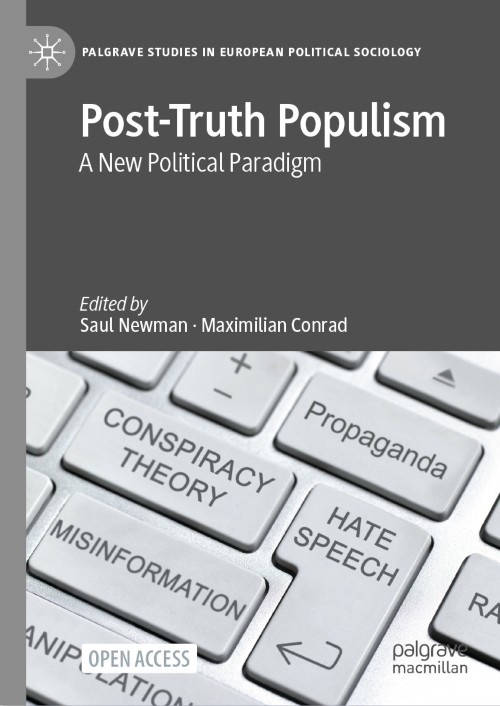
Post-Truth Populism [electronic resource] : A New Political Paradigm / edited by Saul Newman, Maximilian Conrad.
Erişim Adresi
ISBN
9783031641787
Dil Kodu
İngilizce
Yer Numarası
DK/20961
Basım Bildirimi
1st ed. 2024.
Yayın Bilgisi
Cham : Springer Nature Switzerland : Imprint: Palgrave Macmillan, 2024.
Fiziksel Niteleme
XII, 348 p. 3 illus., 2 illus. in color. online resource.
Dizi
Palgrave Studies in European Political Sociology, 2946-6024
İçindekiler Notu
1. Introduction: Post-truth populism: a new political paradigm? -- Part I: Debating PTP -- 2. Post-truth politics and populism studies: missing forms of trust and facts -- 3. Nostalgic post-truth: towards an anti-humanist theory of communication -- 4. (Anti-)populism and post-truth -- Part 2: Political communications and the media -- 5. The epistemic dimension of populist communication: can exposure to populist communication spark factual relativism -- 6. Refusing to be Silenced: Critical Journalism, Populism and the Post-Truth Condition -- Part III: Counterknowledge and conspiracy theories -- 7. ‘The first in the service of truth': construction of counterknowledge claims and the case of Janša's SDS' media outlets -- 8. A three-step rhetorical model of conspiratorial populism -- Part 4: PTP and democracy -- 9. Populisms in democracies under post-truth pressure: giving new life to public debate or blurring it? -- 10. New turn populism: ideological or epistemic? An inquiry into explanatory models of populism and the meaning of ‘post-truth -- 12. Populist democracy and the post-truth condition -- 13. Conclusion.
Özet, vb.
This open access book analyses the convergence between ‘post-truth’ political culture and the politics of populism. The premise is that there is an intrinsic link between post-truth discourse (referring to mis/disinformation, ‘alternative facts’, ‘fake news’, conspiracy theories and the general distrust of expert knowledge and official sources of information) and the central narrative of populism, which opposes the ‘common sense’ wisdom of ordinary honest people to the ‘expert knowledge’ of duplicitous technocratic elites. The book investigates the current post-truth phenomenon as a distinct feature of contemporary political life, and the specific ways in which it intersects with the resurgence of populism. While there has been a considerable literature on both post-truth and populism, they are largely treated as separate phenomena, and very little research has been conducted on their actual connection. The original contribution of this book to an emerging field of study is to develop a strong, coherent and empirically informed theoretical framework for understanding the specific paradigm of post-truth populism. The authors propose this paradigm as a way of interpreting different contemporary political phenomena, such as conspiracy theories, political destabilisation, and debates around immigration, the role of journalists and the media, climate change, gender and sexuality, Islam, and minority rights, as well as a way of understanding the threats and challenges this poses to the liberal democratic model and way of life. Saul Newman is Professor of Politics at Goldsmiths. His research specialisms are in the politics of right-wing populism, post-truth, and political theology. He is the author of ten monographs, including most recently, Order, Crisis, Redemption: Political Theology after Schmitt (SUNY 2023). He is currently involved in an EU Horizon project on ‘Reclaiming Liberal Democracy in the Postfactual Age’. Maximilian Conrad is Professor of Political Science at the University of Iceland. He is a specialist on the politics of post-truth, European integration, and the politics of the EU. He has published extensively on these and related topics, and is leading the Horizon Europe project on ‘Reclaiming Liberal Democracy in the Postfactual Age’.
Konu
Europe __ Politics and government.
Political sociology.
Communication in politics.
European Politics.
Political Sociology.
Political Communication.
Political sociology.
Communication in politics.
European Politics.
Political Sociology.
Political Communication.
Diğer Yazarlar
Kurum Adı
Eseri Alıntıla
Referansları kullanmadan önce gözden geçirmeniz ve varsa gerekli düzeltmeleri yapmanız önerilir.
Dijital Kaynak
MARC Görünümü
LEADER 06794nam a22006855i 4500
001 819754
003 TR_AnAIT
005 20260130172411
007 cr nn 008mamaa
008 241002s2024 sz | s |||| 0|eng d
020 |a9783031641787|9978-3-031-64178-7
024 7 |a10.1007/978-3-031-64178-7|2doi
041 |aeng
049 |aTürk Tarih Kurumu Kütüphanesi
050 4|aJN1-9692.2
072 7|aJP|2bicssc
072 7|a1D|2bicssc
072 7|aPOL058000|2bisacsh
072 7|aJP|x1D|2thema
082 04|a320.94|223
090 |aDK/20961
245 10|aPost-Truth Populism|h[electronic resource] :|bA New Political Paradigm /|cedited by Saul Newman, Maximilian Conrad.
250 |a1st ed. 2024.
264 1|aCham :|bSpringer Nature Switzerland :|bImprint: Palgrave Macmillan,|c2024.
300 |aXII, 348 p. 3 illus., 2 illus. in color.|bonline resource.
336 |atext|btxt|2rdacontent
337 |acomputer|bc|2rdamedia
338 |aonline resource|bcr|2rdacarrier
341 0 |bTable of contents navigation|2onix
341 0 |bSingle logical reading order|2onix
341 0 |bShort alternative textual descriptions|2onix
341 0 |bUse of color is not sole means of conveying information|2onix
341 0 |bUse of high contrast between text and background color|2onix
341 0 |bNext / Previous structural navigation|2onix
341 0 |bAll non-decorative content supports reading without sight|2onix
347 |atext file|bPDF|2rda
490 1 |aPalgrave Studies in European Political Sociology,|x2946-6024
505 0 |a1. Introduction: Post-truth populism: a new political paradigm? -- Part I: Debating PTP -- 2. Post-truth politics and populism studies: missing forms of trust and facts -- 3. Nostalgic post-truth: towards an anti-humanist theory of communication -- 4. (Anti-)populism and post-truth -- Part 2: Political communications and the media -- 5. The epistemic dimension of populist communication: can exposure to populist communication spark factual relativism -- 6. Refusing to be Silenced: Critical Journalism, Populism and the Post-Truth Condition -- Part III: Counterknowledge and conspiracy theories -- 7. ‘The first in the service of truth': construction of counterknowledge claims and the case of Janša's SDS' media outlets -- 8. A three-step rhetorical model of conspiratorial populism -- Part 4: PTP and democracy -- 9. Populisms in democracies under post-truth pressure: giving new life to public debate or blurring it? -- 10. New turn populism: ideological or epistemic? An inquiry into explanatory models of populism and the meaning of ‘post-truth -- 12. Populist democracy and the post-truth condition -- 13. Conclusion.
506 0 |aOpen Access
520 |aThis open access book analyses the convergence between ‘post-truth’ political culture and the politics of populism. The premise is that there is an intrinsic link between post-truth discourse (referring to mis/disinformation, ‘alternative facts’, ‘fake news’, conspiracy theories and the general distrust of expert knowledge and official sources of information) and the central narrative of populism, which opposes the ‘common sense’ wisdom of ordinary honest people to the ‘expert knowledge’ of duplicitous technocratic elites. The book investigates the current post-truth phenomenon as a distinct feature of contemporary political life, and the specific ways in which it intersects with the resurgence of populism. While there has been a considerable literature on both post-truth and populism, they are largely treated as separate phenomena, and very little research has been conducted on their actual connection. The original contribution of this book to an emerging field of study is to develop a strong, coherent and empirically informed theoretical framework for understanding the specific paradigm of post-truth populism. The authors propose this paradigm as a way of interpreting different contemporary political phenomena, such as conspiracy theories, political destabilisation, and debates around immigration, the role of journalists and the media, climate change, gender and sexuality, Islam, and minority rights, as well as a way of understanding the threats and challenges this poses to the liberal democratic model and way of life. Saul Newman is Professor of Politics at Goldsmiths. His research specialisms are in the politics of right-wing populism, post-truth, and political theology. He is the author of ten monographs, including most recently, Order, Crisis, Redemption: Political Theology after Schmitt (SUNY 2023). He is currently involved in an EU Horizon project on ‘Reclaiming Liberal Democracy in the Postfactual Age’. Maximilian Conrad is Professor of Political Science at the University of Iceland. He is a specialist on the politics of post-truth, European integration, and the politics of the EU. He has published extensively on these and related topics, and is leading the Horizon Europe project on ‘Reclaiming Liberal Democracy in the Postfactual Age’.
532 8 |aAccessibility summary: This PDF does not fully comply with PDF/UA standards, but does feature limited screen reader support, described non-text content (images, graphs), bookmarks for easy navigation and searchable, selectable text. Users of assistive technologies may experience difficulty navigating or interpreting content in this document. We recognize the importance of accessibility, and we welcome queries about accessibility for any of our products. If you have a question or an access need, please get in touch with us at accessibilitysupport@springernature.com.
532 8 |aNo reading system accessibility options actively disabled
532 8 |aPublisher contact for further accessibility information: accessibilitysupport@springernature.com
650 0|aEurope|xPolitics and government.
650 0|aPolitical sociology.
650 0|aCommunication in politics.
650 14|aEuropean Politics.
650 24|aPolitical Sociology.
650 24|aPolitical Communication.
700 1 |aNewman, Saul.|eeditor.|4edt|4http://id.loc.gov/vocabulary/relators/edt
700 1 |aConrad, Maximilian.|eeditor.|4edt|4http://id.loc.gov/vocabulary/relators/edt
710 2 |aSpringerLink (Online service)
773 0 |tSpringer Nature eBook
776 08|iPrinted edition:|z9783031641770
776 08|iPrinted edition:|z9783031641794
776 08|iPrinted edition:|z9783031641800
830 0|aPalgrave Studies in European Political Sociology,|x2946-6024
856 40|uhttps://doi.org/10.1007/978-3-031-64178-7
912 |aZDB-2-POS
912 |aZDB-2-SXPI
912 |aZDB-2-SOB
950 |aPolitical Science and International Studies (SpringerNature-41174)
950 |aPolitical Science and International Studies (R0) (SpringerNature-43724)
001 819754
003 TR_AnAIT
005 20260130172411
007 cr nn 008mamaa
008 241002s2024 sz | s |||| 0|eng d
020 |a9783031641787|9978-3-031-64178-7
024 7 |a10.1007/978-3-031-64178-7|2doi
041 |aeng
049 |aTürk Tarih Kurumu Kütüphanesi
050 4|aJN1-9692.2
072 7|aJP|2bicssc
072 7|a1D|2bicssc
072 7|aPOL058000|2bisacsh
072 7|aJP|x1D|2thema
082 04|a320.94|223
090 |aDK/20961
245 10|aPost-Truth Populism|h[electronic resource] :|bA New Political Paradigm /|cedited by Saul Newman, Maximilian Conrad.
250 |a1st ed. 2024.
264 1|aCham :|bSpringer Nature Switzerland :|bImprint: Palgrave Macmillan,|c2024.
300 |aXII, 348 p. 3 illus., 2 illus. in color.|bonline resource.
336 |atext|btxt|2rdacontent
337 |acomputer|bc|2rdamedia
338 |aonline resource|bcr|2rdacarrier
341 0 |bTable of contents navigation|2onix
341 0 |bSingle logical reading order|2onix
341 0 |bShort alternative textual descriptions|2onix
341 0 |bUse of color is not sole means of conveying information|2onix
341 0 |bUse of high contrast between text and background color|2onix
341 0 |bNext / Previous structural navigation|2onix
341 0 |bAll non-decorative content supports reading without sight|2onix
347 |atext file|bPDF|2rda
490 1 |aPalgrave Studies in European Political Sociology,|x2946-6024
505 0 |a1. Introduction: Post-truth populism: a new political paradigm? -- Part I: Debating PTP -- 2. Post-truth politics and populism studies: missing forms of trust and facts -- 3. Nostalgic post-truth: towards an anti-humanist theory of communication -- 4. (Anti-)populism and post-truth -- Part 2: Political communications and the media -- 5. The epistemic dimension of populist communication: can exposure to populist communication spark factual relativism -- 6. Refusing to be Silenced: Critical Journalism, Populism and the Post-Truth Condition -- Part III: Counterknowledge and conspiracy theories -- 7. ‘The first in the service of truth': construction of counterknowledge claims and the case of Janša's SDS' media outlets -- 8. A three-step rhetorical model of conspiratorial populism -- Part 4: PTP and democracy -- 9. Populisms in democracies under post-truth pressure: giving new life to public debate or blurring it? -- 10. New turn populism: ideological or epistemic? An inquiry into explanatory models of populism and the meaning of ‘post-truth -- 12. Populist democracy and the post-truth condition -- 13. Conclusion.
506 0 |aOpen Access
520 |aThis open access book analyses the convergence between ‘post-truth’ political culture and the politics of populism. The premise is that there is an intrinsic link between post-truth discourse (referring to mis/disinformation, ‘alternative facts’, ‘fake news’, conspiracy theories and the general distrust of expert knowledge and official sources of information) and the central narrative of populism, which opposes the ‘common sense’ wisdom of ordinary honest people to the ‘expert knowledge’ of duplicitous technocratic elites. The book investigates the current post-truth phenomenon as a distinct feature of contemporary political life, and the specific ways in which it intersects with the resurgence of populism. While there has been a considerable literature on both post-truth and populism, they are largely treated as separate phenomena, and very little research has been conducted on their actual connection. The original contribution of this book to an emerging field of study is to develop a strong, coherent and empirically informed theoretical framework for understanding the specific paradigm of post-truth populism. The authors propose this paradigm as a way of interpreting different contemporary political phenomena, such as conspiracy theories, political destabilisation, and debates around immigration, the role of journalists and the media, climate change, gender and sexuality, Islam, and minority rights, as well as a way of understanding the threats and challenges this poses to the liberal democratic model and way of life. Saul Newman is Professor of Politics at Goldsmiths. His research specialisms are in the politics of right-wing populism, post-truth, and political theology. He is the author of ten monographs, including most recently, Order, Crisis, Redemption: Political Theology after Schmitt (SUNY 2023). He is currently involved in an EU Horizon project on ‘Reclaiming Liberal Democracy in the Postfactual Age’. Maximilian Conrad is Professor of Political Science at the University of Iceland. He is a specialist on the politics of post-truth, European integration, and the politics of the EU. He has published extensively on these and related topics, and is leading the Horizon Europe project on ‘Reclaiming Liberal Democracy in the Postfactual Age’.
532 8 |aAccessibility summary: This PDF does not fully comply with PDF/UA standards, but does feature limited screen reader support, described non-text content (images, graphs), bookmarks for easy navigation and searchable, selectable text. Users of assistive technologies may experience difficulty navigating or interpreting content in this document. We recognize the importance of accessibility, and we welcome queries about accessibility for any of our products. If you have a question or an access need, please get in touch with us at accessibilitysupport@springernature.com.
532 8 |aNo reading system accessibility options actively disabled
532 8 |aPublisher contact for further accessibility information: accessibilitysupport@springernature.com
650 0|aEurope|xPolitics and government.
650 0|aPolitical sociology.
650 0|aCommunication in politics.
650 14|aEuropean Politics.
650 24|aPolitical Sociology.
650 24|aPolitical Communication.
700 1 |aNewman, Saul.|eeditor.|4edt|4http://id.loc.gov/vocabulary/relators/edt
700 1 |aConrad, Maximilian.|eeditor.|4edt|4http://id.loc.gov/vocabulary/relators/edt
710 2 |aSpringerLink (Online service)
773 0 |tSpringer Nature eBook
776 08|iPrinted edition:|z9783031641770
776 08|iPrinted edition:|z9783031641794
776 08|iPrinted edition:|z9783031641800
830 0|aPalgrave Studies in European Political Sociology,|x2946-6024
856 40|uhttps://doi.org/10.1007/978-3-031-64178-7
912 |aZDB-2-POS
912 |aZDB-2-SXPI
912 |aZDB-2-SOB
950 |aPolitical Science and International Studies (SpringerNature-41174)
950 |aPolitical Science and International Studies (R0) (SpringerNature-43724)
Materyaller
Depodan talep edilen materyal sadece kütüphane içerisinde kullanılmaktadır.
Materyal dışarıya ödünç verilmemektedir.
Materyal dışarıya ödünç verilmemektedir.
