

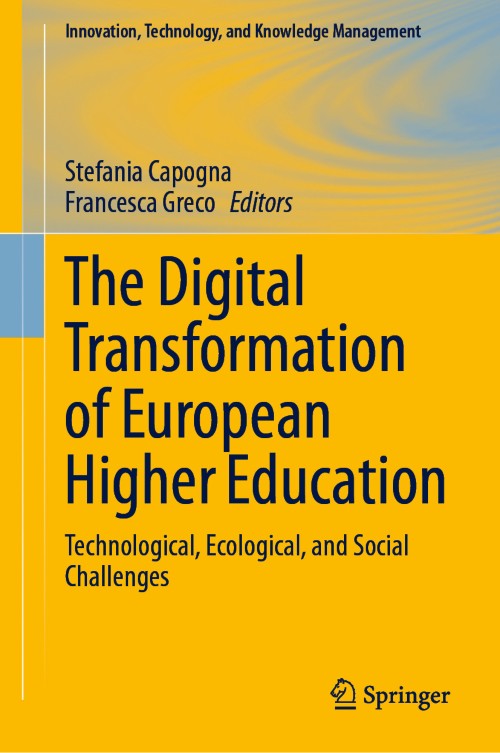
The Digital Transformation of European Higher Education [electronic resource] : Technological, Ecological, and Social Challenges / edited by Stefania Capogna, Francesca Greco.
Erişim Adresi
ISBN
9783031707636
Dil Kodu
İngilizce
Yer Numarası
DK/21058
Basım Bildirimi
1st ed. 2024.
Yayın Bilgisi
Cham : Springer Nature Switzerland : Imprint: Springer, 2024.
Fiziksel Niteleme
XVII, 221 p. 27 illus., 14 illus. in color. online resource.
Dizi
Innovation, Technology, and Knowledge Management, 2197-5701
İçindekiler Notu
Chapter 1. Introduction -- Part 1: ECOLHE: the Main Project Results -- Chapter 2. Building the EHEA Through the “translation” Perspective -- Chapter 3. Digital Transformation in Europe -- Chapter 4. Digital Development Culture in Europe -- Chapter 5. Students’ Perspective of Digital Technologies in Higher Education -- Chapter 6. Online Training Model for Improving Teachers in He: Challenges, Criticalities, Possibilities -- Chapter 7. Gamification as a Strategy to Increase Student Engagement in Higher Education: Exploring Teachers' Perspectives -- Chapter 8. The Symbiotic Learning Paradigm (SLP): Teacher Competencies, Methods & Approaches in Higher Education -- Chapter 9. Conclusion of the Project Findings -- Part 2: Recommendation and Guidelines for Academic Bodies -- Chapter 10. Digital Transformation and Digital Pedagogy- Quality of Learning and Teaching in EHEA -- Chapter 11. Suggestions for Academic Bodies -- Chapter 12. Networking and Cooperation in Promoting Quality Standards Through Internationalization -- Chapter 13. Conclusion.
Özet, vb.
This volume analyzes e-learning in European higher education, focusing on the technological, ecological, and social challenges of digital transformation. Started pre-pandemic and a result of an ECOLHE project funded by the European Union's Erasmus+ programme, the book discusses the impact of this global crisis, as well as the need for universities to integrate information and communications technology (ICT) in teaching and learning. The book presents multiple national case studies and examines how European universities adopt ICT for Lifelong Learning (LLL), uphold quality standards, and foster teachers' professional growth. It further sheds light on the translation of e-learning ideals into practical realities within academic institutions. From enhancing digital skills to refining teaching methodologies, the book offers valuable insights for educators, administrators, and policymakers alike. The multidisciplinary approach includes theoretical frameworks, pilot training initiatives, and strategic recommendations, all aimed at strengthening higher education's digital infrastructure. Navigating the challenges of digitalization, the book offers solutions for how European universities can remain resilient against the evolving demands of the modern world.
Konu
Political science.
Education, Higher.
Continuing education.
Education and state.
Technological innovations.
Public administration.
Governance and Government.
Higher Education.
Lifelong Learning.
Education Policy.
Innovation and Technology Management.
Public Administration.
Education, Higher.
Continuing education.
Education and state.
Technological innovations.
Public administration.
Governance and Government.
Higher Education.
Lifelong Learning.
Education Policy.
Innovation and Technology Management.
Public Administration.
Diğer Yazarlar
Kurum Adı
Eseri Alıntıla
Referansları kullanmadan önce gözden geçirmeniz ve varsa gerekli düzeltmeleri yapmanız önerilir.
Dijital Kaynak
MARC Görünümü
LEADER 05875nam a22007215i 4500
001 819851
003 TR_AnAIT
005 20260130172033
007 cr nn 008mamaa
008 241224s2024 sz | s |||| 0|eng d
020 |a9783031707636|9978-3-031-70763-6
024 7 |a10.1007/978-3-031-70763-6|2doi
041 |aeng
049 |aTürk Tarih Kurumu Kütüphanesi
050 4|aJF20-2112
072 7|aJPQ|2bicssc
072 7|aPOL028000|2bisacsh
072 7|aJPQ|2thema
082 04|a320.4|223
090 |aDK/21058
245 14|aThe Digital Transformation of European Higher Education|h[electronic resource] :|bTechnological, Ecological, and Social Challenges /|cedited by Stefania Capogna, Francesca Greco.
250 |a1st ed. 2024.
264 1|aCham :|bSpringer Nature Switzerland :|bImprint: Springer,|c2024.
300 |aXVII, 221 p. 27 illus., 14 illus. in color.|bonline resource.
336 |atext|btxt|2rdacontent
337 |acomputer|bc|2rdamedia
338 |aonline resource|bcr|2rdacarrier
341 0 |bTable of contents navigation|2onix
341 0 |bSingle logical reading order|2onix
341 0 |bShort alternative textual descriptions|2onix
341 0 |bUse of color is not sole means of conveying information|2onix
341 0 |bUse of high contrast between text and background color|2onix
341 0 |bNext / Previous structural navigation|2onix
341 0 |bAll non-decorative content supports reading without sight|2onix
347 |atext file|bPDF|2rda
490 1 |aInnovation, Technology, and Knowledge Management,|x2197-5701
505 0 |aChapter 1. Introduction -- Part 1: ECOLHE: the Main Project Results -- Chapter 2. Building the EHEA Through the “translation” Perspective -- Chapter 3. Digital Transformation in Europe -- Chapter 4. Digital Development Culture in Europe -- Chapter 5. Students’ Perspective of Digital Technologies in Higher Education -- Chapter 6. Online Training Model for Improving Teachers in He: Challenges, Criticalities, Possibilities -- Chapter 7. Gamification as a Strategy to Increase Student Engagement in Higher Education: Exploring Teachers' Perspectives -- Chapter 8. The Symbiotic Learning Paradigm (SLP): Teacher Competencies, Methods & Approaches in Higher Education -- Chapter 9. Conclusion of the Project Findings -- Part 2: Recommendation and Guidelines for Academic Bodies -- Chapter 10. Digital Transformation and Digital Pedagogy- Quality of Learning and Teaching in EHEA -- Chapter 11. Suggestions for Academic Bodies -- Chapter 12. Networking and Cooperation in Promoting Quality Standards Through Internationalization -- Chapter 13. Conclusion.
520 |aThis volume analyzes e-learning in European higher education, focusing on the technological, ecological, and social challenges of digital transformation. Started pre-pandemic and a result of an ECOLHE project funded by the European Union's Erasmus+ programme, the book discusses the impact of this global crisis, as well as the need for universities to integrate information and communications technology (ICT) in teaching and learning. The book presents multiple national case studies and examines how European universities adopt ICT for Lifelong Learning (LLL), uphold quality standards, and foster teachers' professional growth. It further sheds light on the translation of e-learning ideals into practical realities within academic institutions. From enhancing digital skills to refining teaching methodologies, the book offers valuable insights for educators, administrators, and policymakers alike. The multidisciplinary approach includes theoretical frameworks, pilot training initiatives, and strategic recommendations, all aimed at strengthening higher education's digital infrastructure. Navigating the challenges of digitalization, the book offers solutions for how European universities can remain resilient against the evolving demands of the modern world.
532 8 |aAccessibility summary: This PDF does not fully comply with PDF/UA standards, but does feature limited screen reader support, described non-text content (images, graphs), bookmarks for easy navigation and searchable, selectable text. Users of assistive technologies may experience difficulty navigating or interpreting content in this document. We recognize the importance of accessibility, and we welcome queries about accessibility for any of our products. If you have a question or an access need, please get in touch with us at accessibilitysupport@springernature.com.
532 8 |aNo reading system accessibility options actively disabled
532 8 |aPublisher contact for further accessibility information: accessibilitysupport@springernature.com
650 0|aPolitical science.
650 0|aEducation, Higher.
650 0|aContinuing education.
650 0|aEducation and state.
650 0|aTechnological innovations.
650 0|aPublic administration.
650 14|aGovernance and Government.
650 24|aHigher Education.
650 24|aLifelong Learning.
650 24|aEducation Policy.
650 24|aInnovation and Technology Management.
650 24|aPublic Administration.
700 1 |aCapogna, Stefania.|eeditor.|4edt|4http://id.loc.gov/vocabulary/relators/edt
700 1 |aGreco, Francesca.|eeditor.|4edt|4http://id.loc.gov/vocabulary/relators/edt
710 2 |aSpringerLink (Online service)
773 0 |tSpringer Nature eBook
776 08|iPrinted edition:|z9783031707629
776 08|iPrinted edition:|z9783031707643
776 08|iPrinted edition:|z9783031707650
830 0|aInnovation, Technology, and Knowledge Management,|x2197-5701
856 40|uhttps://doi.org/10.1007/978-3-031-70763-6
912 |aZDB-2-POS
912 |aZDB-2-SXPI
950 |aPolitical Science and International Studies (SpringerNature-41174)
950 |aPolitical Science and International Studies (R0) (SpringerNature-43724)
001 819851
003 TR_AnAIT
005 20260130172033
007 cr nn 008mamaa
008 241224s2024 sz | s |||| 0|eng d
020 |a9783031707636|9978-3-031-70763-6
024 7 |a10.1007/978-3-031-70763-6|2doi
041 |aeng
049 |aTürk Tarih Kurumu Kütüphanesi
050 4|aJF20-2112
072 7|aJPQ|2bicssc
072 7|aPOL028000|2bisacsh
072 7|aJPQ|2thema
082 04|a320.4|223
090 |aDK/21058
245 14|aThe Digital Transformation of European Higher Education|h[electronic resource] :|bTechnological, Ecological, and Social Challenges /|cedited by Stefania Capogna, Francesca Greco.
250 |a1st ed. 2024.
264 1|aCham :|bSpringer Nature Switzerland :|bImprint: Springer,|c2024.
300 |aXVII, 221 p. 27 illus., 14 illus. in color.|bonline resource.
336 |atext|btxt|2rdacontent
337 |acomputer|bc|2rdamedia
338 |aonline resource|bcr|2rdacarrier
341 0 |bTable of contents navigation|2onix
341 0 |bSingle logical reading order|2onix
341 0 |bShort alternative textual descriptions|2onix
341 0 |bUse of color is not sole means of conveying information|2onix
341 0 |bUse of high contrast between text and background color|2onix
341 0 |bNext / Previous structural navigation|2onix
341 0 |bAll non-decorative content supports reading without sight|2onix
347 |atext file|bPDF|2rda
490 1 |aInnovation, Technology, and Knowledge Management,|x2197-5701
505 0 |aChapter 1. Introduction -- Part 1: ECOLHE: the Main Project Results -- Chapter 2. Building the EHEA Through the “translation” Perspective -- Chapter 3. Digital Transformation in Europe -- Chapter 4. Digital Development Culture in Europe -- Chapter 5. Students’ Perspective of Digital Technologies in Higher Education -- Chapter 6. Online Training Model for Improving Teachers in He: Challenges, Criticalities, Possibilities -- Chapter 7. Gamification as a Strategy to Increase Student Engagement in Higher Education: Exploring Teachers' Perspectives -- Chapter 8. The Symbiotic Learning Paradigm (SLP): Teacher Competencies, Methods & Approaches in Higher Education -- Chapter 9. Conclusion of the Project Findings -- Part 2: Recommendation and Guidelines for Academic Bodies -- Chapter 10. Digital Transformation and Digital Pedagogy- Quality of Learning and Teaching in EHEA -- Chapter 11. Suggestions for Academic Bodies -- Chapter 12. Networking and Cooperation in Promoting Quality Standards Through Internationalization -- Chapter 13. Conclusion.
520 |aThis volume analyzes e-learning in European higher education, focusing on the technological, ecological, and social challenges of digital transformation. Started pre-pandemic and a result of an ECOLHE project funded by the European Union's Erasmus+ programme, the book discusses the impact of this global crisis, as well as the need for universities to integrate information and communications technology (ICT) in teaching and learning. The book presents multiple national case studies and examines how European universities adopt ICT for Lifelong Learning (LLL), uphold quality standards, and foster teachers' professional growth. It further sheds light on the translation of e-learning ideals into practical realities within academic institutions. From enhancing digital skills to refining teaching methodologies, the book offers valuable insights for educators, administrators, and policymakers alike. The multidisciplinary approach includes theoretical frameworks, pilot training initiatives, and strategic recommendations, all aimed at strengthening higher education's digital infrastructure. Navigating the challenges of digitalization, the book offers solutions for how European universities can remain resilient against the evolving demands of the modern world.
532 8 |aAccessibility summary: This PDF does not fully comply with PDF/UA standards, but does feature limited screen reader support, described non-text content (images, graphs), bookmarks for easy navigation and searchable, selectable text. Users of assistive technologies may experience difficulty navigating or interpreting content in this document. We recognize the importance of accessibility, and we welcome queries about accessibility for any of our products. If you have a question or an access need, please get in touch with us at accessibilitysupport@springernature.com.
532 8 |aNo reading system accessibility options actively disabled
532 8 |aPublisher contact for further accessibility information: accessibilitysupport@springernature.com
650 0|aPolitical science.
650 0|aEducation, Higher.
650 0|aContinuing education.
650 0|aEducation and state.
650 0|aTechnological innovations.
650 0|aPublic administration.
650 14|aGovernance and Government.
650 24|aHigher Education.
650 24|aLifelong Learning.
650 24|aEducation Policy.
650 24|aInnovation and Technology Management.
650 24|aPublic Administration.
700 1 |aCapogna, Stefania.|eeditor.|4edt|4http://id.loc.gov/vocabulary/relators/edt
700 1 |aGreco, Francesca.|eeditor.|4edt|4http://id.loc.gov/vocabulary/relators/edt
710 2 |aSpringerLink (Online service)
773 0 |tSpringer Nature eBook
776 08|iPrinted edition:|z9783031707629
776 08|iPrinted edition:|z9783031707643
776 08|iPrinted edition:|z9783031707650
830 0|aInnovation, Technology, and Knowledge Management,|x2197-5701
856 40|uhttps://doi.org/10.1007/978-3-031-70763-6
912 |aZDB-2-POS
912 |aZDB-2-SXPI
950 |aPolitical Science and International Studies (SpringerNature-41174)
950 |aPolitical Science and International Studies (R0) (SpringerNature-43724)
Materyaller
Depodan talep edilen materyal sadece kütüphane içerisinde kullanılmaktadır.
Materyal dışarıya ödünç verilmemektedir.
Materyal dışarıya ödünç verilmemektedir.
