

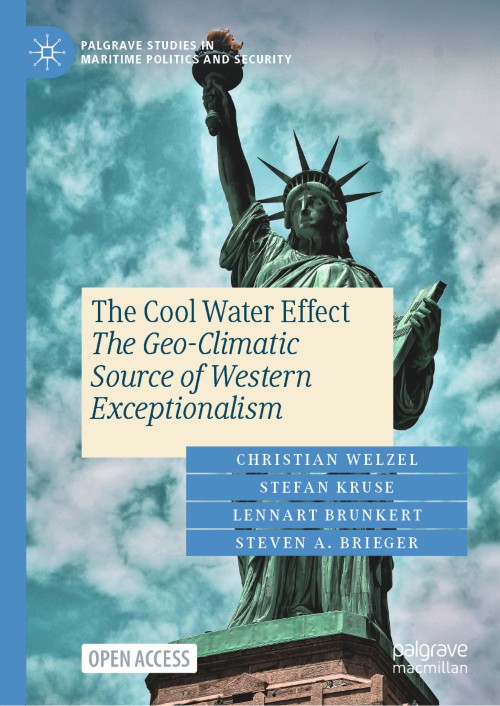
The Cool Water Effect [electronic resource] : The Geo-Climatic Source of Western Exceptionalism / by Christian Welzel, Stefan Kruse, Lennart Brunkert, Steven A. Brieger.
Erişim Adresi
ISBN
9783031818615
Dil Kodu
İngilizce
Yer Numarası
DK/21129
Yazar
Basım Bildirimi
1st ed. 2025.
Yayın Bilgisi
Cham : Springer Nature Switzerland : Imprint: Palgrave Macmillan, 2025.
Fiziksel Niteleme
XXI, 491 p. 69 illus., 50 illus. in color. online resource.
Dizi
Palgrave Studies in Maritime Politics and Security, 2730-7980
İçindekiler Notu
Introduction -- Chapter 1 The Emancipatory Turn in Civilization 14 -- Chapter 2 The CW-Condition Understood -- Chapter 3 The CW-Condition Measured -- Chapter 4 Development as Emancipation -- Chapter 5 The CW-Condition’s Gestation -- Chapter 6 The CW-Condition’s Egalitarianness -- Chapter 7 The CW-Condition and Colonialism -- Chapter 8 The CW-Condition in Perspective -- Chapter 9 The CW-Effect beyond Countries -- Chapter 10 The CW-Condition and Genes -- Chapter 11 The Recess of the CW-Condition’s Grip -- Conclusion.
Özet, vb.
This open access book unravels the geo-climatic source of the West’s emancipatory struggles and why the spirit of these struggles is about to spread around the world beyond its original geo-climatic root—which we describe as the Cool Water (CW-) Condition: that is, the combination of mostly cool seasons with steady rain in coastal proximity. What is so special about the CW-Condition? In a nutshell, the CW-Condition makes water and its derivative resources (i.e., land usable for hunting, fishery, forestry, crop cultivation and cattle herding) so diffuse that any emerging economy only functions with decentral management of water, land and labor. Decentral management infuses local autonomies into the social fabric, so much that evolving forms of social organization—be it family households, religious orders, business corporations or civic associations—mature under self-governance. Experience in self-governance equips social groups with two essential skills: resource mobilization and coalition building. In combination, these skills generate the power to organize grassroots resistance against top-down impositions, such as over-taxation and related forms of resource extraction. As a consequence, the state-building process begins slowly and proceeds as a conflictual affair between rulers’ authority ambitions and bottom-up opposition. This conflict steers state formation towards contractual institutional arrangements in which elected assemblies check the executive power of central rulers. Under these checks, government action navigates towards an indiscriminate pursuit of the common good. Christian Welzel is Chair in Political Culture Research at Leuphana University in Lueneburg, Germany, and Vice-President of the World Values Survey Association. Stefan Kruse is an International Development Consultant and former Postdoctoral Researcher at the Center for the Study of Democracy at Leuphana University, Lueneburg, Germany. Lennart Brunkert is a Postdoctoral Researcher at the Center for the Study of Democracy, Leuphana University in Lueneburg, Germany. Steven A. Brieger is an Associate Professor in International Business at the University of Sussex Business School, University of Sussex, UK.
Konu
International relations.
International Relations Theory.
International Relations Theory.
Diğer Yazarlar
Kurum Adı
