

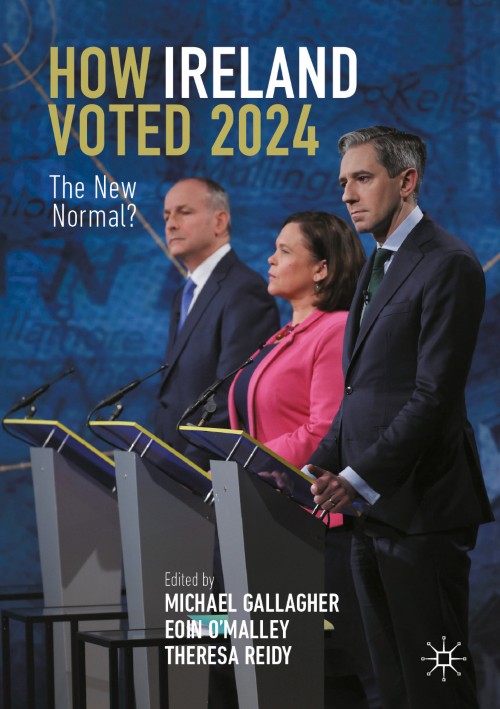
How Ireland Voted 2024 [electronic resource] : The New Normal? / edited by Michael Gallagher, Eoin O'Malley, Theresa Reidy.
Erişim Adresi
ISBN
9783031937958
Dil Kodu
İngilizce
Yer Numarası
DK/21137
Basım Bildirimi
1st ed. 2025.
Yayın Bilgisi
Cham : Springer Nature Switzerland : Imprint: Palgrave Macmillan, 2025.
Fiziksel Niteleme
L, 372 p. 95 illus., 92 illus. in color. online resource.
İçindekiler Notu
Chapter 1: The Road to the Election -- Chapter 2: The Local and European Elections of 2024 -- Chapter 3: The Record of the Outgoing Government: Pledge Fulfilment in a Time of Plenty -- Chapter 4: Candidate Selection: Many, Many More of the Same Kinds of Candidates -- Chapter 5: What the 2024 Manifestos Reveal: Issue Salience and Left–Right Positions -- Chapter 6: Campaign Strategies: the Inside Story of How Election 2024 was Fought -- Chapter 7: Digital Media Trends and Testing Regulatory Structures -- Chapter 8: Inside the Election: the Candidates’ Perspective -- Chapter 9: The Results Analysed: the Centre Strikes Back -- Chapter 10: Voter Dynamics in the 2024 Election: Stability with Hidden Currents of Change -- Chapter 11: Immigration and the ‘Far Right’ in the Election -- Chapter 12: Continuity with Change: Government Formation in 2025 -- Chapter 13: The Election in Context: Has Irish Politics Really Changed?.
Özet, vb.
‘The indispensable guide to the election: invaluable statistics, revealing insights, astute analysis. A must-read for those interested in Irish politics.’ — David McCullagh, author, journalist and news presenter, RTÉ ‘The How Ireland Voted series is the go-to guide for each election, used to analyse the last election and prepare for the next. How Ireland Voted 2024 continues in that tradition with fascinating data, analysis and coverage of the whole election. Indispensable.’ — Mary Regan, Political Editor, Irish Independent ‘The book offers fascinating insights into party and voter dynamics during the 2024 Irish elections, all within the unique Irish party and electoral system. It’s exciting to see so many political scientists building on the growing wealth of high-quality research data to explore electoral and campaign behaviour in such depth and detail.’ — Professor Georg Lutz, University of Lausanne In 2024, all across the democratic world governments were being thrown out of office as far-right and other radical parties made breakthroughs. In Ireland, the conditions seemed favourable for change. An ongoing housing crisis, which had heightened Sinn Féin’s electoral expectations, and a turbulent year preceding the election, which had seen anti-immigration riots in Dublin city centre, suggested that Ireland might follow the international trends. Yet support for the incumbent Fianna Fáil and Fine Gael parties held up, and the government was returned to office, albeit with new junior partners. How did this happen? This tenth volume in the How Ireland Voted series provides the definitive analysis of the election. It covers the campaign, the results and voting behaviour, government formation, and has a particular focus on the reasons why there was no far-right breakthrough. With an overview of Ireland’s newly emerging party system, it asks: is this the New Normal? Michael Gallagher is Emeritus Professor of Comparative Politics at Trinity College Dublin, Ireland. Eoin O’Malley is Associate Professor of Politics at Dublin City University, Ireland. Theresa Reidy is Professor in Government at University College Cork, Ireland.
Konu
Europe __ Politics and government.
Elections.
Communication in politics.
European Politics.
Electoral Politics.
Political Communication.
Elections.
Communication in politics.
European Politics.
Electoral Politics.
Political Communication.
Diğer Yazarlar
Kurum Adı
Eseri Alıntıla
Referansları kullanmadan önce gözden geçirmeniz ve varsa gerekli düzeltmeleri yapmanız önerilir.
Dijital Kaynak
MARC Görünümü
LEADER 06363nam a22006495i 4500
001 819930
003 TR_AnAIT
005 20260130171744
007 cr nn 008mamaa
008 250924s2025 sz | s |||| 0|eng d
020 |a9783031937958|9978-3-031-93795-8
024 7 |a10.1007/978-3-031-93795-8|2doi
041 |aeng
049 |aTürk Tarih Kurumu Kütüphanesi
050 4|aJN1-9692.2
072 7|aJP|2bicssc
072 7|a1D|2bicssc
072 7|aPOL058000|2bisacsh
072 7|aJP|x1D|2thema
082 04|a320.94|223
090 |aDK/21137
245 10|aHow Ireland Voted 2024|h[electronic resource] :|bThe New Normal? /|cedited by Michael Gallagher, Eoin O'Malley, Theresa Reidy.
250 |a1st ed. 2025.
264 1|aCham :|bSpringer Nature Switzerland :|bImprint: Palgrave Macmillan,|c2025.
300 |aL, 372 p. 95 illus., 92 illus. in color.|bonline resource.
336 |atext|btxt|2rdacontent
337 |acomputer|bc|2rdamedia
338 |aonline resource|bcr|2rdacarrier
341 0 |bPDF/UA-1|2onix
341 0 |bTable of contents navigation|2onix
341 0 |bSingle logical reading order|2onix
341 0 |bShort alternative textual descriptions|2onix
341 0 |bUse of color is not sole means of conveying information|2onix
341 0 |bUse of high contrast between text and background color|2onix
341 0 |bNext / Previous structural navigation|2onix
341 0 |bAll non-decorative content supports reading without sight|2onix
347 |atext file|bPDF|2rda
505 0 |aChapter 1: The Road to the Election -- Chapter 2: The Local and European Elections of 2024 -- Chapter 3: The Record of the Outgoing Government: Pledge Fulfilment in a Time of Plenty -- Chapter 4: Candidate Selection: Many, Many More of the Same Kinds of Candidates -- Chapter 5: What the 2024 Manifestos Reveal: Issue Salience and Left–Right Positions -- Chapter 6: Campaign Strategies: the Inside Story of How Election 2024 was Fought -- Chapter 7: Digital Media Trends and Testing Regulatory Structures -- Chapter 8: Inside the Election: the Candidates’ Perspective -- Chapter 9: The Results Analysed: the Centre Strikes Back -- Chapter 10: Voter Dynamics in the 2024 Election: Stability with Hidden Currents of Change -- Chapter 11: Immigration and the ‘Far Right’ in the Election -- Chapter 12: Continuity with Change: Government Formation in 2025 -- Chapter 13: The Election in Context: Has Irish Politics Really Changed?.
520 |a‘The indispensable guide to the election: invaluable statistics, revealing insights, astute analysis. A must-read for those interested in Irish politics.’ — David McCullagh, author, journalist and news presenter, RTÉ ‘The How Ireland Voted series is the go-to guide for each election, used to analyse the last election and prepare for the next. How Ireland Voted 2024 continues in that tradition with fascinating data, analysis and coverage of the whole election. Indispensable.’ — Mary Regan, Political Editor, Irish Independent ‘The book offers fascinating insights into party and voter dynamics during the 2024 Irish elections, all within the unique Irish party and electoral system. It’s exciting to see so many political scientists building on the growing wealth of high-quality research data to explore electoral and campaign behaviour in such depth and detail.’ — Professor Georg Lutz, University of Lausanne In 2024, all across the democratic world governments were being thrown out of office as far-right and other radical parties made breakthroughs. In Ireland, the conditions seemed favourable for change. An ongoing housing crisis, which had heightened Sinn Féin’s electoral expectations, and a turbulent year preceding the election, which had seen anti-immigration riots in Dublin city centre, suggested that Ireland might follow the international trends. Yet support for the incumbent Fianna Fáil and Fine Gael parties held up, and the government was returned to office, albeit with new junior partners. How did this happen? This tenth volume in the How Ireland Voted series provides the definitive analysis of the election. It covers the campaign, the results and voting behaviour, government formation, and has a particular focus on the reasons why there was no far-right breakthrough. With an overview of Ireland’s newly emerging party system, it asks: is this the New Normal? Michael Gallagher is Emeritus Professor of Comparative Politics at Trinity College Dublin, Ireland. Eoin O’Malley is Associate Professor of Politics at Dublin City University, Ireland. Theresa Reidy is Professor in Government at University College Cork, Ireland.
532 8 |aAccessibility summary: This PDF has been created in accordance with the PDF/UA-1 standard to enhance accessibility, including screen reader support, described non-text content (images, graphs), bookmarks for easy navigation, keyboard-friendly links and forms and searchable, selectable text. We recognize the importance of accessibility, and we welcome queries about accessibility for any of our products. If you have a question or an access need, please get in touch with us at accessibilitysupport@springernature.com. Please note that a more accessible version of this eBook is available as ePub.
532 8 |aNo reading system accessibility options actively disabled
532 8 |aPublisher contact for further accessibility information: accessibilitysupport@springernature.com
650 0|aEurope|xPolitics and government.
650 0|aElections.
650 0|aCommunication in politics.
650 14|aEuropean Politics.
650 24|aElectoral Politics.
650 24|aPolitical Communication.
700 1 |aGallagher, Michael.|eeditor.|4edt|4http://id.loc.gov/vocabulary/relators/edt
700 1 |aO'Malley, Eoin.|eeditor.|4edt|4http://id.loc.gov/vocabulary/relators/edt
700 1 |aReidy, Theresa.|eeditor.|4edt|4http://id.loc.gov/vocabulary/relators/edt
710 2 |aSpringerLink (Online service)
773 0 |tSpringer Nature eBook
776 08|iPrinted edition:|z9783031937941
776 08|iPrinted edition:|z9783031937965
856 40|uhttps://doi.org/10.1007/978-3-031-93795-8
912 |aZDB-2-POS
912 |aZDB-2-SXPI
950 |aPolitical Science and International Studies (SpringerNature-41174)
950 |aPolitical Science and International Studies (R0) (SpringerNature-43724)
001 819930
003 TR_AnAIT
005 20260130171744
007 cr nn 008mamaa
008 250924s2025 sz | s |||| 0|eng d
020 |a9783031937958|9978-3-031-93795-8
024 7 |a10.1007/978-3-031-93795-8|2doi
041 |aeng
049 |aTürk Tarih Kurumu Kütüphanesi
050 4|aJN1-9692.2
072 7|aJP|2bicssc
072 7|a1D|2bicssc
072 7|aPOL058000|2bisacsh
072 7|aJP|x1D|2thema
082 04|a320.94|223
090 |aDK/21137
245 10|aHow Ireland Voted 2024|h[electronic resource] :|bThe New Normal? /|cedited by Michael Gallagher, Eoin O'Malley, Theresa Reidy.
250 |a1st ed. 2025.
264 1|aCham :|bSpringer Nature Switzerland :|bImprint: Palgrave Macmillan,|c2025.
300 |aL, 372 p. 95 illus., 92 illus. in color.|bonline resource.
336 |atext|btxt|2rdacontent
337 |acomputer|bc|2rdamedia
338 |aonline resource|bcr|2rdacarrier
341 0 |bPDF/UA-1|2onix
341 0 |bTable of contents navigation|2onix
341 0 |bSingle logical reading order|2onix
341 0 |bShort alternative textual descriptions|2onix
341 0 |bUse of color is not sole means of conveying information|2onix
341 0 |bUse of high contrast between text and background color|2onix
341 0 |bNext / Previous structural navigation|2onix
341 0 |bAll non-decorative content supports reading without sight|2onix
347 |atext file|bPDF|2rda
505 0 |aChapter 1: The Road to the Election -- Chapter 2: The Local and European Elections of 2024 -- Chapter 3: The Record of the Outgoing Government: Pledge Fulfilment in a Time of Plenty -- Chapter 4: Candidate Selection: Many, Many More of the Same Kinds of Candidates -- Chapter 5: What the 2024 Manifestos Reveal: Issue Salience and Left–Right Positions -- Chapter 6: Campaign Strategies: the Inside Story of How Election 2024 was Fought -- Chapter 7: Digital Media Trends and Testing Regulatory Structures -- Chapter 8: Inside the Election: the Candidates’ Perspective -- Chapter 9: The Results Analysed: the Centre Strikes Back -- Chapter 10: Voter Dynamics in the 2024 Election: Stability with Hidden Currents of Change -- Chapter 11: Immigration and the ‘Far Right’ in the Election -- Chapter 12: Continuity with Change: Government Formation in 2025 -- Chapter 13: The Election in Context: Has Irish Politics Really Changed?.
520 |a‘The indispensable guide to the election: invaluable statistics, revealing insights, astute analysis. A must-read for those interested in Irish politics.’ — David McCullagh, author, journalist and news presenter, RTÉ ‘The How Ireland Voted series is the go-to guide for each election, used to analyse the last election and prepare for the next. How Ireland Voted 2024 continues in that tradition with fascinating data, analysis and coverage of the whole election. Indispensable.’ — Mary Regan, Political Editor, Irish Independent ‘The book offers fascinating insights into party and voter dynamics during the 2024 Irish elections, all within the unique Irish party and electoral system. It’s exciting to see so many political scientists building on the growing wealth of high-quality research data to explore electoral and campaign behaviour in such depth and detail.’ — Professor Georg Lutz, University of Lausanne In 2024, all across the democratic world governments were being thrown out of office as far-right and other radical parties made breakthroughs. In Ireland, the conditions seemed favourable for change. An ongoing housing crisis, which had heightened Sinn Féin’s electoral expectations, and a turbulent year preceding the election, which had seen anti-immigration riots in Dublin city centre, suggested that Ireland might follow the international trends. Yet support for the incumbent Fianna Fáil and Fine Gael parties held up, and the government was returned to office, albeit with new junior partners. How did this happen? This tenth volume in the How Ireland Voted series provides the definitive analysis of the election. It covers the campaign, the results and voting behaviour, government formation, and has a particular focus on the reasons why there was no far-right breakthrough. With an overview of Ireland’s newly emerging party system, it asks: is this the New Normal? Michael Gallagher is Emeritus Professor of Comparative Politics at Trinity College Dublin, Ireland. Eoin O’Malley is Associate Professor of Politics at Dublin City University, Ireland. Theresa Reidy is Professor in Government at University College Cork, Ireland.
532 8 |aAccessibility summary: This PDF has been created in accordance with the PDF/UA-1 standard to enhance accessibility, including screen reader support, described non-text content (images, graphs), bookmarks for easy navigation, keyboard-friendly links and forms and searchable, selectable text. We recognize the importance of accessibility, and we welcome queries about accessibility for any of our products. If you have a question or an access need, please get in touch with us at accessibilitysupport@springernature.com. Please note that a more accessible version of this eBook is available as ePub.
532 8 |aNo reading system accessibility options actively disabled
532 8 |aPublisher contact for further accessibility information: accessibilitysupport@springernature.com
650 0|aEurope|xPolitics and government.
650 0|aElections.
650 0|aCommunication in politics.
650 14|aEuropean Politics.
650 24|aElectoral Politics.
650 24|aPolitical Communication.
700 1 |aGallagher, Michael.|eeditor.|4edt|4http://id.loc.gov/vocabulary/relators/edt
700 1 |aO'Malley, Eoin.|eeditor.|4edt|4http://id.loc.gov/vocabulary/relators/edt
700 1 |aReidy, Theresa.|eeditor.|4edt|4http://id.loc.gov/vocabulary/relators/edt
710 2 |aSpringerLink (Online service)
773 0 |tSpringer Nature eBook
776 08|iPrinted edition:|z9783031937941
776 08|iPrinted edition:|z9783031937965
856 40|uhttps://doi.org/10.1007/978-3-031-93795-8
912 |aZDB-2-POS
912 |aZDB-2-SXPI
950 |aPolitical Science and International Studies (SpringerNature-41174)
950 |aPolitical Science and International Studies (R0) (SpringerNature-43724)
Materyaller
Depodan talep edilen materyal sadece kütüphane içerisinde kullanılmaktadır.
Materyal dışarıya ödünç verilmemektedir.
Materyal dışarıya ödünç verilmemektedir.
