

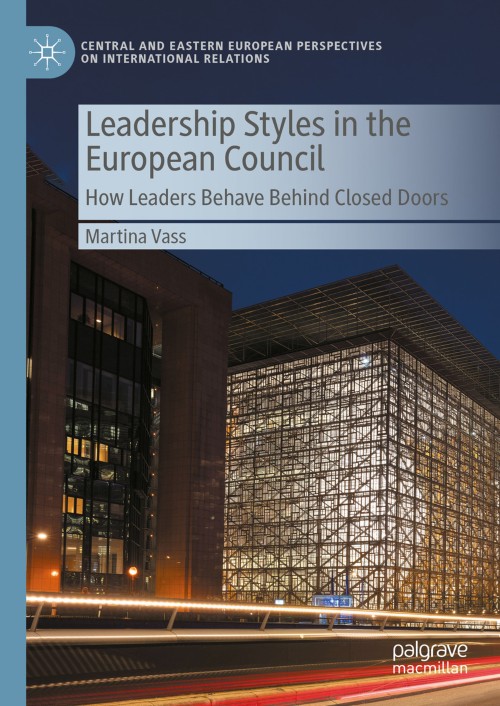
Leadership Styles in the European Council [electronic resource] : How Leaders Behave Behind Closed Doors / by Martina Vass.
Erişim Adresi
ISBN
9783031736216
Dil Kodu
İngilizce
Yer Numarası
DK/21160
Basım Bildirimi
1st ed. 2024.
Yayın Bilgisi
Cham : Springer Nature Switzerland : Imprint: Palgrave Macmillan, 2024.
Fiziksel Niteleme
XIX, 294 p. 6 illus., 5 illus. in color. online resource.
Dizi
Central and Eastern European Perspectives on International Relations, 2947-7999
İçindekiler Notu
Introduction -- 1. Theoretical and methodological foundations -- 2. How do Leaders Behave Behind Closed Doors? -- 3. Leadership Styles in the European Council -- Conclusion.
Özet, vb.
Using the example of Werner Faymann, Dalia Grybauskaité, Angela Merkel, Viktor Orbán and Mark Rutte, the book examines the impact that the European Council’s environment has on leadership styles and the impact of leaders on the institution’s decision-making during the financial and debt crisis, the Ukraine crisis, and the migration crisis (2010-2016). It presents domestic factors affecting the choice of leadership style nationally, finding cooperative styles are best suited to the European Council, as its structure relies on negotiated consensus. The European Council’s environment has three effects on leadership styles and decision-making: socialisation towards cooperation, compromise making, and Europeanisation. The book provides an in-depth insight into how leaders behave among their peers behind closed doors. Martina Vass PhD is a political scientist, former University of Oxford Weidenfeld scholar, and journalist. She worked in different private and government institutions in Slovakia and has a professional background in EU affairs. “This book offers a unique glimpse into the inner workings of European diplomacy, allowing readers to observe how leaders manage critical negotiations. By detailing their interactions, the book sheds light on the strategic thinking behind their actions, and how fellow leaders perceive these. It is an informative read for anyone wanting to understand the complex dynamics of European politics and the decision-making processes that influence the continent's future.” Sebastian Kurz, Minister of Foreign Affairs (2013-2017) and Chancellor of Austria (2017-2019, 2020-2021) “This book is the first to provide a theoretically informed and empirically rich analysis of the leadership styles of five heads of state or government in the European Council. It traces both the sources of variations in these styles in the domestic realm and their formation under conditions of European Council decision-making. A must read for all, who are interested in Leadership and European Studies, and particularly those who wonder why consensus in the European Council is often so difficult to achieve. “ .
Konu
Political science.
Europe __ Politics and government.
International relations.
International organization.
Political Science.
European Politics.
International Relations.
International Organization.
International Relations Theory.
Europe __ Politics and government.
International relations.
International organization.
Political Science.
European Politics.
International Relations.
International Organization.
International Relations Theory.
Kurum Adı
Eseri Alıntıla
Referansları kullanmadan önce gözden geçirmeniz ve varsa gerekli düzeltmeleri yapmanız önerilir.
Dijital Kaynak
MARC Görünümü
LEADER 04512nam a22005535i 4500
001 819953
003 TR_AnAIT
005 20260130171656
007 cr nn 008mamaa
008 250204s2024 sz | s |||| 0|eng d
020 |a9783031736216|9978-3-031-73621-6
024 7 |a10.1007/978-3-031-73621-6|2doi
041 |aeng
049 |aTürk Tarih Kurumu Kütüphanesi
050 4|aJA1-92
072 7|aJPA|2bicssc
072 7|aPOL000000|2bisacsh
072 7|aJPA|2thema
082 04|a320|223
090 |aDK/21160
100 1 |aVass, Martina.|eauthor.|0(orcid)0009-0001-5932-3811|1https://orcid.org/0009-0001-5932-3811|4aut|4http://id.loc.gov/vocabulary/relators/aut
245 10|aLeadership Styles in the European Council|h[electronic resource] :|bHow Leaders Behave Behind Closed Doors /|cby Martina Vass.
250 |a1st ed. 2024.
264 1|aCham :|bSpringer Nature Switzerland :|bImprint: Palgrave Macmillan,|c2024.
300 |aXIX, 294 p. 6 illus., 5 illus. in color.|bonline resource.
336 |atext|btxt|2rdacontent
337 |acomputer|bc|2rdamedia
338 |aonline resource|bcr|2rdacarrier
347 |atext file|bPDF|2rda
490 1 |aCentral and Eastern European Perspectives on International Relations,|x2947-7999
505 0 |aIntroduction -- 1. Theoretical and methodological foundations -- 2. How do Leaders Behave Behind Closed Doors? -- 3. Leadership Styles in the European Council -- Conclusion.
520 |aUsing the example of Werner Faymann, Dalia Grybauskaité, Angela Merkel, Viktor Orbán and Mark Rutte, the book examines the impact that the European Council’s environment has on leadership styles and the impact of leaders on the institution’s decision-making during the financial and debt crisis, the Ukraine crisis, and the migration crisis (2010-2016). It presents domestic factors affecting the choice of leadership style nationally, finding cooperative styles are best suited to the European Council, as its structure relies on negotiated consensus. The European Council’s environment has three effects on leadership styles and decision-making: socialisation towards cooperation, compromise making, and Europeanisation. The book provides an in-depth insight into how leaders behave among their peers behind closed doors. Martina Vass PhD is a political scientist, former University of Oxford Weidenfeld scholar, and journalist. She worked in different private and government institutions in Slovakia and has a professional background in EU affairs. “This book offers a unique glimpse into the inner workings of European diplomacy, allowing readers to observe how leaders manage critical negotiations. By detailing their interactions, the book sheds light on the strategic thinking behind their actions, and how fellow leaders perceive these. It is an informative read for anyone wanting to understand the complex dynamics of European politics and the decision-making processes that influence the continent's future.” Sebastian Kurz, Minister of Foreign Affairs (2013-2017) and Chancellor of Austria (2017-2019, 2020-2021) “This book is the first to provide a theoretically informed and empirically rich analysis of the leadership styles of five heads of state or government in the European Council. It traces both the sources of variations in these styles in the domestic realm and their formation under conditions of European Council decision-making. A must read for all, who are interested in Leadership and European Studies, and particularly those who wonder why consensus in the European Council is often so difficult to achieve. “ .
650 0|aPolitical science.
650 0|aEurope|xPolitics and government.
650 0|aInternational relations.
650 0|aInternational organization.
650 14|aPolitical Science.
650 24|aEuropean Politics.
650 24|aInternational Relations.
650 24|aInternational Organization.
650 24|aInternational Relations Theory.
710 2 |aSpringerLink (Online service)
773 0 |tSpringer Nature eBook
776 08|iPrinted edition:|z9783031736209
776 08|iPrinted edition:|z9783031736223
776 08|iPrinted edition:|z9783031736230
830 0|aCentral and Eastern European Perspectives on International Relations,|x2947-7999
856 40|uhttps://doi.org/10.1007/978-3-031-73621-6
912 |aZDB-2-POS
912 |aZDB-2-SXPI
950 |aPolitical Science and International Studies (SpringerNature-41174)
950 |aPolitical Science and International Studies (R0) (SpringerNature-43724)
001 819953
003 TR_AnAIT
005 20260130171656
007 cr nn 008mamaa
008 250204s2024 sz | s |||| 0|eng d
020 |a9783031736216|9978-3-031-73621-6
024 7 |a10.1007/978-3-031-73621-6|2doi
041 |aeng
049 |aTürk Tarih Kurumu Kütüphanesi
050 4|aJA1-92
072 7|aJPA|2bicssc
072 7|aPOL000000|2bisacsh
072 7|aJPA|2thema
082 04|a320|223
090 |aDK/21160
100 1 |aVass, Martina.|eauthor.|0(orcid)0009-0001-5932-3811|1https://orcid.org/0009-0001-5932-3811|4aut|4http://id.loc.gov/vocabulary/relators/aut
245 10|aLeadership Styles in the European Council|h[electronic resource] :|bHow Leaders Behave Behind Closed Doors /|cby Martina Vass.
250 |a1st ed. 2024.
264 1|aCham :|bSpringer Nature Switzerland :|bImprint: Palgrave Macmillan,|c2024.
300 |aXIX, 294 p. 6 illus., 5 illus. in color.|bonline resource.
336 |atext|btxt|2rdacontent
337 |acomputer|bc|2rdamedia
338 |aonline resource|bcr|2rdacarrier
347 |atext file|bPDF|2rda
490 1 |aCentral and Eastern European Perspectives on International Relations,|x2947-7999
505 0 |aIntroduction -- 1. Theoretical and methodological foundations -- 2. How do Leaders Behave Behind Closed Doors? -- 3. Leadership Styles in the European Council -- Conclusion.
520 |aUsing the example of Werner Faymann, Dalia Grybauskaité, Angela Merkel, Viktor Orbán and Mark Rutte, the book examines the impact that the European Council’s environment has on leadership styles and the impact of leaders on the institution’s decision-making during the financial and debt crisis, the Ukraine crisis, and the migration crisis (2010-2016). It presents domestic factors affecting the choice of leadership style nationally, finding cooperative styles are best suited to the European Council, as its structure relies on negotiated consensus. The European Council’s environment has three effects on leadership styles and decision-making: socialisation towards cooperation, compromise making, and Europeanisation. The book provides an in-depth insight into how leaders behave among their peers behind closed doors. Martina Vass PhD is a political scientist, former University of Oxford Weidenfeld scholar, and journalist. She worked in different private and government institutions in Slovakia and has a professional background in EU affairs. “This book offers a unique glimpse into the inner workings of European diplomacy, allowing readers to observe how leaders manage critical negotiations. By detailing their interactions, the book sheds light on the strategic thinking behind their actions, and how fellow leaders perceive these. It is an informative read for anyone wanting to understand the complex dynamics of European politics and the decision-making processes that influence the continent's future.” Sebastian Kurz, Minister of Foreign Affairs (2013-2017) and Chancellor of Austria (2017-2019, 2020-2021) “This book is the first to provide a theoretically informed and empirically rich analysis of the leadership styles of five heads of state or government in the European Council. It traces both the sources of variations in these styles in the domestic realm and their formation under conditions of European Council decision-making. A must read for all, who are interested in Leadership and European Studies, and particularly those who wonder why consensus in the European Council is often so difficult to achieve. “ .
650 0|aPolitical science.
650 0|aEurope|xPolitics and government.
650 0|aInternational relations.
650 0|aInternational organization.
650 14|aPolitical Science.
650 24|aEuropean Politics.
650 24|aInternational Relations.
650 24|aInternational Organization.
650 24|aInternational Relations Theory.
710 2 |aSpringerLink (Online service)
773 0 |tSpringer Nature eBook
776 08|iPrinted edition:|z9783031736209
776 08|iPrinted edition:|z9783031736223
776 08|iPrinted edition:|z9783031736230
830 0|aCentral and Eastern European Perspectives on International Relations,|x2947-7999
856 40|uhttps://doi.org/10.1007/978-3-031-73621-6
912 |aZDB-2-POS
912 |aZDB-2-SXPI
950 |aPolitical Science and International Studies (SpringerNature-41174)
950 |aPolitical Science and International Studies (R0) (SpringerNature-43724)
Materyaller
Depodan talep edilen materyal sadece kütüphane içerisinde kullanılmaktadır.
Materyal dışarıya ödünç verilmemektedir.
Materyal dışarıya ödünç verilmemektedir.
