

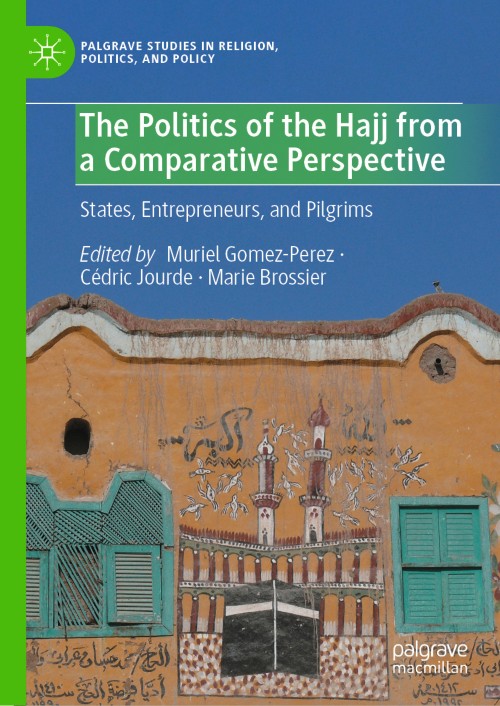
The Politics of the Hajj from a Comparative Perspective [electronic resource] : States, Entrepreneurs, and Pilgrims / edited by Muriel Gomez-Perez, Cédric Jourde, Marie Brossier.
Erişim Adresi
ISBN
9783031653490
Dil Kodu
İngilizce
Yer Numarası
DK/21176
Basım Bildirimi
1st ed. 2024.
Yayın Bilgisi
Cham : Springer Nature Switzerland : Imprint: Palgrave Macmillan, 2024.
Fiziksel Niteleme
XIX, 251 p. 16 illus., 13 illus. in color. online resource.
Dizi
Palgrave Studies in Religion, Politics, and Policy, 2731-6777
İçindekiler Notu
Introduction -- Chapter 2: The Last Muslim Empire? The Hajj in French Colonial Africa on the Eve of Decolonization -- Chapter 3: King Faisal’s Hajj Policy: Making Mecca a Forum for Pan-Islamic Thought (1964-1975) -- Chapter 4: Hajj Management in Malaysia Since 1969 -- Chapter 5: Managing the Hajj in Contemporary Ghana -- Chapter 6: Performing Hajj from Palestine: Beyond Barriers to Spiritual Fulfillment -- Chapter 7: Nationalizing the Nigerian Hajj: Politics, Citizenship, and Emotions (1950-1965) -- Chapter 8: Saudi Hajj Management through Moroccan Pilgrims’ Eyes -- Chapter 9: Management and Pilgrims’ Encounters with the State in Contemporary Indonesia.
Özet, vb.
"This volume offers an important transnational and historical examination of the contemporary politics of the Hajj. It adds a great deal to the literature that has been waiting for new and fresh insights into the management of an institution that has acquired overtime increased socioeconomic and political significance." -- Aboulaye Sounaye, Head of Research Unit Contested Religion and Intellectual Culture, at the Leibniz-Zentrum Moderner Orient, Germany “One of the book’s strengths is its comparative aspect across different countries and periods. It highlights the main issues behind the politics of organizing the Hajj, i.e. security, legitimation and clientelism, as well as the construction of citizenship. This volume constitutes an essential reading not only for scholars and students but also for policymakers.” --Aminah Mohammad-Arif, Research Director at the Centre d'études sud-asiatiques et himalayennes (EHESS/CNRS), France “The present volume addresses the questions of control, and, thus, of politics surrounding the Hajj from multidisciplinary perspectives. Due to this multi-vocal approach the present volume is a welcome and highly overdue contribution to our knowledge of the Hajj.” --Roman Loimeier, Professor at the Institute of Social and Cultural Anthropology, Göttingen University, Germany This book analyzes the contemporary politics of the Hajj in countries of Africa (Ghana, Morocco, Nigeria), the Near East (Palestine, Saudi Arabia), and Southeast Asia (Indonesia, Malaysia). It studies two aspects of the Hajj organization: first, the power relations states develop with pilgrims, religious leaders, and entrepreneurs, and how these relations impact their domestic legitimacy, internal security, and geopolitical positioning. Second, how pilgrims make sense of, and navigate, the bureaucratic apparatus they encounter, both at home and in Saudi Arabia. Muriel Gomez-Perez is Full Professor in the Interdisciplinary Research Center on Africa and the Middle East (CIRAM), Department of Historical Sciences, Université Laval, Canada. Cédric Jourde is Associate Professor in Political Studies at the University of Ottawa, Canada. Marie Brossier is Full Professor in the Interdisciplinary Research Center on Africa and the Middle East (CIRAM), Department of Political Science, Université Laval, Canada.
Konu
Religion and politics.
Comparative government.
Religions.
Africa __ Religion.
Middle East.
Politics and Religion.
Comparative Politics.
Comparative Religion.
African Religions.
Middle Eastern Religions.
Comparative government.
Religions.
Africa __ Religion.
Middle East.
Politics and Religion.
Comparative Politics.
Comparative Religion.
African Religions.
Middle Eastern Religions.
Diğer Yazarlar
Kurum Adı
Eseri Alıntıla
Referansları kullanmadan önce gözden geçirmeniz ve varsa gerekli düzeltmeleri yapmanız önerilir.
Dijital Kaynak
MARC Görünümü
LEADER 05332nam a22005895i 4500
001 819969
003 TR_AnAIT
005 20260130171625
007 cr nn 008mamaa
008 250301s2024 sz | s |||| 0|eng d
020 |a9783031653490|9978-3-031-65349-0
024 7 |a10.1007/978-3-031-65349-0|2doi
041 |aeng
049 |aTürk Tarih Kurumu Kütüphanesi
050 4|aBL65.P7
072 7|aHRAM2|2bicssc
072 7|aREL084000|2bisacsh
072 7|aQRAM2|2thema
082 04|a322.1|223
090 |aDK/21176
245 14|aThe Politics of the Hajj from a Comparative Perspective|h[electronic resource] :|bStates, Entrepreneurs, and Pilgrims /|cedited by Muriel Gomez-Perez, Cédric Jourde, Marie Brossier.
250 |a1st ed. 2024.
264 1|aCham :|bSpringer Nature Switzerland :|bImprint: Palgrave Macmillan,|c2024.
300 |aXIX, 251 p. 16 illus., 13 illus. in color.|bonline resource.
336 |atext|btxt|2rdacontent
337 |acomputer|bc|2rdamedia
338 |aonline resource|bcr|2rdacarrier
347 |atext file|bPDF|2rda
490 1 |aPalgrave Studies in Religion, Politics, and Policy,|x2731-6777
505 0 |aIntroduction -- Chapter 2: The Last Muslim Empire? The Hajj in French Colonial Africa on the Eve of Decolonization -- Chapter 3: King Faisal’s Hajj Policy: Making Mecca a Forum for Pan-Islamic Thought (1964-1975) -- Chapter 4: Hajj Management in Malaysia Since 1969 -- Chapter 5: Managing the Hajj in Contemporary Ghana -- Chapter 6: Performing Hajj from Palestine: Beyond Barriers to Spiritual Fulfillment -- Chapter 7: Nationalizing the Nigerian Hajj: Politics, Citizenship, and Emotions (1950-1965) -- Chapter 8: Saudi Hajj Management through Moroccan Pilgrims’ Eyes -- Chapter 9: Management and Pilgrims’ Encounters with the State in Contemporary Indonesia.
520 |a"This volume offers an important transnational and historical examination of the contemporary politics of the Hajj. It adds a great deal to the literature that has been waiting for new and fresh insights into the management of an institution that has acquired overtime increased socioeconomic and political significance." -- Aboulaye Sounaye, Head of Research Unit Contested Religion and Intellectual Culture, at the Leibniz-Zentrum Moderner Orient, Germany “One of the book’s strengths is its comparative aspect across different countries and periods. It highlights the main issues behind the politics of organizing the Hajj, i.e. security, legitimation and clientelism, as well as the construction of citizenship. This volume constitutes an essential reading not only for scholars and students but also for policymakers.” --Aminah Mohammad-Arif, Research Director at the Centre d'études sud-asiatiques et himalayennes (EHESS/CNRS), France “The present volume addresses the questions of control, and, thus, of politics surrounding the Hajj from multidisciplinary perspectives. Due to this multi-vocal approach the present volume is a welcome and highly overdue contribution to our knowledge of the Hajj.” --Roman Loimeier, Professor at the Institute of Social and Cultural Anthropology, Göttingen University, Germany This book analyzes the contemporary politics of the Hajj in countries of Africa (Ghana, Morocco, Nigeria), the Near East (Palestine, Saudi Arabia), and Southeast Asia (Indonesia, Malaysia). It studies two aspects of the Hajj organization: first, the power relations states develop with pilgrims, religious leaders, and entrepreneurs, and how these relations impact their domestic legitimacy, internal security, and geopolitical positioning. Second, how pilgrims make sense of, and navigate, the bureaucratic apparatus they encounter, both at home and in Saudi Arabia. Muriel Gomez-Perez is Full Professor in the Interdisciplinary Research Center on Africa and the Middle East (CIRAM), Department of Historical Sciences, Université Laval, Canada. Cédric Jourde is Associate Professor in Political Studies at the University of Ottawa, Canada. Marie Brossier is Full Professor in the Interdisciplinary Research Center on Africa and the Middle East (CIRAM), Department of Political Science, Université Laval, Canada.
650 0|aReligion and politics.
650 0|aComparative government.
650 0|aReligions.
650 0|aAfrica|xReligion.
650 0|aMiddle East.
650 14|aPolitics and Religion.
650 24|aComparative Politics.
650 24|aComparative Religion.
650 24|aAfrican Religions.
650 24|aMiddle Eastern Religions.
700 1 |aGomez-Perez, Muriel.|eeditor.|4edt|4http://id.loc.gov/vocabulary/relators/edt
700 1 |aJourde, Cédric.|eeditor.|4edt|4http://id.loc.gov/vocabulary/relators/edt
700 1 |aBrossier, Marie.|eeditor.|4edt|4http://id.loc.gov/vocabulary/relators/edt
710 2 |aSpringerLink (Online service)
773 0 |tSpringer Nature eBook
776 08|iPrinted edition:|z9783031653483
776 08|iPrinted edition:|z9783031653506
776 08|iPrinted edition:|z9783031653513
830 0|aPalgrave Studies in Religion, Politics, and Policy,|x2731-6777
856 40|uhttps://doi.org/10.1007/978-3-031-65349-0
912 |aZDB-2-POS
912 |aZDB-2-SXPI
950 |aPolitical Science and International Studies (SpringerNature-41174)
950 |aPolitical Science and International Studies (R0) (SpringerNature-43724)
001 819969
003 TR_AnAIT
005 20260130171625
007 cr nn 008mamaa
008 250301s2024 sz | s |||| 0|eng d
020 |a9783031653490|9978-3-031-65349-0
024 7 |a10.1007/978-3-031-65349-0|2doi
041 |aeng
049 |aTürk Tarih Kurumu Kütüphanesi
050 4|aBL65.P7
072 7|aHRAM2|2bicssc
072 7|aREL084000|2bisacsh
072 7|aQRAM2|2thema
082 04|a322.1|223
090 |aDK/21176
245 14|aThe Politics of the Hajj from a Comparative Perspective|h[electronic resource] :|bStates, Entrepreneurs, and Pilgrims /|cedited by Muriel Gomez-Perez, Cédric Jourde, Marie Brossier.
250 |a1st ed. 2024.
264 1|aCham :|bSpringer Nature Switzerland :|bImprint: Palgrave Macmillan,|c2024.
300 |aXIX, 251 p. 16 illus., 13 illus. in color.|bonline resource.
336 |atext|btxt|2rdacontent
337 |acomputer|bc|2rdamedia
338 |aonline resource|bcr|2rdacarrier
347 |atext file|bPDF|2rda
490 1 |aPalgrave Studies in Religion, Politics, and Policy,|x2731-6777
505 0 |aIntroduction -- Chapter 2: The Last Muslim Empire? The Hajj in French Colonial Africa on the Eve of Decolonization -- Chapter 3: King Faisal’s Hajj Policy: Making Mecca a Forum for Pan-Islamic Thought (1964-1975) -- Chapter 4: Hajj Management in Malaysia Since 1969 -- Chapter 5: Managing the Hajj in Contemporary Ghana -- Chapter 6: Performing Hajj from Palestine: Beyond Barriers to Spiritual Fulfillment -- Chapter 7: Nationalizing the Nigerian Hajj: Politics, Citizenship, and Emotions (1950-1965) -- Chapter 8: Saudi Hajj Management through Moroccan Pilgrims’ Eyes -- Chapter 9: Management and Pilgrims’ Encounters with the State in Contemporary Indonesia.
520 |a"This volume offers an important transnational and historical examination of the contemporary politics of the Hajj. It adds a great deal to the literature that has been waiting for new and fresh insights into the management of an institution that has acquired overtime increased socioeconomic and political significance." -- Aboulaye Sounaye, Head of Research Unit Contested Religion and Intellectual Culture, at the Leibniz-Zentrum Moderner Orient, Germany “One of the book’s strengths is its comparative aspect across different countries and periods. It highlights the main issues behind the politics of organizing the Hajj, i.e. security, legitimation and clientelism, as well as the construction of citizenship. This volume constitutes an essential reading not only for scholars and students but also for policymakers.” --Aminah Mohammad-Arif, Research Director at the Centre d'études sud-asiatiques et himalayennes (EHESS/CNRS), France “The present volume addresses the questions of control, and, thus, of politics surrounding the Hajj from multidisciplinary perspectives. Due to this multi-vocal approach the present volume is a welcome and highly overdue contribution to our knowledge of the Hajj.” --Roman Loimeier, Professor at the Institute of Social and Cultural Anthropology, Göttingen University, Germany This book analyzes the contemporary politics of the Hajj in countries of Africa (Ghana, Morocco, Nigeria), the Near East (Palestine, Saudi Arabia), and Southeast Asia (Indonesia, Malaysia). It studies two aspects of the Hajj organization: first, the power relations states develop with pilgrims, religious leaders, and entrepreneurs, and how these relations impact their domestic legitimacy, internal security, and geopolitical positioning. Second, how pilgrims make sense of, and navigate, the bureaucratic apparatus they encounter, both at home and in Saudi Arabia. Muriel Gomez-Perez is Full Professor in the Interdisciplinary Research Center on Africa and the Middle East (CIRAM), Department of Historical Sciences, Université Laval, Canada. Cédric Jourde is Associate Professor in Political Studies at the University of Ottawa, Canada. Marie Brossier is Full Professor in the Interdisciplinary Research Center on Africa and the Middle East (CIRAM), Department of Political Science, Université Laval, Canada.
650 0|aReligion and politics.
650 0|aComparative government.
650 0|aReligions.
650 0|aAfrica|xReligion.
650 0|aMiddle East.
650 14|aPolitics and Religion.
650 24|aComparative Politics.
650 24|aComparative Religion.
650 24|aAfrican Religions.
650 24|aMiddle Eastern Religions.
700 1 |aGomez-Perez, Muriel.|eeditor.|4edt|4http://id.loc.gov/vocabulary/relators/edt
700 1 |aJourde, Cédric.|eeditor.|4edt|4http://id.loc.gov/vocabulary/relators/edt
700 1 |aBrossier, Marie.|eeditor.|4edt|4http://id.loc.gov/vocabulary/relators/edt
710 2 |aSpringerLink (Online service)
773 0 |tSpringer Nature eBook
776 08|iPrinted edition:|z9783031653483
776 08|iPrinted edition:|z9783031653506
776 08|iPrinted edition:|z9783031653513
830 0|aPalgrave Studies in Religion, Politics, and Policy,|x2731-6777
856 40|uhttps://doi.org/10.1007/978-3-031-65349-0
912 |aZDB-2-POS
912 |aZDB-2-SXPI
950 |aPolitical Science and International Studies (SpringerNature-41174)
950 |aPolitical Science and International Studies (R0) (SpringerNature-43724)
Materyaller
Depodan talep edilen materyal sadece kütüphane içerisinde kullanılmaktadır.
Materyal dışarıya ödünç verilmemektedir.
Materyal dışarıya ödünç verilmemektedir.
