

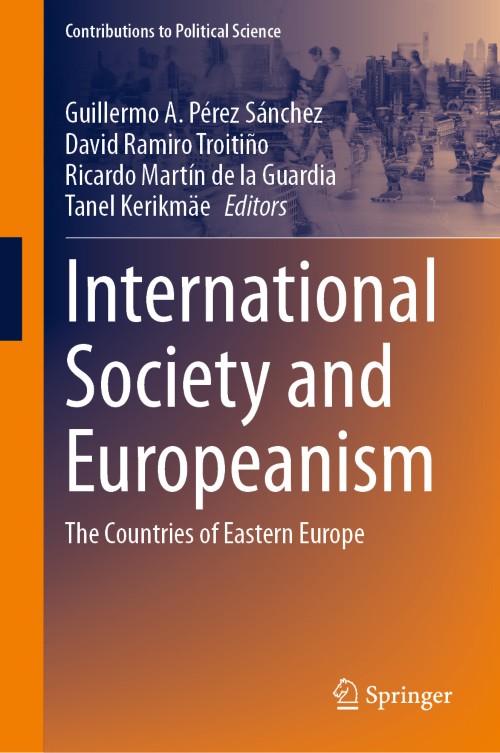
International Society and Europeanism [electronic resource] : The Countries of Eastern Europe / edited by Guillermo A. Pérez Sánchez, David Ramiro Troitiño, Ricardo Martín de la Guardia, Tanel Kerikmäe.
Erişim Adresi
ISBN
9783031660771
Dil Kodu
İngilizce
Yer Numarası
DK/21180
Basım Bildirimi
1st ed. 2025.
Yayın Bilgisi
Cham : Springer Nature Switzerland : Imprint: Springer, 2025.
Fiziksel Niteleme
VI, 246 p. 6 illus. online resource.
Dizi
Contributions to Political Science, 2198-7297
İçindekiler Notu
Chapter 1. Building Europe in a Time of Deconstruction and Destruction -- Chapter 2. The Baltic States and Europeanism in the Interwar Period. The Implementation of a European Model Antagonist to Soviet Structure -- Chapter 3. Exile and Europeanism. Eastern European Exiles During the Years of Real Socialism and Their Influence on the Fall of the Soviet System When the Liberation Revolutions of 1989-1991 Took Place in the Area -- Chapter 4. Central Europe and Europeanism: Divided Germany After World War II, East German Dissidence and Europeanism -- Chapter 5. At the Boundaries of Europe, From the Interwar Period to Post-second World War: Turkey and Europeanism -- Chapter 6. Europe, From the Interwar Period to the Decolonization Process: Anticolonialism and Europeanism? -- Chapter 7. Central Europe and Europeanism: the Case of Czechoslovakia, From the Interwar Period to Its Aspiration for Integration Into the European Community -- Chapter 8. Balkan Europe and Europeanism: the Case of Croatia, From the Interwar Period to Its Aspiration to Join to Community of Europe -- Chapter 9. On the Eastern Border of Europe: the Case of Ukrainian Nationalism, From the Inter-war Period to the Years the Second World War: Towards an Independent Ukraine? -- Chapter 10. The Petite Entente Des Femmes in the Interwar Period and Their Integration Ideas -- Chapter 11. Central Europe and Europeanism: the Case of Hungary, From the Interwar Period to Its Aspiration for Integration Into the European Community -- Chapter 12. Europe’s Importance to Poland During the Communist Period -- Chapter 13. From Europeanism to Europeanisation: Electoral Behaviour in the Baltic States and the Visegrad Group (2004-2024) -- Chapter 14. Women in Interwar Period and Europeanism in Central Europe.
Özet, vb.
This pioneering volume examines Europeanism in the new international society that emerged after the First World War through the League of Nations, with a focus on the countries of Central and Eastern Europe (CEE), the Baltic countries, and the Balkans. The book analyzes how Europeanism was consolidated as an argument for the future, especially after the Second World War, when the three strong ideas of Europeanism came to fruition: peace among Europeans, good democratic government, and the socioeconomic welfare of peoples. By doing so, this book offers a comprehensive overview of the evolution of Europeanism and its positive influence in the countries of Eastern Europe, from the interwar period to the present day. The book will appeal to researchers, students, and scholars of political science, international relations, European studies, and history, as well as policy-makers interested in a better understanding of Europeanism and the European integration process of the CEE, Baltic, and Balkan countries.
Konu
Comparative government.
Europe __ Politics and government.
World politics.
International organization.
International relations.
Comparative Politics.
European Politics.
Political History.
International Organization.
Foreign Policy.
Europe __ Politics and government.
World politics.
International organization.
International relations.
Comparative Politics.
European Politics.
Political History.
International Organization.
Foreign Policy.
Diğer Yazarlar
Kurum Adı
Eseri Alıntıla
Referansları kullanmadan önce gözden geçirmeniz ve varsa gerekli düzeltmeleri yapmanız önerilir.
Dijital Kaynak
MARC Görünümü
LEADER 06599nam a22007215i 4500
001 819973
003 TR_AnAIT
005 20260130171617
007 cr nn 008mamaa
008 250302s2025 sz | s |||| 0|eng d
020 |a9783031660771|9978-3-031-66077-1
024 7 |a10.1007/978-3-031-66077-1|2doi
041 |aeng
049 |aTürk Tarih Kurumu Kütüphanesi
050 4|aJF20-1177
072 7|aJPB|2bicssc
072 7|aPOL009000|2bisacsh
072 7|aJPB|2thema
082 04|a320.3|223
090 |aDK/21180
245 10|aInternational Society and Europeanism|h[electronic resource] :|bThe Countries of Eastern Europe /|cedited by Guillermo A. Pérez Sánchez, David Ramiro Troitiño, Ricardo Martín de la Guardia, Tanel Kerikmäe.
250 |a1st ed. 2025.
264 1|aCham :|bSpringer Nature Switzerland :|bImprint: Springer,|c2025.
300 |aVI, 246 p. 6 illus.|bonline resource.
336 |atext|btxt|2rdacontent
337 |acomputer|bc|2rdamedia
338 |aonline resource|bcr|2rdacarrier
341 0 |bTable of contents navigation|2onix
341 0 |bSingle logical reading order|2onix
341 0 |bShort alternative textual descriptions|2onix
341 0 |bUse of color is not sole means of conveying information|2onix
341 0 |bUse of high contrast between text and background color|2onix
341 0 |bNext / Previous structural navigation|2onix
341 0 |bAll non-decorative content supports reading without sight|2onix
347 |atext file|bPDF|2rda
490 1 |aContributions to Political Science,|x2198-7297
505 0 |aChapter 1. Building Europe in a Time of Deconstruction and Destruction -- Chapter 2. The Baltic States and Europeanism in the Interwar Period. The Implementation of a European Model Antagonist to Soviet Structure -- Chapter 3. Exile and Europeanism. Eastern European Exiles During the Years of Real Socialism and Their Influence on the Fall of the Soviet System When the Liberation Revolutions of 1989-1991 Took Place in the Area -- Chapter 4. Central Europe and Europeanism: Divided Germany After World War II, East German Dissidence and Europeanism -- Chapter 5. At the Boundaries of Europe, From the Interwar Period to Post-second World War: Turkey and Europeanism -- Chapter 6. Europe, From the Interwar Period to the Decolonization Process: Anticolonialism and Europeanism? -- Chapter 7. Central Europe and Europeanism: the Case of Czechoslovakia, From the Interwar Period to Its Aspiration for Integration Into the European Community -- Chapter 8. Balkan Europe and Europeanism: the Case of Croatia, From the Interwar Period to Its Aspiration to Join to Community of Europe -- Chapter 9. On the Eastern Border of Europe: the Case of Ukrainian Nationalism, From the Inter-war Period to the Years the Second World War: Towards an Independent Ukraine? -- Chapter 10. The Petite Entente Des Femmes in the Interwar Period and Their Integration Ideas -- Chapter 11. Central Europe and Europeanism: the Case of Hungary, From the Interwar Period to Its Aspiration for Integration Into the European Community -- Chapter 12. Europe’s Importance to Poland During the Communist Period -- Chapter 13. From Europeanism to Europeanisation: Electoral Behaviour in the Baltic States and the Visegrad Group (2004-2024) -- Chapter 14. Women in Interwar Period and Europeanism in Central Europe.
520 |aThis pioneering volume examines Europeanism in the new international society that emerged after the First World War through the League of Nations, with a focus on the countries of Central and Eastern Europe (CEE), the Baltic countries, and the Balkans. The book analyzes how Europeanism was consolidated as an argument for the future, especially after the Second World War, when the three strong ideas of Europeanism came to fruition: peace among Europeans, good democratic government, and the socioeconomic welfare of peoples. By doing so, this book offers a comprehensive overview of the evolution of Europeanism and its positive influence in the countries of Eastern Europe, from the interwar period to the present day. The book will appeal to researchers, students, and scholars of political science, international relations, European studies, and history, as well as policy-makers interested in a better understanding of Europeanism and the European integration process of the CEE, Baltic, and Balkan countries.
532 8 |aAccessibility summary: This PDF does not fully comply with PDF/UA standards, but does feature limited screen reader support, described non-text content (images, graphs), bookmarks for easy navigation and searchable, selectable text. Users of assistive technologies may experience difficulty navigating or interpreting content in this document. We recognize the importance of accessibility, and we welcome queries about accessibility for any of our products. If you have a question or an access need, please get in touch with us at accessibilitysupport@springernature.com.
532 8 |aNo reading system accessibility options actively disabled
532 8 |aPublisher contact for further accessibility information: accessibilitysupport@springernature.com
650 0|aComparative government.
650 0|aEurope|xPolitics and government.
650 0|aWorld politics.
650 0|aInternational organization.
650 0|aInternational relations.
650 14|aComparative Politics.
650 24|aEuropean Politics.
650 24|aPolitical History.
650 24|aInternational Organization.
650 24|aForeign Policy.
700 1 |aPérez Sánchez, Guillermo A.|eeditor.|4edt|4http://id.loc.gov/vocabulary/relators/edt
700 1 |aRamiro Troitiño, David.|eeditor.|0(orcid)0000-0002-0542-5724|1https://orcid.org/0000-0002-0542-5724|4edt|4http://id.loc.gov/vocabulary/relators/edt
700 1 |aMartín de la Guardia, Ricardo.|eeditor.|4edt|4http://id.loc.gov/vocabulary/relators/edt
700 1 |aKerikmäe, Tanel.|eeditor.|0(orcid)0000-0002-5972-827X|1https://orcid.org/0000-0002-5972-827X|4edt|4http://id.loc.gov/vocabulary/relators/edt
710 2 |aSpringerLink (Online service)
773 0 |tSpringer Nature eBook
776 08|iPrinted edition:|z9783031660764
776 08|iPrinted edition:|z9783031660788
776 08|iPrinted edition:|z9783031660795
830 0|aContributions to Political Science,|x2198-7297
856 40|uhttps://doi.org/10.1007/978-3-031-66077-1
912 |aZDB-2-POS
912 |aZDB-2-SXPI
950 |aPolitical Science and International Studies (SpringerNature-41174)
950 |aPolitical Science and International Studies (R0) (SpringerNature-43724)
001 819973
003 TR_AnAIT
005 20260130171617
007 cr nn 008mamaa
008 250302s2025 sz | s |||| 0|eng d
020 |a9783031660771|9978-3-031-66077-1
024 7 |a10.1007/978-3-031-66077-1|2doi
041 |aeng
049 |aTürk Tarih Kurumu Kütüphanesi
050 4|aJF20-1177
072 7|aJPB|2bicssc
072 7|aPOL009000|2bisacsh
072 7|aJPB|2thema
082 04|a320.3|223
090 |aDK/21180
245 10|aInternational Society and Europeanism|h[electronic resource] :|bThe Countries of Eastern Europe /|cedited by Guillermo A. Pérez Sánchez, David Ramiro Troitiño, Ricardo Martín de la Guardia, Tanel Kerikmäe.
250 |a1st ed. 2025.
264 1|aCham :|bSpringer Nature Switzerland :|bImprint: Springer,|c2025.
300 |aVI, 246 p. 6 illus.|bonline resource.
336 |atext|btxt|2rdacontent
337 |acomputer|bc|2rdamedia
338 |aonline resource|bcr|2rdacarrier
341 0 |bTable of contents navigation|2onix
341 0 |bSingle logical reading order|2onix
341 0 |bShort alternative textual descriptions|2onix
341 0 |bUse of color is not sole means of conveying information|2onix
341 0 |bUse of high contrast between text and background color|2onix
341 0 |bNext / Previous structural navigation|2onix
341 0 |bAll non-decorative content supports reading without sight|2onix
347 |atext file|bPDF|2rda
490 1 |aContributions to Political Science,|x2198-7297
505 0 |aChapter 1. Building Europe in a Time of Deconstruction and Destruction -- Chapter 2. The Baltic States and Europeanism in the Interwar Period. The Implementation of a European Model Antagonist to Soviet Structure -- Chapter 3. Exile and Europeanism. Eastern European Exiles During the Years of Real Socialism and Their Influence on the Fall of the Soviet System When the Liberation Revolutions of 1989-1991 Took Place in the Area -- Chapter 4. Central Europe and Europeanism: Divided Germany After World War II, East German Dissidence and Europeanism -- Chapter 5. At the Boundaries of Europe, From the Interwar Period to Post-second World War: Turkey and Europeanism -- Chapter 6. Europe, From the Interwar Period to the Decolonization Process: Anticolonialism and Europeanism? -- Chapter 7. Central Europe and Europeanism: the Case of Czechoslovakia, From the Interwar Period to Its Aspiration for Integration Into the European Community -- Chapter 8. Balkan Europe and Europeanism: the Case of Croatia, From the Interwar Period to Its Aspiration to Join to Community of Europe -- Chapter 9. On the Eastern Border of Europe: the Case of Ukrainian Nationalism, From the Inter-war Period to the Years the Second World War: Towards an Independent Ukraine? -- Chapter 10. The Petite Entente Des Femmes in the Interwar Period and Their Integration Ideas -- Chapter 11. Central Europe and Europeanism: the Case of Hungary, From the Interwar Period to Its Aspiration for Integration Into the European Community -- Chapter 12. Europe’s Importance to Poland During the Communist Period -- Chapter 13. From Europeanism to Europeanisation: Electoral Behaviour in the Baltic States and the Visegrad Group (2004-2024) -- Chapter 14. Women in Interwar Period and Europeanism in Central Europe.
520 |aThis pioneering volume examines Europeanism in the new international society that emerged after the First World War through the League of Nations, with a focus on the countries of Central and Eastern Europe (CEE), the Baltic countries, and the Balkans. The book analyzes how Europeanism was consolidated as an argument for the future, especially after the Second World War, when the three strong ideas of Europeanism came to fruition: peace among Europeans, good democratic government, and the socioeconomic welfare of peoples. By doing so, this book offers a comprehensive overview of the evolution of Europeanism and its positive influence in the countries of Eastern Europe, from the interwar period to the present day. The book will appeal to researchers, students, and scholars of political science, international relations, European studies, and history, as well as policy-makers interested in a better understanding of Europeanism and the European integration process of the CEE, Baltic, and Balkan countries.
532 8 |aAccessibility summary: This PDF does not fully comply with PDF/UA standards, but does feature limited screen reader support, described non-text content (images, graphs), bookmarks for easy navigation and searchable, selectable text. Users of assistive technologies may experience difficulty navigating or interpreting content in this document. We recognize the importance of accessibility, and we welcome queries about accessibility for any of our products. If you have a question or an access need, please get in touch with us at accessibilitysupport@springernature.com.
532 8 |aNo reading system accessibility options actively disabled
532 8 |aPublisher contact for further accessibility information: accessibilitysupport@springernature.com
650 0|aComparative government.
650 0|aEurope|xPolitics and government.
650 0|aWorld politics.
650 0|aInternational organization.
650 0|aInternational relations.
650 14|aComparative Politics.
650 24|aEuropean Politics.
650 24|aPolitical History.
650 24|aInternational Organization.
650 24|aForeign Policy.
700 1 |aPérez Sánchez, Guillermo A.|eeditor.|4edt|4http://id.loc.gov/vocabulary/relators/edt
700 1 |aRamiro Troitiño, David.|eeditor.|0(orcid)0000-0002-0542-5724|1https://orcid.org/0000-0002-0542-5724|4edt|4http://id.loc.gov/vocabulary/relators/edt
700 1 |aMartín de la Guardia, Ricardo.|eeditor.|4edt|4http://id.loc.gov/vocabulary/relators/edt
700 1 |aKerikmäe, Tanel.|eeditor.|0(orcid)0000-0002-5972-827X|1https://orcid.org/0000-0002-5972-827X|4edt|4http://id.loc.gov/vocabulary/relators/edt
710 2 |aSpringerLink (Online service)
773 0 |tSpringer Nature eBook
776 08|iPrinted edition:|z9783031660764
776 08|iPrinted edition:|z9783031660788
776 08|iPrinted edition:|z9783031660795
830 0|aContributions to Political Science,|x2198-7297
856 40|uhttps://doi.org/10.1007/978-3-031-66077-1
912 |aZDB-2-POS
912 |aZDB-2-SXPI
950 |aPolitical Science and International Studies (SpringerNature-41174)
950 |aPolitical Science and International Studies (R0) (SpringerNature-43724)
Materyaller
Depodan talep edilen materyal sadece kütüphane içerisinde kullanılmaktadır.
Materyal dışarıya ödünç verilmemektedir.
Materyal dışarıya ödünç verilmemektedir.
