

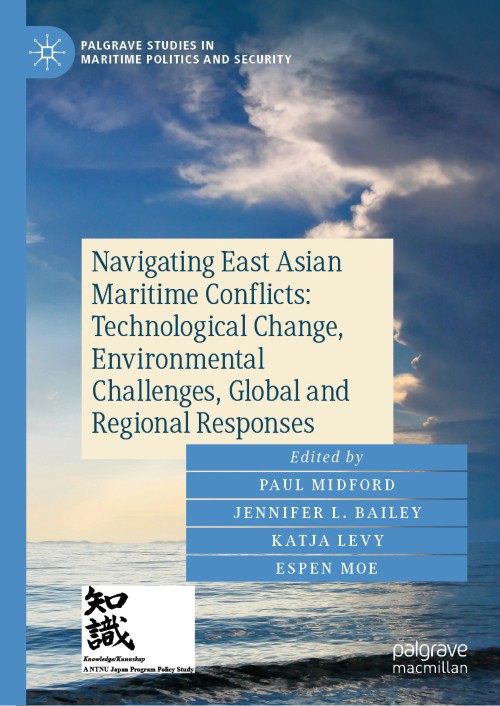
Navigating East Asian Maritime Conflicts: Technological Change, Environmental Challenges, Global and Regional Responses [electronic resource] / edited by Paul Midford, Jennifer L. Bailey, Katja Levy, Espen Moe.
Erişim Adresi
ISBN
9783031519895
Dil Kodu
İngilizce
Yer Numarası
DK/21273
Basım Bildirimi
1st ed. 2024.
Yayın Bilgisi
Cham : Springer Nature Switzerland : Imprint: Palgrave Macmillan, 2024.
Fiziksel Niteleme
XXIX, 422 p. 16 illus., 13 illus. in color. online resource.
Dizi
Palgrave Studies in Maritime Politics and Security, 2730-7980
İçindekiler Notu
Part I: Framework -- Chapter 1: Introduction -- Chapter 2: The Law of the Sea and its Relevance for Maritime Conflicts in East Asia -- Part II: Security Dimensions -- Chapter 3: Unmanned maritime platforms and the undersea struggle in the South China -- Chapter 4: Low Intensity Maritime Conflicts, Escalation Management and Technology -- Chapter 5: Military Automation, Robotics, and Maritime Security, Understanding New Dynamics in Conflict Escalation -- Part III: East Asian Maritime Competition and the Arctic -- Chapter 6: The Impact of Russia’s Ukraine Invasion on the Arctic-From Cooperation to Conflict? -- Chapter 7: China’s Arctic Strategy, From Follow-up to “Creative Involvement” -- Chapter 8: Japan’s Arctic Strategy, Countering East Asian Maritime Insecurity and Competition with China -- Part IV: Seabed Mining -- Chapter 9: Rare and Infinite The Minami-torishima “Semi-infinite” Rare Earth Elements and the historical dynamics of Deep-Sea Mining -- Chapter 10: Japan’s Seabed Mining as a Cause and Result of East Asian Maritime Tensions -- Chapter 11: Limited semi-infinity Japan's deepsea resources against the backdrop of China's rare earth -- Part V: Fishing and Renewable Energy -- Chapter 12: China's Digitalised Fishery Reform and Its Implications on the East Asian Maritime Order -- Chapter 13: Japan's New Whaling Policy, Marine Management in an Evolving Security and Technological Setting -- Chapter 14: Offshore Wind in Japan, Energy Production and Conflict Reduction? -- Part VI: Conclusions -- Chapter 15: Conclusions.
Özet, vb.
“This volume brings together leading experts to examine the potentials for maritime conflict and cooperation in a region where geopolitical rivalries are intensifying. I highly recommend it to scholars, practitioners, and students alike.” —Miranda A. Schreurs, Professor, Technical University of Munich. “With an original approach to maritime conflicts that focuses on the effects of technological and environmental change, this is a must-read for anyone interested in East Asian peace and security!” — Stein Tønnesson, Research Professor Emeritus, Peace Research Institute Oslo “A crucial read for anyone interested in understanding the complexities of maritime conflicts in East Asia and their broader global implications.” —Yurika Ishii, Associate Professor, National Defense Academy of Japan “The volume offers multi-disciplinary perspectives that reach across disciplinary boundaries and connect perspectivesfrom natural sciences and engineering to social sciences and policy.” —Clive Schofield, Professor, University of Wollongong, Australia As technological development and diffusion have greatly increased the resources states can recover from maritime space, the stakes of these conflicts have grown. Nowhere is this clearer than in East Asia. This book examines how technological change and diffusion impact East Asian maritime conflicts, and approaches for conflict management and resolution. Paul Midford is Professor of Political Science, Meiji Gakuin University, Japan. Jennifer L. Bailey is Professor of Political Science, Norwegian University of Science and Technology (NTNU), Norway. Katja Levy is Associate Professor of Political Science, Norwegian University of Science and Technology (NTNU), Norway. Espen Moe is Professor of Political Science, Norwegian University of Science and Technology (NTNU), Norway.
Konu
International relations.
Security, International.
International Relations Theory.
International Security Studies.
Security, International.
International Relations Theory.
International Security Studies.
Diğer Yazarlar
Kurum Adı
Eseri Alıntıla
Referansları kullanmadan önce gözden geçirmeniz ve varsa gerekli düzeltmeleri yapmanız önerilir.
Dijital Kaynak
MARC Görünümü
LEADER 06959nam a22006495i 4500
001 820066
003 TR_AnAIT
005 20260130171249
007 cr nn 008mamaa
008 240824s2024 sz | s |||| 0|eng d
020 |a9783031519895|9978-3-031-51989-5
024 7 |a10.1007/978-3-031-51989-5|2doi
041 |aeng
049 |aTürk Tarih Kurumu Kütüphanesi
050 4|aJZ2-6530
072 7|aJPS|2bicssc
072 7|aPOL011000|2bisacsh
072 7|aJPS|2thema
082 04|a327.101|223
090 |aDK/21273
245 10|aNavigating East Asian Maritime Conflicts: Technological Change, Environmental Challenges, Global and Regional Responses|h[electronic resource] /|cedited by Paul Midford, Jennifer L. Bailey, Katja Levy, Espen Moe.
250 |a1st ed. 2024.
264 1|aCham :|bSpringer Nature Switzerland :|bImprint: Palgrave Macmillan,|c2024.
300 |aXXIX, 422 p. 16 illus., 13 illus. in color.|bonline resource.
336 |atext|btxt|2rdacontent
337 |acomputer|bc|2rdamedia
338 |aonline resource|bcr|2rdacarrier
341 0 |bTable of contents navigation|2onix
341 0 |bSingle logical reading order|2onix
341 0 |bShort alternative textual descriptions|2onix
341 0 |bUse of color is not sole means of conveying information|2onix
341 0 |bUse of high contrast between text and background color|2onix
341 0 |bNext / Previous structural navigation|2onix
341 0 |bAll non-decorative content supports reading without sight|2onix
347 |atext file|bPDF|2rda
490 1 |aPalgrave Studies in Maritime Politics and Security,|x2730-7980
505 0 |aPart I: Framework -- Chapter 1: Introduction -- Chapter 2: The Law of the Sea and its Relevance for Maritime Conflicts in East Asia -- Part II: Security Dimensions -- Chapter 3: Unmanned maritime platforms and the undersea struggle in the South China -- Chapter 4: Low Intensity Maritime Conflicts, Escalation Management and Technology -- Chapter 5: Military Automation, Robotics, and Maritime Security, Understanding New Dynamics in Conflict Escalation -- Part III: East Asian Maritime Competition and the Arctic -- Chapter 6: The Impact of Russia’s Ukraine Invasion on the Arctic-From Cooperation to Conflict? -- Chapter 7: China’s Arctic Strategy, From Follow-up to “Creative Involvement” -- Chapter 8: Japan’s Arctic Strategy, Countering East Asian Maritime Insecurity and Competition with China -- Part IV: Seabed Mining -- Chapter 9: Rare and Infinite The Minami-torishima “Semi-infinite” Rare Earth Elements and the historical dynamics of Deep-Sea Mining -- Chapter 10: Japan’s Seabed Mining as a Cause and Result of East Asian Maritime Tensions -- Chapter 11: Limited semi-infinity Japan's deepsea resources against the backdrop of China's rare earth -- Part V: Fishing and Renewable Energy -- Chapter 12: China's Digitalised Fishery Reform and Its Implications on the East Asian Maritime Order -- Chapter 13: Japan's New Whaling Policy, Marine Management in an Evolving Security and Technological Setting -- Chapter 14: Offshore Wind in Japan, Energy Production and Conflict Reduction? -- Part VI: Conclusions -- Chapter 15: Conclusions.
520 |a“This volume brings together leading experts to examine the potentials for maritime conflict and cooperation in a region where geopolitical rivalries are intensifying. I highly recommend it to scholars, practitioners, and students alike.” —Miranda A. Schreurs, Professor, Technical University of Munich. “With an original approach to maritime conflicts that focuses on the effects of technological and environmental change, this is a must-read for anyone interested in East Asian peace and security!” — Stein Tønnesson, Research Professor Emeritus, Peace Research Institute Oslo “A crucial read for anyone interested in understanding the complexities of maritime conflicts in East Asia and their broader global implications.” —Yurika Ishii, Associate Professor, National Defense Academy of Japan “The volume offers multi-disciplinary perspectives that reach across disciplinary boundaries and connect perspectivesfrom natural sciences and engineering to social sciences and policy.” —Clive Schofield, Professor, University of Wollongong, Australia As technological development and diffusion have greatly increased the resources states can recover from maritime space, the stakes of these conflicts have grown. Nowhere is this clearer than in East Asia. This book examines how technological change and diffusion impact East Asian maritime conflicts, and approaches for conflict management and resolution. Paul Midford is Professor of Political Science, Meiji Gakuin University, Japan. Jennifer L. Bailey is Professor of Political Science, Norwegian University of Science and Technology (NTNU), Norway. Katja Levy is Associate Professor of Political Science, Norwegian University of Science and Technology (NTNU), Norway. Espen Moe is Professor of Political Science, Norwegian University of Science and Technology (NTNU), Norway.
532 8 |aAccessibility summary: This PDF does not fully comply with PDF/UA standards, but does feature limited screen reader support, described non-text content (images, graphs), bookmarks for easy navigation and searchable, selectable text. Users of assistive technologies may experience difficulty navigating or interpreting content in this document. We recognize the importance of accessibility, and we welcome queries about accessibility for any of our products. If you have a question or an access need, please get in touch with us at accessibilitysupport@springernature.com.
532 8 |aNo reading system accessibility options actively disabled
532 8 |aPublisher contact for further accessibility information: accessibilitysupport@springernature.com
650 0|aInternational relations.
650 0|aSecurity, International.
650 14|aInternational Relations Theory.
650 24|aInternational Security Studies.
700 1 |aMidford, Paul.|eeditor.|4edt|4http://id.loc.gov/vocabulary/relators/edt
700 1 |aBailey, Jennifer L.|eeditor.|4edt|4http://id.loc.gov/vocabulary/relators/edt
700 1 |aLevy, Katja.|eeditor.|0(orcid)0000-0002-9186-5792|1https://orcid.org/0000-0002-9186-5792|4edt|4http://id.loc.gov/vocabulary/relators/edt
700 1 |aMoe, Espen.|eeditor.|4edt|4http://id.loc.gov/vocabulary/relators/edt
710 2 |aSpringerLink (Online service)
773 0 |tSpringer Nature eBook
776 08|iPrinted edition:|z9783031519888
776 08|iPrinted edition:|z9783031519901
776 08|iPrinted edition:|z9783031519918
830 0|aPalgrave Studies in Maritime Politics and Security,|x2730-7980
856 40|uhttps://doi.org/10.1007/978-3-031-51989-5
912 |aZDB-2-POS
912 |aZDB-2-SXPI
950 |aPolitical Science and International Studies (SpringerNature-41174)
950 |aPolitical Science and International Studies (R0) (SpringerNature-43724)
001 820066
003 TR_AnAIT
005 20260130171249
007 cr nn 008mamaa
008 240824s2024 sz | s |||| 0|eng d
020 |a9783031519895|9978-3-031-51989-5
024 7 |a10.1007/978-3-031-51989-5|2doi
041 |aeng
049 |aTürk Tarih Kurumu Kütüphanesi
050 4|aJZ2-6530
072 7|aJPS|2bicssc
072 7|aPOL011000|2bisacsh
072 7|aJPS|2thema
082 04|a327.101|223
090 |aDK/21273
245 10|aNavigating East Asian Maritime Conflicts: Technological Change, Environmental Challenges, Global and Regional Responses|h[electronic resource] /|cedited by Paul Midford, Jennifer L. Bailey, Katja Levy, Espen Moe.
250 |a1st ed. 2024.
264 1|aCham :|bSpringer Nature Switzerland :|bImprint: Palgrave Macmillan,|c2024.
300 |aXXIX, 422 p. 16 illus., 13 illus. in color.|bonline resource.
336 |atext|btxt|2rdacontent
337 |acomputer|bc|2rdamedia
338 |aonline resource|bcr|2rdacarrier
341 0 |bTable of contents navigation|2onix
341 0 |bSingle logical reading order|2onix
341 0 |bShort alternative textual descriptions|2onix
341 0 |bUse of color is not sole means of conveying information|2onix
341 0 |bUse of high contrast between text and background color|2onix
341 0 |bNext / Previous structural navigation|2onix
341 0 |bAll non-decorative content supports reading without sight|2onix
347 |atext file|bPDF|2rda
490 1 |aPalgrave Studies in Maritime Politics and Security,|x2730-7980
505 0 |aPart I: Framework -- Chapter 1: Introduction -- Chapter 2: The Law of the Sea and its Relevance for Maritime Conflicts in East Asia -- Part II: Security Dimensions -- Chapter 3: Unmanned maritime platforms and the undersea struggle in the South China -- Chapter 4: Low Intensity Maritime Conflicts, Escalation Management and Technology -- Chapter 5: Military Automation, Robotics, and Maritime Security, Understanding New Dynamics in Conflict Escalation -- Part III: East Asian Maritime Competition and the Arctic -- Chapter 6: The Impact of Russia’s Ukraine Invasion on the Arctic-From Cooperation to Conflict? -- Chapter 7: China’s Arctic Strategy, From Follow-up to “Creative Involvement” -- Chapter 8: Japan’s Arctic Strategy, Countering East Asian Maritime Insecurity and Competition with China -- Part IV: Seabed Mining -- Chapter 9: Rare and Infinite The Minami-torishima “Semi-infinite” Rare Earth Elements and the historical dynamics of Deep-Sea Mining -- Chapter 10: Japan’s Seabed Mining as a Cause and Result of East Asian Maritime Tensions -- Chapter 11: Limited semi-infinity Japan's deepsea resources against the backdrop of China's rare earth -- Part V: Fishing and Renewable Energy -- Chapter 12: China's Digitalised Fishery Reform and Its Implications on the East Asian Maritime Order -- Chapter 13: Japan's New Whaling Policy, Marine Management in an Evolving Security and Technological Setting -- Chapter 14: Offshore Wind in Japan, Energy Production and Conflict Reduction? -- Part VI: Conclusions -- Chapter 15: Conclusions.
520 |a“This volume brings together leading experts to examine the potentials for maritime conflict and cooperation in a region where geopolitical rivalries are intensifying. I highly recommend it to scholars, practitioners, and students alike.” —Miranda A. Schreurs, Professor, Technical University of Munich. “With an original approach to maritime conflicts that focuses on the effects of technological and environmental change, this is a must-read for anyone interested in East Asian peace and security!” — Stein Tønnesson, Research Professor Emeritus, Peace Research Institute Oslo “A crucial read for anyone interested in understanding the complexities of maritime conflicts in East Asia and their broader global implications.” —Yurika Ishii, Associate Professor, National Defense Academy of Japan “The volume offers multi-disciplinary perspectives that reach across disciplinary boundaries and connect perspectivesfrom natural sciences and engineering to social sciences and policy.” —Clive Schofield, Professor, University of Wollongong, Australia As technological development and diffusion have greatly increased the resources states can recover from maritime space, the stakes of these conflicts have grown. Nowhere is this clearer than in East Asia. This book examines how technological change and diffusion impact East Asian maritime conflicts, and approaches for conflict management and resolution. Paul Midford is Professor of Political Science, Meiji Gakuin University, Japan. Jennifer L. Bailey is Professor of Political Science, Norwegian University of Science and Technology (NTNU), Norway. Katja Levy is Associate Professor of Political Science, Norwegian University of Science and Technology (NTNU), Norway. Espen Moe is Professor of Political Science, Norwegian University of Science and Technology (NTNU), Norway.
532 8 |aAccessibility summary: This PDF does not fully comply with PDF/UA standards, but does feature limited screen reader support, described non-text content (images, graphs), bookmarks for easy navigation and searchable, selectable text. Users of assistive technologies may experience difficulty navigating or interpreting content in this document. We recognize the importance of accessibility, and we welcome queries about accessibility for any of our products. If you have a question or an access need, please get in touch with us at accessibilitysupport@springernature.com.
532 8 |aNo reading system accessibility options actively disabled
532 8 |aPublisher contact for further accessibility information: accessibilitysupport@springernature.com
650 0|aInternational relations.
650 0|aSecurity, International.
650 14|aInternational Relations Theory.
650 24|aInternational Security Studies.
700 1 |aMidford, Paul.|eeditor.|4edt|4http://id.loc.gov/vocabulary/relators/edt
700 1 |aBailey, Jennifer L.|eeditor.|4edt|4http://id.loc.gov/vocabulary/relators/edt
700 1 |aLevy, Katja.|eeditor.|0(orcid)0000-0002-9186-5792|1https://orcid.org/0000-0002-9186-5792|4edt|4http://id.loc.gov/vocabulary/relators/edt
700 1 |aMoe, Espen.|eeditor.|4edt|4http://id.loc.gov/vocabulary/relators/edt
710 2 |aSpringerLink (Online service)
773 0 |tSpringer Nature eBook
776 08|iPrinted edition:|z9783031519888
776 08|iPrinted edition:|z9783031519901
776 08|iPrinted edition:|z9783031519918
830 0|aPalgrave Studies in Maritime Politics and Security,|x2730-7980
856 40|uhttps://doi.org/10.1007/978-3-031-51989-5
912 |aZDB-2-POS
912 |aZDB-2-SXPI
950 |aPolitical Science and International Studies (SpringerNature-41174)
950 |aPolitical Science and International Studies (R0) (SpringerNature-43724)
Materyaller
Depodan talep edilen materyal sadece kütüphane içerisinde kullanılmaktadır.
Materyal dışarıya ödünç verilmemektedir.
Materyal dışarıya ödünç verilmemektedir.
