

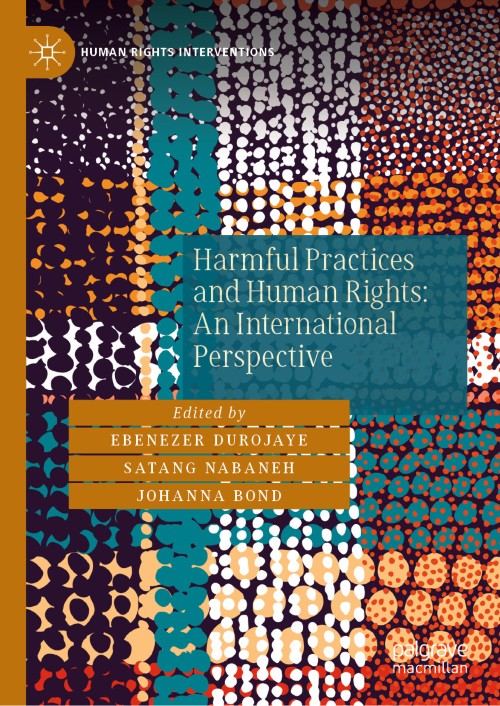
Harmful Practices and Human Rights: An International Perspective [electronic resource] / edited by Ebenezer Durojaye, Satang Nabaneh, Johanna Bond.
Erişim Adresi
ISBN
9783031903335
Dil Kodu
İngilizce
Yer Numarası
DK/21281
Basım Bildirimi
1st ed. 2025.
Yayın Bilgisi
Cham : Springer Nature Switzerland : Imprint: Palgrave Macmillan, 2025.
Fiziksel Niteleme
XVII, 429 p. 1 illus. online resource.
Dizi
Human Rights Interventions, 2946-5125
İçindekiler Notu
Chapter 1: Harmful practices as a human rights challenge -- Chapter 2: International and regional norms on harmful practices -- Chapter 3: Widowhood practices and human rights in Nigeria -- Chapter 4: Beyond the legal debates: An African legal feminist response to support victims of ukuthwala in South Africa -- Chapter 5: Cultural relativism versus universalism: a critical analysis of the chinamwari/khomba practice in Zimbabwe -- Chapter 6: The conundrum of exchange of bride wealth in customary marriages: is it a harmful practice? -- Chapter 7: Tobacco-related harms & gender: An overview with perspectives from India -- Chapter 8: Child marriage in the United States: A human rights and feminist perspective -- Chapter 9: Intimate partner violence, gender vulnerability and the realisation of women’s fundamental rights in Australia -- Chapter 10: The protection of human trafficking victims in the UK: The role of the Palermo Protocol and state obligations in the international law -- Chapter 11: An African feminist analysis of the impact of menstrual taboos in Abrahamic religions on women and girls in Africa -- Chapter 12: Punishing pregnant students through expulsion from school: A case study of Uganda -- Chapter 13: Engaging harmful traditional practices from a supranational perspective: Reflections from the African Committee of Experts on the Rights and Welfare of the Child -- Chapter 14: Cultivating agency and claiming bodily autonomy: A response to the politics of child marriage in the African context.
Özet, vb.
Harmful Practices and Human Rights: An International Perspective examines different forms of harmful practices, globally, which constitute human rights violations as guaranteed in international and regional human rights instruments. Drawing examples from Africa, Asia, North America, Europe, and Australasia, it demonstrates how these practices undermine the right to health, including sexual and reproductive health, and also impugn the dignity and autonomy of women and girls. Using diverse harmful practices as case studies, the book critically examines the factors that drive harmful practices in developing and developed countries. Specifically, this book focuses on a selection of harmful practices—including dowry payments, ukuthwala, intimate partner violence, harmful tobacco use and its gendered implications, trafficking in persons, widowhood practices, the chinamwari/khomba practice, and child marriage—from both the Global South and North. Its intent is to demonstrate the prevalence of these abuses and underscore the urgent need for states to take decisive steps toward eradication. Ebenezer Durojaye is Professor of Law, Centre for Human Rights, University of Pretoria, South Africa. He has published extensively in his areas of research and he is the co-editor of the book COVID-19 and the Right to Health in Africa. Satang Nabaneh is Assistant Professor of Practice and Director of Programs at the University of Dayton Human Rights Center, USA. She is also Global Fellow at CMI-UiB Centre on Law & Social Transformation, Bergen, Norway. Johanna Bond is Dean and Professor of Law at Rutgers Law School, The State University of New Jersey, USA. Her scholarship focuses on women’s human rights, the United Nations human rights treaty system, and feminist legal theory.
Konu
Human rights.
International relations.
Humanitarian law.
Politics and Human Rights.
International Relations Theory.
International Humanitarian Law, Law of Armed Conflict.
International relations.
Humanitarian law.
Politics and Human Rights.
International Relations Theory.
International Humanitarian Law, Law of Armed Conflict.
Diğer Yazarlar
Kurum Adı
Eseri Alıntıla
Referansları kullanmadan önce gözden geçirmeniz ve varsa gerekli düzeltmeleri yapmanız önerilir.
Dijital Kaynak
MARC Görünümü
LEADER 06728nam a22006735i 4500
001 820074
003 TR_AnAIT
005 20260130171236
007 cr nn 008mamaa
008 250702s2025 sz | s |||| 0|eng d
020 |a9783031903335|9978-3-031-90333-5
024 7 |a10.1007/978-3-031-90333-5|2doi
041 |aeng
049 |aTürk Tarih Kurumu Kütüphanesi
050 4|aJC571-628
072 7|aJPVH|2bicssc
072 7|aPOL035010|2bisacsh
072 7|aJPVH|2thema
082 04|a323|223
090 |aDK/21281
245 10|aHarmful Practices and Human Rights: An International Perspective|h[electronic resource] /|cedited by Ebenezer Durojaye, Satang Nabaneh, Johanna Bond.
250 |a1st ed. 2025.
264 1|aCham :|bSpringer Nature Switzerland :|bImprint: Palgrave Macmillan,|c2025.
300 |aXVII, 429 p. 1 illus.|bonline resource.
336 |atext|btxt|2rdacontent
337 |acomputer|bc|2rdamedia
338 |aonline resource|bcr|2rdacarrier
341 0 |bPDF/UA-1|2onix
341 0 |bTable of contents navigation|2onix
341 0 |bSingle logical reading order|2onix
341 0 |bShort alternative textual descriptions|2onix
341 0 |bUse of color is not sole means of conveying information|2onix
341 0 |bUse of high contrast between text and background color|2onix
341 0 |bNext / Previous structural navigation|2onix
341 0 |bAll non-decorative content supports reading without sight|2onix
347 |atext file|bPDF|2rda
490 1 |aHuman Rights Interventions,|x2946-5125
505 0 |aChapter 1: Harmful practices as a human rights challenge -- Chapter 2: International and regional norms on harmful practices -- Chapter 3: Widowhood practices and human rights in Nigeria -- Chapter 4: Beyond the legal debates: An African legal feminist response to support victims of ukuthwala in South Africa -- Chapter 5: Cultural relativism versus universalism: a critical analysis of the chinamwari/khomba practice in Zimbabwe -- Chapter 6: The conundrum of exchange of bride wealth in customary marriages: is it a harmful practice? -- Chapter 7: Tobacco-related harms & gender: An overview with perspectives from India -- Chapter 8: Child marriage in the United States: A human rights and feminist perspective -- Chapter 9: Intimate partner violence, gender vulnerability and the realisation of women’s fundamental rights in Australia -- Chapter 10: The protection of human trafficking victims in the UK: The role of the Palermo Protocol and state obligations in the international law -- Chapter 11: An African feminist analysis of the impact of menstrual taboos in Abrahamic religions on women and girls in Africa -- Chapter 12: Punishing pregnant students through expulsion from school: A case study of Uganda -- Chapter 13: Engaging harmful traditional practices from a supranational perspective: Reflections from the African Committee of Experts on the Rights and Welfare of the Child -- Chapter 14: Cultivating agency and claiming bodily autonomy: A response to the politics of child marriage in the African context.
520 |aHarmful Practices and Human Rights: An International Perspective examines different forms of harmful practices, globally, which constitute human rights violations as guaranteed in international and regional human rights instruments. Drawing examples from Africa, Asia, North America, Europe, and Australasia, it demonstrates how these practices undermine the right to health, including sexual and reproductive health, and also impugn the dignity and autonomy of women and girls. Using diverse harmful practices as case studies, the book critically examines the factors that drive harmful practices in developing and developed countries. Specifically, this book focuses on a selection of harmful practices—including dowry payments, ukuthwala, intimate partner violence, harmful tobacco use and its gendered implications, trafficking in persons, widowhood practices, the chinamwari/khomba practice, and child marriage—from both the Global South and North. Its intent is to demonstrate the prevalence of these abuses and underscore the urgent need for states to take decisive steps toward eradication. Ebenezer Durojaye is Professor of Law, Centre for Human Rights, University of Pretoria, South Africa. He has published extensively in his areas of research and he is the co-editor of the book COVID-19 and the Right to Health in Africa. Satang Nabaneh is Assistant Professor of Practice and Director of Programs at the University of Dayton Human Rights Center, USA. She is also Global Fellow at CMI-UiB Centre on Law & Social Transformation, Bergen, Norway. Johanna Bond is Dean and Professor of Law at Rutgers Law School, The State University of New Jersey, USA. Her scholarship focuses on women’s human rights, the United Nations human rights treaty system, and feminist legal theory.
532 8 |aAccessibility summary: This PDF has been created in accordance with the PDF/UA-1 standard to enhance accessibility, including screen reader support, described non-text content (images, graphs), bookmarks for easy navigation, keyboard-friendly links and forms and searchable, selectable text. We recognize the importance of accessibility, and we welcome queries about accessibility for any of our products. If you have a question or an access need, please get in touch with us at accessibilitysupport@springernature.com. Please note that a more accessible version of this eBook is available as ePub.
532 8 |aNo reading system accessibility options actively disabled
532 8 |aPublisher contact for further accessibility information: accessibilitysupport@springernature.com
650 0|aHuman rights.
650 0|aInternational relations.
650 0|aHumanitarian law.
650 14|aPolitics and Human Rights.
650 24|aInternational Relations Theory.
650 24|aInternational Humanitarian Law, Law of Armed Conflict.
700 1 |aDurojaye, Ebenezer.|eeditor.|4edt|4http://id.loc.gov/vocabulary/relators/edt
700 1 |aNabaneh, Satang.|eeditor.|4edt|4http://id.loc.gov/vocabulary/relators/edt
700 1 |aBond, Johanna.|eeditor.|4edt|4http://id.loc.gov/vocabulary/relators/edt
710 2 |aSpringerLink (Online service)
773 0 |tSpringer Nature eBook
776 08|iPrinted edition:|z9783031903328
776 08|iPrinted edition:|z9783031903342
776 08|iPrinted edition:|z9783031903359
830 0|aHuman Rights Interventions,|x2946-5125
856 40|uhttps://doi.org/10.1007/978-3-031-90333-5
912 |aZDB-2-POS
912 |aZDB-2-SXPI
950 |aPolitical Science and International Studies (SpringerNature-41174)
950 |aPolitical Science and International Studies (R0) (SpringerNature-43724)
001 820074
003 TR_AnAIT
005 20260130171236
007 cr nn 008mamaa
008 250702s2025 sz | s |||| 0|eng d
020 |a9783031903335|9978-3-031-90333-5
024 7 |a10.1007/978-3-031-90333-5|2doi
041 |aeng
049 |aTürk Tarih Kurumu Kütüphanesi
050 4|aJC571-628
072 7|aJPVH|2bicssc
072 7|aPOL035010|2bisacsh
072 7|aJPVH|2thema
082 04|a323|223
090 |aDK/21281
245 10|aHarmful Practices and Human Rights: An International Perspective|h[electronic resource] /|cedited by Ebenezer Durojaye, Satang Nabaneh, Johanna Bond.
250 |a1st ed. 2025.
264 1|aCham :|bSpringer Nature Switzerland :|bImprint: Palgrave Macmillan,|c2025.
300 |aXVII, 429 p. 1 illus.|bonline resource.
336 |atext|btxt|2rdacontent
337 |acomputer|bc|2rdamedia
338 |aonline resource|bcr|2rdacarrier
341 0 |bPDF/UA-1|2onix
341 0 |bTable of contents navigation|2onix
341 0 |bSingle logical reading order|2onix
341 0 |bShort alternative textual descriptions|2onix
341 0 |bUse of color is not sole means of conveying information|2onix
341 0 |bUse of high contrast between text and background color|2onix
341 0 |bNext / Previous structural navigation|2onix
341 0 |bAll non-decorative content supports reading without sight|2onix
347 |atext file|bPDF|2rda
490 1 |aHuman Rights Interventions,|x2946-5125
505 0 |aChapter 1: Harmful practices as a human rights challenge -- Chapter 2: International and regional norms on harmful practices -- Chapter 3: Widowhood practices and human rights in Nigeria -- Chapter 4: Beyond the legal debates: An African legal feminist response to support victims of ukuthwala in South Africa -- Chapter 5: Cultural relativism versus universalism: a critical analysis of the chinamwari/khomba practice in Zimbabwe -- Chapter 6: The conundrum of exchange of bride wealth in customary marriages: is it a harmful practice? -- Chapter 7: Tobacco-related harms & gender: An overview with perspectives from India -- Chapter 8: Child marriage in the United States: A human rights and feminist perspective -- Chapter 9: Intimate partner violence, gender vulnerability and the realisation of women’s fundamental rights in Australia -- Chapter 10: The protection of human trafficking victims in the UK: The role of the Palermo Protocol and state obligations in the international law -- Chapter 11: An African feminist analysis of the impact of menstrual taboos in Abrahamic religions on women and girls in Africa -- Chapter 12: Punishing pregnant students through expulsion from school: A case study of Uganda -- Chapter 13: Engaging harmful traditional practices from a supranational perspective: Reflections from the African Committee of Experts on the Rights and Welfare of the Child -- Chapter 14: Cultivating agency and claiming bodily autonomy: A response to the politics of child marriage in the African context.
520 |aHarmful Practices and Human Rights: An International Perspective examines different forms of harmful practices, globally, which constitute human rights violations as guaranteed in international and regional human rights instruments. Drawing examples from Africa, Asia, North America, Europe, and Australasia, it demonstrates how these practices undermine the right to health, including sexual and reproductive health, and also impugn the dignity and autonomy of women and girls. Using diverse harmful practices as case studies, the book critically examines the factors that drive harmful practices in developing and developed countries. Specifically, this book focuses on a selection of harmful practices—including dowry payments, ukuthwala, intimate partner violence, harmful tobacco use and its gendered implications, trafficking in persons, widowhood practices, the chinamwari/khomba practice, and child marriage—from both the Global South and North. Its intent is to demonstrate the prevalence of these abuses and underscore the urgent need for states to take decisive steps toward eradication. Ebenezer Durojaye is Professor of Law, Centre for Human Rights, University of Pretoria, South Africa. He has published extensively in his areas of research and he is the co-editor of the book COVID-19 and the Right to Health in Africa. Satang Nabaneh is Assistant Professor of Practice and Director of Programs at the University of Dayton Human Rights Center, USA. She is also Global Fellow at CMI-UiB Centre on Law & Social Transformation, Bergen, Norway. Johanna Bond is Dean and Professor of Law at Rutgers Law School, The State University of New Jersey, USA. Her scholarship focuses on women’s human rights, the United Nations human rights treaty system, and feminist legal theory.
532 8 |aAccessibility summary: This PDF has been created in accordance with the PDF/UA-1 standard to enhance accessibility, including screen reader support, described non-text content (images, graphs), bookmarks for easy navigation, keyboard-friendly links and forms and searchable, selectable text. We recognize the importance of accessibility, and we welcome queries about accessibility for any of our products. If you have a question or an access need, please get in touch with us at accessibilitysupport@springernature.com. Please note that a more accessible version of this eBook is available as ePub.
532 8 |aNo reading system accessibility options actively disabled
532 8 |aPublisher contact for further accessibility information: accessibilitysupport@springernature.com
650 0|aHuman rights.
650 0|aInternational relations.
650 0|aHumanitarian law.
650 14|aPolitics and Human Rights.
650 24|aInternational Relations Theory.
650 24|aInternational Humanitarian Law, Law of Armed Conflict.
700 1 |aDurojaye, Ebenezer.|eeditor.|4edt|4http://id.loc.gov/vocabulary/relators/edt
700 1 |aNabaneh, Satang.|eeditor.|4edt|4http://id.loc.gov/vocabulary/relators/edt
700 1 |aBond, Johanna.|eeditor.|4edt|4http://id.loc.gov/vocabulary/relators/edt
710 2 |aSpringerLink (Online service)
773 0 |tSpringer Nature eBook
776 08|iPrinted edition:|z9783031903328
776 08|iPrinted edition:|z9783031903342
776 08|iPrinted edition:|z9783031903359
830 0|aHuman Rights Interventions,|x2946-5125
856 40|uhttps://doi.org/10.1007/978-3-031-90333-5
912 |aZDB-2-POS
912 |aZDB-2-SXPI
950 |aPolitical Science and International Studies (SpringerNature-41174)
950 |aPolitical Science and International Studies (R0) (SpringerNature-43724)
Materyaller
Depodan talep edilen materyal sadece kütüphane içerisinde kullanılmaktadır.
Materyal dışarıya ödünç verilmemektedir.
Materyal dışarıya ödünç verilmemektedir.
