

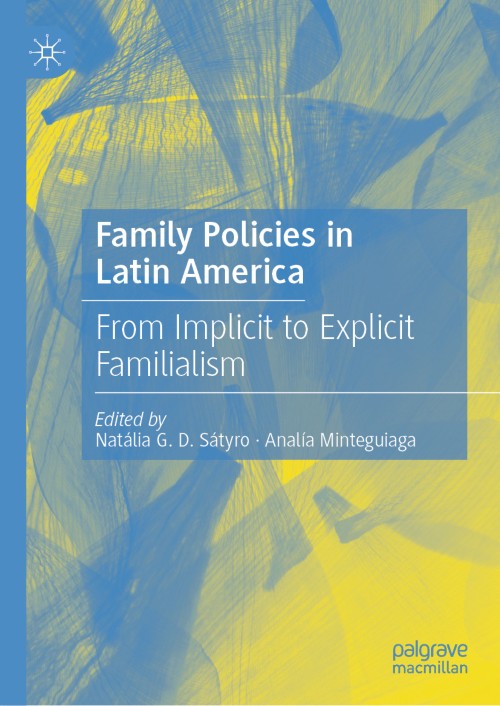
Family Policies in Latin America [electronic resource] : From Implicit to Explicit Familialism / edited by Natália G.D. Sátyro, Analía Minteguiaga.
Erişim Adresi
ISBN
9783031881381
Dil Kodu
İngilizce
Yer Numarası
DK/21309
Basım Bildirimi
1st ed. 2025.
Yayın Bilgisi
Cham : Springer Nature Switzerland : Imprint: Palgrave Macmillan, 2025.
Fiziksel Niteleme
XX, 386 p. 42 illus., 29 illus. in color. online resource.
İçindekiler Notu
1. Introduction: family policies in Latin America in perspective -- Part I: Problematizing family and familialism -- 2. The debate on family policies in Latin America: advances and setbacks -- 3. Care and its implications for social protection and family relationships- 4. “(Un)making a family”: what family are we talking about? -- Part II: Family policy in a global context: what sets Latin America apart? -- 5. The debate on family policies in a European context: what sets us apart? -- 6. A diagnosis of the labor market in Latin America -- 7. Care and its implications for social protection and family relationships -- Part III: National cases in comparative perspective -- 8. Transnational social protection: a view from Ecuador and Argentina -- 9. Family policies in Brazil since re-democratization -- 10. Family policies in Mexico: between familiialism and the caring right -- 11. Familypolicies in Argentina, Chile and Uruguay: innovation during the early 2000s -- 12. Family policies in Colombia and Peru -- 13. Family policies in Ecuador, Bolivia and Paraguay -- 14. "De facto" family policies and exception regimes in Central America: the case of El Salvador -- 15. Family arrangements, social protection and the state: the case of Brazil -- 16. Conclusions: combating poverty vs supporting the emancipation of individuals.
Özet, vb.
This book examines family policies in Latin America. The first half of the book adopts a thematic approach to assess how the concept of ‘family’ has changed over the last few decades, and how family policies are intrinsically linked to demographic changes, social class, family arrangements and the labour market. The second half of the book provides detailed country case studies in order to analyse family policies in action. Drawing on evidence from Argentina, Bolivia, Brazil, Chile, Costa Rica, Ecuador, El Salvador, Guatemala, Honduras, Mexico, Nicaragua, Panama, Paraguay, and Uruguay, it offers a comprehensive and comparative overview of family policies across the continent, demonstrating the various ways in which they have been impacted by political regimes and governance. The book also compares family policies in Latin America to those in Europe and North America. It will appeal to all those interested in family policy, public policy, development studies and sociology, as well as Latin America more generally. Natália G. D. Sátyro is Associate Professor in the Department of Political Science, Federal University of Minas Gerais, Brazil. Her research interests include welfare policy, income inequality, and political institutions. Analía Minteguiaga is a Researcher at the National Scientific and Technical Research Council of Argentina (CONICET) and the Gino Germani Research Institute, University of Buenos Aires, Argentina. Her research examines welfare regimes, social protection systems, socio-labor policies and dynamics of (in)equality in Latin America.
Konu
Political planning.
Family policy.
Sociology.
Social groups.
Public Policy.
Children, Youth and Family Policy.
Sociology of Family, Youth and Aging.
Family policy.
Sociology.
Social groups.
Public Policy.
Children, Youth and Family Policy.
Sociology of Family, Youth and Aging.
Diğer Yazarlar
Kurum Adı
Eseri Alıntıla
Referansları kullanmadan önce gözden geçirmeniz ve varsa gerekli düzeltmeleri yapmanız önerilir.
Dijital Kaynak
MARC Görünümü
LEADER 06163nam a22006495i 4500
001 820102
003 TR_AnAIT
005 20260130171154
007 cr nn 008mamaa
008 250731s2025 sz | s |||| 0|eng d
020 |a9783031881381|9978-3-031-88138-1
024 7 |a10.1007/978-3-031-88138-1|2doi
041 |aeng
049 |aTürk Tarih Kurumu Kütüphanesi
050 4|aJF1525.P6
072 7|aJPP|2bicssc
072 7|aPOL028000|2bisacsh
072 7|aJPP|2thema
082 04|a320.6|223
090 |aDK/21309
245 10|aFamily Policies in Latin America|h[electronic resource] :|bFrom Implicit to Explicit Familialism /|cedited by Natália G.D. Sátyro, Analía Minteguiaga.
250 |a1st ed. 2025.
264 1|aCham :|bSpringer Nature Switzerland :|bImprint: Palgrave Macmillan,|c2025.
300 |aXX, 386 p. 42 illus., 29 illus. in color.|bonline resource.
336 |atext|btxt|2rdacontent
337 |acomputer|bc|2rdamedia
338 |aonline resource|bcr|2rdacarrier
341 0 |bPDF/UA-1|2onix
341 0 |bTable of contents navigation|2onix
341 0 |bSingle logical reading order|2onix
341 0 |bShort alternative textual descriptions|2onix
341 0 |bUse of color is not sole means of conveying information|2onix
341 0 |bUse of high contrast between text and background color|2onix
341 0 |bNext / Previous structural navigation|2onix
341 0 |bAll non-decorative content supports reading without sight|2onix
347 |atext file|bPDF|2rda
505 0 |a1. Introduction: family policies in Latin America in perspective -- Part I: Problematizing family and familialism -- 2. The debate on family policies in Latin America: advances and setbacks -- 3. Care and its implications for social protection and family relationships- 4. “(Un)making a family”: what family are we talking about? -- Part II: Family policy in a global context: what sets Latin America apart? -- 5. The debate on family policies in a European context: what sets us apart? -- 6. A diagnosis of the labor market in Latin America -- 7. Care and its implications for social protection and family relationships -- Part III: National cases in comparative perspective -- 8. Transnational social protection: a view from Ecuador and Argentina -- 9. Family policies in Brazil since re-democratization -- 10. Family policies in Mexico: between familiialism and the caring right -- 11. Familypolicies in Argentina, Chile and Uruguay: innovation during the early 2000s -- 12. Family policies in Colombia and Peru -- 13. Family policies in Ecuador, Bolivia and Paraguay -- 14. "De facto" family policies and exception regimes in Central America: the case of El Salvador -- 15. Family arrangements, social protection and the state: the case of Brazil -- 16. Conclusions: combating poverty vs supporting the emancipation of individuals.
520 |aThis book examines family policies in Latin America. The first half of the book adopts a thematic approach to assess how the concept of ‘family’ has changed over the last few decades, and how family policies are intrinsically linked to demographic changes, social class, family arrangements and the labour market. The second half of the book provides detailed country case studies in order to analyse family policies in action. Drawing on evidence from Argentina, Bolivia, Brazil, Chile, Costa Rica, Ecuador, El Salvador, Guatemala, Honduras, Mexico, Nicaragua, Panama, Paraguay, and Uruguay, it offers a comprehensive and comparative overview of family policies across the continent, demonstrating the various ways in which they have been impacted by political regimes and governance. The book also compares family policies in Latin America to those in Europe and North America. It will appeal to all those interested in family policy, public policy, development studies and sociology, as well as Latin America more generally. Natália G. D. Sátyro is Associate Professor in the Department of Political Science, Federal University of Minas Gerais, Brazil. Her research interests include welfare policy, income inequality, and political institutions. Analía Minteguiaga is a Researcher at the National Scientific and Technical Research Council of Argentina (CONICET) and the Gino Germani Research Institute, University of Buenos Aires, Argentina. Her research examines welfare regimes, social protection systems, socio-labor policies and dynamics of (in)equality in Latin America.
532 8 |aAccessibility summary: This PDF has been created in accordance with the PDF/UA-1 standard to enhance accessibility, including screen reader support, described non-text content (images, graphs), bookmarks for easy navigation, keyboard-friendly links and forms and searchable, selectable text. We recognize the importance of accessibility, and we welcome queries about accessibility for any of our products. If you have a question or an access need, please get in touch with us at accessibilitysupport@springernature.com. Please note that a more accessible version of this eBook is available as ePub.
532 8 |aNo reading system accessibility options actively disabled
532 8 |aPublisher contact for further accessibility information: accessibilitysupport@springernature.com
650 0|aPolitical planning.
650 0|aFamily policy.
650 0|aSociology.
650 0|aSocial groups.
650 14|aPublic Policy.
650 24|aChildren, Youth and Family Policy.
650 24|aSociology of Family, Youth and Aging.
700 1 |aSátyro, Natália G.D.|eeditor.|4edt|4http://id.loc.gov/vocabulary/relators/edt
700 1 |aMinteguiaga, Analía.|eeditor.|4edt|4http://id.loc.gov/vocabulary/relators/edt
710 2 |aSpringerLink (Online service)
773 0 |tSpringer Nature eBook
776 08|iPrinted edition:|z9783031881374
776 08|iPrinted edition:|z9783031881398
776 08|iPrinted edition:|z9783031881404
856 40|uhttps://doi.org/10.1007/978-3-031-88138-1
912 |aZDB-2-POS
912 |aZDB-2-SXPI
950 |aPolitical Science and International Studies (SpringerNature-41174)
950 |aPolitical Science and International Studies (R0) (SpringerNature-43724)
001 820102
003 TR_AnAIT
005 20260130171154
007 cr nn 008mamaa
008 250731s2025 sz | s |||| 0|eng d
020 |a9783031881381|9978-3-031-88138-1
024 7 |a10.1007/978-3-031-88138-1|2doi
041 |aeng
049 |aTürk Tarih Kurumu Kütüphanesi
050 4|aJF1525.P6
072 7|aJPP|2bicssc
072 7|aPOL028000|2bisacsh
072 7|aJPP|2thema
082 04|a320.6|223
090 |aDK/21309
245 10|aFamily Policies in Latin America|h[electronic resource] :|bFrom Implicit to Explicit Familialism /|cedited by Natália G.D. Sátyro, Analía Minteguiaga.
250 |a1st ed. 2025.
264 1|aCham :|bSpringer Nature Switzerland :|bImprint: Palgrave Macmillan,|c2025.
300 |aXX, 386 p. 42 illus., 29 illus. in color.|bonline resource.
336 |atext|btxt|2rdacontent
337 |acomputer|bc|2rdamedia
338 |aonline resource|bcr|2rdacarrier
341 0 |bPDF/UA-1|2onix
341 0 |bTable of contents navigation|2onix
341 0 |bSingle logical reading order|2onix
341 0 |bShort alternative textual descriptions|2onix
341 0 |bUse of color is not sole means of conveying information|2onix
341 0 |bUse of high contrast between text and background color|2onix
341 0 |bNext / Previous structural navigation|2onix
341 0 |bAll non-decorative content supports reading without sight|2onix
347 |atext file|bPDF|2rda
505 0 |a1. Introduction: family policies in Latin America in perspective -- Part I: Problematizing family and familialism -- 2. The debate on family policies in Latin America: advances and setbacks -- 3. Care and its implications for social protection and family relationships- 4. “(Un)making a family”: what family are we talking about? -- Part II: Family policy in a global context: what sets Latin America apart? -- 5. The debate on family policies in a European context: what sets us apart? -- 6. A diagnosis of the labor market in Latin America -- 7. Care and its implications for social protection and family relationships -- Part III: National cases in comparative perspective -- 8. Transnational social protection: a view from Ecuador and Argentina -- 9. Family policies in Brazil since re-democratization -- 10. Family policies in Mexico: between familiialism and the caring right -- 11. Familypolicies in Argentina, Chile and Uruguay: innovation during the early 2000s -- 12. Family policies in Colombia and Peru -- 13. Family policies in Ecuador, Bolivia and Paraguay -- 14. "De facto" family policies and exception regimes in Central America: the case of El Salvador -- 15. Family arrangements, social protection and the state: the case of Brazil -- 16. Conclusions: combating poverty vs supporting the emancipation of individuals.
520 |aThis book examines family policies in Latin America. The first half of the book adopts a thematic approach to assess how the concept of ‘family’ has changed over the last few decades, and how family policies are intrinsically linked to demographic changes, social class, family arrangements and the labour market. The second half of the book provides detailed country case studies in order to analyse family policies in action. Drawing on evidence from Argentina, Bolivia, Brazil, Chile, Costa Rica, Ecuador, El Salvador, Guatemala, Honduras, Mexico, Nicaragua, Panama, Paraguay, and Uruguay, it offers a comprehensive and comparative overview of family policies across the continent, demonstrating the various ways in which they have been impacted by political regimes and governance. The book also compares family policies in Latin America to those in Europe and North America. It will appeal to all those interested in family policy, public policy, development studies and sociology, as well as Latin America more generally. Natália G. D. Sátyro is Associate Professor in the Department of Political Science, Federal University of Minas Gerais, Brazil. Her research interests include welfare policy, income inequality, and political institutions. Analía Minteguiaga is a Researcher at the National Scientific and Technical Research Council of Argentina (CONICET) and the Gino Germani Research Institute, University of Buenos Aires, Argentina. Her research examines welfare regimes, social protection systems, socio-labor policies and dynamics of (in)equality in Latin America.
532 8 |aAccessibility summary: This PDF has been created in accordance with the PDF/UA-1 standard to enhance accessibility, including screen reader support, described non-text content (images, graphs), bookmarks for easy navigation, keyboard-friendly links and forms and searchable, selectable text. We recognize the importance of accessibility, and we welcome queries about accessibility for any of our products. If you have a question or an access need, please get in touch with us at accessibilitysupport@springernature.com. Please note that a more accessible version of this eBook is available as ePub.
532 8 |aNo reading system accessibility options actively disabled
532 8 |aPublisher contact for further accessibility information: accessibilitysupport@springernature.com
650 0|aPolitical planning.
650 0|aFamily policy.
650 0|aSociology.
650 0|aSocial groups.
650 14|aPublic Policy.
650 24|aChildren, Youth and Family Policy.
650 24|aSociology of Family, Youth and Aging.
700 1 |aSátyro, Natália G.D.|eeditor.|4edt|4http://id.loc.gov/vocabulary/relators/edt
700 1 |aMinteguiaga, Analía.|eeditor.|4edt|4http://id.loc.gov/vocabulary/relators/edt
710 2 |aSpringerLink (Online service)
773 0 |tSpringer Nature eBook
776 08|iPrinted edition:|z9783031881374
776 08|iPrinted edition:|z9783031881398
776 08|iPrinted edition:|z9783031881404
856 40|uhttps://doi.org/10.1007/978-3-031-88138-1
912 |aZDB-2-POS
912 |aZDB-2-SXPI
950 |aPolitical Science and International Studies (SpringerNature-41174)
950 |aPolitical Science and International Studies (R0) (SpringerNature-43724)
Materyaller
Depodan talep edilen materyal sadece kütüphane içerisinde kullanılmaktadır.
Materyal dışarıya ödünç verilmemektedir.
Materyal dışarıya ödünç verilmemektedir.
