

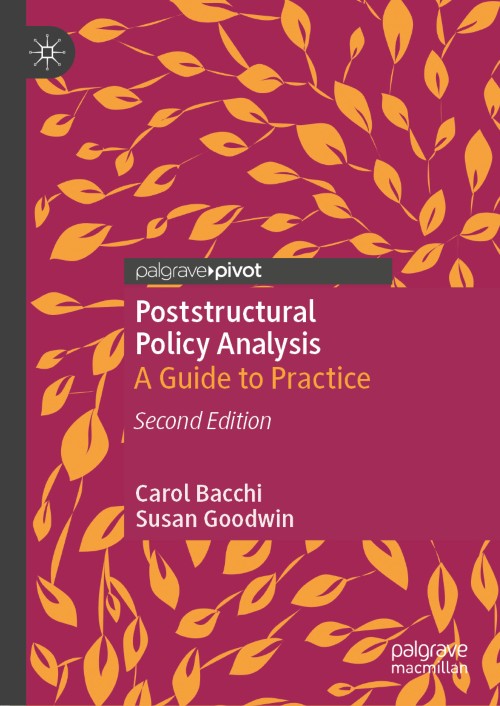
Poststructural Policy Analysis [electronic resource] : A Guide to Practice / by Carol Bacchi, Susan Goodwin.
Erişim Adresi
ISBN
9781349961344
Dil Kodu
İngilizce
Yer Numarası
DK/21318
Yazar
Basım Bildirimi
2nd ed. 2025.
Yayın Bilgisi
New York : Palgrave Macmillan US : Imprint: Palgrave Macmillan, 2025.
Fiziksel Niteleme
IX, 178 p. 1 illus. online resource.
İçindekiler Notu
Part I: Asking New Policy Questions -- Chapter 1: Introduction -- Chapter 2: Making Politics Visible: The WPR Approach -- Chapter 3: Key Themes and Concepts -- Part II: Interrogating Policies as Constitutive: WPR Applications -- Chapter 4: Making and Unmaking “problems” -- Chapter 5: Making and Unmaking “subjects” -- Chapter 6: Making and Unmaking “objects” -- Chapter 7: Making and Unmaking “places” -- Chapter 8: Poststructural Interview Analysis: Politicizing "personhood" by Carol Bacchi and Jennifer Bonham -- Chapter 9: Conclusion -- Bibliography -- Index.
Özet, vb.
This book offers a distinctive approach to policy analysis and a refreshing and politically engaged way of thinking about policy. It clearly articulates a Foucault-influenced poststructural perspective on policy and policy analysis for researchers, students and policy makers. As a "guide to practice", the book introduces a critical analytical approach to policy analysis called ‘What’s the Problem Represented to be?’ (WPR). Instead of treating policy as simply the government’s best efforts to address problems, this analytic strategy highlights how policies produce ‘problems’ as particular sorts of problem and how governing takes place through these problematisations. First published in 2016, the book describes the conceptual and theoretical underpinnings of the WPR approach to policy analysis in a detailed and accessible manner. It features examples of application of the approach with topics as diverse as obesity, economic policy, migration, drug and alcohol policy, and gender equality. In this second edition, the authors centralise a complementary analytic strategy for poststructural policy analysis—poststructural interview analysis (PIA). This edition integrates this material as a new chapter which sets out PIA as a novel approach to poststructural interview analysis and includes examples of PIA applications. The new chapter provides excellent guidance to undertake interview analysis in a manner congruent with the poststructural precepts set out in the book. Carol Bacchi is Professor Emerita of Politics at the University of Adelaide, Australia. Her work over the past forty years has encouraged rethinking of taken-for-granted truths about women’s history, equality policy and public policy generally. Major publications include Same Difference: Feminism and Sexual Difference (1990/2024), Women, Policy and Politics: The Construction of Policy Problems (1999), The Politics of Affirmative Action: 'Women', Equality & Category Politics (1996) and Analysing Policy: What’s the Problem Represented to Be? (2009). Susan Goodwin is Professor of Policy Studies at the University of Sydney, Australia. Her research focuses on social policy and policy processes, and she is involved in critical policy analysis with organisations at local, national and international levels. Her books include Working Across Difference: Social Work, Social Policy and Social Justice (2019), Markets, Rights and Power in Australian Social Policy (2015), Schools, Communities and Social Inclusion (2011) and Social Policy for Social Change (2010). .
Konu
Political planning.
Political science.
America __ Politics and government.
Public Policy.
Political Science.
American Politics.
Political science.
America __ Politics and government.
Public Policy.
Political Science.
American Politics.
Diğer Yazarlar
Kurum Adı
Eseri Alıntıla
Referansları kullanmadan önce gözden geçirmeniz ve varsa gerekli düzeltmeleri yapmanız önerilir.
Dijital Kaynak
MARC Görünümü
LEADER 06267nam a22006375i 4500
001 820111
003 TR_AnAIT
005 20260130171137
007 cr nn 008mamaa
008 250812s2025 xxu| s |||| 0|eng d
020 |a9781349961344|9978-1-349-96134-4
024 7 |a10.1057/978-1-349-96134-4|2doi
041 |aeng
049 |aTürk Tarih Kurumu Kütüphanesi
050 4|aJF1525.P6
072 7|aJPP|2bicssc
072 7|aPOL028000|2bisacsh
072 7|aJPP|2thema
082 04|a320.6|223
090 |aDK/21318
100 1 |aBacchi, Carol.|eauthor.|4aut|4http://id.loc.gov/vocabulary/relators/aut
245 10|aPoststructural Policy Analysis|h[electronic resource] :|bA Guide to Practice /|cby Carol Bacchi, Susan Goodwin.
250 |a2nd ed. 2025.
264 1|aNew York :|bPalgrave Macmillan US :|bImprint: Palgrave Macmillan,|c2025.
300 |aIX, 178 p. 1 illus.|bonline resource.
336 |atext|btxt|2rdacontent
337 |acomputer|bc|2rdamedia
338 |aonline resource|bcr|2rdacarrier
341 0 |bPDF/UA-1|2onix
341 0 |bTable of contents navigation|2onix
341 0 |bSingle logical reading order|2onix
341 0 |bShort alternative textual descriptions|2onix
341 0 |bUse of color is not sole means of conveying information|2onix
341 0 |bUse of high contrast between text and background color|2onix
341 0 |bNext / Previous structural navigation|2onix
341 0 |bAll non-decorative content supports reading without sight|2onix
347 |atext file|bPDF|2rda
505 0 |aPart I: Asking New Policy Questions -- Chapter 1: Introduction -- Chapter 2: Making Politics Visible: The WPR Approach -- Chapter 3: Key Themes and Concepts -- Part II: Interrogating Policies as Constitutive: WPR Applications -- Chapter 4: Making and Unmaking “problems” -- Chapter 5: Making and Unmaking “subjects” -- Chapter 6: Making and Unmaking “objects” -- Chapter 7: Making and Unmaking “places” -- Chapter 8: Poststructural Interview Analysis: Politicizing "personhood" by Carol Bacchi and Jennifer Bonham -- Chapter 9: Conclusion -- Bibliography -- Index.
520 |aThis book offers a distinctive approach to policy analysis and a refreshing and politically engaged way of thinking about policy. It clearly articulates a Foucault-influenced poststructural perspective on policy and policy analysis for researchers, students and policy makers. As a "guide to practice", the book introduces a critical analytical approach to policy analysis called ‘What’s the Problem Represented to be?’ (WPR). Instead of treating policy as simply the government’s best efforts to address problems, this analytic strategy highlights how policies produce ‘problems’ as particular sorts of problem and how governing takes place through these problematisations. First published in 2016, the book describes the conceptual and theoretical underpinnings of the WPR approach to policy analysis in a detailed and accessible manner. It features examples of application of the approach with topics as diverse as obesity, economic policy, migration, drug and alcohol policy, and gender equality. In this second edition, the authors centralise a complementary analytic strategy for poststructural policy analysis—poststructural interview analysis (PIA). This edition integrates this material as a new chapter which sets out PIA as a novel approach to poststructural interview analysis and includes examples of PIA applications. The new chapter provides excellent guidance to undertake interview analysis in a manner congruent with the poststructural precepts set out in the book. Carol Bacchi is Professor Emerita of Politics at the University of Adelaide, Australia. Her work over the past forty years has encouraged rethinking of taken-for-granted truths about women’s history, equality policy and public policy generally. Major publications include Same Difference: Feminism and Sexual Difference (1990/2024), Women, Policy and Politics: The Construction of Policy Problems (1999), The Politics of Affirmative Action: 'Women', Equality & Category Politics (1996) and Analysing Policy: What’s the Problem Represented to Be? (2009). Susan Goodwin is Professor of Policy Studies at the University of Sydney, Australia. Her research focuses on social policy and policy processes, and she is involved in critical policy analysis with organisations at local, national and international levels. Her books include Working Across Difference: Social Work, Social Policy and Social Justice (2019), Markets, Rights and Power in Australian Social Policy (2015), Schools, Communities and Social Inclusion (2011) and Social Policy for Social Change (2010). .
532 8 |aAccessibility summary: This PDF has been created in accordance with the PDF/UA-1 standard to enhance accessibility, including screen reader support, described non-text content (images, graphs), bookmarks for easy navigation, keyboard-friendly links and forms and searchable, selectable text. We recognize the importance of accessibility, and we welcome queries about accessibility for any of our products. If you have a question or an access need, please get in touch with us at accessibilitysupport@springernature.com. Please note that a more accessible version of this eBook is available as ePub.
532 8 |aNo reading system accessibility options actively disabled
532 8 |aPublisher contact for further accessibility information: accessibilitysupport@springernature.com
650 0|aPolitical planning.
650 0|aPolitical science.
650 0|aAmerica|xPolitics and government.
650 14|aPublic Policy.
650 24|aPolitical Science.
650 24|aAmerican Politics.
700 1 |aGoodwin, Susan.|eauthor.|4aut|4http://id.loc.gov/vocabulary/relators/aut
710 2 |aSpringerLink (Online service)
773 0 |tSpringer Nature eBook
776 08|iPrinted edition:|z9781349961337
776 08|iPrinted edition:|z9781349961351
776 08|iPrinted edition:|z9781349961368
856 40|uhttps://doi.org/10.1057/978-1-349-96134-4
912 |aZDB-2-POS
912 |aZDB-2-SXPI
950 |aPolitical Science and International Studies (SpringerNature-41174)
950 |aPolitical Science and International Studies (R0) (SpringerNature-43724)
Materyaller
Depodan talep edilen materyal sadece kütüphane içerisinde kullanılmaktadır.
Materyal dışarıya ödünç verilmemektedir.
Materyal dışarıya ödünç verilmemektedir.
