

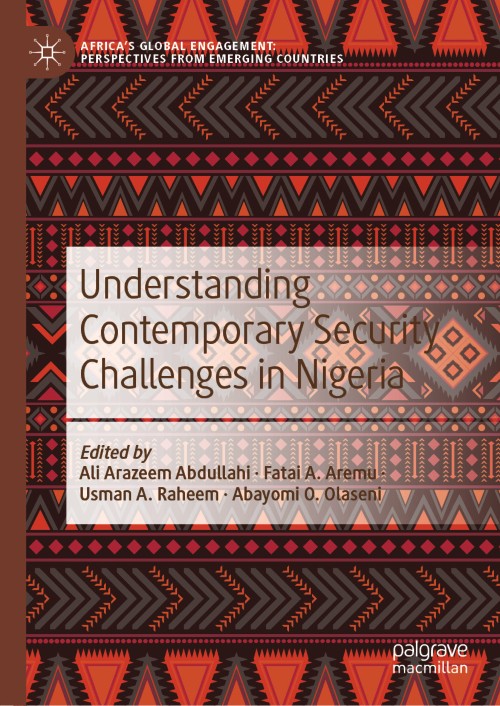
Understanding Contemporary Security Challenges in Nigeria [electronic resource] / edited by Ali Arazeem Abdullahi, Fatai A. Aremu, Usman A. Raheem, Abayomi O. Olaseni.
Erişim Adresi
ISBN
9789819750122
Dil Kodu
İngilizce
Yer Numarası
DK/21368
Basım Bildirimi
1st ed. 2024.
Yayın Bilgisi
Singapore : Springer Nature Singapore : Imprint: Palgrave Macmillan, 2024.
Fiziksel Niteleme
XVII, 315 p. 11 illus., 9 illus. in color. online resource.
Dizi
Africa's Global Engagement: Perspectives from Emerging Countries, 2662-7833
İçindekiler Notu
Part I: Some Security Threats in Nigeria -- 1. Unpacking Contemporary Security Challenges in Nigeria -- 2. Secessionist Agitations and National Security in Nigeria -- 3. Kidnapping and Human Security in Nigeria -- 4. Maritime Security in Nigeria: Perspectives for a Comprehensive Approach -- Part II: Drivers of Insecurity in Nigeria -- 5. The Social Context of Insecurity in Nigeria -- 6. Proliferation of Small Arms and Light Weapons and Security Challenges in Nigeria -- 7. Substance Abuse and Human Security in Nigeria -- 8. Migration and National Security in Nigeria -- 9. ‘Get Rich Syndrome’ and the Challenges of Insecurity in Nigeria -- Part III: Violent Conflicts and Human Security -- 10. Living through Terrorism and Insecurity: Construction of Mental Health Outcomes among Nigerians -- 11. Insecurity and the Nigerian Economy -- 12. Insecurity and Education in Nigeria -- 13. The Impact of Armed-Conflicts on Women and Children in Nigeria -- 14. Terrorism and Food Security in Nigeria: An Appraisal -- 15. Human Rights and Internal Security Operations in Nigeria: An Appraisal.
Özet, vb.
This book explores how the Nigerian state grapples with both internal and external forces that are fueling insecurity in the country. For more than a decade, Nigeria has been viciously attacked by different clusters of non-state armed actors, ranging from religious extremists, terrorists, kidnappers, herders, bandits, secessionists, and unknown gunmen. While insurgency-related deaths have dropped, the north-east remains the epicenter of insurgency and terrorism. This book unpacks the contemporary security challenges in Nigeria. Instead of a monolithic analysis of Boko-Haram, it discusses other armed groups, secessionist agitations, maritime security, the social context of insecurity, the nexus between the proliferation of small arms and light weapons and insecurity, the mental health outcomes of insecurity, substance abuse and security, as well as migration and national security. The book is a policy-driven research work that speaks directly to policymakers, students, and other important stakeholders in the security sector in Nigeria and beyond. Ali Arazeem Abdullahi is Professor of Sociology at the University of Ilorin, Nigeria, and Senior Research Associate at the Department of Sociology, Faculty of Humanities, University of Johannesburg, South Africa. He currently heads the Department of Criminology and Security Studies at the University of Ilorin, Nigeria. Fatai A. Aremu is Professor of Political Science, University of Ilorin, Nigeria. He is Visiting Research Fellow at the Africa Institute of South Africa (AISA), Human Sciences Research Council (HSRC), South Africa. Usman A. Raheem is Professor of Geography in the Department of Geography and Environmental Management at the University of Ilorin, Nigeria. He is, currently, Director of Technical and Entrepreneurship Centre (TEC) at the University. Abayomi O. Olaseni is Clinical Psychologist, who bagged an NPA accredited doctoral and master’s degree in Clinical Psychology from the University of Ibadan, Nigeria.
Konu
Africa __ Politics and government.
Peace.
Terrorism.
Political violence.
Regionalism.
Security, International.
International relations.
African Politics.
Peace and Conflict Studies.
Terrorism and Political Violence.
Regionalism.
International Security Studies.
Foreign Policy.
Peace.
Terrorism.
Political violence.
Regionalism.
Security, International.
International relations.
African Politics.
Peace and Conflict Studies.
Terrorism and Political Violence.
Regionalism.
International Security Studies.
Foreign Policy.
Diğer Yazarlar
Kurum Adı
Eseri Alıntıla
Referansları kullanmadan önce gözden geçirmeniz ve varsa gerekli düzeltmeleri yapmanız önerilir.
Dijital Kaynak
MARC Görünümü
LEADER 07042nam a22007695i 4500
001 820161
003 TR_AnAIT
005 20260130170943
007 cr nn 008mamaa
008 241001s2024 si | s |||| 0|eng d
020 |a9789819750122|9978-981-97-5012-2
024 7 |a10.1007/978-981-97-5012-2|2doi
041 |aeng
049 |aTürk Tarih Kurumu Kütüphanesi
050 4|aJQ1870-3981
072 7|aJP|2bicssc
072 7|a1H|2bicssc
072 7|aPOL053000|2bisacsh
072 7|aJP|x1H|2thema
082 04|a320.96|223
090 |aDK/21368
245 10|aUnderstanding Contemporary Security Challenges in Nigeria|h[electronic resource] /|cedited by Ali Arazeem Abdullahi, Fatai A. Aremu, Usman A. Raheem, Abayomi O. Olaseni.
250 |a1st ed. 2024.
264 1|aSingapore :|bSpringer Nature Singapore :|bImprint: Palgrave Macmillan,|c2024.
300 |aXVII, 315 p. 11 illus., 9 illus. in color.|bonline resource.
336 |atext|btxt|2rdacontent
337 |acomputer|bc|2rdamedia
338 |aonline resource|bcr|2rdacarrier
341 0 |bTable of contents navigation|2onix
341 0 |bSingle logical reading order|2onix
341 0 |bShort alternative textual descriptions|2onix
341 0 |bUse of color is not sole means of conveying information|2onix
341 0 |bUse of high contrast between text and background color|2onix
341 0 |bNext / Previous structural navigation|2onix
341 0 |bAll non-decorative content supports reading without sight|2onix
347 |atext file|bPDF|2rda
490 1 |aAfrica's Global Engagement: Perspectives from Emerging Countries,|x2662-7833
505 0 |aPart I: Some Security Threats in Nigeria -- 1. Unpacking Contemporary Security Challenges in Nigeria -- 2. Secessionist Agitations and National Security in Nigeria -- 3. Kidnapping and Human Security in Nigeria -- 4. Maritime Security in Nigeria: Perspectives for a Comprehensive Approach -- Part II: Drivers of Insecurity in Nigeria -- 5. The Social Context of Insecurity in Nigeria -- 6. Proliferation of Small Arms and Light Weapons and Security Challenges in Nigeria -- 7. Substance Abuse and Human Security in Nigeria -- 8. Migration and National Security in Nigeria -- 9. ‘Get Rich Syndrome’ and the Challenges of Insecurity in Nigeria -- Part III: Violent Conflicts and Human Security -- 10. Living through Terrorism and Insecurity: Construction of Mental Health Outcomes among Nigerians -- 11. Insecurity and the Nigerian Economy -- 12. Insecurity and Education in Nigeria -- 13. The Impact of Armed-Conflicts on Women and Children in Nigeria -- 14. Terrorism and Food Security in Nigeria: An Appraisal -- 15. Human Rights and Internal Security Operations in Nigeria: An Appraisal.
520 |aThis book explores how the Nigerian state grapples with both internal and external forces that are fueling insecurity in the country. For more than a decade, Nigeria has been viciously attacked by different clusters of non-state armed actors, ranging from religious extremists, terrorists, kidnappers, herders, bandits, secessionists, and unknown gunmen. While insurgency-related deaths have dropped, the north-east remains the epicenter of insurgency and terrorism. This book unpacks the contemporary security challenges in Nigeria. Instead of a monolithic analysis of Boko-Haram, it discusses other armed groups, secessionist agitations, maritime security, the social context of insecurity, the nexus between the proliferation of small arms and light weapons and insecurity, the mental health outcomes of insecurity, substance abuse and security, as well as migration and national security. The book is a policy-driven research work that speaks directly to policymakers, students, and other important stakeholders in the security sector in Nigeria and beyond. Ali Arazeem Abdullahi is Professor of Sociology at the University of Ilorin, Nigeria, and Senior Research Associate at the Department of Sociology, Faculty of Humanities, University of Johannesburg, South Africa. He currently heads the Department of Criminology and Security Studies at the University of Ilorin, Nigeria. Fatai A. Aremu is Professor of Political Science, University of Ilorin, Nigeria. He is Visiting Research Fellow at the Africa Institute of South Africa (AISA), Human Sciences Research Council (HSRC), South Africa. Usman A. Raheem is Professor of Geography in the Department of Geography and Environmental Management at the University of Ilorin, Nigeria. He is, currently, Director of Technical and Entrepreneurship Centre (TEC) at the University. Abayomi O. Olaseni is Clinical Psychologist, who bagged an NPA accredited doctoral and master’s degree in Clinical Psychology from the University of Ibadan, Nigeria.
532 8 |aAccessibility summary: This PDF does not fully comply with PDF/UA standards, but does feature limited screen reader support, described non-text content (images, graphs), bookmarks for easy navigation and searchable, selectable text. Users of assistive technologies may experience difficulty navigating or interpreting content in this document. We recognize the importance of accessibility, and we welcome queries about accessibility for any of our products. If you have a question or an access need, please get in touch with us at accessibilitysupport@springernature.com.
532 8 |aNo reading system accessibility options actively disabled
532 8 |aPublisher contact for further accessibility information: accessibilitysupport@springernature.com
650 0|aAfrica|xPolitics and government.
650 0|aPeace.
650 0|aTerrorism.
650 0|aPolitical violence.
650 0|aRegionalism.
650 0|aSecurity, International.
650 0|aInternational relations.
650 14|aAfrican Politics.
650 24|aPeace and Conflict Studies.
650 24|aTerrorism and Political Violence.
650 24|aRegionalism.
650 24|aInternational Security Studies.
650 24|aForeign Policy.
700 1 |aAbdullahi, Ali Arazeem.|eeditor.|0(orcid)0000-0002-8304-3967|1https://orcid.org/0000-0002-8304-3967|4edt|4http://id.loc.gov/vocabulary/relators/edt
700 1 |aAremu, Fatai A.|eeditor.|4edt|4http://id.loc.gov/vocabulary/relators/edt
700 1 |aRaheem, Usman A.|eeditor.|4edt|4http://id.loc.gov/vocabulary/relators/edt
700 1 |aOlaseni, Abayomi O.|eeditor.|0(orcid)0000-0002-0209-1407|1https://orcid.org/0000-0002-0209-1407|4edt|4http://id.loc.gov/vocabulary/relators/edt
710 2 |aSpringerLink (Online service)
773 0 |tSpringer Nature eBook
776 08|iPrinted edition:|z9789819750115
776 08|iPrinted edition:|z9789819750139
776 08|iPrinted edition:|z9789819750146
830 0|aAfrica's Global Engagement: Perspectives from Emerging Countries,|x2662-7833
856 40|uhttps://doi.org/10.1007/978-981-97-5012-2
912 |aZDB-2-POS
912 |aZDB-2-SXPI
950 |aPolitical Science and International Studies (SpringerNature-41174)
950 |aPolitical Science and International Studies (R0) (SpringerNature-43724)
001 820161
003 TR_AnAIT
005 20260130170943
007 cr nn 008mamaa
008 241001s2024 si | s |||| 0|eng d
020 |a9789819750122|9978-981-97-5012-2
024 7 |a10.1007/978-981-97-5012-2|2doi
041 |aeng
049 |aTürk Tarih Kurumu Kütüphanesi
050 4|aJQ1870-3981
072 7|aJP|2bicssc
072 7|a1H|2bicssc
072 7|aPOL053000|2bisacsh
072 7|aJP|x1H|2thema
082 04|a320.96|223
090 |aDK/21368
245 10|aUnderstanding Contemporary Security Challenges in Nigeria|h[electronic resource] /|cedited by Ali Arazeem Abdullahi, Fatai A. Aremu, Usman A. Raheem, Abayomi O. Olaseni.
250 |a1st ed. 2024.
264 1|aSingapore :|bSpringer Nature Singapore :|bImprint: Palgrave Macmillan,|c2024.
300 |aXVII, 315 p. 11 illus., 9 illus. in color.|bonline resource.
336 |atext|btxt|2rdacontent
337 |acomputer|bc|2rdamedia
338 |aonline resource|bcr|2rdacarrier
341 0 |bTable of contents navigation|2onix
341 0 |bSingle logical reading order|2onix
341 0 |bShort alternative textual descriptions|2onix
341 0 |bUse of color is not sole means of conveying information|2onix
341 0 |bUse of high contrast between text and background color|2onix
341 0 |bNext / Previous structural navigation|2onix
341 0 |bAll non-decorative content supports reading without sight|2onix
347 |atext file|bPDF|2rda
490 1 |aAfrica's Global Engagement: Perspectives from Emerging Countries,|x2662-7833
505 0 |aPart I: Some Security Threats in Nigeria -- 1. Unpacking Contemporary Security Challenges in Nigeria -- 2. Secessionist Agitations and National Security in Nigeria -- 3. Kidnapping and Human Security in Nigeria -- 4. Maritime Security in Nigeria: Perspectives for a Comprehensive Approach -- Part II: Drivers of Insecurity in Nigeria -- 5. The Social Context of Insecurity in Nigeria -- 6. Proliferation of Small Arms and Light Weapons and Security Challenges in Nigeria -- 7. Substance Abuse and Human Security in Nigeria -- 8. Migration and National Security in Nigeria -- 9. ‘Get Rich Syndrome’ and the Challenges of Insecurity in Nigeria -- Part III: Violent Conflicts and Human Security -- 10. Living through Terrorism and Insecurity: Construction of Mental Health Outcomes among Nigerians -- 11. Insecurity and the Nigerian Economy -- 12. Insecurity and Education in Nigeria -- 13. The Impact of Armed-Conflicts on Women and Children in Nigeria -- 14. Terrorism and Food Security in Nigeria: An Appraisal -- 15. Human Rights and Internal Security Operations in Nigeria: An Appraisal.
520 |aThis book explores how the Nigerian state grapples with both internal and external forces that are fueling insecurity in the country. For more than a decade, Nigeria has been viciously attacked by different clusters of non-state armed actors, ranging from religious extremists, terrorists, kidnappers, herders, bandits, secessionists, and unknown gunmen. While insurgency-related deaths have dropped, the north-east remains the epicenter of insurgency and terrorism. This book unpacks the contemporary security challenges in Nigeria. Instead of a monolithic analysis of Boko-Haram, it discusses other armed groups, secessionist agitations, maritime security, the social context of insecurity, the nexus between the proliferation of small arms and light weapons and insecurity, the mental health outcomes of insecurity, substance abuse and security, as well as migration and national security. The book is a policy-driven research work that speaks directly to policymakers, students, and other important stakeholders in the security sector in Nigeria and beyond. Ali Arazeem Abdullahi is Professor of Sociology at the University of Ilorin, Nigeria, and Senior Research Associate at the Department of Sociology, Faculty of Humanities, University of Johannesburg, South Africa. He currently heads the Department of Criminology and Security Studies at the University of Ilorin, Nigeria. Fatai A. Aremu is Professor of Political Science, University of Ilorin, Nigeria. He is Visiting Research Fellow at the Africa Institute of South Africa (AISA), Human Sciences Research Council (HSRC), South Africa. Usman A. Raheem is Professor of Geography in the Department of Geography and Environmental Management at the University of Ilorin, Nigeria. He is, currently, Director of Technical and Entrepreneurship Centre (TEC) at the University. Abayomi O. Olaseni is Clinical Psychologist, who bagged an NPA accredited doctoral and master’s degree in Clinical Psychology from the University of Ibadan, Nigeria.
532 8 |aAccessibility summary: This PDF does not fully comply with PDF/UA standards, but does feature limited screen reader support, described non-text content (images, graphs), bookmarks for easy navigation and searchable, selectable text. Users of assistive technologies may experience difficulty navigating or interpreting content in this document. We recognize the importance of accessibility, and we welcome queries about accessibility for any of our products. If you have a question or an access need, please get in touch with us at accessibilitysupport@springernature.com.
532 8 |aNo reading system accessibility options actively disabled
532 8 |aPublisher contact for further accessibility information: accessibilitysupport@springernature.com
650 0|aAfrica|xPolitics and government.
650 0|aPeace.
650 0|aTerrorism.
650 0|aPolitical violence.
650 0|aRegionalism.
650 0|aSecurity, International.
650 0|aInternational relations.
650 14|aAfrican Politics.
650 24|aPeace and Conflict Studies.
650 24|aTerrorism and Political Violence.
650 24|aRegionalism.
650 24|aInternational Security Studies.
650 24|aForeign Policy.
700 1 |aAbdullahi, Ali Arazeem.|eeditor.|0(orcid)0000-0002-8304-3967|1https://orcid.org/0000-0002-8304-3967|4edt|4http://id.loc.gov/vocabulary/relators/edt
700 1 |aAremu, Fatai A.|eeditor.|4edt|4http://id.loc.gov/vocabulary/relators/edt
700 1 |aRaheem, Usman A.|eeditor.|4edt|4http://id.loc.gov/vocabulary/relators/edt
700 1 |aOlaseni, Abayomi O.|eeditor.|0(orcid)0000-0002-0209-1407|1https://orcid.org/0000-0002-0209-1407|4edt|4http://id.loc.gov/vocabulary/relators/edt
710 2 |aSpringerLink (Online service)
773 0 |tSpringer Nature eBook
776 08|iPrinted edition:|z9789819750115
776 08|iPrinted edition:|z9789819750139
776 08|iPrinted edition:|z9789819750146
830 0|aAfrica's Global Engagement: Perspectives from Emerging Countries,|x2662-7833
856 40|uhttps://doi.org/10.1007/978-981-97-5012-2
912 |aZDB-2-POS
912 |aZDB-2-SXPI
950 |aPolitical Science and International Studies (SpringerNature-41174)
950 |aPolitical Science and International Studies (R0) (SpringerNature-43724)
Materyaller
Depodan talep edilen materyal sadece kütüphane içerisinde kullanılmaktadır.
Materyal dışarıya ödünç verilmemektedir.
Materyal dışarıya ödünç verilmemektedir.
