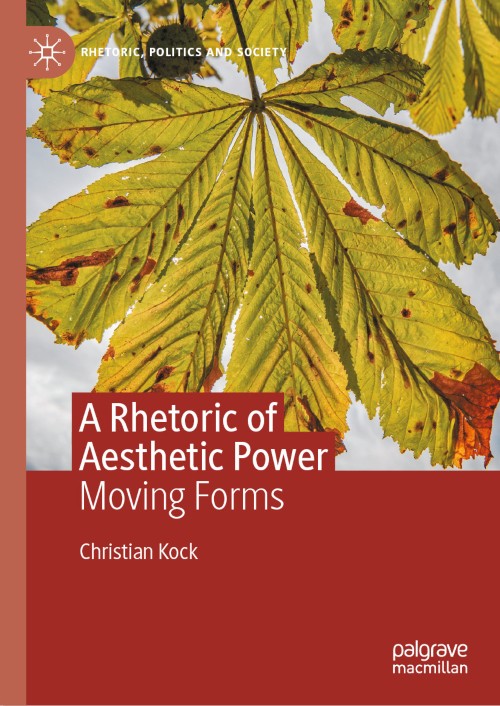
LEADER 03602nam a22005895i 4500
001 820165
003 TR_AnAIT
005 20260130170937
007 cr nn 008mamaa
008 241019s2024 sz | s |||| 0|eng d
020 |a9783031689703|9978-3-031-68970-3
024 7 |a10.1007/978-3-031-68970-3|2doi
041 |aeng
049 |aTürk Tarih Kurumu Kütüphanesi
050 4|aJA85-85.2
072 7|aJPH|2bicssc
072 7|aGTC|2bicssc
072 7|aPOL000000|2bisacsh
072 7|aJPH|2thema
072 7|aGTC|2thema
082 04|a320.014|223
090 |aDK/21372
100 1 |aKock, Christian.|eauthor.|4aut|4http://id.loc.gov/vocabulary/relators/aut
245 12|aA Rhetoric of Aesthetic Power|h[electronic resource] :|bMoving Forms /|cby Christian Kock.
250 |a1st ed. 2024.
264 1|aCham :|bSpringer Nature Switzerland :|bImprint: Palgrave Macmillan,|c2024.
300 |aX, 386 p. 41 illus., 2 illus. in color.|bonline resource.
336 |atext|btxt|2rdacontent
337 |acomputer|bc|2rdamedia
338 |aonline resource|bcr|2rdacarrier
347 |atext file|bPDF|2rda
490 1 |aRhetoric, Politics and Society,|x2947-5155
505 0 |aChapter One: What Moves Us -- Chapter Two: A Rhetorical Aesthetics -- Chapter Three: Affective Attractions -- Chapter Four: Structural Attractions -- Chapter Five: Semiotic Attractions.
520 |aThis book offers a theory of those formal properties of art that are apt to afford strong aesthetic experience – a project resembling Aristotle’s in the Poetics, where he analysed structures in tragedies that condition the “peculiar pleasure” of tragedy. However, the book’s scope cuts across all genres of literature and also includes classical music – the formal art par excellence. Drawing on a wide array of recent theoretical work and empirical evidence, the book closely analyses dozens of examples of both art forms. Besides Aristotle, major inspiration comes from two modern master thinkers: the linguist Roman Jakobson, who defined the “poetic function” of language, and the rhetorician Kenneth Burke, who proposed a “psychological” concept of form. Throughout, the book argues for aesthetic experience as an end in itself and a component of quality of life, one to which everyone should have access – rather than just a means to other ends. Christian Kock is Emeritus Professor at the University of Copenhagen. Formerly an Associate Professor of English Literature and a Visiting Professor at Indiana University, he was Professor of Rhetoric from 1997 to 2018. He still publishes extensively, mainly on argumentation and political debate, as well as on the aesthetics of literature and classical music. .
650 0|aCommunication in politics.
650 0|aPolitical science.
650 0|aPolitical science|xStudy and teaching.
650 0|aPolitical sociology.
650 0|aWorld politics.
650 14|aPolitical Communication.
650 24|aPolitical Theory.
650 24|aPolitical Education.
650 24|aPolitical Sociology.
650 24|aPolitical History.
710 2 |aSpringerLink (Online service)
773 0 |tSpringer Nature eBook
776 08|iPrinted edition:|z9783031689697
776 08|iPrinted edition:|z9783031689710
776 08|iPrinted edition:|z9783031689727
830 0|aRhetoric, Politics and Society,|x2947-5155
856 40|uhttps://doi.org/10.1007/978-3-031-68970-3
912 |aZDB-2-POS
912 |aZDB-2-SXPI
950 |aPolitical Science and International Studies (SpringerNature-41174)
950 |aPolitical Science and International Studies (R0) (SpringerNature-43724)