

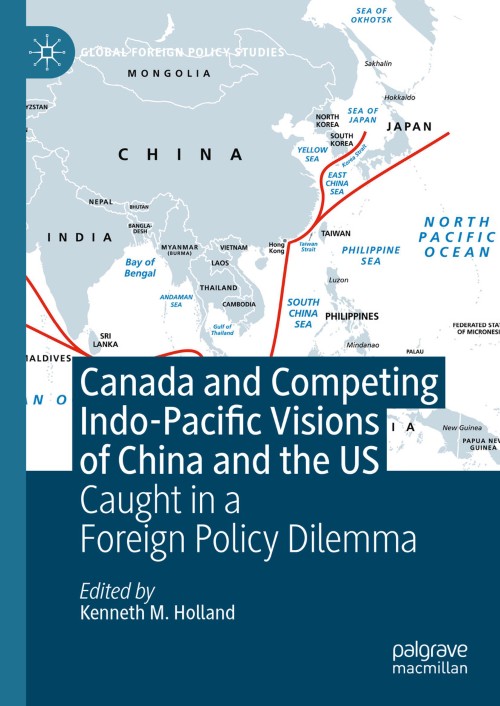
Canada and Competing Indo-Pacific Visions of China and the US [electronic resource] : Caught in a Foreign Policy Dilemma / edited by Kenneth M. Holland.
Erişim Adresi
ISBN
9783031717857
Dil Kodu
İngilizce
Yer Numarası
DK/21397
Basım Bildirimi
1st ed. 2024.
Yayın Bilgisi
Cham : Springer Nature Switzerland : Imprint: Palgrave Macmillan, 2024.
Fiziksel Niteleme
XV, 319 p. 9 illus. online resource.
Dizi
Global Foreign Policy Studies, 2731-7544
İçindekiler Notu
Chapter 1- Introduction: The Strategic Choices Facing Canada in Defining its Relationship with China -- Chapter 2 - International Relations Theory and Canada’s Response to the US-China Strategic Rivalry -- Chapter 3- Re-inventing Canada’s Middle Power Identity: Practicing Pragmatic Realism in an Era of US-China Strategic Competition in the Indo-Pacific -- Chapter 4 - Realism Redux: Canada’s Geostrategic Choices in an Era of Great-power Rivalry -- Chapter 5- Canada’s Response to China’s Rise, 2015-2023: Analysis of Ottawa’s Internal Policy Making -- Chapter 6- Canada Carves Out a Unique Role for Itself While Aligning with the United States and its Like-Minded Allies and Partners -- Chapter 7 - Unable to Resist--Unwilling to Take Risks: Canada in the Vice of Sino-American Rivalry -- Chapter 8 - The Polar Silk Road: Canadian Content in Sino-American Relations -- Chapter 9 - Conclusion.
Özet, vb.
This book describes and analyzes the choices that Canada, as a Middle Power, has regarding the strategic rivalry between the United States and China. The administrations of Republican Donald Trump and his successor Democrat Joe Biden have taken a hardline stance toward Beijing, which in turn has adopted an increasingly belligerent tone toward Washington. The posture of the United States toward China has put traditional American allies in a difficult position. They must choose whether to join the effort to counter China’s ambitions, support those ambitions or take some intermediate stance. As one of America’s closest and longest-standing allies, Canada must make decisions that will affect its position in the world for the rest of the twenty-first century. The book argues that Canada’s national interests are best served by alignment with the confrontational posture of the United States while at the same time joining the efforts of U.S. allies Japan, India, and South Korea to moderate the thrust of Washington’s Indo-Pacific Strategy in a direction more consistent with multilateralism and the preservation of the rules-based international order. The book has important implications for other U.S. allies, including the member states of the European Union, Organization of American States and Association of Southeast Asian Nations, each of which finds itself caught in the middle between the world’s two greatest powers. Kenneth Holland is a former president of the Association for Canadian Studies in the United States and has published several books, articles and book chapters on Canada’s foreign policy, including “Canada and the Indo-Pacific Strategy” (2021), “How Unipolarity Impacts Canada’s Engagement with the North Atlantic Treaty Organization” (2017), “The Canada-United States Defence Relationship: A Partnership for the Twenty-First Century” (2014), “An Evaluation of Canada’s Engagement in Afghanistan” (2013), and Canadian-United States Engagement in Afghanistan: An Analysis of the “Whole of Government” Approach (2009). Prof. Holland has been a Visiting Professor at the University of Calgary, Fulbright Professor of Law at Tohoku University in Japan, and Research Fellow at the Australian National University. He has lectured at several Chinese universities on U.S.-China relations and assisted China in complying with the conditions established by the United States for China’sadmission into the World Trade Organization.
Konu
International relations.
Foreign Policy.
Foreign Policy.
Diğer Yazarlar
Kurum Adı
Eseri Alıntıla
Referansları kullanmadan önce gözden geçirmeniz ve varsa gerekli düzeltmeleri yapmanız önerilir.
Dijital Kaynak
MARC Görünümü
LEADER 05221nam a22004695i 4500
001 820190
003 TR_AnAIT
005 20260130170848
007 cr nn 008mamaa
008 241213s2024 sz | s |||| 0|eng d
020 |a9783031717857|9978-3-031-71785-7
024 7 |a10.1007/978-3-031-71785-7|2doi
041 |aeng
049 |aTürk Tarih Kurumu Kütüphanesi
050 4|aJZ2-6530
072 7|aJPS|2bicssc
072 7|aPOL028000|2bisacsh
072 7|aJPS|2thema
082 04|a327.1|223
090 |aDK/21397
245 10|aCanada and Competing Indo-Pacific Visions of China and the US|h[electronic resource] :|bCaught in a Foreign Policy Dilemma /|cedited by Kenneth M. Holland.
250 |a1st ed. 2024.
264 1|aCham :|bSpringer Nature Switzerland :|bImprint: Palgrave Macmillan,|c2024.
300 |aXV, 319 p. 9 illus.|bonline resource.
336 |atext|btxt|2rdacontent
337 |acomputer|bc|2rdamedia
338 |aonline resource|bcr|2rdacarrier
347 |atext file|bPDF|2rda
490 1 |aGlobal Foreign Policy Studies,|x2731-7544
505 0 |aChapter 1- Introduction: The Strategic Choices Facing Canada in Defining its Relationship with China -- Chapter 2 - International Relations Theory and Canada’s Response to the US-China Strategic Rivalry -- Chapter 3- Re-inventing Canada’s Middle Power Identity: Practicing Pragmatic Realism in an Era of US-China Strategic Competition in the Indo-Pacific -- Chapter 4 - Realism Redux: Canada’s Geostrategic Choices in an Era of Great-power Rivalry -- Chapter 5- Canada’s Response to China’s Rise, 2015-2023: Analysis of Ottawa’s Internal Policy Making -- Chapter 6- Canada Carves Out a Unique Role for Itself While Aligning with the United States and its Like-Minded Allies and Partners -- Chapter 7 - Unable to Resist--Unwilling to Take Risks: Canada in the Vice of Sino-American Rivalry -- Chapter 8 - The Polar Silk Road: Canadian Content in Sino-American Relations -- Chapter 9 - Conclusion.
520 |aThis book describes and analyzes the choices that Canada, as a Middle Power, has regarding the strategic rivalry between the United States and China. The administrations of Republican Donald Trump and his successor Democrat Joe Biden have taken a hardline stance toward Beijing, which in turn has adopted an increasingly belligerent tone toward Washington. The posture of the United States toward China has put traditional American allies in a difficult position. They must choose whether to join the effort to counter China’s ambitions, support those ambitions or take some intermediate stance. As one of America’s closest and longest-standing allies, Canada must make decisions that will affect its position in the world for the rest of the twenty-first century. The book argues that Canada’s national interests are best served by alignment with the confrontational posture of the United States while at the same time joining the efforts of U.S. allies Japan, India, and South Korea to moderate the thrust of Washington’s Indo-Pacific Strategy in a direction more consistent with multilateralism and the preservation of the rules-based international order. The book has important implications for other U.S. allies, including the member states of the European Union, Organization of American States and Association of Southeast Asian Nations, each of which finds itself caught in the middle between the world’s two greatest powers. Kenneth Holland is a former president of the Association for Canadian Studies in the United States and has published several books, articles and book chapters on Canada’s foreign policy, including “Canada and the Indo-Pacific Strategy” (2021), “How Unipolarity Impacts Canada’s Engagement with the North Atlantic Treaty Organization” (2017), “The Canada-United States Defence Relationship: A Partnership for the Twenty-First Century” (2014), “An Evaluation of Canada’s Engagement in Afghanistan” (2013), and Canadian-United States Engagement in Afghanistan: An Analysis of the “Whole of Government” Approach (2009). Prof. Holland has been a Visiting Professor at the University of Calgary, Fulbright Professor of Law at Tohoku University in Japan, and Research Fellow at the Australian National University. He has lectured at several Chinese universities on U.S.-China relations and assisted China in complying with the conditions established by the United States for China’sadmission into the World Trade Organization.
650 0|aInternational relations.
650 14|aForeign Policy.
700 1 |aHolland, Kenneth M.|eeditor.|0(orcid)0000-0003-2527-7009|1https://orcid.org/0000-0003-2527-7009|4edt|4http://id.loc.gov/vocabulary/relators/edt
710 2 |aSpringerLink (Online service)
773 0 |tSpringer Nature eBook
776 08|iPrinted edition:|z9783031717840
776 08|iPrinted edition:|z9783031717864
776 08|iPrinted edition:|z9783031717871
830 0|aGlobal Foreign Policy Studies,|x2731-7544
856 40|uhttps://doi.org/10.1007/978-3-031-71785-7
912 |aZDB-2-POS
912 |aZDB-2-SXPI
950 |aPolitical Science and International Studies (SpringerNature-41174)
950 |aPolitical Science and International Studies (R0) (SpringerNature-43724)
001 820190
003 TR_AnAIT
005 20260130170848
007 cr nn 008mamaa
008 241213s2024 sz | s |||| 0|eng d
020 |a9783031717857|9978-3-031-71785-7
024 7 |a10.1007/978-3-031-71785-7|2doi
041 |aeng
049 |aTürk Tarih Kurumu Kütüphanesi
050 4|aJZ2-6530
072 7|aJPS|2bicssc
072 7|aPOL028000|2bisacsh
072 7|aJPS|2thema
082 04|a327.1|223
090 |aDK/21397
245 10|aCanada and Competing Indo-Pacific Visions of China and the US|h[electronic resource] :|bCaught in a Foreign Policy Dilemma /|cedited by Kenneth M. Holland.
250 |a1st ed. 2024.
264 1|aCham :|bSpringer Nature Switzerland :|bImprint: Palgrave Macmillan,|c2024.
300 |aXV, 319 p. 9 illus.|bonline resource.
336 |atext|btxt|2rdacontent
337 |acomputer|bc|2rdamedia
338 |aonline resource|bcr|2rdacarrier
347 |atext file|bPDF|2rda
490 1 |aGlobal Foreign Policy Studies,|x2731-7544
505 0 |aChapter 1- Introduction: The Strategic Choices Facing Canada in Defining its Relationship with China -- Chapter 2 - International Relations Theory and Canada’s Response to the US-China Strategic Rivalry -- Chapter 3- Re-inventing Canada’s Middle Power Identity: Practicing Pragmatic Realism in an Era of US-China Strategic Competition in the Indo-Pacific -- Chapter 4 - Realism Redux: Canada’s Geostrategic Choices in an Era of Great-power Rivalry -- Chapter 5- Canada’s Response to China’s Rise, 2015-2023: Analysis of Ottawa’s Internal Policy Making -- Chapter 6- Canada Carves Out a Unique Role for Itself While Aligning with the United States and its Like-Minded Allies and Partners -- Chapter 7 - Unable to Resist--Unwilling to Take Risks: Canada in the Vice of Sino-American Rivalry -- Chapter 8 - The Polar Silk Road: Canadian Content in Sino-American Relations -- Chapter 9 - Conclusion.
520 |aThis book describes and analyzes the choices that Canada, as a Middle Power, has regarding the strategic rivalry between the United States and China. The administrations of Republican Donald Trump and his successor Democrat Joe Biden have taken a hardline stance toward Beijing, which in turn has adopted an increasingly belligerent tone toward Washington. The posture of the United States toward China has put traditional American allies in a difficult position. They must choose whether to join the effort to counter China’s ambitions, support those ambitions or take some intermediate stance. As one of America’s closest and longest-standing allies, Canada must make decisions that will affect its position in the world for the rest of the twenty-first century. The book argues that Canada’s national interests are best served by alignment with the confrontational posture of the United States while at the same time joining the efforts of U.S. allies Japan, India, and South Korea to moderate the thrust of Washington’s Indo-Pacific Strategy in a direction more consistent with multilateralism and the preservation of the rules-based international order. The book has important implications for other U.S. allies, including the member states of the European Union, Organization of American States and Association of Southeast Asian Nations, each of which finds itself caught in the middle between the world’s two greatest powers. Kenneth Holland is a former president of the Association for Canadian Studies in the United States and has published several books, articles and book chapters on Canada’s foreign policy, including “Canada and the Indo-Pacific Strategy” (2021), “How Unipolarity Impacts Canada’s Engagement with the North Atlantic Treaty Organization” (2017), “The Canada-United States Defence Relationship: A Partnership for the Twenty-First Century” (2014), “An Evaluation of Canada’s Engagement in Afghanistan” (2013), and Canadian-United States Engagement in Afghanistan: An Analysis of the “Whole of Government” Approach (2009). Prof. Holland has been a Visiting Professor at the University of Calgary, Fulbright Professor of Law at Tohoku University in Japan, and Research Fellow at the Australian National University. He has lectured at several Chinese universities on U.S.-China relations and assisted China in complying with the conditions established by the United States for China’sadmission into the World Trade Organization.
650 0|aInternational relations.
650 14|aForeign Policy.
700 1 |aHolland, Kenneth M.|eeditor.|0(orcid)0000-0003-2527-7009|1https://orcid.org/0000-0003-2527-7009|4edt|4http://id.loc.gov/vocabulary/relators/edt
710 2 |aSpringerLink (Online service)
773 0 |tSpringer Nature eBook
776 08|iPrinted edition:|z9783031717840
776 08|iPrinted edition:|z9783031717864
776 08|iPrinted edition:|z9783031717871
830 0|aGlobal Foreign Policy Studies,|x2731-7544
856 40|uhttps://doi.org/10.1007/978-3-031-71785-7
912 |aZDB-2-POS
912 |aZDB-2-SXPI
950 |aPolitical Science and International Studies (SpringerNature-41174)
950 |aPolitical Science and International Studies (R0) (SpringerNature-43724)
Materyaller
Depodan talep edilen materyal sadece kütüphane içerisinde kullanılmaktadır.
Materyal dışarıya ödünç verilmemektedir.
Materyal dışarıya ödünç verilmemektedir.
