

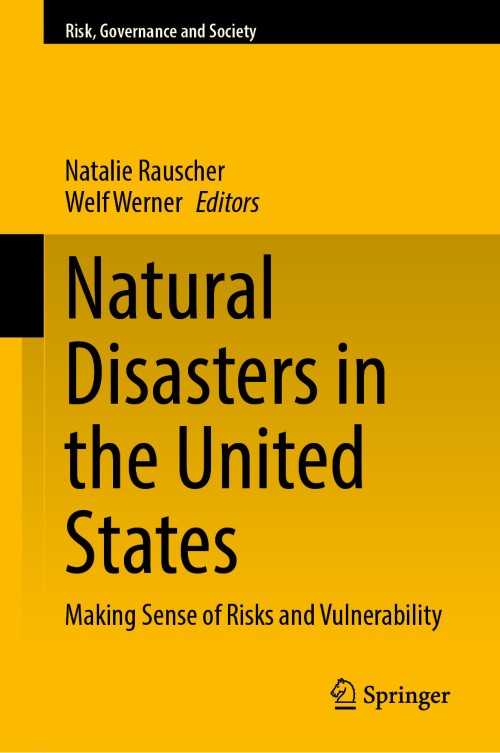
Natural Disasters in the United States [electronic resource] : Making Sense of Risks and Vulnerability / edited by Natalie Rauscher, Welf Werner.
Erişim Adresi
ISBN
9783031964367
Dil Kodu
İngilizce
Yer Numarası
DK/21544
Basım Bildirimi
1st ed. 2025.
Yayın Bilgisi
Cham : Springer Nature Switzerland : Imprint: Springer, 2025.
Fiziksel Niteleme
VII, 270 p. 23 illus., 19 illus. in color. online resource.
Dizi
Risk, Governance and Society, 2512-3084 ; 22
İçindekiler Notu
Chapter 1. Introduction -- Part I: Governance -- Chapter 2. Disaster Made Manifest: The Federal Role in U.S. Natural Disasters -- Chapter 3. Nature by Numbers: The National Flood Insurance Program -- Chapter 4. All of the Above: Energy, Environmental Politics, and U.S. Climate Change Policy since the 1970s Oil Crises -- Chapter 5. Letting Nature Do its Thing: Early Flood Control and Environmental Disaster along the Los Angeles River -- Part II: Representation and Perception -- Chapter 6. Hopeless Optimism: Framing Early 20th Century Earthquakes as News and History in the Making -- Chapter 7. Hurricanes and Theodicy in 20th and 21st Century American Protestantism -- Chapter 8. Through the Eyes of the White, Innocent Child: Whiteness, Vulnerability, and (Environmental) Crisis in Lauren Tarshi’s I Survived Series -- Chapter 9. Reporting Catastrophes: Mainstream Media and Vulnerability to Disasters in the U.S. -- Part III: Impact and Response -- Chapter 10. Multinational Insurers and Catastrophic Loss: Responses to the San Francisco Disaster of 1906 -- Chapter 11. Oil Ports and Hurricanes along the Texas Gulf Coast -- Chapter 12. ‘Becoming Green:’ Resilient and Green Building as Risk Mitigation in Atlanta, Georgia.
Özet, vb.
This volume examines the history of natural disasters in the United States and the nation's ongoing struggles with long-term disaster preparedness and response. It explores the political, economic, and cultural factors that have shaped the country's vulnerability. It highlights why, despite its vast resources, the United States has remained one of the most resistant actors in recognizing and mitigating disaster risk. Bringing together contributions from a variety of fields, this book analyzes the role of political institutions, media narratives, and cultural perceptions in shaping disaster policy. It examines key historical events to identify patterns of governance failure and missed opportunities to build resilience. Ultimately, this volume provides crucial insights into the historical baggage that the United States brings to multilateral climate negotiations, helping to explain its often frustrating role on the international stage. This book is essential reading for students, researchers, and scholars in the social sciences, humanities, and environmental studies, as well as policymakers and practitioners seeking a deeper understanding of the challenges and shortcomings of U.S. disaster mitigation policy. Chapter “‘Becoming Green:’ Resilient and Green Building as Risk Mitigation in Atlanta, Georgia” is available open access under a Creative Commons Attribution 4.0 International License via link.springer.com.
Konu
America __ Politics and government.
Political science.
Natural disasters.
Environmental economics.
Environmental sciences __ Social aspects.
Financial risk management.
American Politics.
Governance and Government.
Natural Hazards.
Environmental Economics.
Environmental Social Sciences.
Risk Management.
Political science.
Natural disasters.
Environmental economics.
Environmental sciences __ Social aspects.
Financial risk management.
American Politics.
Governance and Government.
Natural Hazards.
Environmental Economics.
Environmental Social Sciences.
Risk Management.
Diğer Yazarlar
Kurum Adı
Eseri Alıntıla
Referansları kullanmadan önce gözden geçirmeniz ve varsa gerekli düzeltmeleri yapmanız önerilir.
Dijital Kaynak
MARC Görünümü
LEADER 06365nam a22007575i 4500
001 820337
003 TR_AnAIT
005 20260130170334
007 cr nn 008mamaa
008 250926s2025 sz | s |||| 0|eng d
020 |a9783031964367|9978-3-031-96436-7
024 7 |a10.1007/978-3-031-96436-7|2doi
041 |aeng
049 |aTürk Tarih Kurumu Kütüphanesi
050 4|aJK1-9993
050 4|aJL1-3899
072 7|aJP|2bicssc
072 7|a1K|2bicssc
072 7|aPOL040000|2bisacsh
072 7|aJP|x1K|2thema
082 04|a320.9|223
090 |aDK/21544
245 10|aNatural Disasters in the United States|h[electronic resource] :|bMaking Sense of Risks and Vulnerability /|cedited by Natalie Rauscher, Welf Werner.
250 |a1st ed. 2025.
264 1|aCham :|bSpringer Nature Switzerland :|bImprint: Springer,|c2025.
300 |aVII, 270 p. 23 illus., 19 illus. in color.|bonline resource.
336 |atext|btxt|2rdacontent
337 |acomputer|bc|2rdamedia
338 |aonline resource|bcr|2rdacarrier
341 0 |bPDF/UA-1|2onix
341 0 |bTable of contents navigation|2onix
341 0 |bSingle logical reading order|2onix
341 0 |bShort alternative textual descriptions|2onix
341 0 |bUse of color is not sole means of conveying information|2onix
341 0 |bUse of high contrast between text and background color|2onix
341 0 |bNext / Previous structural navigation|2onix
341 0 |bAll non-decorative content supports reading without sight|2onix
347 |atext file|bPDF|2rda
490 1 |aRisk, Governance and Society,|x2512-3084 ;|v22
505 0 |aChapter 1. Introduction -- Part I: Governance -- Chapter 2. Disaster Made Manifest: The Federal Role in U.S. Natural Disasters -- Chapter 3. Nature by Numbers: The National Flood Insurance Program -- Chapter 4. All of the Above: Energy, Environmental Politics, and U.S. Climate Change Policy since the 1970s Oil Crises -- Chapter 5. Letting Nature Do its Thing: Early Flood Control and Environmental Disaster along the Los Angeles River -- Part II: Representation and Perception -- Chapter 6. Hopeless Optimism: Framing Early 20th Century Earthquakes as News and History in the Making -- Chapter 7. Hurricanes and Theodicy in 20th and 21st Century American Protestantism -- Chapter 8. Through the Eyes of the White, Innocent Child: Whiteness, Vulnerability, and (Environmental) Crisis in Lauren Tarshi’s I Survived Series -- Chapter 9. Reporting Catastrophes: Mainstream Media and Vulnerability to Disasters in the U.S. -- Part III: Impact and Response -- Chapter 10. Multinational Insurers and Catastrophic Loss: Responses to the San Francisco Disaster of 1906 -- Chapter 11. Oil Ports and Hurricanes along the Texas Gulf Coast -- Chapter 12. ‘Becoming Green:’ Resilient and Green Building as Risk Mitigation in Atlanta, Georgia.
520 |aThis volume examines the history of natural disasters in the United States and the nation's ongoing struggles with long-term disaster preparedness and response. It explores the political, economic, and cultural factors that have shaped the country's vulnerability. It highlights why, despite its vast resources, the United States has remained one of the most resistant actors in recognizing and mitigating disaster risk. Bringing together contributions from a variety of fields, this book analyzes the role of political institutions, media narratives, and cultural perceptions in shaping disaster policy. It examines key historical events to identify patterns of governance failure and missed opportunities to build resilience. Ultimately, this volume provides crucial insights into the historical baggage that the United States brings to multilateral climate negotiations, helping to explain its often frustrating role on the international stage. This book is essential reading for students, researchers, and scholars in the social sciences, humanities, and environmental studies, as well as policymakers and practitioners seeking a deeper understanding of the challenges and shortcomings of U.S. disaster mitigation policy. Chapter “‘Becoming Green:’ Resilient and Green Building as Risk Mitigation in Atlanta, Georgia” is available open access under a Creative Commons Attribution 4.0 International License via link.springer.com.
532 8 |aAccessibility summary: This PDF has been created in accordance with the PDF/UA-1 standard to enhance accessibility, including screen reader support, described non-text content (images, graphs), bookmarks for easy navigation, keyboard-friendly links and forms and searchable, selectable text. We recognize the importance of accessibility, and we welcome queries about accessibility for any of our products. If you have a question or an access need, please get in touch with us at accessibilitysupport@springernature.com. Please note that a more accessible version of this eBook is available as ePub.
532 8 |aNo reading system accessibility options actively disabled
532 8 |aPublisher contact for further accessibility information: accessibilitysupport@springernature.com
650 0|aAmerica|xPolitics and government.
650 0|aPolitical science.
650 0|aNatural disasters.
650 0|aEnvironmental economics.
650 0|aEnvironmental sciences|xSocial aspects.
650 0|aFinancial risk management.
650 14|aAmerican Politics.
650 24|aGovernance and Government.
650 24|aNatural Hazards.
650 24|aEnvironmental Economics.
650 24|aEnvironmental Social Sciences.
650 24|aRisk Management.
700 1 |aRauscher, Natalie.|eeditor.|0(orcid)0009-0001-6720-920X|1https://orcid.org/0009-0001-6720-920X|4edt|4http://id.loc.gov/vocabulary/relators/edt
700 1 |aWerner, Welf.|eeditor.|4edt|4http://id.loc.gov/vocabulary/relators/edt
710 2 |aSpringerLink (Online service)
773 0 |tSpringer Nature eBook
776 08|iPrinted edition:|z9783031964350
776 08|iPrinted edition:|z9783031964374
776 08|iPrinted edition:|z9783031964381
830 0|aRisk, Governance and Society,|x2512-3084 ;|v22
856 40|uhttps://doi.org/10.1007/978-3-031-96436-7
912 |aZDB-2-POS
912 |aZDB-2-SXPI
950 |aPolitical Science and International Studies (SpringerNature-41174)
950 |aPolitical Science and International Studies (R0) (SpringerNature-43724)
001 820337
003 TR_AnAIT
005 20260130170334
007 cr nn 008mamaa
008 250926s2025 sz | s |||| 0|eng d
020 |a9783031964367|9978-3-031-96436-7
024 7 |a10.1007/978-3-031-96436-7|2doi
041 |aeng
049 |aTürk Tarih Kurumu Kütüphanesi
050 4|aJK1-9993
050 4|aJL1-3899
072 7|aJP|2bicssc
072 7|a1K|2bicssc
072 7|aPOL040000|2bisacsh
072 7|aJP|x1K|2thema
082 04|a320.9|223
090 |aDK/21544
245 10|aNatural Disasters in the United States|h[electronic resource] :|bMaking Sense of Risks and Vulnerability /|cedited by Natalie Rauscher, Welf Werner.
250 |a1st ed. 2025.
264 1|aCham :|bSpringer Nature Switzerland :|bImprint: Springer,|c2025.
300 |aVII, 270 p. 23 illus., 19 illus. in color.|bonline resource.
336 |atext|btxt|2rdacontent
337 |acomputer|bc|2rdamedia
338 |aonline resource|bcr|2rdacarrier
341 0 |bPDF/UA-1|2onix
341 0 |bTable of contents navigation|2onix
341 0 |bSingle logical reading order|2onix
341 0 |bShort alternative textual descriptions|2onix
341 0 |bUse of color is not sole means of conveying information|2onix
341 0 |bUse of high contrast between text and background color|2onix
341 0 |bNext / Previous structural navigation|2onix
341 0 |bAll non-decorative content supports reading without sight|2onix
347 |atext file|bPDF|2rda
490 1 |aRisk, Governance and Society,|x2512-3084 ;|v22
505 0 |aChapter 1. Introduction -- Part I: Governance -- Chapter 2. Disaster Made Manifest: The Federal Role in U.S. Natural Disasters -- Chapter 3. Nature by Numbers: The National Flood Insurance Program -- Chapter 4. All of the Above: Energy, Environmental Politics, and U.S. Climate Change Policy since the 1970s Oil Crises -- Chapter 5. Letting Nature Do its Thing: Early Flood Control and Environmental Disaster along the Los Angeles River -- Part II: Representation and Perception -- Chapter 6. Hopeless Optimism: Framing Early 20th Century Earthquakes as News and History in the Making -- Chapter 7. Hurricanes and Theodicy in 20th and 21st Century American Protestantism -- Chapter 8. Through the Eyes of the White, Innocent Child: Whiteness, Vulnerability, and (Environmental) Crisis in Lauren Tarshi’s I Survived Series -- Chapter 9. Reporting Catastrophes: Mainstream Media and Vulnerability to Disasters in the U.S. -- Part III: Impact and Response -- Chapter 10. Multinational Insurers and Catastrophic Loss: Responses to the San Francisco Disaster of 1906 -- Chapter 11. Oil Ports and Hurricanes along the Texas Gulf Coast -- Chapter 12. ‘Becoming Green:’ Resilient and Green Building as Risk Mitigation in Atlanta, Georgia.
520 |aThis volume examines the history of natural disasters in the United States and the nation's ongoing struggles with long-term disaster preparedness and response. It explores the political, economic, and cultural factors that have shaped the country's vulnerability. It highlights why, despite its vast resources, the United States has remained one of the most resistant actors in recognizing and mitigating disaster risk. Bringing together contributions from a variety of fields, this book analyzes the role of political institutions, media narratives, and cultural perceptions in shaping disaster policy. It examines key historical events to identify patterns of governance failure and missed opportunities to build resilience. Ultimately, this volume provides crucial insights into the historical baggage that the United States brings to multilateral climate negotiations, helping to explain its often frustrating role on the international stage. This book is essential reading for students, researchers, and scholars in the social sciences, humanities, and environmental studies, as well as policymakers and practitioners seeking a deeper understanding of the challenges and shortcomings of U.S. disaster mitigation policy. Chapter “‘Becoming Green:’ Resilient and Green Building as Risk Mitigation in Atlanta, Georgia” is available open access under a Creative Commons Attribution 4.0 International License via link.springer.com.
532 8 |aAccessibility summary: This PDF has been created in accordance with the PDF/UA-1 standard to enhance accessibility, including screen reader support, described non-text content (images, graphs), bookmarks for easy navigation, keyboard-friendly links and forms and searchable, selectable text. We recognize the importance of accessibility, and we welcome queries about accessibility for any of our products. If you have a question or an access need, please get in touch with us at accessibilitysupport@springernature.com. Please note that a more accessible version of this eBook is available as ePub.
532 8 |aNo reading system accessibility options actively disabled
532 8 |aPublisher contact for further accessibility information: accessibilitysupport@springernature.com
650 0|aAmerica|xPolitics and government.
650 0|aPolitical science.
650 0|aNatural disasters.
650 0|aEnvironmental economics.
650 0|aEnvironmental sciences|xSocial aspects.
650 0|aFinancial risk management.
650 14|aAmerican Politics.
650 24|aGovernance and Government.
650 24|aNatural Hazards.
650 24|aEnvironmental Economics.
650 24|aEnvironmental Social Sciences.
650 24|aRisk Management.
700 1 |aRauscher, Natalie.|eeditor.|0(orcid)0009-0001-6720-920X|1https://orcid.org/0009-0001-6720-920X|4edt|4http://id.loc.gov/vocabulary/relators/edt
700 1 |aWerner, Welf.|eeditor.|4edt|4http://id.loc.gov/vocabulary/relators/edt
710 2 |aSpringerLink (Online service)
773 0 |tSpringer Nature eBook
776 08|iPrinted edition:|z9783031964350
776 08|iPrinted edition:|z9783031964374
776 08|iPrinted edition:|z9783031964381
830 0|aRisk, Governance and Society,|x2512-3084 ;|v22
856 40|uhttps://doi.org/10.1007/978-3-031-96436-7
912 |aZDB-2-POS
912 |aZDB-2-SXPI
950 |aPolitical Science and International Studies (SpringerNature-41174)
950 |aPolitical Science and International Studies (R0) (SpringerNature-43724)
Materyaller
Depodan talep edilen materyal sadece kütüphane içerisinde kullanılmaktadır.
Materyal dışarıya ödünç verilmemektedir.
Materyal dışarıya ödünç verilmemektedir.
