

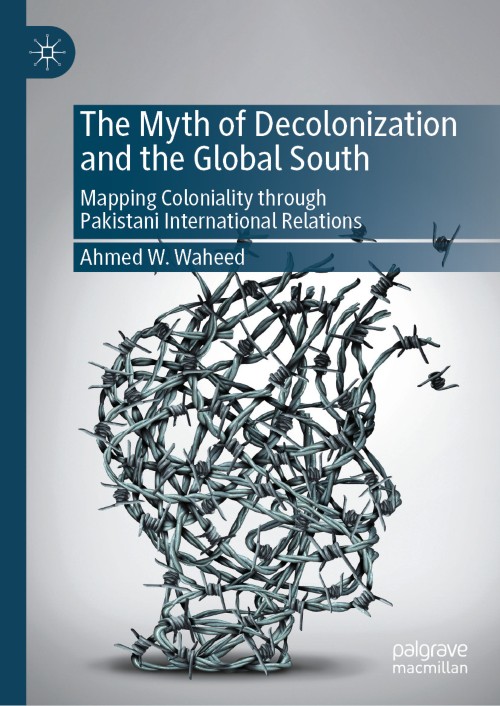
The Myth of Decolonization and the Global South [electronic resource] : Mapping Coloniality through Pakistani International Relations / by Ahmed W. Waheed.
Erişim Adresi
ISBN
9789819696543
Dil Kodu
İngilizce
Yer Numarası
DK/21562
Basım Bildirimi
1st ed. 2025.
Yayın Bilgisi
Singapore : Springer Nature Singapore : Imprint: Palgrave Macmillan, 2025.
Fiziksel Niteleme
XX, 251 p. 13 illus., 12 illus. in color. online resource.
İçindekiler Notu
Chapter 1: Introduction -- Chapter 2: The International Relations Discipline and the Coloniality of Knowledge and Power -- Chapter 3: Pakistani Social Sciences and International Relations: From Colonialism to Coloniality -- Chapter 4: Coloniality of Knowledge and Pakistani International Relations: Mental Captivity and Higher Eductaion -- Chapter 5: Coloniality and Militarization of Pakistani International Relations: Neoliberal Education and Militarized Knowledge -- Chapter 6: Conclusion: A Commentary on Pakistan’s Decolonial Future.
Özet, vb.
“This work displays serious critical decolonial scholarship and erudition. What also distinguishes this important book is its elegant presentation…. It is not only a pleasure to read but an enlightening work. I have nothing but praise for it.” — Professor Sabelo J. Ndlovu-Gatsheni, Chair of Epistemologies of the Global South, University of Bayreuth, Germany “The Myth of Decolonization and the Global South is a searing work of critical deconstruction… A brilliant addition to the growing body of decolonial IR… Highly recommended.” — Professor Richard Jackson, Leading Thinker Chair in Peace Studies, The University of Otago, New Zealand “In focusing on how Pakistani international relations remain hostage to the coloniality of knowledge and power, Waheed skillfully shifts the point of reference of most international relations scholarship towards the Global South.” — Professor Manuela Boatcă, Head of School of the Global Studies Programme at the University of Freiburg, Germany “The Myth of Decolonization and the Global South brilliantly unpacks and analyses the epistemic conditions that shape the possibilities and the limitations of the decolonization agenda in International Relations beyond the West.” — Dr. Somdeep Sen, Associate Professor, Department of Social Sciences and Business, Roskilde University, Denmark This book explores the coloniality of power and knowledge in Pakistan through an examination of Pakistani International Relations. It not only unveils the hegemonic processes embedded within the western capitalist structures of knowledge production but also explores how the eurocentrism of International Relations in Pakistan is sustained and maintained through a coloniality of knowledge and power which is designed to promote western epistemologies and emulate western standards. This book, consequently, provides a view of epistemic oppression from below. Ahmed W. Waheed, Ph.D. (Queen Mary University of London) is the Executive Director of ROADS Initiative, Pakistan and an Honorary Research Fellow at the School of Policy and Global Affairs, City St. George’s University of London. He is the author of the books The Wrong Ally: Pakistan’s State Sovereignty under US Dependence and Constructing ‘Pakistan’ through Knowledge Production in International Relations and Area Studies.
Konu
International relations.
Asia __ Politics and government.
Imperialism.
World politics.
Political sociology.
Political science __ Study and teaching.
International Relations Theory.
Asian Politics.
Imperialism and Colonialism.
Political History.
Political Sociology.
Political Education.
Asia __ Politics and government.
Imperialism.
World politics.
Political sociology.
Political science __ Study and teaching.
International Relations Theory.
Asian Politics.
Imperialism and Colonialism.
Political History.
Political Sociology.
Political Education.
Kurum Adı
Eseri Alıntıla
Referansları kullanmadan önce gözden geçirmeniz ve varsa gerekli düzeltmeleri yapmanız önerilir.
Dijital Kaynak
MARC Görünümü
LEADER 06321nam a22006975i 4500
001 820355
003 TR_AnAIT
005 20260130170252
007 cr nn 008mamaa
008 250926s2025 si | s |||| 0|eng d
020 |a9789819696543|9978-981-96-9654-3
024 7 |a10.1007/978-981-96-9654-3|2doi
041 |aeng
049 |aTürk Tarih Kurumu Kütüphanesi
050 4|aJZ2-6530
072 7|aJPS|2bicssc
072 7|aPOL011000|2bisacsh
072 7|aJPS|2thema
082 04|a327.101|223
090 |aDK/21562
100 1 |aWaheed, Ahmed W.|eauthor.|0(orcid)0000-0002-3591-0771|1https://orcid.org/0000-0002-3591-0771|4aut|4http://id.loc.gov/vocabulary/relators/aut
245 14|aThe Myth of Decolonization and the Global South|h[electronic resource] :|bMapping Coloniality through Pakistani International Relations /|cby Ahmed W. Waheed.
250 |a1st ed. 2025.
264 1|aSingapore :|bSpringer Nature Singapore :|bImprint: Palgrave Macmillan,|c2025.
300 |aXX, 251 p. 13 illus., 12 illus. in color.|bonline resource.
336 |atext|btxt|2rdacontent
337 |acomputer|bc|2rdamedia
338 |aonline resource|bcr|2rdacarrier
341 0 |bPDF/UA-1|2onix
341 0 |bTable of contents navigation|2onix
341 0 |bSingle logical reading order|2onix
341 0 |bShort alternative textual descriptions|2onix
341 0 |bUse of color is not sole means of conveying information|2onix
341 0 |bUse of high contrast between text and background color|2onix
341 0 |bNext / Previous structural navigation|2onix
341 0 |bAll non-decorative content supports reading without sight|2onix
347 |atext file|bPDF|2rda
505 0 |aChapter 1: Introduction -- Chapter 2: The International Relations Discipline and the Coloniality of Knowledge and Power -- Chapter 3: Pakistani Social Sciences and International Relations: From Colonialism to Coloniality -- Chapter 4: Coloniality of Knowledge and Pakistani International Relations: Mental Captivity and Higher Eductaion -- Chapter 5: Coloniality and Militarization of Pakistani International Relations: Neoliberal Education and Militarized Knowledge -- Chapter 6: Conclusion: A Commentary on Pakistan’s Decolonial Future.
520 |a “This work displays serious critical decolonial scholarship and erudition. What also distinguishes this important book is its elegant presentation…. It is not only a pleasure to read but an enlightening work. I have nothing but praise for it.” — Professor Sabelo J. Ndlovu-Gatsheni, Chair of Epistemologies of the Global South, University of Bayreuth, Germany “The Myth of Decolonization and the Global South is a searing work of critical deconstruction… A brilliant addition to the growing body of decolonial IR… Highly recommended.” — Professor Richard Jackson, Leading Thinker Chair in Peace Studies, The University of Otago, New Zealand “In focusing on how Pakistani international relations remain hostage to the coloniality of knowledge and power, Waheed skillfully shifts the point of reference of most international relations scholarship towards the Global South.” — Professor Manuela Boatcă, Head of School of the Global Studies Programme at the University of Freiburg, Germany “The Myth of Decolonization and the Global South brilliantly unpacks and analyses the epistemic conditions that shape the possibilities and the limitations of the decolonization agenda in International Relations beyond the West.” — Dr. Somdeep Sen, Associate Professor, Department of Social Sciences and Business, Roskilde University, Denmark This book explores the coloniality of power and knowledge in Pakistan through an examination of Pakistani International Relations. It not only unveils the hegemonic processes embedded within the western capitalist structures of knowledge production but also explores how the eurocentrism of International Relations in Pakistan is sustained and maintained through a coloniality of knowledge and power which is designed to promote western epistemologies and emulate western standards. This book, consequently, provides a view of epistemic oppression from below. Ahmed W. Waheed, Ph.D. (Queen Mary University of London) is the Executive Director of ROADS Initiative, Pakistan and an Honorary Research Fellow at the School of Policy and Global Affairs, City St. George’s University of London. He is the author of the books The Wrong Ally: Pakistan’s State Sovereignty under US Dependence and Constructing ‘Pakistan’ through Knowledge Production in International Relations and Area Studies.
532 8 |aAccessibility summary: This PDF has been created in accordance with the PDF/UA-1 standard to enhance accessibility, including screen reader support, described non-text content (images, graphs), bookmarks for easy navigation, keyboard-friendly links and forms and searchable, selectable text. We recognize the importance of accessibility, and we welcome queries about accessibility for any of our products. If you have a question or an access need, please get in touch with us at accessibilitysupport@springernature.com. Please note that a more accessible version of this eBook is available as ePub.
532 8 |aNo reading system accessibility options actively disabled
532 8 |aPublisher contact for further accessibility information: accessibilitysupport@springernature.com
650 0|aInternational relations.
650 0|aAsia|xPolitics and government.
650 0|aImperialism.
650 0|aWorld politics.
650 0|aPolitical sociology.
650 0|aPolitical science|xStudy and teaching.
650 14|aInternational Relations Theory.
650 24|aAsian Politics.
650 24|aImperialism and Colonialism.
650 24|aPolitical History.
650 24|aPolitical Sociology.
650 24|aPolitical Education.
710 2 |aSpringerLink (Online service)
773 0 |tSpringer Nature eBook
776 08|iPrinted edition:|z9789819696536
776 08|iPrinted edition:|z9789819696550
776 08|iPrinted edition:|z9789819696567
856 40|uhttps://doi.org/10.1007/978-981-96-9654-3
912 |aZDB-2-POS
912 |aZDB-2-SXPI
950 |aPolitical Science and International Studies (SpringerNature-41174)
950 |aPolitical Science and International Studies (R0) (SpringerNature-43724)
001 820355
003 TR_AnAIT
005 20260130170252
007 cr nn 008mamaa
008 250926s2025 si | s |||| 0|eng d
020 |a9789819696543|9978-981-96-9654-3
024 7 |a10.1007/978-981-96-9654-3|2doi
041 |aeng
049 |aTürk Tarih Kurumu Kütüphanesi
050 4|aJZ2-6530
072 7|aJPS|2bicssc
072 7|aPOL011000|2bisacsh
072 7|aJPS|2thema
082 04|a327.101|223
090 |aDK/21562
100 1 |aWaheed, Ahmed W.|eauthor.|0(orcid)0000-0002-3591-0771|1https://orcid.org/0000-0002-3591-0771|4aut|4http://id.loc.gov/vocabulary/relators/aut
245 14|aThe Myth of Decolonization and the Global South|h[electronic resource] :|bMapping Coloniality through Pakistani International Relations /|cby Ahmed W. Waheed.
250 |a1st ed. 2025.
264 1|aSingapore :|bSpringer Nature Singapore :|bImprint: Palgrave Macmillan,|c2025.
300 |aXX, 251 p. 13 illus., 12 illus. in color.|bonline resource.
336 |atext|btxt|2rdacontent
337 |acomputer|bc|2rdamedia
338 |aonline resource|bcr|2rdacarrier
341 0 |bPDF/UA-1|2onix
341 0 |bTable of contents navigation|2onix
341 0 |bSingle logical reading order|2onix
341 0 |bShort alternative textual descriptions|2onix
341 0 |bUse of color is not sole means of conveying information|2onix
341 0 |bUse of high contrast between text and background color|2onix
341 0 |bNext / Previous structural navigation|2onix
341 0 |bAll non-decorative content supports reading without sight|2onix
347 |atext file|bPDF|2rda
505 0 |aChapter 1: Introduction -- Chapter 2: The International Relations Discipline and the Coloniality of Knowledge and Power -- Chapter 3: Pakistani Social Sciences and International Relations: From Colonialism to Coloniality -- Chapter 4: Coloniality of Knowledge and Pakistani International Relations: Mental Captivity and Higher Eductaion -- Chapter 5: Coloniality and Militarization of Pakistani International Relations: Neoliberal Education and Militarized Knowledge -- Chapter 6: Conclusion: A Commentary on Pakistan’s Decolonial Future.
520 |a “This work displays serious critical decolonial scholarship and erudition. What also distinguishes this important book is its elegant presentation…. It is not only a pleasure to read but an enlightening work. I have nothing but praise for it.” — Professor Sabelo J. Ndlovu-Gatsheni, Chair of Epistemologies of the Global South, University of Bayreuth, Germany “The Myth of Decolonization and the Global South is a searing work of critical deconstruction… A brilliant addition to the growing body of decolonial IR… Highly recommended.” — Professor Richard Jackson, Leading Thinker Chair in Peace Studies, The University of Otago, New Zealand “In focusing on how Pakistani international relations remain hostage to the coloniality of knowledge and power, Waheed skillfully shifts the point of reference of most international relations scholarship towards the Global South.” — Professor Manuela Boatcă, Head of School of the Global Studies Programme at the University of Freiburg, Germany “The Myth of Decolonization and the Global South brilliantly unpacks and analyses the epistemic conditions that shape the possibilities and the limitations of the decolonization agenda in International Relations beyond the West.” — Dr. Somdeep Sen, Associate Professor, Department of Social Sciences and Business, Roskilde University, Denmark This book explores the coloniality of power and knowledge in Pakistan through an examination of Pakistani International Relations. It not only unveils the hegemonic processes embedded within the western capitalist structures of knowledge production but also explores how the eurocentrism of International Relations in Pakistan is sustained and maintained through a coloniality of knowledge and power which is designed to promote western epistemologies and emulate western standards. This book, consequently, provides a view of epistemic oppression from below. Ahmed W. Waheed, Ph.D. (Queen Mary University of London) is the Executive Director of ROADS Initiative, Pakistan and an Honorary Research Fellow at the School of Policy and Global Affairs, City St. George’s University of London. He is the author of the books The Wrong Ally: Pakistan’s State Sovereignty under US Dependence and Constructing ‘Pakistan’ through Knowledge Production in International Relations and Area Studies.
532 8 |aAccessibility summary: This PDF has been created in accordance with the PDF/UA-1 standard to enhance accessibility, including screen reader support, described non-text content (images, graphs), bookmarks for easy navigation, keyboard-friendly links and forms and searchable, selectable text. We recognize the importance of accessibility, and we welcome queries about accessibility for any of our products. If you have a question or an access need, please get in touch with us at accessibilitysupport@springernature.com. Please note that a more accessible version of this eBook is available as ePub.
532 8 |aNo reading system accessibility options actively disabled
532 8 |aPublisher contact for further accessibility information: accessibilitysupport@springernature.com
650 0|aInternational relations.
650 0|aAsia|xPolitics and government.
650 0|aImperialism.
650 0|aWorld politics.
650 0|aPolitical sociology.
650 0|aPolitical science|xStudy and teaching.
650 14|aInternational Relations Theory.
650 24|aAsian Politics.
650 24|aImperialism and Colonialism.
650 24|aPolitical History.
650 24|aPolitical Sociology.
650 24|aPolitical Education.
710 2 |aSpringerLink (Online service)
773 0 |tSpringer Nature eBook
776 08|iPrinted edition:|z9789819696536
776 08|iPrinted edition:|z9789819696550
776 08|iPrinted edition:|z9789819696567
856 40|uhttps://doi.org/10.1007/978-981-96-9654-3
912 |aZDB-2-POS
912 |aZDB-2-SXPI
950 |aPolitical Science and International Studies (SpringerNature-41174)
950 |aPolitical Science and International Studies (R0) (SpringerNature-43724)
Materyaller
Depodan talep edilen materyal sadece kütüphane içerisinde kullanılmaktadır.
Materyal dışarıya ödünç verilmemektedir.
Materyal dışarıya ödünç verilmemektedir.
