

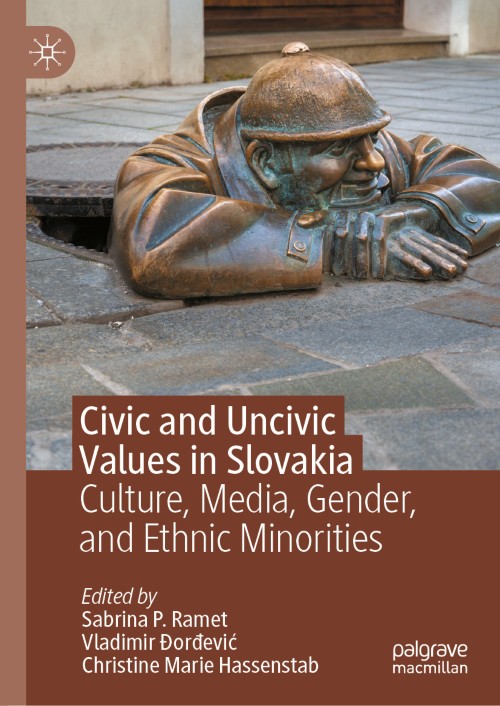
Civic and Uncivic Values in Slovakia [electronic resource] : Culture, Media, Gender, and Ethnic Minorities / edited by Sabrina P. Ramet, Vladimir Ðorđević, Christine Marie Hassenstab.
Erişim Adresi
ISBN
9783031935749
Dil Kodu
İngilizce
Yer Numarası
DK/21638
Basım Bildirimi
1st ed. 2025.
Yayın Bilgisi
Cham : Springer Nature Switzerland : Imprint: Palgrave Macmillan, 2025.
Fiziksel Niteleme
XXIV, 344 p. 22 illus. online resource.
İçindekiler Notu
PART ONE –VALUES & THE SYSTEM -- 1. From the Enlightenment to the Universal Declaration to the EU Charter: Civic/Liberal Values and how they are reflected in Slovak law and practice (An Introduction) – Sabrina P. Ramet -- 2. Values – Jozef Zagrapan -- 3. Politics – Elisabeth Bakke -- 4. Religion and Civic values in Slovakia – Aliaksei Kazharski and Michaela Grančayová -- PART TWO – EDUCATION, MEDIA, & CULTURE Media – L’ubomir Bajanik -- 6. History Textbooks – Juraj Marušiak -- 7. Slovak literature – Radoslav Passia -- PART THREE– GENDER AND CIVIL SOCIETY -- 8. Tolerance & intolerance of sexual minorities -- 9. Feminism in Slovakia – Sharon Wolchik -- 10. Slovakia’s challenges with ethnic minorities and immigrants – Karen Henderson -- 11. The Hungarian minority in Slovakia – Tereza Juhászová -- 12. Civic Culture & Democratic Stability – Conclusion: Vladimir Ðorđević.
Özet, vb.
“The essays gathered in this collection offer a nuanced and insightful exploration of how values—civic, national, liberal, and illiberal—are shaped, contested, and deployed in contemporary Slovak society. The volume combines impressive breadth—from analyses of populist rhetoric to examinations of feminism, Roma exclusion, and civic culture—with scholarly rigour and deep familiarity with the subject. Collectively, these contributions provide a timely and richly contextualized understanding of Slovakia's evolving democratic landscape.” —James Krapfl, McGill University, Canada Like other countries in East Central Europe, the Slovak Republic is facing new challenges which were not on the horizon at the time the communist system collapsed and there are worries that this country, with the pro-Russian Prime Minister Robert Fico now at the helm, might be at risk of democratic backsliding. One of the key factors determining whether Slovakia will weather its current political difficulties or slide away from democracy is the strength of civic values such as tolerance, respect for the equality of people, and readiness to play by the rules of the political game. This book looks at the record of the Slovak Republic in the years since 1993, taking into consideration politics, values as reflected in public opinion surveys, gender inequality, and the values communicated in literature, religion, and film. In addition, the volume takes a look at ethnic minorities, focusing especially on Slovakia’s Hungarian minority. Sabrina P. Ramet is a Professor Emerita in the Department of Sociology & Political Science at the Norwegian University of Science & Technology (NTNU), Norway. Vladimir Ðorđević is an Associate Professor in the Department of Security Studies, Faculty of Security Management, Police Academy of the Czech Republic, Prague, Czech Republic. Christine Marie Hassenstab is a retired attorney who has also worked as an Adviser in the EU Grants Office at the Norwegian University of Science & Technology (NTNU), in Trondheim, Norway. She earned her Ph.D. in Sociology at NTNU in 2010.
Konu
Europe __ Politics and government.
Comparative government.
International relations.
Identity politics.
Elections.
European Politics.
Comparative Politics.
International Relations.
Identity Politics.
Electoral Politics.
Comparative government.
International relations.
Identity politics.
Elections.
European Politics.
Comparative Politics.
International Relations.
Identity Politics.
Electoral Politics.
Kurum Adı
Eseri Alıntıla
Referansları kullanmadan önce gözden geçirmeniz ve varsa gerekli düzeltmeleri yapmanız önerilir.
Dijital Kaynak
MARC Görünümü
LEADER 06538nam a22007095i 4500
001 820431
003 TR_AnAIT
005 20260130165958
007 cr nn 008mamaa
008 251124s2025 sz | s |||| 0|eng d
020 |a9783031935749|9978-3-031-93574-9
024 7 |a10.1007/978-3-031-93574-9|2doi
041 |aeng
049 |aTürk Tarih Kurumu Kütüphanesi
050 4|aJN1-9692.2
072 7|aJP|2bicssc
072 7|a1D|2bicssc
072 7|aPOL058000|2bisacsh
072 7|aJP|x1D|2thema
082 04|a320.94|223
090 |aDK/21638
245 10|aCivic and Uncivic Values in Slovakia|h[electronic resource] :|bCulture, Media, Gender, and Ethnic Minorities /|cedited by Sabrina P. Ramet, Vladimir Ðorđević, Christine Marie Hassenstab.
250 |a1st ed. 2025.
264 1|aCham :|bSpringer Nature Switzerland :|bImprint: Palgrave Macmillan,|c2025.
300 |aXXIV, 344 p. 22 illus.|bonline resource.
336 |atext|btxt|2rdacontent
337 |acomputer|bc|2rdamedia
338 |aonline resource|bcr|2rdacarrier
341 0 |bPDF/UA-1|2onix
341 0 |bTable of contents navigation|2onix
341 0 |bSingle logical reading order|2onix
341 0 |bShort alternative textual descriptions|2onix
341 0 |bUse of color is not sole means of conveying information|2onix
341 0 |bUse of high contrast between text and background color|2onix
341 0 |bNext / Previous structural navigation|2onix
341 0 |bAll non-decorative content supports reading without sight|2onix
347 |atext file|bPDF|2rda
505 0 |aPART ONE –VALUES & THE SYSTEM -- 1. From the Enlightenment to the Universal Declaration to the EU Charter: Civic/Liberal Values and how they are reflected in Slovak law and practice (An Introduction) – Sabrina P. Ramet -- 2. Values – Jozef Zagrapan -- 3. Politics – Elisabeth Bakke -- 4. Religion and Civic values in Slovakia – Aliaksei Kazharski and Michaela Grančayová -- PART TWO – EDUCATION, MEDIA, & CULTURE Media – L’ubomir Bajanik -- 6. History Textbooks – Juraj Marušiak -- 7. Slovak literature – Radoslav Passia -- PART THREE– GENDER AND CIVIL SOCIETY -- 8. Tolerance & intolerance of sexual minorities -- 9. Feminism in Slovakia – Sharon Wolchik -- 10. Slovakia’s challenges with ethnic minorities and immigrants – Karen Henderson -- 11. The Hungarian minority in Slovakia – Tereza Juhászová -- 12. Civic Culture & Democratic Stability – Conclusion: Vladimir Ðorđević.
520 |a“The essays gathered in this collection offer a nuanced and insightful exploration of how values—civic, national, liberal, and illiberal—are shaped, contested, and deployed in contemporary Slovak society. The volume combines impressive breadth—from analyses of populist rhetoric to examinations of feminism, Roma exclusion, and civic culture—with scholarly rigour and deep familiarity with the subject. Collectively, these contributions provide a timely and richly contextualized understanding of Slovakia's evolving democratic landscape.” —James Krapfl, McGill University, Canada Like other countries in East Central Europe, the Slovak Republic is facing new challenges which were not on the horizon at the time the communist system collapsed and there are worries that this country, with the pro-Russian Prime Minister Robert Fico now at the helm, might be at risk of democratic backsliding. One of the key factors determining whether Slovakia will weather its current political difficulties or slide away from democracy is the strength of civic values such as tolerance, respect for the equality of people, and readiness to play by the rules of the political game. This book looks at the record of the Slovak Republic in the years since 1993, taking into consideration politics, values as reflected in public opinion surveys, gender inequality, and the values communicated in literature, religion, and film. In addition, the volume takes a look at ethnic minorities, focusing especially on Slovakia’s Hungarian minority. Sabrina P. Ramet is a Professor Emerita in the Department of Sociology & Political Science at the Norwegian University of Science & Technology (NTNU), Norway. Vladimir Ðorđević is an Associate Professor in the Department of Security Studies, Faculty of Security Management, Police Academy of the Czech Republic, Prague, Czech Republic. Christine Marie Hassenstab is a retired attorney who has also worked as an Adviser in the EU Grants Office at the Norwegian University of Science & Technology (NTNU), in Trondheim, Norway. She earned her Ph.D. in Sociology at NTNU in 2010.
532 8 |aAccessibility summary: This PDF has been created in accordance with the PDF/UA-1 standard to enhance accessibility, including screen reader support, described non-text content (images, graphs), bookmarks for easy navigation, keyboard-friendly links and forms and searchable, selectable text. We recognize the importance of accessibility, and we welcome queries about accessibility for any of our products. If you have a question or an access need, please get in touch with us at accessibilitysupport@springernature.com. Please note that a more accessible version of this eBook is available as ePub.
532 8 |aNo reading system accessibility options actively disabled
532 8 |aPublisher contact for further accessibility information: accessibilitysupport@springernature.com
650 0|aEurope|xPolitics and government.
650 0|aComparative government.
650 0|aInternational relations.
650 0|aIdentity politics.
650 0|aElections.
650 14|aEuropean Politics.
650 24|aComparative Politics.
650 24|aInternational Relations.
650 24|aIdentity Politics.
650 24|aElectoral Politics.
700 1 |aRamet, Sabrina P.|eeditor.|4edt|4http://id.loc.gov/vocabulary/relators/edt
700 1 |aÐorđević, Vladimir.|eeditor.|4edt|4http://id.loc.gov/vocabulary/relators/edt
700 1 |aHassenstab, Christine Marie.|eeditor.|4edt|4http://id.loc.gov/vocabulary/relators/edt
710 2 |aSpringerLink (Online service)
773 0 |tSpringer Nature eBook
776 08|iPrinted edition:|z9783031935732
776 08|iPrinted edition:|z9783031935756
776 08|iPrinted edition:|z9783031935763
856 40|uhttps://doi.org/10.1007/978-3-031-93574-9
912 |aZDB-2-POS
912 |aZDB-2-SXPI
950 |aPolitical Science and International Studies (SpringerNature-41174)
950 |aPolitical Science and International Studies (R0) (SpringerNature-43724)
001 820431
003 TR_AnAIT
005 20260130165958
007 cr nn 008mamaa
008 251124s2025 sz | s |||| 0|eng d
020 |a9783031935749|9978-3-031-93574-9
024 7 |a10.1007/978-3-031-93574-9|2doi
041 |aeng
049 |aTürk Tarih Kurumu Kütüphanesi
050 4|aJN1-9692.2
072 7|aJP|2bicssc
072 7|a1D|2bicssc
072 7|aPOL058000|2bisacsh
072 7|aJP|x1D|2thema
082 04|a320.94|223
090 |aDK/21638
245 10|aCivic and Uncivic Values in Slovakia|h[electronic resource] :|bCulture, Media, Gender, and Ethnic Minorities /|cedited by Sabrina P. Ramet, Vladimir Ðorđević, Christine Marie Hassenstab.
250 |a1st ed. 2025.
264 1|aCham :|bSpringer Nature Switzerland :|bImprint: Palgrave Macmillan,|c2025.
300 |aXXIV, 344 p. 22 illus.|bonline resource.
336 |atext|btxt|2rdacontent
337 |acomputer|bc|2rdamedia
338 |aonline resource|bcr|2rdacarrier
341 0 |bPDF/UA-1|2onix
341 0 |bTable of contents navigation|2onix
341 0 |bSingle logical reading order|2onix
341 0 |bShort alternative textual descriptions|2onix
341 0 |bUse of color is not sole means of conveying information|2onix
341 0 |bUse of high contrast between text and background color|2onix
341 0 |bNext / Previous structural navigation|2onix
341 0 |bAll non-decorative content supports reading without sight|2onix
347 |atext file|bPDF|2rda
505 0 |aPART ONE –VALUES & THE SYSTEM -- 1. From the Enlightenment to the Universal Declaration to the EU Charter: Civic/Liberal Values and how they are reflected in Slovak law and practice (An Introduction) – Sabrina P. Ramet -- 2. Values – Jozef Zagrapan -- 3. Politics – Elisabeth Bakke -- 4. Religion and Civic values in Slovakia – Aliaksei Kazharski and Michaela Grančayová -- PART TWO – EDUCATION, MEDIA, & CULTURE Media – L’ubomir Bajanik -- 6. History Textbooks – Juraj Marušiak -- 7. Slovak literature – Radoslav Passia -- PART THREE– GENDER AND CIVIL SOCIETY -- 8. Tolerance & intolerance of sexual minorities -- 9. Feminism in Slovakia – Sharon Wolchik -- 10. Slovakia’s challenges with ethnic minorities and immigrants – Karen Henderson -- 11. The Hungarian minority in Slovakia – Tereza Juhászová -- 12. Civic Culture & Democratic Stability – Conclusion: Vladimir Ðorđević.
520 |a“The essays gathered in this collection offer a nuanced and insightful exploration of how values—civic, national, liberal, and illiberal—are shaped, contested, and deployed in contemporary Slovak society. The volume combines impressive breadth—from analyses of populist rhetoric to examinations of feminism, Roma exclusion, and civic culture—with scholarly rigour and deep familiarity with the subject. Collectively, these contributions provide a timely and richly contextualized understanding of Slovakia's evolving democratic landscape.” —James Krapfl, McGill University, Canada Like other countries in East Central Europe, the Slovak Republic is facing new challenges which were not on the horizon at the time the communist system collapsed and there are worries that this country, with the pro-Russian Prime Minister Robert Fico now at the helm, might be at risk of democratic backsliding. One of the key factors determining whether Slovakia will weather its current political difficulties or slide away from democracy is the strength of civic values such as tolerance, respect for the equality of people, and readiness to play by the rules of the political game. This book looks at the record of the Slovak Republic in the years since 1993, taking into consideration politics, values as reflected in public opinion surveys, gender inequality, and the values communicated in literature, religion, and film. In addition, the volume takes a look at ethnic minorities, focusing especially on Slovakia’s Hungarian minority. Sabrina P. Ramet is a Professor Emerita in the Department of Sociology & Political Science at the Norwegian University of Science & Technology (NTNU), Norway. Vladimir Ðorđević is an Associate Professor in the Department of Security Studies, Faculty of Security Management, Police Academy of the Czech Republic, Prague, Czech Republic. Christine Marie Hassenstab is a retired attorney who has also worked as an Adviser in the EU Grants Office at the Norwegian University of Science & Technology (NTNU), in Trondheim, Norway. She earned her Ph.D. in Sociology at NTNU in 2010.
532 8 |aAccessibility summary: This PDF has been created in accordance with the PDF/UA-1 standard to enhance accessibility, including screen reader support, described non-text content (images, graphs), bookmarks for easy navigation, keyboard-friendly links and forms and searchable, selectable text. We recognize the importance of accessibility, and we welcome queries about accessibility for any of our products. If you have a question or an access need, please get in touch with us at accessibilitysupport@springernature.com. Please note that a more accessible version of this eBook is available as ePub.
532 8 |aNo reading system accessibility options actively disabled
532 8 |aPublisher contact for further accessibility information: accessibilitysupport@springernature.com
650 0|aEurope|xPolitics and government.
650 0|aComparative government.
650 0|aInternational relations.
650 0|aIdentity politics.
650 0|aElections.
650 14|aEuropean Politics.
650 24|aComparative Politics.
650 24|aInternational Relations.
650 24|aIdentity Politics.
650 24|aElectoral Politics.
700 1 |aRamet, Sabrina P.|eeditor.|4edt|4http://id.loc.gov/vocabulary/relators/edt
700 1 |aÐorđević, Vladimir.|eeditor.|4edt|4http://id.loc.gov/vocabulary/relators/edt
700 1 |aHassenstab, Christine Marie.|eeditor.|4edt|4http://id.loc.gov/vocabulary/relators/edt
710 2 |aSpringerLink (Online service)
773 0 |tSpringer Nature eBook
776 08|iPrinted edition:|z9783031935732
776 08|iPrinted edition:|z9783031935756
776 08|iPrinted edition:|z9783031935763
856 40|uhttps://doi.org/10.1007/978-3-031-93574-9
912 |aZDB-2-POS
912 |aZDB-2-SXPI
950 |aPolitical Science and International Studies (SpringerNature-41174)
950 |aPolitical Science and International Studies (R0) (SpringerNature-43724)
Materyaller
Depodan talep edilen materyal sadece kütüphane içerisinde kullanılmaktadır.
Materyal dışarıya ödünç verilmemektedir.
Materyal dışarıya ödünç verilmemektedir.
