LEADER 04317nam a22005655i 4500
001 820439
003 TR_AnAIT
005 20260130165944
007 cr nn 008mamaa
008 251113s2025 sz | s |||| 0|eng d
020 |a9783032027863|9978-3-032-02786-3
024 7 |a10.1007/978-3-032-02786-3|2doi
041 |aeng
049 |aTürk Tarih Kurumu Kütüphanesi
050 4|aJC11-607
072 7|aJPA|2bicssc
072 7|aPOL010000|2bisacsh
072 7|aJPA|2thema
082 04|a320.01|223
090 |aDK/21646
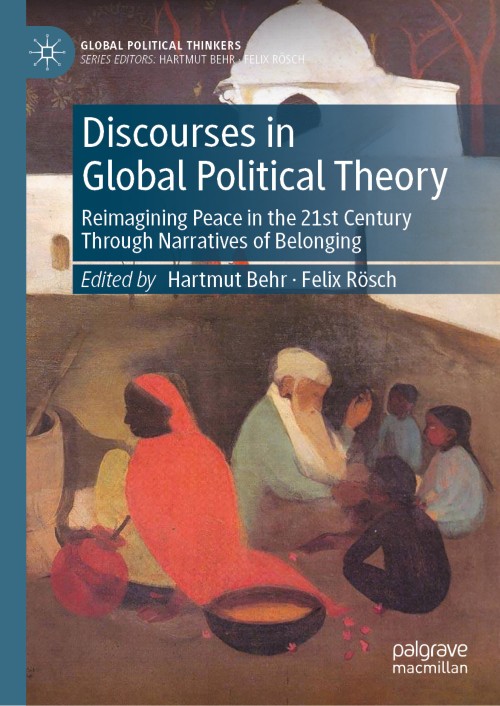
245 10|aDiscourses in Global Political Theory|h[electronic resource] :|bReimagining Peace in the 21st Century Through Narratives of Belonging /|cedited by Hartmut Behr, Felix Rösch.
250 |a1st ed. 2025.
264 1|aCham :|bSpringer Nature Switzerland :|bImprint: Palgrave Macmillan,|c2025.
300 |aXII, 212 p. 3 illus., 2 illus. in color.|bonline resource.
336 |atext|btxt|2rdacontent
337 |acomputer|bc|2rdamedia
338 |aonline resource|bcr|2rdacarrier
347 |atext file|bPDF|2rda
490 1 |aGlobal Political Thinkers,|x2946-3882
505 0 |aChapter 1: Introduction: Narratives of Belonging and Peace. Interrelations between Ontological-Epistemological Observations and Narrative Methodology -- Chapter 2: Peace and Belonging in Aboriginal Australia : A Political “Cosmography” -- Chapter 3: A Confucian Approach to Love and Peace: Benevolence and Solidarity in the Politics of Belonging -- Chapter 4: Peace, Liminality, and Discourses of Identity in Central European Late Modernity -- Chapter 5: Born of the Earth: Autochthony in the Colonial and Decolonial Struggles of the Caucasus -- Chapter 6: Beyond Identity? Narratives of Belonging and Peace in South Asia -- Chapter 7: Transcending Boundaries for Peace: Pluralist Theology, Shūsaku Endō , and Global IR -- Chapter 8: Hermeneutics of Suspicion: Social Emancipation and the Decolonization of Knowledge in -- Chapter 9: Peacebuilding or Excluding Others: Rethinking Cultural Institutions’ Roles Focusing on UNESCO's Intangible Cultural Heritage List and Food Museums in East Asia.
520 |aThis book traces narratives of belonging around the globe from a political theory perspective. It highlights that such narratives have developed within the context of cultural exchange and relationality, i.e. transgressing space and time and embedded in relations between material and immaterial objects. These narratives are formed transculturally, forcing people to re-consider, re-negotiate, and re-evaluate their thoughts about community and belonging over time and often leading to changes and ruptures. In getting a deeper understanding of such exchanges of personal and intellectual constellations, this volume identifies potential anthropological constants in global thinking about belonging. Despite different linguistic, spatial, and cultural socialisations, trying to establish ways of living together that offer ontological security seems intrinsic to human life. Insights into what unites people, rather than divides them, might proof beneficial in finding ways for more sustainable peaceful human relations.
650 0|aPolitical science.
650 0|aPolitical anthropology.
650 0|aEconomic anthropology.
650 0|aComparative government.
650 0|aCultural policy.
650 14|aPolitical Theory.
650 24|aPolitical and Economic Anthropology.
650 24|aComparative Politics.
650 24|aCultural Policy and Politics.
700 1 |aBehr, Hartmut.|eeditor.|0(orcid)0000-0002-5935-6779|1https://orcid.org/0000-0002-5935-6779|4edt|4http://id.loc.gov/vocabulary/relators/edt
700 1 |aRösch, Felix.|eeditor.|0(orcid)0000-0002-6846-6195|1https://orcid.org/0000-0002-6846-6195|4edt|4http://id.loc.gov/vocabulary/relators/edt
710 2 |aSpringerLink (Online service)
773 0 |tSpringer Nature eBook
776 08|iPrinted edition:|z9783032027856
776 08|iPrinted edition:|z9783032027870
776 08|iPrinted edition:|z9783032027887
830 0|aGlobal Political Thinkers,|x2946-3882
856 40|uhttps://doi.org/10.1007/978-3-032-02786-3
912 |aZDB-2-POS
912 |aZDB-2-SXPI
950 |aPolitical Science and International Studies (SpringerNature-41174)
950 |aPolitical Science and International Studies (R0) (SpringerNature-43724)