LEADER 02351nam a22005295i 4500
001 821879
003 TR_AnAIT
005 20260130161623
007 cr nn 008mamaa
008 151222s2004 xxk| s |||| 0|eng d
020 |a9780230000896|9978-0-230-00089-6
024 7 |a10.1057/9780230000896|2doi
041 |aeng
049 |aTürk Tarih Kurumu Kütüphanesi
050 4|aJF1525.P6
072 7|aJPP|2bicssc
072 7|aPOL028000|2bisacsh
072 7|aJPP|2thema
082 04|a320.6|223
090 |aDK/23038
100 1 |aPerri, P.|eauthor.|4aut|4http://id.loc.gov/vocabulary/relators/aut
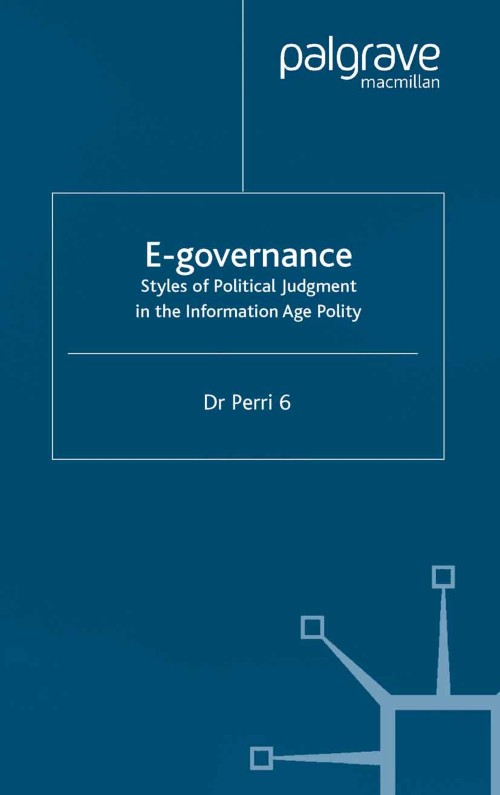
245 10|aE-Governance|h[electronic resource] :|bStyles of Political Judgment in the Information Age Polity /|cby P. Perri.
250 |a1st ed. 2004.
264 1|aLondon :|bPalgrave Macmillan UK :|bImprint: Palgrave Macmillan,|c2004.
300 |aXII, 238 p.|bonline resource.
336 |atext|btxt|2rdacontent
337 |acomputer|bc|2rdamedia
338 |aonline resource|bcr|2rdacarrier
347 |atext file|bPDF|2rda
520 |aThe e-governance revolution is said to be changing everything, but will all the modelling tools, electronic meeting management systems and online consultations really change political judgement in policy formation? Using case studies from local and federal government in the US and Europe, Perri 6 examines these claims and presents a new theory of how policymakers use and reject information and do and don't trust each other with information in using the new tools, before analyzing the implications for democracy.
650 0|aPolitical planning.
650 0|aComputer networks .
650 0|aManagement.
650 0|aEngineering.
650 0|aPolitical science.
650 14|aPublic Policy.
650 24|aComputer Communication Networks.
650 24|aManagement.
650 24|aTechnology and Engineering.
650 24|aPolitical Science.
710 2 |aSpringerLink (Online service)
773 0 |tSpringer Nature eBook
776 08|iPrinted edition:|z9781403912466
776 08|iPrinted edition:|z9781349511099
776 08|iPrinted edition:|z9781349511105
856 40|uhttps://doi.org/10.1057/9780230000896
912 |aZDB-2-PIS
912 |aZDB-2-SXPI
950 |aPalgrave Political & Intern. Studies Collection (SpringerNature-41143)
950 |aPolitical Science and International Studies (R0) (SpringerNature-43724)