LEADER 02288nam a22005655i 4500
001 821900
003 TR_AnAIT
005 20260130161600
007 cr nn 008mamaa
008 151118s2009 xxk| s |||| 0|eng d
020 |a9780230245297|9978-0-230-24529-7
024 7 |a10.1057/9780230245297|2doi
041 |aeng
049 |aTürk Tarih Kurumu Kütüphanesi
050 4|aJN1-9692.2
072 7|aJP|2bicssc
072 7|a1D|2bicssc
072 7|aPOL058000|2bisacsh
072 7|aJP|x1D|2thema
082 04|a320.94|223
090 |aDK/23057
100 1 |aSmith, P.|eauthor.|4aut|4http://id.loc.gov/vocabulary/relators/aut
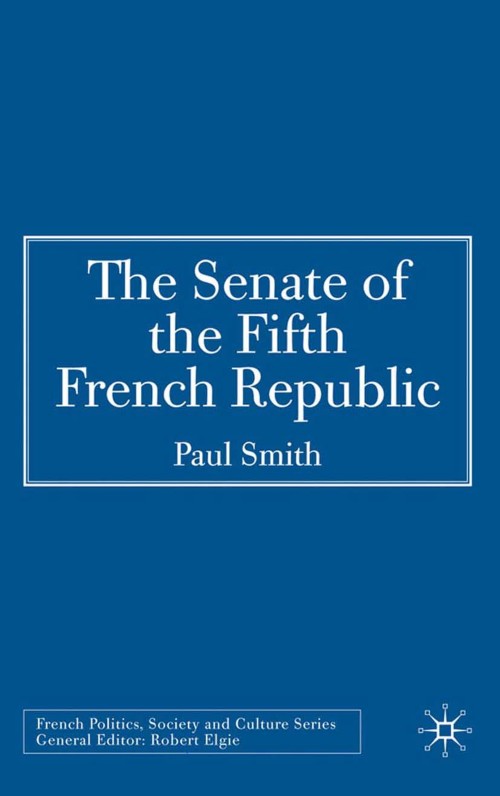
245 14|aThe Senate of the Fifth French Republic|h[electronic resource] /|cby P. Smith.
250 |a1st ed. 2009.
264 1|aLondon :|bPalgrave Macmillan UK :|bImprint: Palgrave Macmillan,|c2009.
300 |aXIV, 225 p.|bonline resource.
336 |atext|btxt|2rdacontent
337 |acomputer|bc|2rdamedia
338 |aonline resource|bcr|2rdacarrier
347 |atext file|bPDF|2rda
490 1 |aFrench Politics, Society and Culture,|x2946-3769
520 |aPaul Smith examines how the Senate has attempted, since 1958, to locate itself within the French (semi-) presidential system, how it asserts its place in relation to the President, Government and National Assembly and how it has sought, in recent years, to develop an autonomous and particular sense of identity.
650 0|aEurope|xPolitics and government.
650 0|aFrance|xHistory.
650 0|aPolitical science.
650 0|aEurope|xHistory.
650 0|aComparative government.
650 14|aEuropean Politics.
650 24|aHistory of France.
650 24|aPolitical Science.
650 24|aEuropean History.
650 24|aComparative Politics.
710 2 |aSpringerLink (Online service)
773 0 |tSpringer Nature eBook
776 08|iPrinted edition:|z9780230008113
776 08|iPrinted edition:|z9781349283743
776 08|iPrinted edition:|z9781349283750
830 0|aFrench Politics, Society and Culture,|x2946-3769
856 40|uhttps://doi.org/10.1057/9780230245297
912 |aZDB-2-PIS
912 |aZDB-2-SXPI
950 |aPalgrave Political & Intern. Studies Collection (SpringerNature-41143)
950 |aPolitical Science and International Studies (R0) (SpringerNature-43724)