LEADER 02332nam a22004935i 4500
001 822441
003 TR_AnAIT
005 20260130160118
007 cr nn 008mamaa
008 151007s2011 xxu| s |||| 0|eng d
020 |a9780230118157|9978-0-230-11815-7
024 7 |a10.1057/9780230118157|2doi
041 |aeng
049 |aTürk Tarih Kurumu Kütüphanesi
050 4|aJA1-92
072 7|aJPA|2bicssc
072 7|aPOL000000|2bisacsh
072 7|aJPA|2thema
082 04|a320|223
090 |aDK/23585
100 1 |aLevine, D.|eauthor.|4aut|4http://id.loc.gov/vocabulary/relators/aut
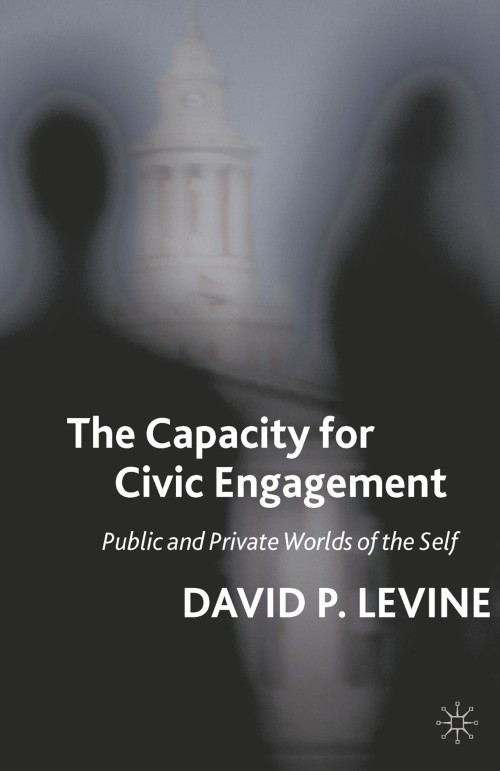
245 14|aThe Capacity for Civic Engagement|h[electronic resource] :|bPublic and Private Worlds of the Self /|cby D. Levine.
250 |a1st ed. 2011.
264 1|aNew York :|bPalgrave Macmillan US :|bImprint: Palgrave Macmillan,|c2011.
300 |aXI, 192 p.|bonline resource.
336 |atext|btxt|2rdacontent
337 |acomputer|bc|2rdamedia
338 |aonline resource|bcr|2rdacarrier
347 |atext file|bPDF|2rda
520 |aHow do we form a connection to the ideals and institutions of public life? This connection is sometimes expressed in the language of civic engagement, public service, and commitment to the public good. While we do not lack for literature to guide us in thinking about public life, we have less to call on when our problem is not only to explore public ideals and institutions, but also to consider the nature and origin of our capacity to make a connection with and find meaning in those institutions and ideals. Levine explores the nature and origin of this capacity to form a connection and find meaning.
650 0|aPolitical science.
650 0|aPolitical planning.
650 0|aPolitical sociology.
650 14|aPolitical Science.
650 24|aPublic Policy.
650 24|aPolitical Sociology.
650 24|aPolitical Theory.
710 2 |aSpringerLink (Online service)
773 0 |tSpringer Nature eBook
776 08|iPrinted edition:|z9780230102835
776 08|iPrinted edition:|z9781349287284
776 08|iPrinted edition:|z9781349287291
856 40|uhttps://doi.org/10.1057/9780230118157
912 |aZDB-2-PIS
912 |aZDB-2-SXPI
950 |aPalgrave Political & Intern. Studies Collection (SpringerNature-41143)
950 |aPolitical Science and International Studies (R0) (SpringerNature-43724)