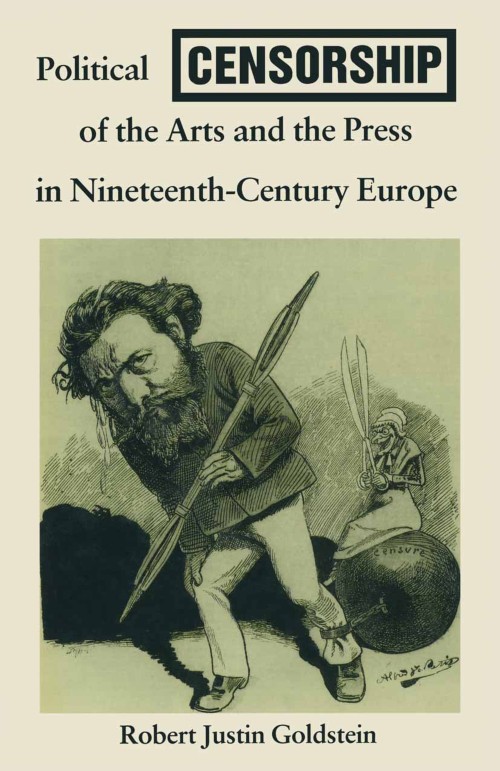
LEADER 03550nam a22005895i 4500
001 823278
003 TR_AnAIT
005 20260130152935
007 cr nn 008mamaa
008 151121s1989 xxk| s |||| 0|eng d
020 |a9781349201280|9978-1-349-20128-0
024 7 |a10.1007/978-1-349-20128-0|2doi
041 |aeng
049 |aTürk Tarih Kurumu Kütüphanesi
050 4|aJA1-92
072 7|aJPA|2bicssc
072 7|aPOL000000|2bisacsh
072 7|aJPA|2thema
082 04|a320|223
090 |aDK/24419
100 1 |aGoldstein, Robert Justin.|eauthor.|4aut|4http://id.loc.gov/vocabulary/relators/aut
245 10|aPolitical Censorship of the Arts and the Press in Nineteenth-Century|h[electronic resource] /|cby Robert Justin Goldstein.
250 |a1st ed. 1989.
264 1|aLondon :|bPalgrave Macmillan UK :|bImprint: Palgrave Macmillan,|c1989.
300 |aXX, 232 p.|bonline resource.
336 |atext|btxt|2rdacontent
337 |acomputer|bc|2rdamedia
338 |aonline resource|bcr|2rdacarrier
347 |atext file|bPDF|2rda
520 |aPolitical Censorship of the Arts and the Press in Nineteenth-Century Europe presents a comprehensive account of the attempts by authorities throughout Europe to stifle the growth of political opposition during the nineteenth-century by censoring newspapers, books, caricatures, plays, operas and film. Appeals for democracy and social reform were especially suspect to the authorities, so in Russia cookbooks which refered to 'free air' in ovens were censored as subversive, while in England in 1829 the censor struck from a play the remark that 'honest men at court don't take up much room'. While nineteenth-century European political censorship blocked the open circulation of much opposition writing and art, it never succeeded entirely in its aim since writers, artists and 'consumers' often evaded the censors by clandestine circulation of forbidden material and by the widely practised skill of 'reading between the lines'.
532 8 |aAccessibility summary: This PDF is not accessible. It is based on scanned pages and does not support features such as screen reader compatibility or described non-text content (images, graphs etc). However, it likely supports searchable and selectable text based on OCR (Optical Character Recognition). Users with accessibility needs may not be able to use this content effectively. Please contact us at accessibilitysupport@springernature.com if you require assistance or an alternative format.
532 8 |aInaccessible, or known limited accessibility
532 8 |aNo reading system accessibility options actively disabled
532 8 |aPublisher contact for further accessibility information: accessibilitysupport@springernature.com
650 0|aPolitical science.
650 0|aIndustries.
650 0|aArts.
650 0|aEurope|xHistory.
650 0|aHistory, Modern.
650 14|aPolitical Science.
650 24|aIndustries.
650 24|aArts.
650 24|aEuropean History.
650 24|aModern History.
710 2 |aSpringerLink (Online service)
773 0 |tSpringer Nature eBook
776 08|iPrinted edition:|z9780333463857
776 08|iPrinted edition:|z9780312024703
776 08|iPrinted edition:|z9781349201297
776 08|iPrinted edition:|z9781349201303
856 40|uhttps://doi.org/10.1007/978-1-349-20128-0
912 |aZDB-2-PIS
912 |aZDB-2-SXPI
950 |aPalgrave Political & Intern. Studies Collection (SpringerNature-41143)
950 |aPolitical Science and International Studies (R0) (SpringerNature-43724)