LEADER 02756nam a22005415i 4500
001 823421
003 TR_AnAIT
005 20260130152537
007 cr nn 008mamaa
008 151127s1999 xxu| s |||| 0|eng d
020 |a9780312299088|9978-0-312-29908-8
024 7 |a10.1057/9780312299088|2doi
041 |aeng
049 |aTürk Tarih Kurumu Kütüphanesi
050 4|aJN1-9692.2
072 7|aJP|2bicssc
072 7|a1D|2bicssc
072 7|aPOL058000|2bisacsh
072 7|aJP|x1D|2thema
082 04|a320.94|223
090 |aDK/24562
100 1 |aNichols, T.|eauthor.|4aut|4http://id.loc.gov/vocabulary/relators/aut
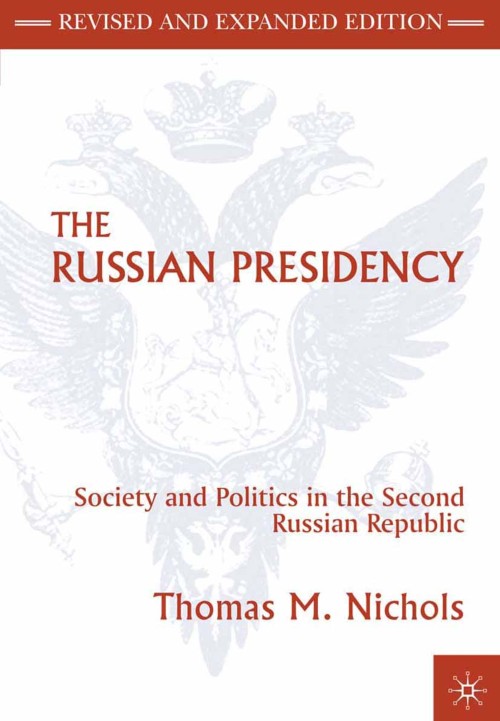
245 14|aThe Russian Presidency|h[electronic resource] :|bSociety and Politics in the Second Russian Republic /|cby T. Nichols.
250 |a1st ed. 1999.
264 1|aNew York :|bPalgrave Macmillan US :|bImprint: Palgrave Macmillan,|c1999.
300 |a224 p.|bonline resource.
336 |atext|btxt|2rdacontent
337 |acomputer|bc|2rdamedia
338 |aonline resource|bcr|2rdacarrier
347 |atext file|bPDF|2rda
520 |aWhy has Russian democracy apparently survived and even strengthened under a presidential system, when so many other presidential regimes have decayed into authoritarian rule? And what are the origins of presidential power in modern Russia? Thomas M. Nichols argues that the answer lies in the relationship between political institutions and trust: where society, and consequently politics, is fractious and divided, structural safeguards inherent in presidentialism actually serve to strengthen democratic behavior. The Russian presidency is not the cause of social turmoil in Russia, but rather a successful response to it. This book's emphasis on the social origins of Russian politics explains not only the unexpected survival of Russian democracy, but encourages a reconsideration of the relationship between institutions, social conditions, and democracy.
650 0|aEurope|xPolitics and government.
650 0|aPolitical science.
650 0|aHistory.
650 0|aRussia|xHistory.
650 0|aEurope, Eastern|xHistory.
650 0|aSoviet Union|xHistory.
650 14|aEuropean Politics.
650 24|aPolitical Science.
650 24|aHistory.
650 24|aRussian, Soviet, and East European History.
710 2 |aSpringerLink (Online service)
773 0 |tSpringer Nature eBook
776 08|iPrinted edition:|z9780333912935
776 08|iPrinted edition:|z9780312293376
776 08|iPrinted edition:|z9781349422708
856 40|uhttps://doi.org/10.1057/9780312299088
912 |aZDB-2-PIS
912 |aZDB-2-SXPI
950 |aPalgrave Political & Intern. Studies Collection (SpringerNature-41143)
950 |aPolitical Science and International Studies (R0) (SpringerNature-43724)