LEADER 03465nam a22006495i 4500
001 826442
003 TR_AnAIT
005 20260131074035
007 cr nn 008mamaa
008 151031s1988 xxk| s |||| 0|eng d
020 |a9781349195107|9978-1-349-19510-7
024 7 |a10.1007/978-1-349-19510-7|2doi
041 |aeng
049 |aTürk Tarih Kurumu Kütüphanesi
050 4|aJC479
072 7|aJKS|2bicssc
072 7|aPOL019000|2bisacsh
072 7|aJKS|2thema
082 04|a361.65|223
090 |aDK/27544
100 1 |aRiley, Denise.|eauthor.|4aut|4http://id.loc.gov/vocabulary/relators/aut
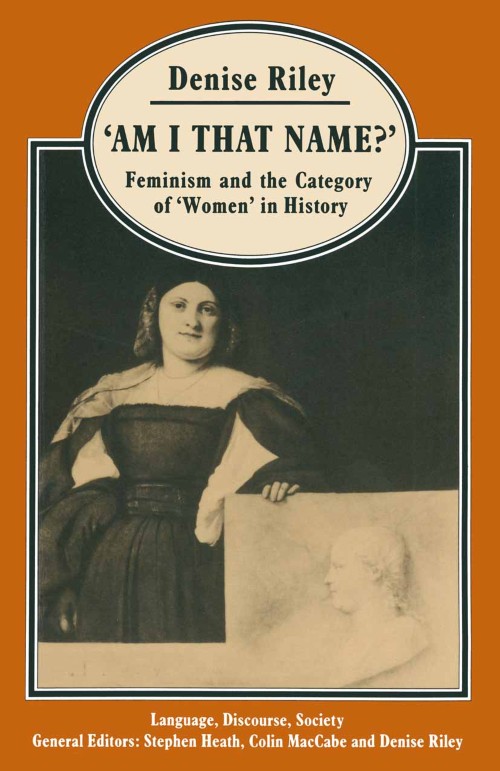
245 10|a‘Am I That Name?’|h[electronic resource] :|bFeminism and the Category of ‘Women’ in History /|cby Denise Riley.
250 |a1st ed. 1988.
264 1|aLondon :|bPalgrave Macmillan UK :|bImprint: Palgrave Macmillan,|c1988.
300 |aVI, 126 p.|bonline resource.
336 |atext|btxt|2rdacontent
337 |acomputer|bc|2rdamedia
338 |aonline resource|bcr|2rdacarrier
347 |atext file|bPDF|2rda
490 1 |aLanguage, Discourse, Society,|x2947-0196
520 |aWriting about changes in the notion of womanhood, Denise Riley examines, in the manner of Foucault, shifting historical constructions of the category of "women" in relation to other categories central to concepts of personhood: the soul, the mind, the body, nature, the social. Feminist movements, Riley argues, have had no choice but to play out this indeterminacy of women. This is made plain in their oscillations, since the 1790s, between concepts of equality and of difference. To fully recognize the ambiguity of the category of "women" is, she contends, a necessary condition for an effective feminist political philosophy.
532 8 |aAccessibility summary: This PDF is not accessible. It is based on scanned pages and does not support features such as screen reader compatibility or described non-text content (images, graphs etc). However, it likely supports searchable and selectable text based on OCR (Optical Character Recognition). Users with accessibility needs may not be able to use this content effectively. Please contact us at accessibilitysupport@springernature.com if you require assistance or an alternative format.
532 8 |aInaccessible, or known limited accessibility
532 8 |aNo reading system accessibility options actively disabled
532 8 |aPublisher contact for further accessibility information: accessibilitysupport@springernature.com
650 0|aWelfare state.
650 0|aLiterature|xPhilosophy.
650 0|aCulture|xStudy and teaching.
650 0|aEthnology.
650 0|aCulture.
650 0|aIntellectual life|xHistory.
650 0|aFeminism.
650 0|aFeminist theory.
650 14|aWelfare.
650 24|aLiterary Theory.
650 24|aCultural Theory.
650 24|aRegional Cultural Studies.
650 24|aIntellectual History.
650 24|aFeminism and Feminist Theory.
710 2 |aSpringerLink (Online service)
773 0 |tSpringer Nature eBook
776 08|iPrinted edition:|z9780333346129
776 08|iPrinted edition:|z9780333346136
776 08|iPrinted edition:|z9781349195114
830 0|aLanguage, Discourse, Society,|x2947-0196
856 40|uhttps://doi.org/10.1007/978-1-349-19510-7
912 |aZDB-2-PRE
912 |aZDB-2-SXPR
950 |aPalgrave Religion & Philosophy Collection (SpringerNature-41145)
950 |aPhilosophy and Religion (R0) (SpringerNature-43725)