LEADER 03351nam a22005415i 4500
001 826536
003 TR_AnAIT
005 20260131073202
007 cr nn 008mamaa
008 151204s1994 xxk| s |||| 0|eng d
020 |a9781349231584|9978-1-349-23158-4
024 7 |a10.1007/978-1-349-23158-4|2doi
041 |aeng
049 |aTürk Tarih Kurumu Kütüphanesi
050 4|aBJ1-1725
072 7|aHPQ|2bicssc
072 7|aPHI005000|2bisacsh
072 7|aQDTQ|2thema
082 04|a170|223
090 |aDK/27638
100 1 |aEmmet, Dorothy.|eauthor.|4aut|4http://id.loc.gov/vocabulary/relators/aut
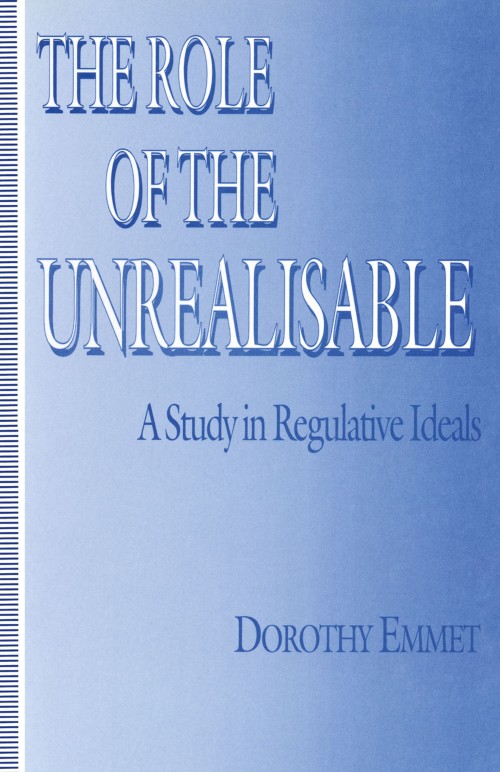
245 10|aRole Of The Unrealisable|h[electronic resource] :|bA Study In Regulative Ideals /|cby Dorothy Emmet.
250 |a1st ed. 1994.
264 1|aLondon :|bPalgrave Macmillan UK :|bImprint: Palgrave Macmillan,|c1994.
300 |aX, 134 p.|bonline resource.
336 |atext|btxt|2rdacontent
337 |acomputer|bc|2rdamedia
338 |aonline resource|bcr|2rdacarrier
347 |atext file|bPDF|2rda
520 |aThere are certain ideals that can never be realised yet play an important role in our thinking, our morality, and our politics: they include the final comprehensive Truth, the General Will, the absolute Good, and certain religious ideals. Our attempts to get closer to them profoundly influence what we do, and our concern for them informs our criticism of what we reject. In politics, in particular, too many idealists are under the illusion that these ideals can be realised and if disillusioned about this they too easily turn to cynicism - which is equally mistaken. This book looks at the role of such ideals in our intellectual and moral lives and in our politics by taking Kant's concept of the Regulative Ideal, and in so doing develops the concept itself further. Other thinkers whose ideas are considered in relation to this range from Plato to Iris Murdoch.
532 8 |aAccessibility summary: This PDF is not accessible. It is based on scanned pages and does not support features such as screen reader compatibility or described non-text content (images, graphs etc). However, it likely supports searchable and selectable text based on OCR (Optical Character Recognition). Users with accessibility needs may not be able to use this content effectively. Please contact us at accessibilitysupport@springernature.com if you require assistance or an alternative format.
532 8 |aInaccessible, or known limited accessibility
532 8 |aNo reading system accessibility options actively disabled
532 8 |aPublisher contact for further accessibility information: accessibilitysupport@springernature.com
650 0|aEthics.
650 0|aKnowledge, Theory of.
650 0|aPhilosophy|xHistory.
650 14|aMoral Philosophy and Applied Ethics.
650 24|aEpistemology.
650 24|aHistory of Philosophy.
710 2 |aSpringerLink (Online service)
773 0 |tSpringer Nature eBook
776 08|iPrinted edition:|z9780333593554
776 08|iPrinted edition:|z9780312106607
776 08|iPrinted edition:|z9781349231591
776 08|iPrinted edition:|z9781349231607
856 40|uhttps://doi.org/10.1007/978-1-349-23158-4
912 |aZDB-2-PRE
912 |aZDB-2-SXPR
950 |aPalgrave Religion & Philosophy Collection (SpringerNature-41145)
950 |aPhilosophy and Religion (R0) (SpringerNature-43725)